
 Published on and written by Cyril Jarnias
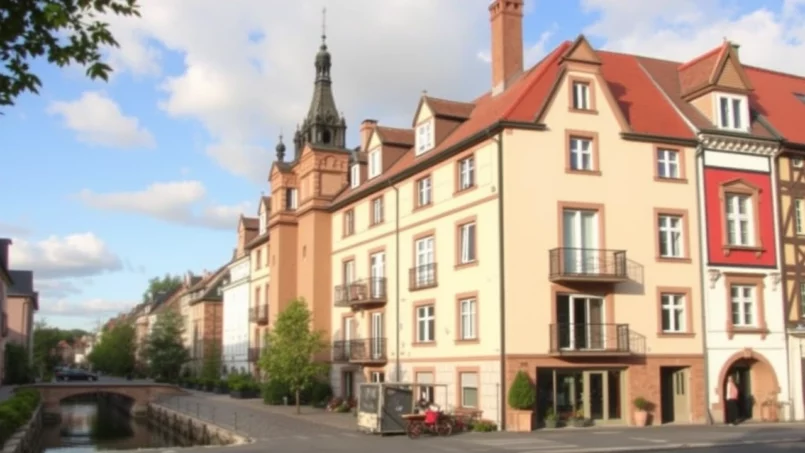
Strasbourg checks nearly every box for being a real estate star pupil: European capital, major university hub, extremely tight rental market, major urban projects, high-speed rail (TGV) access, tramways everywhere, and an abundance of bike paths. At the same time, the city is going through a phase of price correction, regulatory tightening, and an energy shock that are unsettling unprepared investors.
Investing in Strasbourg remains a solid strategy, but the market is no longer ‘easy’. It is now crucial to precisely select the neighborhood, property type, rental model, and tax structure, which requires a more nuanced approach than five years ago.
An attractive market… but more selective
Strasbourg, nearly 300,000 inhabitants, over 60,000 students, and dozens of European institutions, remains one of the most dynamic metropolitan areas in the Grand Est region. The city combines the status of a European capital, a strong university presence, France’s second largest river port, significant cross-border ties with Germany, and still-positive demographics (+1.2% population growth, median age 33).
On paper, all the fundamentals for a strong market are there.
Solid but demanding real estate indicators
Market data, however, shows a less “affordable” environment than it appears, especially for investors using credit.
| Key Financial Indicator | Value in Strasbourg |
|---|---|
| Price-to-income ratio | 7.58 |
| Portion of income dedicated to loan (20 years) | 53.72% |
| Credit accessibility index | 1.86 |
| Price-to-rent ratio (city center) | 27.04 |
| Price-to-rent ratio (outside center) | 24.11 |
| Gross rental yield (center) | 3.70% |
| Gross rental yield (periphery) | 4.15% |
| Average monthly net salary | €2,479.29 |
| Average interest rate, 20-year loan | ~3.7% |
The price-to-income ratio at 7.58 and a theoretical repayment burden of over half of the average income show the market is already quite expensive for residents. This helps explain the very high rate of renters (around 70% of households) and a rental market tension score of 10/10.
The structurally low rental vacancy rate in this real estate market.
A price correction… opening an entry window
After several years of price increases, Strasbourg has seen a genuine breather. Over two years, prices have dropped by about 7.2%, with a decrease of around 4% over the last observed year. At the same time, the average sales period remains relatively short (47 to 62 days depending on sources), proof that correctly positioned properties find buyers quickly.
After a peak in 2023–2024, interest rates are starting to decline, standing around 3.7% for 20 years. This level, though higher than the 2020–2021 period, remains historically reasonable in France, especially as French rates remain lower than in most other European countries.
The result is a paradoxical situation: the number of transactions has declined, new development is struggling, some investors are pulling out… but demand for both buying and renting remains high, driven by students, European civil servants, cross-border commuters, and local households.
For a patient investor, this “more selective” market phase can precisely create interesting entry points, especially in transforming neighborhoods.
Prices, rents, yields: where does Strasbourg stand?
The figures vary slightly by source, but the orders of magnitude converge. The city falls within a mid-range bracket nationally: more expensive than Mulhouse or Metz, less expensive than Lyon, Nice, or obviously Paris, with higher yields than in hyper-tense major cities.
Price ranges for purchases
The Strasbourg market can be summarized as follows: the historic heart and prestige neighborhoods around European institutions are well above €5,000/m², a vast “middle ground” between €3,200 and €4,200/m², and still accessible sectors below €3,000/m².
| Property Type / Source | Average Price €/m² | Low Range | High Range |
|---|---|---|---|
| Apartment Strasbourg (global average) | ~3,878 | ~2,818 | ~5,483 |
| House Strasbourg (global average) | ~3,454 | ~2,591 | ~5,181 |
| Apartments – other source (end 2024) | 3,666 | 2,505 | 4,767 |
| Houses – other source (end 2024) | 3,292 | 2,277 | 4,303 |
| Average property price (Green Acres, all types) | 2,417 | 2,298 (min) | 9,730 (max) |
In detail, some emblematic neighborhoods show very distinct price levels.
| Neighborhood / Sector | Indicative Average Price €/m² |
|---|---|
| La Petite France / hyper-center | ≈ 5,000 (often more) |
| Orangerie / Quartier des XV | 4,500 to 6,000 |
| Krutenau | ≈ 4,000 |
| Esplanade | ≈ 3,700 |
| Neudorf | ≈ 3,600–3,800 |
| Robertsau | ≈ 3,800 |
| Koenigshoffen | ≈ 3,200 |
| Cronenbourg | ≈ 3,200 |
| Hautepierre | 2,800–3,800 |
| Train Station (around station) | ≈ 4,200 (renovated apartments) |
| Laiterie (former industrial sector) | ≈ 3,400 |
Comparing Strasbourg to other cities in the Grand Est, the hierarchy is clear: more expensive than Mulhouse or Metz, a bit above Nancy, but far from Parisian levels.
| City | Apartment Price €/m² | House Price €/m² | Estimated Yield |
|---|---|---|---|
| Strasbourg | ~3,878 | ~3,454 | ~4–6% |
| Schiltigheim | 2,847 | 2,748 | n.a. |
| Illkirch-Graffenstaden | 3,090 | 3,256 | n.a. |
| Colmar | 2,127 | 2,654 | ~6.4% |
| Mulhouse | 1,199 | 1,800 | ~11.3% |
| Nancy | ~2,377 | n.a. | n.a. |
| Metz | ~2,148 | n.a. | n.a. |
Strasbourg is therefore not a “low-cost” city, but prices remain much lower than top-tier cities, with yields higher than those of Paris, Lyon, or Bordeaux.
Rent levels and profitability
On the rental side, the picture is one of a very tight market, driven by a massive share of renters and a structural shortage of well-located small units.
| Property Type / Location | Average Monthly Rent |
|---|---|
| Studio (city average) | ≈ €490 |
| 1-bedroom city center | ≈ €736 (€600–€925) |
| 1-bedroom outside center | ≈ €595 (€500–€720) |
| 3-bedrooms city center | ≈ €1,479 (€1,020–€2,000) |
| 3-bedrooms outside center | ≈ €933 (€800–€1,200) |
| Average rent per m² – apartments | ≈ €13.6/m² |
| Average rent per m² – houses | ≈ €11/m² |
Average gross yields are around 4–4.5%, but with strong disparities depending on property type and neighborhood. Some targeted operations climb much higher.
| Profitability Indicator | Value |
|---|---|
| Average overall gross yield | ≈ 4.2–4.5% |
| Usual range (by neighborhood / property) | 3.5–7% |
| Rough target in student areas | 5–6.5% |
| Gross yield city center (average) | 3.7% |
| Gross yield outside center (average) | 4.15% |
Three concrete examples illustrate the potential when you know how to find properties for renovation or special situations:
| Address / Size / Rooms | Price | Estimated Rent | Gross Yield | Net Yield |
|---|---|---|---|---|
| 20 rue Sainte-Cécile – 83 m² – 5 rooms | €305,000 | €2,325/month | 8.5% | 6.2% |
| 30 rue de Lorraine – 86 m² – 5 rooms | €240,000 | €2,233/month | 10.4% | 7.2% |
| 6 rue Jean-Geoffroy Conrath – 43 m² – 2 rooms | €115,000 | €658/month | 6.4% | 4.6% |
These yields, much higher than average, typically assume a higher level of risk: renovation work, a neighborhood in transition, a more fragile tenant profile, or optimized tax planning. But they show that the Strasbourg market is not condemned to 3–4% gross yields if deals are carefully structured.
Understanding the investment geography of Strasbourg
To invest intelligently, one must move beyond the “postcard” view and enter the real geography of rental demand. Strasbourg is divided into about fifteen major neighborhoods, each with its own profile, prices, and prospects.
Historic center and “prime” neighborhoods: asset security, moderate yield
Grande Île, La Petite France, Orangerie, Quartier des XV, the European Quarter, and some parts of the Neustadt concentrate the essence of the city’s prestige image: bourgeois buildings, listed facades, proximity to European institutions, parks, and the banks of the Ill river.
In these sectors, prices frequently exceed €5,000/m², even €6,000/m² for certain exceptional houses or properties. Tenants are senior executives, Eurocrats, expatriates, professionals, sometimes tourists for high-end furnished rentals.
Yields rarely exceed 4% gross, but these are “safe-haven” assets: extreme land scarcity, nearly incompressible demand, international appeal. The only real long-term threat comes from rising energy requirements: a large 5-room apartment in listed stonework with single glazing and an old boiler can become a financial sinkhole without proper renovation planning.
Student and young professional neighborhoods: Esplanade, Krutenau, Bourse–Krutenau
These sectors have a high concentration of students and young professionals, attracted by proximity to campuses, schools (Sciences Po, EM Strasbourg, university), bars, and public transport.
Small units are real estate gold here: studios and 2-bedroom apartments rent very quickly, with high rents per square meter and an almost permanent occupancy rate.
| Neighborhood | Average Price €/m² | Studio Rent (average) | Estimated Gross Yield |
|---|---|---|---|
| Esplanade | ≈ 3,700 | ≈ €510/month | ≈ 6.5% |
| Krutenau | ≈ 4,000 | ≈ €530/month | ≈ 6% |
In these areas, rental demand is so strong that the vacancy risk is almost zero. In return, tenant turnover is high and property wear and tear is rapid. The furnished rental / shared apartment (colocation) / student lease or mobility lease choice is central to maximizing profitability.
Neudorf, Robertsau, Meinau: family residential and mixed areas
Neudorf illustrates well the category of neighborhoods in an upward transition. Long considered an intermediate sector, it has benefited from tramway extensions, urban renewal, and the scarcity of the city center to move upmarket. Prices there hover around €3,600–€3,800/m², with estimated gross yields around 6.3% for well-located small units.
The Robertsau neighborhood, with its residential ambiance and ‘village within the city’ character, particularly attracts families and young couples. This stable clientele is reinforced by proximity to European institutions. With rents generally more affordable there, it constitutes a relevant market for long-term rental strategies.
Meinau, long associated with its stadium and heterogeneous urban fabric (industrial zones, large housing estates), is engaged in renovation and redevelopment programs, notably around Lake Baggersee and a vast project on the Stellantis site (nearly 400 housing units, student residence, hotel, offices, and significant landscaping). For an investor, this is typically a zone for betting on the future: still affordable today, but likely to see its image and prices evolve if the projects materialize.
Neighborhoods in transition: Koenigshoffen, Cronenbourg, Hautepierre, Laiterie, Train Station area
These are the favorite playgrounds for investors seeking yield without leaving the central urban area. They share a common point: lower entry prices, a sometimes industrial or working-class past, significantly improving public transport access, and urban renewal programs.
The estimated gross yield for real estate investments in the Koenigshoffen neighborhood, which attracts investors.
Cronenbourg, once very working-class, follows a similar pattern: still low prices for the city, but significant improvement in accessibility. Hautepierre, more stigmatized, offers some of the lowest prices per square meter (€2,800–€3,800/m²), but requires real on-the-ground knowledge, as micro-locations make all the difference between a good deal and a difficult-to-manage operation.
The Laiterie / Museum of Modern Art area illustrates, for its part, a former industrial sector recycled into a cultural and residential neighborhood, with concert halls, pedestrian and bike paths. Prices there hover around €3,400/m², but are pushed up by the influence of the renovated train station and the banks of the Ill. The likelihood of continued gentrification in the medium term is high.
Price per square meter for renovated apartments in the train station area, converging towards those in the city center.
Major urban projects reshaping the map
Several large-scale operations will continue to transform the metropolitan area in the coming years, with a direct impact on property values.
The Deux-Rives / Zwei-Ufer project, on former port lands, is emblematic: ultimately, 9,000 housing units, 20,000 new residents, 1.5 million m² developed, over 20 hectares of new green spaces, 3,700 housing units in the current phase, 40% affordable housing, all centered around the cross-border tram to Kehl. Subsectors like Citadelle, Starlette, Coop, and Port du Rhin are at the heart of this development, with significant potential but also the usual risks of ZACs (joint development zones): delays, developer bankruptcies, political uncertainties.
The Archipel 2 project, north of the center, illustrates a change in doctrine: priority given to housing over offices, with a large 4-hectare park, landscaped promenades, bicycle footbridges, and several residential programs (including apartment towers, ground-floor shops, a student residence, and spaces for artists).
To the west, tramway extensions (Tram Ouest, TSPO, Tram Nord) will bring municipalities like Wolfisheim or Schiltigheim even closer to central Strasbourg, which will gradually be reflected in prices per square meter and rents.
For an investor, understanding these projects is decisive: buying today in a well-served sector still marked by its industrial past, near a future tram line or a park under creation, often means positioning ahead of a slow but profound revaluation.
An ultra-tight but heavily regulated rental market
With about 70% renters, over 63,000 students, an influx of civil servants and cross-border commuters, Strasbourg has a structurally undersupplied rental market, especially for well-located small units. Studios in the right spots rent for over €500 per month, sometimes more, and waiting lists are long each academic year.
However, just looking at the potential rent would be a mistake: the city has strengthened its regulatory arsenal, both on energy and short-term rentals, and the national tax framework has evolved.
Energy shock: sorting good from bad EPCs
As everywhere in France, the Energy Performance Certificate (EPC/DPE) has become a central parameter. Several elements combine in Strasbourg:
– a significant stock of old housing, notably half-timbered houses and poorly insulated old buildings;
– progressive bans on renting “thermal sieves” (EPC F and G), with a tightening schedule;
– a local estimate that nearly 30% of the rental stock could be affected by recent bans.
A direct consequence of the regulations: many small landlords, unable to finance €30,000 to €50,000 in work for studios rented at €400 in regulated sectors, prefer to sell. This creates buying opportunities, but only for investors who truly integrate the cost of energy renovation into their business plan.
Value gaps between a property with an EPC A–C and one with F–G can already reach 25 to 35% in some segments, a trend expected to strengthen. Investing in Strasbourg real estate therefore means either targeting energy-efficient properties from the start, or buying discounted properties with a financed and costed renovation plan.
Classic furnished rental: LMNP, micro-BIC, or standard accounting?
The Non-Professional Furnished Rental (LMNP) remains the basic tool for many investors in Strasbourg, especially for studios and 2-bedroom units aimed at students and young professionals.
The micro-BIC regime offers a flat-rate deduction (50% for “standard” furnished rental, 30% for certain short-term cases), but as soon as you exceed €10,000 in annual rent or have significant expenses (interest, work, depreciation), the standard accounting regime often becomes more interesting.
Under the standard LMNP, it is possible to depreciate the property, furniture, and part of the work, which allows tax-neutralizing a good portion of the rent for several years. In an environment of gross yields between 4 and 6%, this optimization can make the difference between negative and at least neutral cash flow.
Beyond the purchase price, rental investment involves recurring costs (condominium fees, property tax) and specific taxes (tax on vacant housing, capital gains tax, wealth tax above €1.3M in assets). Energy renovation work may also be required by the EPC. It is recommended to seek professional guidance, especially when owning several properties.
Tax breaks for old properties: Malraux and Denormandie
The historic center of Strasbourg, a UNESCO World Heritage site, offers a privileged playing field for the Malraux scheme. In a protected area, major restoration work can qualify for a tax reduction of up to 30% of the work amount, capped at €400,000 over four years. This is a powerful tool, but reserved for highly taxed investors, capable of financing significant work and accepting a more modest rental yield in exchange for strong fiscal and asset leverage.
The Denormandie scheme targets old neighborhoods for rehabilitation, where you commit to carrying out significant work on an old property and renting it under specific conditions. Again, Strasbourg, with its renovation sectors, offers use cases, provided the constraints are properly understood.
The case of short-term rentals: tight regulation on potential
The short-term rental market in Strasbourg has developed significantly in recent years, with between 2,500 and over 4,000 active listings depending on the period, a median occupancy rate around 46–72%, and an average daily rate between €93 and €105. A two-room apartment can generate over €20,000 in gross annual revenue.
The city has chosen to impose very strict rules to strongly regulate this segment.
– in a primary residence, tourist rental is limited to 120 nights per year;
– any tourist furnished rental of a secondary residence requires a change of use authorized by the city hall, limited in time (up to 6 years) and subject to conditions, with an overall quota;
– prior registration with the city hall is mandatory, with the registration number displayed on the listing;
– energy performance requirements (EPC A to E, then A to D eventually) apply for certain high-pressure zones;
– fines can go up to €10,000, even €20,000 for false declarations.
For an investor, the message is clear: Strasbourg is not an “Airbnb without rules” paradise. Very short-term rental strategies are only relevant for specific cases (occasional rental of a primary residence, classified tourist furnished rental, very well-structured professional setup), accepting administrative complexity. Long-term furnished rental, possibly with a mobility lease or shared apartment (colocation), often remains a better risk/reward compromise.
Local taxation and taxes: factors to integrate from the purchase
Beyond national taxation, investing in Strasbourg real estate involves integrating a fairly heavy local tax environment, particularly regarding property tax and additional taxes.
In 2023, the property tax on built properties had a municipal rate of 37.44%, to which intercommunal rates and special taxes are added, notably the household waste collection tax (11.59%). Strasbourg is among municipalities with a historically high level of residence tax, even though it now only concerns secondary residences and certain profiles.
For an investment in an old building in popular sectors, the annual property tax can reduce the net yield by several tenths of a percentage point. It is crucial to calculate it precisely when studying a property, just like condominium fees and planned renovation costs.
By 2026, the revision of cadastral rental values, which serve as the basis for these taxes, is expected to lead to an average increase of about €63 per property for affected housing nationally. Again, nothing dramatic, but another factor to anticipate.
Who invests in Strasbourg and why?
The profile of investors is relatively diversified:
Strasbourg’s real estate market attracts a diverse clientele. It includes Alsatian residents arbitrating between a primary residence in the suburbs and a rental investment in the city, as well as Parisians and residents of the Paris region using the TGV (2h20) to set up a primary or secondary residence while partially teleworking. The city also constitutes an ideal compromise for Franco-German cross-border commuters, combining a German salary and French daily life. Finally, it attracts foreign buyers, notably Germans and Swiss, already very active in Alsace (representing 59% of foreign clientele in the Bas-Rhin, with 35% German clients and 31% Swiss in the Haut-Rhin).
The presence of European institutions, grandes écoles, research centers, and corporate headquarters reinforces this mixed profile: students, young graduates, international executives, European civil servants, upper-middle-class families… all segments that structure rental demand by neighborhood.
For an investor, this means it is possible to tailor a project to a clear target: studio for a student, furnished 2-bedroom for a young professional, 3–4 bedroom for shared housing or a family, luxury apartment for a Eurocrat, etc. Each target implies a different level of amenities, type of lease, and management strategy.
How to position yourself in Strasbourg today?
In a context of gentle market correction and strengthened regulation, the key is to move away from a “standardized investment” logic and adopt a surgical approach.
Several key strategies emerge.
Bet on well-located small units… but energy-efficient ones
Studios and small 2-bedroom units near campuses, tram lines, and employment hubs remain the core of the Strasbourg rental engine. Demand there is permanent, regardless of the economic climate. However, buying a small property with a poor EPC rating today in a building that will need major work anyway is foolish without integrating a renovation plan.
The equation to aim for: a size of 20 to 40 m², in a student or dynamic neighborhood (Esplanade, Krutenau, Neudorf, Train Station area, certain sectors of Koenigshoffen or Cronenbourg), in a sound building, ideally already well-insulated or recently renovated, with a decent EPC. Such a property, rented furnished under the standard LMNP regime, can achieve 5 to 6.5% gross yield, with significantly reduced taxation in the early years.
Take advantage of discounts on energy sieves… only with a real battle plan
Conversely, EPC F or G properties, currently unpopular, can become great deals if the price truly factors in the cost of necessary work to bring it up to a D or C. This requires accepting construction work (and therefore a period without rent), mobilizing contractors in a context of rising construction costs, and structuring financing that includes this envelope.
Buying with a significant discount can allow benefiting from renovation grants. This results in owning an energy-efficient property, a decisive asset for renting and resale in an urban environment.
Position yourself ahead of major projects
In sectors like Deux-Rives, Archipel 2, Koenigshoffen, part of the future value is already anticipated in new development prices. But the immediate surroundings (old houses, small old buildings, premises to convert) sometimes remain undervalued relative to the ten-year potential.
This requires a long-term vision, as urban projects unfold over more than a decade, with their share of delays and changes of direction. The investor must accept profitability that does not rely solely on immediate rental yield, but also on potential capital gains.
Arbitrate between Strasbourg intra-muros and first-ring municipalities
The first-ring municipalities (Schiltigheim, Illkirch-Graffenstaden, Lingolsheim, Bischheim, Ostwald, Hoenheim, etc.) often offer an interesting compromise: lower prices per square meter, slightly higher yields, and tram or direct bus service to Strasbourg.
Gross rental profitability can reach 6 to 7% for a studio or 2-bedroom in developing areas.
Avoid classic mistakes
Feedback from the field and studies highlight some recurring pitfalls to avoid:
– underestimating the weight of fees and taxes (condominium, property tax, household waste tax, possible tax on vacant housing);
– ignoring the reality of the EPC and upcoming required work;
– buying based on “gross yield” without integrating actual taxation (choice of LMNP regime, micro-BIC vs. standard accounting, etc.);
– choosing a neighborhood solely based on price per square meter, without understanding the tenant profile and local reputation;
– venturing into short-term rental without mastering the specific Strasbourg regulations.
Conversely, those who take the time for thorough analysis are able to position themselves today in a market that, despite recent price drops, remains structurally solid: maximum rental tension, diversified demand, major urban projects, European and academic appeal. Investing in Strasbourg real estate is no longer about buying “anything anywhere,” but building a tailor-made project, neighborhood by neighborhood, property by property.
Disclaimer: The information provided on this website is for informational purposes only and does not constitute financial, legal, or professional advice. We encourage you to consult qualified experts before making any investment, real estate, or expatriation decisions. Although we strive to maintain up-to-date and accurate information, we do not guarantee the completeness, accuracy, or timeliness of the proposed content. As investment and expatriation involve risks, we disclaim any liability for potential losses or damages arising from the use of this site. Your use of this site confirms your acceptance of these terms and your understanding of the associated risks.

Cyril Jarnias is an independent expert in international wealth management with over 20 years of experience. As an expatriate himself, he is dedicated to helping individuals and business leaders build, protect, and pass on their wealth with complete peace of mind.
On his website, cyriljarnias.com, he shares his expertise on international real estate, offshore company formation, and expatriation.
Thanks to his expertise, he offers sound advice to optimize his clients' wealth management. Cyril Jarnias is also recognized for his appearances in many prestigious media outlets such as BFM Business, les Français de l’étranger, Le Figaro, Les Echos, and Mieux vivre votre argent, where he shares his knowledge and know-how in wealth management.





