
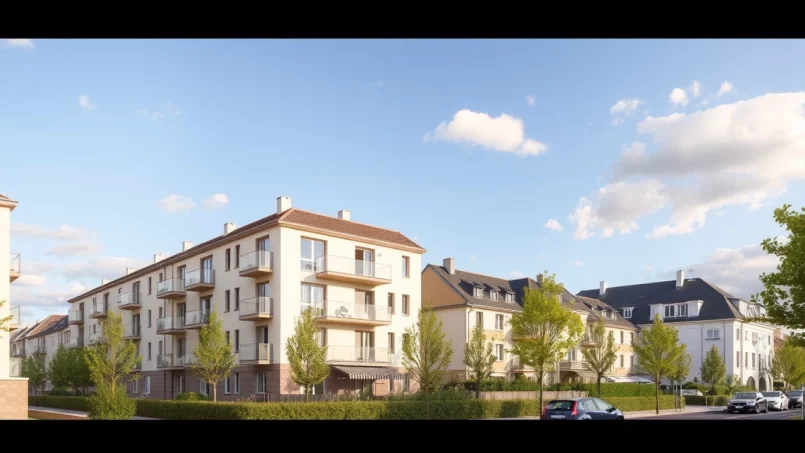
 Published on and written by Cyril Jarnias
Just minutes from Paris, with prices still well below those of the capital and a metro system undergoing a full revolution, Villejuif ticks almost all the boxes for an investor’s “one to watch” city. Between the arrival of lines 14 and 15 of the Grand Paris Express, the explosion of the health hub around the Institut Gustave-Roussy, and a downpour of new developments, the local real estate market is changing in scale.
Real estate investment in this area presents risks: high rental demand, significant local taxation, neighborhoods under renovation, and a market that has already risen substantially. It is crucial to analyze the data in detail rather than rely on promises to avoid costly investments.
A strategic city at the gates of Paris
Villejuif is located in the Val-de-Marne, on the plateau overlooking the Seine valley, approximately 8 km from Notre-Dame and just over a kilometer from the Porte d’Italie. It is an integral part of the Greater Paris metropolis.
With between 55,000 and 58,000 inhabitants depending on the source, it is the 7th most populous municipality in the department. Density is very high, around 10,000 to 11,000 inhabitants per km², in a compact area of 5.28 km². The population has grown by more than 14% in recent years, driven by the arrival of new households, particularly young professionals and families.
The median annual household income, slightly below the national average, is around €29,500.
Another characteristic of direct interest to an investor: Villejuif is predominantly a tenant city. According to sources, between 59% and 64% of primary residences are occupied by tenants, compared to only about one-third owner-occupiers. Social housing represents nearly one-third of the housing stock (approximately 7,500 units). This profile fuels a structural rental demand, largely insensitive to market fluctuations.
A real estate market twice as cheap as Paris, but rising sharply
Villejuif still shows prices well below those of Paris while having already experienced a clear revaluation. For apartments, the price range is around €5,400–€5,500/m² on average, with a wide range from about €3,600 to over €7,800/m² depending on the area, condition, and immediate proximity to transportation.
For houses, which are less numerous (only 16–17% of the stock), average prices are around €5,200–€5,800/m², again with variations ranging from just over €3,000 to over €8,000/m².
A quick overview situates Villejuif in its environment:
| Area | Avg. Apt. Price (€/m²) | Avg. House Price (€/m²) |
|---|---|---|
| Villejuif | ≈ 5,475 | ≈ 5,278 |
| Paris (order of magnitude) | ≈ 10,000 | > 10,000 |
| Ivry-sur-Seine | ≈ 6,000 | n/a |
| Vitry-sur-Seine | ≈ 4,413 | ≈ 4,444 |
| Alfortville | ≈ 5,519 | ≈ 5,583 |
| Val-de-Marne (average) | ≈ 5,300–5,500 | ≈ 5,300–5,600 |
In other words, Villejuif is cheaper than Paris and Ivry, more expensive than Vitry, and in the upper average range for the department. For a Greater Paris investor, it’s a rather rare compromise between price accessibility and immediate proximity to the capital.
A meteoric rise, then a plateau
In terms of price evolution, the figures are telling. Over twenty years, prices have more than doubled. Over five years, the cumulative increase reaches around +24% to +30% depending on the source. In some recent periods, figures show +33.8% over five years, +8.5% over one year, or even +2.6%… per quarter at the peak of the price surge.
Concrete benchmarks illustrate this trajectory, providing tangible reference points to better understand its evolution or development.
| Period / property type | Approximate average price |
|---|---|
| 2013 – T3 apt. city center | ≈ €3,200/m² |
| 2018 – general average | ≈ €5,000–€5,500/m² |
| 2023 – T3 apt. city center | ≈ €5,000/m² |
| 2013 – average single-family home | ≈ €4,000/m² |
| 2023 – average single-family home | ≈ €6,500/m² |
| 2015 – all areas | €3,000–€3,500/m² |
| 2018 – all areas | €5,000–€5,500/m² |
Since 2022, however, the curve has slightly flattened. The average indicator dropped from €5,744/m² to around €5,440/m² in 2024, a small decrease on the order of –1% to –2% over two years, in a national context of rising interest rates. For existing properties, prices have fallen by about –5% over one year and –10% over five years for apartments, while new builds have held up better, even showing a slight +1% to +2% over five years.
This is not a violent downturn, but rather a breather after a very bullish decade. Especially since the market remains very tight.
Real Estate Expert
Maximum real estate tension
Various observatories assign Villejuif a real estate tension index of 10/10. On average, there are 17% more buyers than properties available for sale. The number of transactions has declined (only 183 sales in 2024, about –62% in two years), a sign of a market slowed by interest rates, but selling times tend to remain short for well-positioned properties.
On the rental side, vacancy fluctuates between 3% and 5%, a low level confirming the ease of re-letting as long as the property is correctly located and priced right. Primary residences account for over 90% of the stock, with the share of permanently vacant dwellings around 5%.
For an investor, this means two things: the probability of renting quickly is high, but competition for purchase is real and prices already incorporate a good part of the “Grand Paris scenario”.
Grand Paris Express: the turbo for Villejuif’s market
The main driver of Villejuif’s revaluation comes down to an acronym: GPE, for Grand Paris Express. The city is set to become one of the major hubs of the new automated metro network.
It is already served by line 7 (stations Léo Lagrange, Paul-Vaillant-Couturier, Louis-Aragon), tram T7 (terminus Villejuif-Louis-Aragon), eight bus lines, and two Noctilien night bus lines. To this are now added the line 14 extension to Villejuif–Gustave-Roussy, and soon line 15 south.
Three hubs concentrate the stakes:
This major intersection, crossing of line 7, T7, and the future line 15 south, is compared to a “new Bastille.” With over 100,000 daily passengers expected and 30,000 m² of offices planned, ongoing urban studies aim to transform it into a complete centrality integrating shops, hotels, housing, and amenities.
– Villejuif – Institut Gustave-Roussy (Gustave-Roussy / Campus Grand Parc): interchange station for lines 14 and 15, at the foot of one of Europe’s largest cancer centers and at the heart of the “Campus Grand Parc,” the future international campus for health, research, and innovation.
– Chevilly – Trois-Communes: located a few minutes to the south, it strengthens accessibility for the southern end of Villejuif.
The Grand Paris Express significantly reduces travel times: about 12 minutes to reach Châtelet (versus over 30 today), 10 minutes to Orly (versus nearly 50), 25 minutes to La Défense, 30 to Saint-Denis, and 12 to Créteil. Villejuif thus joins the inner circle of the best-connected suburbs.
Unsurprisingly, sectors within an 800–1,000 meter radius of these future stations are where the strongest price increases have already been observed, up to +10–12% per year at certain times, and where developers are flocking. Some studies mention potential revaluation on the order of +20% to +30% in the medium term for the closest zones.
For an investor, the rule is simple: the closer you are to a metro station (less than 5 minutes on foot), the more the price premium is justified — a gap of about 25% was even noted as early as 2019 between a property less than 5 minutes from the metro and another farther away.
An economic fabric driven by health and innovation
Villejuif is not just a commuter town. It concentrates about 18,000 to 23,000 jobs, with a job concentration rate close to 90–95% (almost one job per resident worker), dominated by the health and research sector.
Three major hospital complexes are located here: Paul-Brousse, Paul-Guiraud, and especially the Institut Gustave-Roussy. Around them orbit research units (INSERM, CNTS) and an incubator dedicated to biotechs, the Villejuif Bio Park. At the territorial scale, the “Paris Biotech Vallée” brings together four engineering schools, 17 CNRS laboratories, and four hospitals.
Villejuif is a dynamic economic hub, characterized by strong growth in the number of businesses and the presence of large corporations, structured by several business zones.
Hosts the headquarters of LCL (about 3,000 employees) and a major Orange site (over 1,000 employees).
The number of businesses increased by nearly 70% between 2012 and 2020.
Five economic activity zones organize the territory, complemented by thousands of SMEs/SMIs.
Numerous SMEs/SMIs are active in high value-added sectors.
The Campus Grand Parc will accentuate this trend: more than 3,300 housing units, 150,000 m² of offices and research space, 20,000 m² of health training facilities, 20,000 to 30,000 m² of retail, a network of green spaces, and six new streets. The city’s stated objective is ambitious: to move towards an urban fabric composed of 50% housing and 50% economic activities, and attract middle-class households, researchers, health and engineering students.
This knowledge economy fuels a solid and relatively solvent rental demand: students from engineering schools (EFREI, EPITA, Sup’Biotech…), young researchers, hospital staff, executives from large companies.
A predominantly collective… and rental housing stock
Out of a little over 28,000 dwellings, around 81–83% are apartments and 16–17% are houses. Primary residences represent over 90% of the stock, secondary residences are marginal (2–3%), and structural vacancy is limited (5%).
The distribution by dwelling size is instructive:
| Typology (primary residences) | Approximate share |
|---|---|
| Studios | ≈ 9.7% |
| 2-room apartments | ≈ 21–23% |
| 3-room apartments | ≈ 32–34% |
| 4-room apartments | ≈ 20–23% |
| 5-room apartments and larger | ≈ 11–12% |
T2 and T3 apartments are highly sought after for rent, especially by students and young professionals, while T3–T4 apartments and single-family houses attract more families. For an investor, these segments correspond precisely to the products that “perform” best.
The proportion of tenants in the housing stock, significantly higher than that of owner-occupiers.
Neighborhoods: where to invest in Villejuif?
Potential is not uniform from one neighborhood to another. In Villejuif, the choice of area often makes the difference between a high-performing investment and a slower-moving one.
City Center / Town Hall – République – Paul-Vaillant-Couturier
This is the historic and commercial heart: town hall, central square, cultural facilities, numerous shops, good service by line 7 (Paul-Vaillant-Couturier station) and buses. The architecture mixes buildings from the 1930s and more recent residences.
Prices here are among the highest in the municipality, between €5,300 and over €6,000/m² for apartments, even more on the most sought-after streets like avenue de Paris (over €6,600/m² in 2024 on some sales). A T2 rents easily for around €1,000–€1,100 and a well-placed T3 often exceeds €1,300–€1,400.
The city center is perfectly suited for a rental strategy targeting young professionals and families, or even for standard furnished rentals or mid-term rentals for executives on assignment.
Louis-Aragon / Pasteur / Aragon Area
Around the terminus of line 7, tram T7, and the future line 15, this area is undergoing a real transformation. Numerous new developments have been built or are under construction: hotels, offices (at least 30,000 m²), housing (about 650 in the ZAC Aragon alone), shops.
Gross rental yield can reach 4.5% to 5.5% depending on property type and rental model.
For an investor, these neighborhoods concentrate the essence of the Grand Paris Express bet: buying close to the Louis-Aragon and Gustave-Roussy stations means betting on future metropolitan centrality. However, be careful not to overpay for very standardized products in very dense blocks: not all ground-floor units on noisy streets will have the same capital gains prospects as a high floor with an open view.
Campus Grand Parc / Hautes-Bruyères – Gustave-Roussy
In the northwest, bordering the departmental park of Hautes-Bruyères (20 hectares of greenery) and the Institut Gustave-Roussy, the ZAC Campus Grand Parc will virtually double the housing supply in the area. It includes:
– 142,400 m² of housing,
– nearly 173,000 m² of offices,
– 20,000 m² of amenities,
– shops, hotels, and a landscaped promenade.
The buildings are of significant scale (up to 15 stories on some plots), but the development plan includes a strong presence of green spaces, pedestrian walkways, and connections to the GPE station. For an investor, the major interest lies in the immediate proximity to the health and research hub: health students, interns, researchers, international consultants, etc.
Price per square meter in new real estate ranges between €5,500 and €6,500.
Esselières, Léo-Lagrange, Barmonts
In the north and east of the city, these neighborhoods benefit from proximity to the Léo-Lagrange station, shops, schools, and major sports facilities (Martial Arts Center…). The Esselières neighborhood is particularly sought after for its quality of life and green spaces.
Prices are slightly lower than in the city center but above average, especially for properties near the metro (T2 around €1,000–€1,100 monthly rent, T3 around €1,300). These are areas suitable for a strategy of buying older properties to renovate and add value, targeting young professionals and couples with a first child.
The Barmonts neighborhood, near the Léo-Lagrange station, attracts a rather affluent population. Interesting opportunities exist here for high-quality co-living, particularly for employees of nearby hospitals and companies.
Neighborhoods under renewal: Lozaits – République – Nelson-Mandela, Lebon – Lamartine
These areas are the subject of extensive urban renewal projects: demolition and reconstruction of old housing blocks, creation of new housing, redesign of public spaces. In the Lozaits – République – Nelson-Mandela sector, former industrial sites are gradually giving way to modern residential complexes, with rents already relatively high for the environment.
This 1960s neighborhood, classified for urban renewal, currently has 560 social housing units. A project plans for nearly 900 new dwellings, half of which for homeownership, aiming to attract a more affluent population. Current prices remain about 5% below the city average, due to social difficulties and a still degraded image.
For an investor, these neighborhoods represent a more speculative bet: potential for capital gains if the urban renewal delivers on all its promises, but also a higher risk of vacancy and more complex rental management. It’s better to approach them with a very good knowledge of the area.
Single-family neighborhoods: Lion d’Or and periphery
On the fringes of the city, some blocks like the Lion d’Or neighborhood feature a fabric of small single-family houses with gardens, highly sought after by households under 40, especially since the health crisis. Prices per square meter may seem high, but the scarcity of this type of property in an environment so close to Paris sustains demand.
This segment is more suited for primary residence projects or long-term patrimonial investment rather than highly profitable short-term operations. Gross rental yield is generally lower here (3.5–4%), unless opting for co-living or high-end furnished rentals.
Rental profitability: what the figures say
Villejuif is neither the most profitable city in Île-de-France nor the least attractive. Everything depends on the type of property and the rental strategy.
Rent levels
Rents are generally in the €17–€26/m² range for standard dwellings, with an average around €20–€21/m². Overall statistics show:
– apartments: average rent ≈ €20.9/m²/month (range €14–€35),
– houses: ≈ €24.4/m²/month (€17–€30).
In practice, this translates to market rents on the order of:
| Property type (order of magnitude) | Average monthly rent |
|---|---|
| Studio | €750–€900 |
| T2 | €950–€1,200 |
| T3 | €1,300–€1,700 (depending on size and area) |
| T4 | €1,400–€2,000 |
T2 and T3 apartments located near the Léo-Lagrange, Paul-Vaillant-Couturier and Louis-Aragon stations are the most in demand. A T2 in the city center rents easily for around €1,100. In the Pasteur area, rents are around €1,000, and about €950 around Léo-Lagrange.
Gross yields: from 4% to 8%
Various sources report an average gross yield close to 4.8–5%, with notable variations depending on the product:
Overview of average expected gross rental yields by housing category.
Up to 6.2% gross on average (and more in practice for well-optimized furnished units).
Gross yield generally between 5% and 5.5%.
Gross yield around 4.5% to 5%.
Gross yield often below 4%, except in special cases (co-living, subdivision…).
A quantified example illustrates the typical case of a T2 of 40 m² purchased for €200,000 and rented unfurnished:
– estimated market rent: €852/month,
– gross yield: (€852 × 12) / €200,000 ≈ 5.11%.
Within the framework of a Pinel investment (zone A bis, rent cap of €17.43/m²), the rent for the same property would drop to €697, for a gross yield of about 4.2%, offset by the tax advantage.
Sources mention that, depending on location and quality, gross yields of up to 8% are still possible, particularly in renovated older properties, well-located small units, and/or by using co-living or short-term rentals.
Focus on furnished rentals and short-term lets
For standard furnished rentals (LMNP), rents are generally 10 to 20% higher than unfurnished. The tax regime (actual BIC regime) also allows for depreciation of the property and furniture, significantly reducing the tax bill for 10 to 15 years.
Villejuif has about 5,500 students, representing nearly 10% of its total population.
Short-term rentals like Airbnb can achieve an average annual income exceeding €24,000 with an occupancy rate of about 60–65% and an average daily rate around €100–€110. The best listings peak at over €30,000 in annual revenue. This niche, however, is more time-consuming, riskier from a regulatory standpoint, and dependent on the tourist and business climate.
New, existing, Pinel, LMNP: which structures to prioritize?
Villejuif is located in zone A bis, the most tense zone in the metropolis. This makes it eligible for several tax schemes, particularly for new builds.
Investing in new builds: comfort and tax benefits… at a price
New builds often sell for between €6,000 and €7,000/m², or even more for premium developments steps away from the future stations. Some developments are eligible for reduced VAT at 5.5%, interest-free loans (up to 50% of the price in collective buildings in zones A/A bis for primary residences), or social homeownership schemes like BRS.
For an investor, the advantages are:
Investing in a new property presents several financial and practical assets: notary fees are lower (2–3% versus 7–8% for existing properties) and maintenance is limited in the first years. Energy performance, compliant with RE 2020 standards, makes it an attractive rental property and protects it from future regulations on “energy sieves.” Finally, depending on the evolution of the scheme, it may allow for tax reductions under the Pinel law.
The main drawback remains the high purchase price, which weighs on gross yield. It’s common to see yields around 3.5–4.5% gross on a Pinel property, before tax benefits. For an investor focused on the long term and security, these products are still defendable, especially in high-potential areas like Louis-Aragon and Campus Grand Parc.
Renovated existing properties: the playground for profitability
In the existing market, opportunities can be found around €4,500–€5,000/m², sometimes less in transitioning neighborhoods. Adding a renovation budget (between €240/m² for a refresh and over €1,000/m² for a major renovation), it’s often possible to stay below new build prices while offering a high-quality product.
Here, two tax strategies stand out:
– Unfurnished rental with property tax deficit: significant renovation costs, if they exceed collected rents, can be deducted from overall income (within certain limits), reducing the household’s income tax. This is a powerful tool for highly taxed taxpayers looking to optimize an investment with a 4–5% gross yield.
– Furnished non-professional rental (LMNP) under the actual regime: depreciation of the property, furniture, and renovation work, virtually eliminating taxable income for many years, higher rents than unfurnished. This is the premier formula for a T1/T2 near the metro, targeting students, young professionals, or healthcare staff.
In all cases, it is necessary to factor in higher notary fees (around 8%), but also the possibility of creating value through renovations and better marketing potential.
Local taxation, regulations, and risks not to be underestimated
Behind the promising prospects, some elements call for caution.
Local taxes and cost of ownership
Villejuif is distinguished by high local taxes. The average property tax is around €2,100 per year for a standard dwelling, or about €10–€20/m². An increase in the equipment tax for new developments (from 9% to 20% in UA zones) has been voted to finance amenities needed for new residents.
These levels do not fundamentally challenge overall profitability, but they absolutely must be integrated into your cash flow simulations, especially if you are investing heavily with a mortgage.
Tense city, regulated rental income
Villejuif is classified as a severely tense zone under housing legislation:
The notice period for tenants to leave a dwelling (furnished or unfurnished) is reduced to one month. Rent increases during a lease are capped by the Reference Rent Index (IRL). It is prohibited to increase the rent for properties classified F or G on the Energy Performance Certificate (DPE), and the worst energy sieves can no longer be rented out.
Unlike Paris intra-muros, the city is not subject to the rent cap of the ELAN law, but the Pinel cap in A bis (€17.43/m²) applies to investments benefiting from that tax reduction.
Since 2023, a rental permit is mandatory in certain areas to combat substandard housing. Furthermore, properties left vacant for more than a year are subject to a tax on vacant dwellings that can climb to 34% in the second year.
Renting furnished or seasonal requires compliance with specific obligations, such as a declaration to the town hall, adherence to safety standards, and taxation under the Industrial and Commercial Profits (BIC) regime.
A market already well-valued
After increases of over 50% in ten years, it would be unrealistic to expect to replicate the same trajectory exactly over the next ten years. The Grand Paris Express is now largely factored into price expectations, even though some areas will retain additional potential compared to others.
The rise in interest rates, regulatory pressure on energy, and high local taxation can weigh on households’ ability to keep up with price increases. The main risk for an investor is not so much a sudden crash but a long phase of stagnation, or even slight erosion in constant euros, with growing gaps between “prime” properties and others.
How to build an investment strategy suited to Villejuif?
In light of this data, the question is not so much “should one invest?” but “how?” and “with what objectives?“.
Bet on the most structuring zones
In a city with such contrasts, location is decisive. For a first investment focused on profitability/long-term rental, several axes stand out:
– around the Louis-Aragon, Paul-Vaillant-Couturier, Léo-Lagrange stations: logic of maximum accessibility for students, young professionals, urban families without a car,
– perimeter of Gustave-Roussy / Campus Grand Parc: logic of health and research hub, student and medical clientele, good resilience in case of a slowdown,
– city center and Esselières/Barmonts: balance between shops, transport, quality of life, offering an interesting mix between patrimonial valuation and rental security.
Neighborhoods under renovation (Lebon, Lozaits, Nelson-Mandela…) may present opportunities, but require a good understanding of ongoing urban projects. They are generally not recommended for a first purchase, being better suited to experienced and well-informed profiles.
Choose the right product for the right target
In Villejuif, the strongest demand is for:
– T1–T2 near the metro, for students, interns, young professionals, singles,
– well-laid-out T3 apartments, for young couples and families with one child,
– T4 apartments of 75–90 m², especially in more residential neighborhoods, for families.
Studios often show the best gross yield, but with higher tenant turnover. T2 and T3 offer a good compromise between yield, limited vacancy, and easier resale. Large apartments and single-family houses are more suited to a patrimonial logic or specific projects (high-end co-living, furnished rentals for expatriate families, etc.).
Adapt your tax and financial structure
Several configurations stand out as particularly relevant:
– LMNP under actual regime on a T1/T2 near the metro, in a renovated older property or a very well-located new build: for investors seeking strong tax optimization and a mobile clientele (students, healthcare workers, consultants…).
– Unfurnished rental with property tax deficit on a T3/T4 or small older building to renovate: for highly taxed households wishing to offset part of their income tax while preparing for a retirement rental income.
– Pinel (or substitute schemes) on a new T2/T3 in A bis, in carefully selected developments (location, building quality, controlled charges): for those prioritizing management simplicity, technical security, and a defined tax advantage.
In all cases, it is crucial to integrate into your calculations:
– the high property tax,
– condominium fees (especially for buildings with services and parking),
– potential upcoming work (façade renovation, energy upgrades),
– taxation on rental income (property income vs. BIC),
– the cost of financing (interest rate, term, insurance).
Villejuif: a reasonably aggressive bet
Ultimately, Villejuif offers a rather rare profile in Greater Paris: a hyper-connected municipality (or about to become even more so), at the heart of a cutting-edge economic hub (health, biotech, engineering), with a young, predominantly tenant population, prices significantly lower than Paris while remaining in the upper average of the department, and a massive pipeline of urban projects for the next fifteen years.
For an investor, it is neither an oasis of spectacular yields, nor an ultra-speculative market at the end of a cycle. It is a territory where one can reasonably aim for:
Discover the main assets that make rental investment an attractive option for diversifying your portfolio.
Benefit from gross yields between 4.5% and 6% on well-selected properties.
Take advantage of an interesting appreciation perspective, especially around major transport and employment hubs.
Benefit from low vacancy due to strong rental tension in the market.
Adapt your investment according to your risk profile: unfurnished, furnished, student, co-living, or short-term.
This assumes in return:
– carefully selecting neighborhoods, avoiding still fragile areas if one is not prepared to assume the risks,
– not overpaying for new builds solely because of the Grand Paris Express,
– anticipating local and national taxation, as well as energy renovation costs,
– treating the project as a professional investment, with market analysis, stress scenarios, and, if possible, guidance from specialists in the Greater Paris region.
In a metropolis where true bargains are becoming rarer, Villejuif remains a solid playing field for those willing to take the time to understand its geography, dynamics, and numbers before signing the preliminary contract.
Disclaimer: The information provided on this website is for informational purposes only and does not constitute financial, legal, or professional advice. We encourage you to consult qualified experts before making any investment, real estate, or expatriation decisions. Although we strive to maintain up-to-date and accurate information, we do not guarantee the completeness, accuracy, or timeliness of the proposed content. As investment and expatriation involve risks, we disclaim any liability for potential losses or damages arising from the use of this site. Your use of this site confirms your acceptance of these terms and your understanding of the associated risks.

Cyril Jarnias is an independent expert in international wealth management with over 20 years of experience. As an expatriate himself, he is dedicated to helping individuals and business leaders build, protect, and pass on their wealth with complete peace of mind.
On his website, cyriljarnias.com, he shares his expertise on international real estate, offshore company formation, and expatriation.
Thanks to his expertise, he offers sound advice to optimize his clients' wealth management. Cyril Jarnias is also recognized for his appearances in many prestigious media outlets such as BFM Business, les Français de l’étranger, Le Figaro, Les Echos, and Mieux vivre votre argent, where he shares his knowledge and know-how in wealth management.





