
 Published on and written by Cyril Jarnias
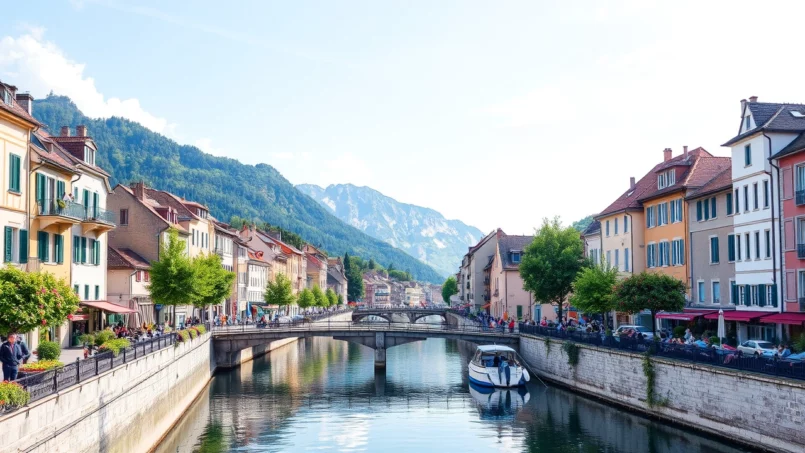
Annecy ticks practically all the boxes for a good real estate investment: a highly sought-after city, a postcard-perfect setting between lake and mountains, a solid economy, powerful tourism, strong demographic pressure, and a limited housing supply. The logical result: prices are soaring, yields remain decent but come at a high price, and an investor’s margin for error is slim.
This article provides a comprehensive guide to investing in Annecy, including market analysis, local specificities, new developments, taxation, financing options, and rental regulations (including seasonal rentals), in order to develop a realistic strategy tailored to your profile.
Why invest in Annecy today?
Annecy, the prefecture of Haute-Savoie, is at the heart of a territory combining economic and touristic assets. Located in the Auvergne‑Rhône‑Alpes region – France’s third most expensive real estate market – the city benefits from an exceptional environment: a lake renowned for its water quality, immediate proximity to the Alpine mountain ranges within 30 minutes, Geneva about forty minutes away, ski resorts and the Geneva basin within easy reach.
The city has just over 130,000 inhabitants, with a low unemployment rate of around 6.5%.
This massive demand – from residents, Swiss cross-border workers, students, and tourists – clashes with scarce land availability and strong construction constraints. The result: a tight market, short sales times (around 65 days in Haute‑Savoie), and market tension evaluated at 10/10, with more buyers than properties for sale. For an investor, this means both a risk of overpaying, but also a high probability of medium-term appreciation, provided the product and neighborhood are chosen well.
Within the regional context, Annecy stands as a “prime” market. Prices there far exceed the already high averages of Auvergne‑Rhône‑Alpes (approximately €3,963/m² for apartments and €2,536/m² for houses).
Price levels in Annecy and Haute‑Savoie
The figures converge on one observation: investing in Annecy is expensive, very expensive, but the historical increase is impressive.
| Indicator | Indicative Value |
|---|---|
| Average apt. price Annecy (source 1) | ≈ €5,101/m² |
| Average apt. price Annecy (source 2) | ≈ €6,261/m² (range €4,150 – €8,574/m²) |
| Average house price Annecy | ≈ €6,599 – €7,435/m² (depending on sources) |
| Overall average sale price Annecy | ≈ €5,288/m² |
| Average price Haute‑Savoie (apartment) | ≈ €5,531/m² |
| Average price Haute‑Savoie (house) | ≈ €4,906/m² |
| Price increase in Annecy over 5 years | ≈ +43% |
| Min. / avg. / max price (source) | €3,968 / €7,862 / €19,259/m² |
| Price per m² (Sept. 2025, other source) | €5,665 (min) / €6,998 (avg.) / €10,758 (max)/m² |
In summary, prices are significantly above the regional average, but remain below those of highly-rated areas in PACA or central Paris. Annecy is thus an expensive market, but considered more “accessible” than the French Riviera while offering a strong international positioning, notably with Swiss, British, and European clientele.
Price variations by neighborhood
The city is far from homogeneous: some sectors command premium prices, others remain relatively more affordable and offer slightly better yields.
| Neighborhood / Area | Indicative Average Price per m² (Sale) | Profile / Remarks |
|---|---|---|
| Golden Triangle (Albingy – lake – Bonlieu) | ≈ €5,000/m² (often higher in practice) | Most prestigious address, lake views, high demand |
| Old Town / historic center | ≈ €4,800/m² | Touristic, highly sought-after for seasonal rentals |
| Balmettes | ≈ €3,400/m² | Quieter, central, mid-range budgets |
| Novel (Avenue de Genève) | ≈ €3,000/m² | Northern area, residential, more affordable |
| Outside the ring road (Teppes, Parc des Sports…) | €2,000 – €2,700/m² | Outskirts, potential for rental yield |
| Annecy‑le‑Vieux (neighboring town) | ≈ €4,600/m² (sometimes > €6,000/m²) | Highly sought-after, family-oriented, close to lake |
| Seynod | €3,500 – €4,200/m² | Interesting for price/quality ratio |
| Cran‑Gevrier | €3,000 – €3,900/m² | In transition, good yield, most profitable neighborhood |
In the urban area, other communes of “Greater Annecy” (Pringy, Argonay, Epagny, Sevrier, Saint‑Jorioz, Duingt, Talloires, Veyrier‑du‑Lac, Menthon‑Saint‑Bernard, etc.) offer varied entry points but remain highly prized, especially around the lake. The eastern shore (Veyrier, Talloires, the “Beverly Hills of Annecy”) concentrates the very high-end, while the western shore (Sevrier, Saint‑Jorioz, Duingt, Doussard) retains a bit more accessibility, with strong potential for remote work and actively rented second homes.
A market driven by diverse and sustained demand
The 43% price increase over five years did not come out of thin air: it is explained by a combination of structural dynamics.
First, residential attractiveness: Annecy has been ranked the best city to live in France by various studies, with a living environment combining lake, mountains, green spaces (94 hectares in the heart of the city), cultural facilities, and services. The population is growing, around 3 to 4% per year according to some estimates, in a department that has gained 100,000 inhabitants in ten years.
Proximity to the Lake Geneva basin and Geneva offers major economic opportunities, with about 11% of Annéciens working in Switzerland. This phenomenon, coupled with a robust local entrepreneurial fabric and the presence of leading-edge companies, supports high purchasing power. The real estate market is further energized by strong demand from Swiss buyers, benefiting from a strong Swiss franc.
Add to this massive tourism, both summer and winter. The lake and festivals (Fête du Lac, International Animated Film Festival) fill accommodations in summer, while the mountains and surrounding resorts ensure sustained winter attendance. The Savoie‑Mont‑Blanc basin cumulates over 67 million overnight stays, and the wellness economy (hiking, outdoor sports, spa, yoga, etc.) is booming.
Forecast housing starts in France for 2025, illustrating the structural difficulties in the building sector.
For an investor, this translates into a structurally supportive environment: low vacancy rates, strong resilience in case of an economic slowdown, and still positive appreciation prospects in the medium term, even if the frenetic increases of past years tend to moderate.
Long-term or seasonal: What does a property in Annecy yield?
Investing in real estate in Annecy requires choosing a clear rental strategy. Between traditional “classic” long-term rental and touristic rental like Airbnb, the numbers tell a different story, both in terms of yield and regulatory constraints.
Long-term rental yields
In the traditional residential market, data converges around an average gross yield close to 3.6 to 3.7%, slightly higher for furnished rentals than for unfurnished.
| Indicator (Long-term Rental) | Indicative Value |
|---|---|
| Average monthly rent (all types) | ≈ €890/month |
| Average long-term rent per m² | ≈ €15.9/m²/month |
| Average apt. rent (recent source) | ≈ €18.2/m²/month |
| Average house rent | ≈ €21.9/m²/month |
| Average furnished rent | ≈ €21/m²/month |
| Average unfurnished rent | ≈ €17/m²/month |
| Overall average gross yield | ≈ 3.62% |
| Furnished yield | ≈ 3.74% (3.19% to 4.29% depending on neighborhood) |
| Unfurnished yield | ≈ 3.37% |
| Estimated “self-financing” duration | ≈ 41.1 years |
Yields vary strongly by property size. Large apartments are in demand but are expensive and often offer a yield lower than T2s or T3s.
| Apartment Type | Average Sale Price | Average Monthly Rent | Annual Revenue | Average Gross Yield |
|---|---|---|---|---|
| 1-room (T1) | ≈ €245,000 | ≈ €640 | €7,680/year | ≈ 3.11% |
| 2-room (T2) | ≈ €298,000 | ≈ €1,030 | €12,360/year | ≈ 4.13% |
| 3-room (T3) | ≈ €420,200 | ≈ €1,550 | €18,600/year | ≈ 4.43% |
| 4-room and + (T4+) | ≈ €730,000 | ≈ €1,400 | €16,800/year | ≈ 2.30% |
T2s and T3s appear as the core target for rental investors, especially furnished: they are highly sought after (young professionals, families, students, cross-border workers), remain “financeable,” and offer the best price/yield ratio.
The Cran‑Gevrier neighborhood stands out for its highest gross rental yield for furnished properties, around 4.4%. This yield is favored by relatively low acquisition prices and sustained rental demand.
Potential and constraints of seasonal rental
The Airbnb market in Annecy is particularly developed, but highly regulated. There are over 3,000 active listings, more than 90% of which are entire homes, mainly apartments, mostly with one bedroom and an average capacity of 3.3 travelers.
The figures illustrate a significantly higher income potential compared to traditional rental, at the cost of more intensive management and strict rules.
| Indicator (Short-term Rental) | Indicative Value |
|---|---|
| Number of active listings | ≈ 3,116 (another source: 2,150) |
| Share of entire homes | ≈ 92.1% |
| Share of apartments/condos | ≈ 90.7% |
| Average annual revenue | ≈ €28,600 – €30,000 |
| Median occupancy rate | ≈ 64 – 72% |
| Average Daily Rate (ADR) | ≈ €119 – €122 |
| Typical nights rented | ≈ 263 nights/year |
| Median monthly revenue | ≈ $2,020 (order of magnitude) |
| Top 10% (monthly revenue) | ≥ $5,010 |
| Top 25% | ≥ $3,123 |
| Bottom 25% | ≈ $1,136 |
| Peak season (June‑August) | ≈ $4,197/month, 63% occupancy, $207 ADR |
| Low season (Jan., March, Nov.) | ≈ $1,526/month, 38.9% occupancy, $137 ADR |
| Listings with a license | 74% to 95% depending on sources |
| Top-performing neighborhoods | City Center, Cran‑Gevrier |
| Annual revenue City Center (example) | ≈ €38,368, 73% occupancy, ADR ≈ €141 |
| Annual revenue Cran‑Gevrier (example) | ≈ €25,602, 72% occupancy, ADR ≈ €95 |
In touristic areas, seasonal rental can generate 2 to 3 times more income than traditional rental, but the city now strictly regulates this market.
Since 2023, the city of Annecy has implemented strict zoning, dividing its territory into three zones, with particularly rigorous rules in the Old Town. The number of second homes that can be converted into tourist furnished rentals is now capped at 2,200, a significant reduction from the previous threshold of over 2,800. To be compliant, owners must absolutely register with the town hall, hold a license, and comply with change-of-use rules for the premises. Furthermore, the national context shows a tightening of tax benefits, with a reduction of the standard deduction from 71% to 50% for tourist furnished rentals.
In this context, an investor targeting seasonal rental in Annecy must imperatively factor in regulatory risk and favor secure setups (real LMNP, VAT recovery on new builds with services, etc.), preferably by relying on professional operators or local concierge services.
New build, existing, city center or outskirts: Where and what to buy?
Investing in real estate in Annecy first requires choosing between several axes: new or existing, city center or surrounding communes, long-term or tourist rental, luxury “lake and view” or more rational product.
New builds: Comfort, standards, and tax benefits, but a high entry ticket
Annecy is one of the most active Savoyard cities for new development programs, even though land remains scarce. There are about 25 ongoing real estate programs in the commune, representing nearly 300 apartments and houses.
Among the developers present are major national names and regional operators: EIFFAGE IMMOBILIER, Cogedim, BOUYGUES IMMOBILIER, Marignan, Nexity, ICADE PROMOTION, SAGEC, EDIFIM Annecy Léman, TERACTEM, PRIMALP, SOGERIM, PRIAMS, AURIL, as well as local specialists like Affluence Immobilier, NOVANEA, IMMO COMVOUS, or Ultiméa, which markets several programs.
Many projects are planned with staggered deliveries between 2025 and 2027: the “L’éveil” range (Everlake, Vesna, Ostara) by Eiffage, “Osmose” (including bare ownership) and “Vertuose” by Cogedim, “Les Camarines” and “My Campus Annecy” by Bouygues, “Passage de Flore” by Marignan and Nexity, “Les promenades de Billy” and “Jardin des sens” by Icade, “L’écrin d’Annecy” by Recherche Appartement ou Maison, “L’Étoile” by EDIFIM, “Azuré” by Teractem, “La Venise des Alpes” by Affluence Immobilier, “Convergence” by Primalp, “Esquisse” by Sogerim, “Maestria” by Priams, “Hoya” by AURIL, or “Villa Annecia” by SAGEC.
An emblematic real estate program carried by NOVANEA, located in a large private landscaped park in Annecy.
24 units from T1 to T5 duplexes, with surface areas from 36 to 114 m². Each unit has outdoor space: balcony, loggia, terrace, or rooftop.
Modern architecture with optimal exposures, large bay windows, 60×60 cm tiles. Quality features: contemporary bathrooms, underground parking, bike storage, and a shared vegetable garden on the rooftop.
Prices ranging from approximately $279,000 to over $1.2 million. Program delivery is scheduled for around 2026.
Other peripheral programs, well-connected to Annecy, offer slightly lower entry points. In Seynod (5 km from the center), “Domaine du Chêne” offers T2s to T4s starting from €259,000, in a complex certified RE 2020. In Doussard (30 minutes from Annecy), “Douss’ Perspective” combines 2 to 4-room apartments and 3-bedroom houses, also RE 2020 compliant.
New builds present several advantages for the investor: high energy standards (RE 2020), strong attractiveness to tenants sensitive to lower charges and comfort, no major works needed in the short term, possible eligibility for a zero-interest loan (PTZ) for first-time buyers, a reduced VAT rate of 5.5% in certain neighborhoods, and even setups allowing VAT recovery (20%) if the property is operated as a furnished rental with tourist services for about twenty years. Some operations also offer commercial incentives (notary fees covered, discounts per room, etc.).
Investing in new builds often comes with a higher price per m² than existing properties, especially in premium sectors, and a potentially lower immediate gross yield. It involves specific risks: delivery delays, specification changes, and administrative uncertainties. In return, energy ratings are generally excellent, protecting from the progressive rental restrictions applicable to properties rated G and F (energy sieves).
Existing properties: City center, charm, value-add potential, but works and regulations
Existing properties still largely dominate the Annécien housing stock, with nearly 30,000 dwellings in the commune alone. Character properties (Old Town, Thiou canal banks, medieval streets) or bourgeois buildings in the center and on avenue d’Albigny command a high price but constitute highly sought-after patrimonial assets, especially for high-end seasonal rentals or a prestigious primary residence.
Existing properties sometimes allow for value-creation opportunities: major renovation of a floor-through apartment, energy improvement to move out of an F or G class and make the property rentable again, converting a large T5 into two T2s to optimize rents, etc. The law also allows, in specific cases, for tax advantages (ex-Pinel for existing properties undergoing heavy renovation, schemes like BRS or Intermediate Rental in certain neighborhoods, VAT and aids like MaPrimeRénov’ for energy performance improvement).
The investor must anticipate several challenges: high renovation costs, scarce labor, long construction timelines, and constraints related to co-ownership. Furthermore, regulation is progressively banning the rental of the most energy-inefficient dwellings (rated G on the DPE since 2025), steering the market towards efficient properties (classes A to C) which sell at a premium of 15 to 20% compared to ‘energy sieves’.
Center, residential neighborhoods, or first ring suburbs?
The choice of area closely depends on your strategy.
For high-end long-term rental, targeting young professionals or high-income families, areas like the city center, Golden Triangle, Albigny, Parmelan, or Annecy‑le‑Vieux are safe bets, but with yields contained around 3 to 3.5%. Properties with a balcony, terrace, lake view, or proximity to schools and transport find takers easily.
To optimize gross yield, it is often wiser to look towards Cran‑Gevrier, Seynod, Novel, or even well-served neighboring communes (Pringy, Poisy, Argonay, Epagny, Doussard). Acquisition prices there are more reasonable and rental demand remains very strong.
For seasonal and high-end international rental, the immediate lake surroundings (Veyrier, Talloires, Menthon, western shore like Sevrier or Saint‑Jorioz) constitute prime locations, provided you master the tourist regulations and accept prices that can reach, in some cases, levels worthy of the most upscale ski resorts.
Renting, managing, optimizing: The service ecosystem for the investor
The success of an investment, particularly in seasonal rentals, largely depends on the quality of management. The Annecy basin has become structured around numerous specialized agencies and concierge services.
For high-end properties, Annecy Sotheby’s International Realty has established itself as a major player, with transactions of several million euros (contemporary villa in Veyrier‑du‑Lac sold for €4M, historic property in Annecy‑le‑Vieux over €4.2M, 19th-century bourgeois house for €3.5M) and over €41M in annual sales in the prestige segment.
This is the percentage of properties selected by the OVO Network platform among those it reviews for seasonal rental.
For a foreign investor or one who is seldom present, these services allow for complete delegation of management: check-in, cleaning, laundry, maintenance, booking tracking, price optimization, regulatory compliance. They also favor continuity of rental income by targeting diversified clientele (France, United Kingdom, Northern Europe, North America, increasingly Asia) and combining platforms (Airbnb, Booking, Abritel, own website, etc.).
Financing, taxation, and legal framework: Parameters not to underestimate
Even with good market fundamentals, a poorly financed or poorly tax-structured investment can lose much of its appeal.
Mortgage loans: A context that has become clearer again
In 2025, borrowing rates in France have stabilized around 3% for good profiles, with averages around 3.16% over 20 years and 3.26% over 25 years. Excellent applications can negotiate below 3%, down to 2.85% over 15 years.
In Annecy, given the prices, borrowing capacity and down payment play a central role: banks generally require at least 10 to 20% down payment, and must not exceed a debt-to-income ratio of about 30%. First-time buyers can benefit from the PTZ (Zero-Interest Loan) for new builds, which helps boost demand in this segment.
An investment of €250,000 financed over 25 years at 3.26% generates a monthly payment of around €1,215 excluding insurance. Compare this to an expected rent of around €900 to €1,000 for a small T2 in a sought-after area: the cash flow might be slightly negative initially, but offset by the prospect of capital gain and the tax advantages of the LMNP status for furnished rentals.
Taxation: LMNP, VAT, local taxes, capital gains
French taxation offers several levers to mitigate the investor’s net effort in Annecy, provided they are used correctly.
The Non-Professional Furnished Landlord (LMNP) status offers several tax and financial advantages. It notably allows for the tax deduction of the depreciation of the property, furniture, and work carried out. This deduction can significantly reduce, or even cancel out, the taxable profit for many years. Furthermore, rents received for a furnished rental are generally about 30% higher than those for an unfurnished property, which mechanically improves the investment’s gross yield. This status is accessible under conditions: annual rental income must not exceed €23,000 or not constitute the main source of income for the tax household.
For setups oriented towards tourism in new builds, it is possible, under conditions (active rental with hotel-type services: welcome, linen, cleaning…), to recover the 20% VAT on the purchase price and works. In return, the property must remain in this circuit for 20 years; an early exit requires repaying a portion of the recovered VAT.
Local taxes (property tax, possibly residence tax on second homes) tend to increase, with notable hikes on second homes. In Annecy, the property tax rate recently rose from about 29.8% to 34%. For a high-end property, this weighs significantly on net profitability.
Real estate capital gains are taxed at a 19% rate for income tax, plus 17.2% in social contributions. A progressive allowance applies based on the length of ownership, leading to full exemption from income tax after 22 years and from social contributions after 30 years. Primary residences are fully exempt. For a patrimonial investor, this tax mechanism makes long-term holding particularly advantageous, especially in a growing market like Annecy’s.
Rental regulations and energy performance
The regulation of seasonal rentals in Annecy is a sensitive point. Besides the quota of 2,200 second homes authorized for tourist furnished rentals, the city has implemented a division into three zones, with reinforced restrictions in the Old Town. The change-of-use procedure for second homes rented short-term is technical and costly. Ignoring these rules exposes one to significant fines and a ban on operation.
In the long-term segment, owners must factor in DPE (Energy Performance Diagnostic) constraints: properties rated G are progressively banned from rental (and F eventually), unless energy renovation works are carried out. In a city with a large stock of existing properties, this aspect can turn a constraint into an opportunity: buying a property needing heavy renovation, performing the works (with the help of MaPrimeRénov’, Energy Savings Certificates, etc.), bringing it up to class C or D, and benefiting from price and rental value appreciation.
Investment strategies suited to Annecy
Faced with such a tight and expensive market, the key is to adopt a coherent strategy aligned with your goals, investment horizon, and risk tolerance.
A first, patrimonial approach consists of targeting the most “secure” locations: city center, lake surroundings, Annecy‑le‑Vieux, upscale residential neighborhoods. The gross yield will hardly exceed 3 to 3.5%, but capital appreciation and resale liquidity are excellent. This is the logic of an investor looking to preserve and grow capital over the long term, potentially in the luxury segment (lake-view villa, exceptional apartment).
For a rental investment in Annecy, a balanced approach is to target neighborhoods like Cran‑Gevrier, Seynod, or Novel, on the outskirts but well-connected. Favor new development programs with good energy performance. Ideally, acquire a furnished T2 or T3, intended for local professionals or cross-border workers. This strategy allows for an expected gross yield of 3.8% to 4.4% while benefiting from the region’s upward real estate momentum.
A third, more opportunistic approach, looks towards seasonal rental, either in very touristic locations (Old Town, Pâquier, immediate lake proximity), or around the lake (Sevrier, Saint‑Jorioz, Duingt, Talloires, Veyrier…). In this case, the investor must accept very high entry tickets, strong seasonality, and an evolving regulatory framework. The challenge becomes to smooth out activity throughout the year by targeting varied clientele: outdoor sports enthusiasts in summer, skiers in winter, remote workers, active retirees, international clientele seeking wellness stays.
Some investors target communes around Annecy (like La Clusaz, Le Grand‑Bornand, or the Aravis resorts) where tourist demand remains strong, prices per square meter are lower than in the city center, and where one still benefits from the economic and touristic influence of Lake Annecy.
Conclusion: A demanding but solid market in the long term
Investing in real estate in Annecy means accepting to enter an already highly valued market, where the slightest error in location, product, or price calibration can be costly. But it also means positioning oneself in a city and territory whose growth drivers (demographics, tourism, proximity to Geneva, natural attractiveness, improving infrastructure) should remain powerful for the next 10 to 15 years.
Projections for the Auvergne-Rhône-Alpes region anticipate a continued rise in real estate prices, albeit more moderate. This trend is supported by a chronic shortage of new housing and an aging population, which stimulates demand for suitable dwellings. Annecy, already one of the region’s most dynamic markets, is expected to remain at the heart of this trend.
The success of an investment project therefore relies on some fundamentals: a rigorous selection of the neighborhood and property type, a detailed analysis of the rental strategy (long-term vs. seasonal), a realistic consideration of taxation and charges (taxes, co-ownership fees, management, works), optimized and secure financing, and, increasingly, solid professional support, both for the transaction and for management.
In an evolving short-term rental market, success in Annecy relies on anticipating regulations, choosing a quality property (construction, location, management), and a long-term investment strategy. These criteria make this city one of France’s most solid and desirable real estate markets.
Disclaimer: The information provided on this website is for informational purposes only and does not constitute financial, legal, or professional advice. We encourage you to consult qualified experts before making any investment, real estate, or expatriation decisions. Although we strive to maintain up-to-date and accurate information, we do not guarantee the completeness, accuracy, or timeliness of the proposed content. As investment and expatriation involve risks, we disclaim any liability for potential losses or damages arising from the use of this site. Your use of this site confirms your acceptance of these terms and your understanding of the associated risks.

Cyril Jarnias is an independent expert in international wealth management with over 20 years of experience. As an expatriate himself, he is dedicated to helping individuals and business leaders build, protect, and pass on their wealth with complete peace of mind.
On his website, cyriljarnias.com, he shares his expertise on international real estate, offshore company formation, and expatriation.
Thanks to his expertise, he offers sound advice to optimize his clients' wealth management. Cyril Jarnias is also recognized for his appearances in many prestigious media outlets such as BFM Business, les Français de l’étranger, Le Figaro, Les Echos, and Mieux vivre votre argent, where he shares his knowledge and know-how in wealth management.





