
 Published on and written by Cyril Jarnias
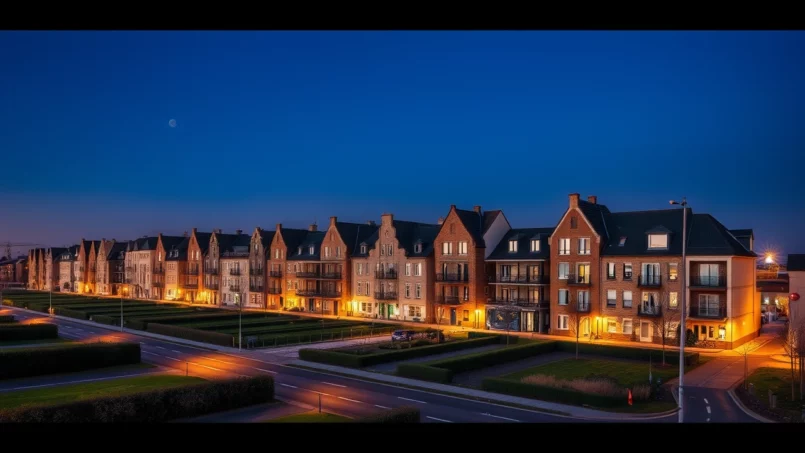
Roubaix is increasingly intriguing real estate investors. Long marked by deindustrialization and high unemployment, the city is now reinventing itself around innovation, culture, and urban renewal. The result: prices that are still very affordable, some of the highest yields in France, and a rental market driven by a young population and a significant student presence.
Investing in Roubaix is not limited to buying at a low price. The market is energized by major urban renewal programs, advantageous tax schemes like Denormandie or Pinel in zone B1, and strong demand for renovated housing.
A high-potential city at the heart of the Lille metropolitan area
Roubaix is located in the Nord department, within the European Metropolis of Lille (MEL), between Brussels, Paris, and London. Just 11 km from Lille, the city is connected by metro, bus, or tram in about ten minutes, and by regional train in 9 minutes. It benefits from the direct proximity of large towns like Tourcoing, Villeneuve-d’Ascq, Croix, or Marcq-en-Barœul, where prices are significantly higher.
Roubaix has about 98,000 inhabitants, a city characterized by its youth with a median age of 30 to 34 years.
This youthfulness, combined with a very high tenant rate (between 62.9% and 65% of households depending on the source), structures a deep, diversified, and for the investor, particularly promising rental market.
Low prices, very high yields
One of the main assets of real estate in Roubaix remains the price level. On average, the price per square meter is around €1,600–€1,900 depending on the source, with a median of about €1,875/m² at the end of 2025. Roughly speaking, this is 20 to 30% below the average prices in the Lille metropolitan area, and far from the levels in central Lille.
Over five years, prices have increased by 28 to 38%, with an annual rise of 12 to 13% for apartments. Monthly peaks approaching 8% have been observed. Despite a sharp slowdown in sales volume (343 in 2024, -50% in two years), the market remains extremely tight with about 11% more buyers than available properties, rated as ’10/10′.
A very profitable market
This low price level combined with decent rents mechanically results in high yields. At the city level, data converges around an average gross yield between 8 and 9%.
Notably, we find:
| Indicator | Average value in Roubaix |
|---|---|
| Average price per m² (all properties) | ~€1,648 |
| Average price per m² (apartments) | ~€1,815–€1,885 |
| Average price per m² (houses) | ~€1,383–€1,417 |
| Average rent per m² (apartments) | ~€12.5/m² |
| Average rent per m² (houses) | ~€10.7/m² |
| Average furnished rent | ~€18/m² |
| Average unfurnished rent | ~€12/m² |
| Average overall gross yield | ~8.8% |
| Average furnished yield | ~7.96% |
| Average unfurnished yield | ~7.08% |
In certain micro-sectors, profitability climbs even higher: the Épeule – Trichon neighborhood, for example, shows an average gross yield of about 11.5% for furnished rentals, a rare figure in a large urban area.
For an investor, these yield levels, more than 3 points above the national average (around 4.2%), provide an interesting safety margin to absorb costs, renovations, taxes, and potential rental vacancies.
An urban context undergoing profound transformation
One cannot understand the Roubaix real estate market without recalling its recent history. The city, a former textile stronghold, lost about 50,000 industrial jobs between the 1970s and 2000. This shock translated into rising unemployment, impoverishment of some neighborhoods, downtown decline, and a collapse in real estate prices: between 1990 and 2000, houses in Roubaix lost about half their value compared to central Lille.
For about twenty years, the Lille metropolitan area has been rebuilding its urban model around the ‘Ville renouvelée’ (Renewed City) project, integrated into its strategic plan since the late 1990s. This strategy relies on massive urban renewal programs, the conversion of industrial heritage, an ambitious cultural policy, and the development of new economic sectors like digital tech, e-commerce, innovative textiles, and the circular economy.
ANRU programs and major projects in several neighborhoods
Roubaix is one of the emblematic areas for urban renewal programs led by the ANRU (National Agency for Urban Renewal). The “New Urban Renewal Program” (NPRU), validated in 2020, targets four priority neighborhoods: Alma, Épeule, Pile, and Trois Ponts, with transformations planned for the 2027–2032 horizon.
The projects include: initiatives, action plans, strategic objectives.
The transformation of priority neighborhoods involves a multidimensional approach including the demolition of obsolete social housing blocks to open up areas and create green spaces, marketplaces, and new public facilities. It also includes the rehabilitation of degraded social and private housing stock, particularly in areas with dense, old, and dilapidated urban fabric like the Pile neighborhood. Urban renewal integrates the creation or modernization of schools, community centers, sports facilities, and public service hubs. Finally, the requalification of public spaces (squares, streets, canal banks, etc.) is essential to improve the overall quality of life for residents.
Part of the city is in ANRU zones or QPVs (Priority Urban Neighborhoods), which allows, within certain perimeters, to benefit from a reduced VAT rate of 5.5% on new builds and specific schemes like Denormandie on older properties to renovate.
At the same time, the city leads exemplary conversion projects like the Union eco-district, a vast 80-hectare operation between Roubaix, Tourcoing, and Wattrelos, where former industrial wastelands are being transformed into housing, offices, green spaces, and business premises. Ultimately, the Union aims for 1,200 homes, 3,000 new residents, 6,000 jobs, and 160 businesses.
These interventions, supported by heavy funding (an €80 million framework loan from the European Investment Bank within a municipal investment plan of about €160 million for 2025–2029), structure the potential for medium- and long-term real estate value appreciation.
An economy in transition, but employment still fragile
The social reality of Roubaix remains mixed. The median income is around €17,400 per year, well below the national average. Unemployment is very high when considering all 15–64 year olds (nearly 31% according to some sources), with peaks above 28–30% in several priority neighborhoods.
Paradoxically, the city has more jobs than working residents: about 45,000 positions for a little over 37,000 employed people, implying the daily influx of about 20,000 commuters. The problem is therefore less the absence of activity than the mismatch between local profiles and available jobs.
Despite figures that may be concerning, several structural elements guarantee solid rental demand in the market.
A very young population constitutes a significant pool of potential tenants.
The presence of a large social housing stock indicates a high proportion of households dependent on renting.
A high proportion of modest-income households favors renting over home ownership.
A constantly increasing student population generates targeted and renewed rental demand.
A homeownership rate between 33% and 45% means a large majority of the population rents.
Demand is particularly concentrated on well-located and properly renovated housing.
Furthermore, the city is no longer just a former industrial bastion: it now hosts major players in cloud computing (OVHcloud), digital creation (Ankama), e-commerce (showroomprive.com, La Redoute), and textile innovation (CETI, Bi@nchemaille cluster). It holds the French Impact label for its role in social innovation and the circular economy, and attracts an ecosystem of businesses that feeds the rental market, particularly for managers, engineers, and young graduates.
Deep and varied rental demand
Between the youth of the population, the strong presence of students, the significant share of modest households, a relatively low homeownership rate, and a significant number of vacant homes to renovate, Roubaix presents a typical profile of a city with a strong rental culture.
Out of about 40,000 homes, nearly 88% are primary residences, and between 55% and 66% of households are renters. Studios and small apartments represent a notable share of the stock (nearly 6.9% for studios, 15.2% for two-room units, and over 21% for three-room units), while more than a third of primary residences have five rooms or more.
The average rent for an apartment is around €12–€13/m², with a range between €8 and €22/m² depending on size, condition, and location; houses rent on average for a little over €10/m². The differential between unfurnished and furnished is marked: around €12/m² for unfurnished rentals versus nearly €18/m² for furnished.
For an investor, this allows the development of several strategies:
Discover the different rental options suited to your profile and needs in the region.
Student or young professional rental, close to schools and downtown.
Shared housing in large 1930s townhouses or renovated courtyard houses, located in well-served areas.
Family rental in quieter residential neighborhoods like L’Hommelet or certain sectors of Barbieux.
Airbnb-style rental in the city center and heritage areas, complying with current regulations.
The short-term rental market, although smaller compared to Lille, is already well established: there are about 276 to 337 active listings on Airbnb, with an average occupancy rate of 52%, a daily rate of around €77, and an average annual revenue around €14,500. The best properties exceed €20,000 in annual revenue with occupancy rates above 70%.
Key neighborhoods for investing in Roubaix
Not all areas are equal in Roubaix. The city combines highly sought-after zones, others in clear transition, and neighborhoods still very fragile, where high gross yield comes at the price of greater risk (vacancy, non-payment, harder resale). The challenge is not to avoid working-class neighborhoods, but to distinguish those that are truly undergoing transformation from those that remain very unstable.
Barbieux and surrounding residential sectors
Around Barbieux Park – a 34-hectare park classified as a “Remarkable Garden” and the largest green space of its kind in Hauts-de-France – lies the city’s most upscale neighborhood. This area includes subsets like Vauban, Barbieux, Édouard Vaillant, and even Croix-Roubaix on the Croix Rouge side.
Prices here are significantly higher than the Roubaix average, with apartments around €2,500–€2,700/m² and houses at comparable levels, even a bit lower. The median income is much higher than in the rest of the city (over €31,000 annually), and the unemployment rate falls below 6%.
This is an ideal area for:
– Heritage investments (beautiful 1930s houses, quality rental buildings);
– High-end shared housing for students from prestigious schools or young professionals;
– Upscale furnished rentals, possibly geared towards a transient clientele (professors, consultants, managers on assignment in Lille).
The entry ticket is higher, but liquidity upon resale, tenant quality, and neighborhood stability compensate for a gross yield somewhat lower than the rest of the city.
Nouveau Roubaix / Hauts Champs
Sociologically at the opposite end, Nouveau Roubaix – Hauts Champs is a vibrant, working-class neighborhood where rental demand is very strong. Nearly 88% of residents are renters, incomes are well below the national average, and unemployment is very high (around 11–12% according to some sources, higher when considering priority neighborhood data).
Gross yields are frequent in this real estate sector, especially when targeting certain types of properties.
– Unfurnished family rentals (T3/T4) for modest households;
– Small furnished units or T1/T2 for young professionals or students, taking advantage of proximity to shops (L’Usine, commercial zones) and transport.
This type of sector, however, requires good local knowledge and solid management (application screening, rigorous follow-up) to withstand social volatility and risks of vacancy or non-payment.
L’Union: the eco-district of the future
L’Union is probably one of the best symbols of the “new Roubaix.” On a vast industrial wasteland, an eco-district is springing up on the border of Tourcoing and Wattrelos. The project mixes housing, offices, businesses, green spaces, services, and retail, with the goal of welcoming 3,000 residents and 6,000 jobs.
Prices are still very affordable for sustainable new builds: around €1,450/m² on average, with a range roughly between €800 and €2,200/m² depending on the property type. For an investor, it’s fertile ground for:
This investment in new builds in Pinel zone B1 targets a clientele of young professionals working in the Lille-Roubaix-Tourcoing innovation corridor. The homes offer high energy quality, facilitating renting at a good price and ensuring resilience against future Energy Performance Certificate (DPE) standards.
City Center and Grande Place
Roubaix’s city center concentrates the main facilities, city hall, shops, cafes, restaurants, transport (metro, tram, bus), and many educational institutions (notably Campus Gare). It also houses the famous “La Piscine” museum, located in a former Art Deco swimming pool.
Prices remain lower than Lille or even some medium-sized French town centers: around €1,500/m² on average, with strong variations by street and building condition. The center offers:
– Significant renovation potential (many old, sometimes dilapidated buildings);
– Solid rental demand for studios, T1, and T2 furnished units;
– Good compatibility with Denormandie strategies if targeting old buildings to rehabilitate.
It’s also the neighborhood with the largest number of properties for sale, a sign of strong liquidity: over 60 properties for sale recorded in some surveys.
Épeule – Trichon
This neighborhood in transition blends industrial heritage and urban renewal, with green spaces and a geography that interests investors seeking profitability. This is where the highest average gross yield for furnished rentals is found: over 11.5%.
Average prices are attractive, around €1,300/m², with many opportunities for small buildings or townhouses to renovate for shared housing or young professional rentals. The area also stands out for experimental projects like urban farms (e.g., Ferme du Trichon) and artisanal reuse platforms, gradually strengthening its appeal through the circular economy.
Other sectors to watch… or handle with caution
Other neighborhoods should be closely monitored, either for their potential or for the risks they entail:
– Alma – Gare – Fosse aux Chênes, which combines a sometimes good-quality real estate heritage, a massive renewal program (NPRU Alma), and a still very high level of insecurity;
– Le Pile, a very dense old neighborhood, targeted by major requalification works but still fragile socially;
– Trois Ponts, already partially renovated, which continues to benefit from new investments;
– L’Hommelet, a quieter residential sector sought by families, where stable family rental strategies can be targeted;
– Croix-Roubaix / Croix Rouge, at the gates of Croix and Barbieux Park, with beautiful architecture and a green environment, interesting for a more heritage-oriented positioning.
In several of these sectors, prices per square meter can drop very low (sometimes near or below €1,000/m²), which skyrockets the gross yield, but at the cost of a higher risk of vacancy, non-payment, or degradation. The challenge for the investor is to select the location very finely even within the neighborhood, and to rely on local feedback (agents, other investors, property finders) before committing.
Tax schemes: Denormandie, Pinel B1, and reduced VAT
Roubaix offers a particularly interesting combination of tax schemes, linked to its classification in zone B1 and the presence of ANRU / QPV perimeters.
Denormandie: renovating old properties with a strong tax incentive
The city is explicitly eligible for the Denormandie scheme, focused on renovating old homes located in city centers or revitalization zones. The principle is simple: by buying an old home to renovate in an eligible perimeter and carrying out work representing a significant share of the operation’s cost, the investor obtains an income tax reduction of between 12%, 18%, or 21% of the amount invested (purchase + works), depending on whether they commit to renting for 6, 9, or 12 years.
A typical illustrated numerical example for Roubaix:
| Parameter | Example Value |
|---|---|
| Purchase price (old property) | €180,000 |
| Amount of renovation work | €60,000 |
| Total eligible cost | €240,000 |
| Rental commitment period | 9 years |
| Reduction rate (9 years) | 18% |
| Total tax saving over 9 years | €43,200 |
The interest in Roubaix is twofold. On one hand, acquisition prices are low, which allows for significant works (and thus real modernization of the property: energy performance, comfort, etc.) while staying under the scheme’s overall ceiling. On the other hand, rental demand for renovated housing is strong, in a stock that remains largely old and often energy-intensive. In practice, a renovated old apartment in the city center or a transitioning neighborhood rents quickly and limits vacancy risks.
Some operators in Roubaix offer properties already renovated and compliant with the Denormandie scheme, sold ready to rent. This solution allows investors, even beginners, to benefit from tax advantages without having to manage renovation work or administrative procedures.
Pinel in zone B1 and reduced VAT in ANRU zones
Roubaix is classified in zone B1 for the Pinel scheme, which opens the possibility to invest in new or equivalent-to-new builds with, again, a tax reduction in exchange for a commitment to rent at a capped rent for 6, 9, or 12 years. The “classic” Pinel has been gradually refocused, then closed to new operations starting in 2025, but the city benefited from this framework for several years and remains concerned by other forms of incentives (intermediate rental, Loc’Avantages, etc.).
Purchasing a new home in an ANRU zone or priority neighborhood can benefit from a reduced VAT rate of 5.5% instead of 20%, under certain conditions. This reduction significantly lowers the all-inclusive price, thereby improving the investment’s profitability and the investor’s borrowing capacity.
By combining a purchase of a new build with reduced VAT in an eco-district like L’Union with a market rent higher than that of degraded old stock, it is possible to combine comfort, rental appeal, better energy profile, and solid profitability.
Relevant investment strategies in Roubaix
The Roubaix market allows for the deployment of several approaches, depending on risk appetite, investment horizon, and objective (cash flow, tax reduction, capital gain, heritage building).
In Barbieux, Croix-Roubaix, L’Hommelet, or certain sectors of the renovated city center, the logic is more heritage-oriented:
– Purchase of character houses from the 1930s, highly sought-after, or large, upscale apartments;
– High-quality renovation work to upgrade (insulation, layout, finishes);
– Furnished or unfurnished rental to a solvent clientele (managers, families, professors from higher education institutions, self-employed professionals).
The gross yield will rather be around 5–7%, but visibility on resale, the quality of the condominium, and tenant stability compensate for a sometimes more limited cash flow, especially with 100% financing over 20–25 years.
Yield-focused in transitioning or working-class neighborhoods
In Épeule-Trichon, Nouveau Roubaix, Pile, Alma-Gare, or even parts of Fresnoy-Mackellerie or Moulin-Potennerie, the strategy is more oriented towards yield:
This approach involves acquiring small units or houses at very discounted prices, sometimes below €1,200/m². It often involves heavy renovation work to bring up to standard (structure, utilities, insulation, DPE). To optimize profitability, furnished rentals (for higher rents per m²) or shared housing (for houses) are favored. The use of tax regimes like LMNP (Furnished Non-Professional Rental) on a real basis or Denormandie allows for depreciation of the property and neutralizing tax on rental income received.
In these sectors, achieving 9–11% gross yield is not exceptional. The trade-off is a higher rental risk: sometimes fragile applications, fast turnover, need for active management and good local knowledge. Working with an experienced property management agency in Roubaix or a local “property finder” can make the difference between a profitable investment and a management nightmare.
Renovation and capital gain through Denormandie
By targeting old properties in the city center or eligible neighborhoods in poor condition (unfit housing, very low DPE ratings, dilapidated condos), then undertaking a major renovation partly financed by Denormandie and sometimes public aid for energy renovation, the investor can play on both:
– Property value appreciation (a renovated old home sells much better and for more than a fixer-upper);
– Significant rent increase (without exceeding caps, but moving up the range);
– Tax reduction over several years.
Renovation costs range from €500/m² for a light renovation to over €1,200/m² for a heavy rehabilitation.
Targeting students and young professionals
The city has over 11,000 students and a significant young professional population, often attracted by lower rents than Lille while being just ten minutes by transport from the regional capital. Demand for furnished studios and T1/T2 is therefore structural, notably:
– Around Campus Gare and the city center;
– Near EDHEC, ENSAIT, ESAAT, or IUT C;
– In well-served neighborhoods (proximity to metro line 2, tram, bus).
By investing in units of 20 to 40 m², close to transport and schools, the investor can aim for:
– A very low vacancy rate (the city is the second-largest student hub in the MEL);
– A furnished yield around 8–10%;
– Limited risk of long vacancy, provided the quality and décor are well-maintained.
Risks, pitfalls, and best practices
Roubaix is not an “easy” market, however. The high yield should not mask certain specific risks.
Risks to consider
The first point of vigilance concerns precise location. Differences between streets and micro-sectors can be considerable, both in terms of safety, building condition, resident profile, rental vacancy, or resale potential. Some areas undergoing heavy renovation (Pile, Alma, Trois Ponts, Hauts Champs) contain excellent opportunities, but also properties nearly unsellable outside a subsidized context.
The second relates to the social situation. With a very high unemployment rate and nearly half the population considered in a precarious situation, the risk of non-payment is real if rentals are not properly secured (solid guarantors, rent default insurance, application screening).
The average annual property tax for a typical property, to be integrated into the financing plan.
Finally, as everywhere in France, energy constraints are tightening. Homes rated F or G on the DPE are progressively banned from rental, which requires, in Roubaix’s very old stock, sometimes heavy renovations to remain in the game. In the long run, well-renovated properties will be even more sought after, but in the short term, this can weigh on the budget.
How to limit risks
Some best practices can secure an investment in Roubaix:
To succeed in a rental investment in a neighborhood undergoing urban renewal, it is crucial to rely on local players (real estate agents, property finders, managers) for precise feedback on each street. Analyze the neighborhood finely: vacancy rate, type of population, ongoing ANRU projects, level of services (schools, shops, transport), and residents’ perception. Budget for a realistic renovation envelope, ranging from a careful refresh (about €12,000–€15,000 for a T3) to a more thorough renovation (€35,000 and up) for an old property. Integrate a safety margin in cash flow to absorb potential rental delays, non-payments, or exceptional condominium charges. Finally, favor properties offering a good price-to-size ratio and architectural charm likely to gain value through urban renewal and the evolving image of the city.
Consulting public data (DVF), street-level price statistics, and urban renewal plans (ANRU documents, MEL communications) is also a useful supplement before taking a position.
Where does Roubaix stand compared to other French cities?
Compared to other cities of comparable size, Roubaix stands out with a very rare yield/price combination.
Looking at some benchmarks:
| City | Average apt price/m² | Average rent/m² | Estimated yield |
|---|---|---|---|
| Paris | ~€11,300 | > €25/m² | ~3–4% |
| Lyon | ~€5,600 | > €16/m² | ~3–4.5% |
| Lille | ~€3,260 | ~€15/m² | ~5% |
| Tourcoing | ~€1,670–€1,850 | ~€12–€13/m² | ~8% |
| Saint-Étienne | ~€1,390 | ~€12/m² | ~8.5% |
| Mulhouse | ~€1,580 | ~€13/m² | ~7.6% |
| Roubaix | ~€1,650–€1,900 | ~€12–€13/m² | ~8–9% |
Roubaix is clearly in the leading pack of the most profitable cities, on par with Saint-Étienne or Tourcoing, but with an additional advantage: its direct integration into the Lille metropolitan area, one of France’s most dynamic agglomerations in terms of employment, higher education, and transport.
For an investor looking to diversify away from saturated and expensive markets like Paris, Lyon, or Bordeaux, Roubaix represents an alternative within a major urban basin. However, it is essential to master the specific social and urban characteristics of this city to succeed in the investment.
Conclusion: why invest in real estate in Roubaix today?
Investing in real estate in Roubaix is betting on a city with a double face: still marked by insecurity and unemployment, but engaged in a trajectory of profound transformation, supported by massive public investments, an ambitious cultural policy, the rise of innovative companies, and a strong student presence.
The arguments in favor of an investment are clear:
The local real estate market has among the lowest prices per m² in major French urban areas, 20 to 30% lower than the Lille average. Gross yields are attractive, around 8–9% on average and exceeding 10–11% in some neighborhoods. Rental demand is solid, driven by a young population, students, and professionals attracted by affordable rents. Advantageous tax schemes (Denormandie, reduced VAT in ANRU zones, etc.) allow combining tax reduction and value appreciation. Finally, large-scale urban projects (NPRU, L’Union eco-district) point to medium-term capital gain potential.
Nevertheless, it is not a market to be approached lightly. Location selection, mastering rental risk, anticipating renovation work and energy standards, and the quality of management are more decisive than ever. A well-structured project, backed by good local knowledge and a clear strategy (heritage, yield, tax reduction), can, however, make Roubaix one of the current best compromises between yield and capital gain potential in the French real estate landscape.
For the investor ready to renovate and surround themselves with local expertise, real estate in Roubaix offers an attractive yield. This investment allows participation in the renovation of the old, sometimes substandard, housing stock while creating long-term value and having a positive urban impact.
Disclaimer: The information provided on this website is for informational purposes only and does not constitute financial, legal, or professional advice. We encourage you to consult qualified experts before making any investment, real estate, or expatriation decisions. Although we strive to maintain up-to-date and accurate information, we do not guarantee the completeness, accuracy, or timeliness of the proposed content. As investment and expatriation involve risks, we disclaim any liability for potential losses or damages arising from the use of this site. Your use of this site confirms your acceptance of these terms and your understanding of the associated risks.

Cyril Jarnias is an independent expert in international wealth management with over 20 years of experience. As an expatriate himself, he is dedicated to helping individuals and business leaders build, protect, and pass on their wealth with complete peace of mind.
On his website, cyriljarnias.com, he shares his expertise on international real estate, offshore company formation, and expatriation.
Thanks to his expertise, he offers sound advice to optimize his clients' wealth management. Cyril Jarnias is also recognized for his appearances in many prestigious media outlets such as BFM Business, les Français de l’étranger, Le Figaro, Les Echos, and Mieux vivre votre argent, where he shares his knowledge and know-how in wealth management.





