
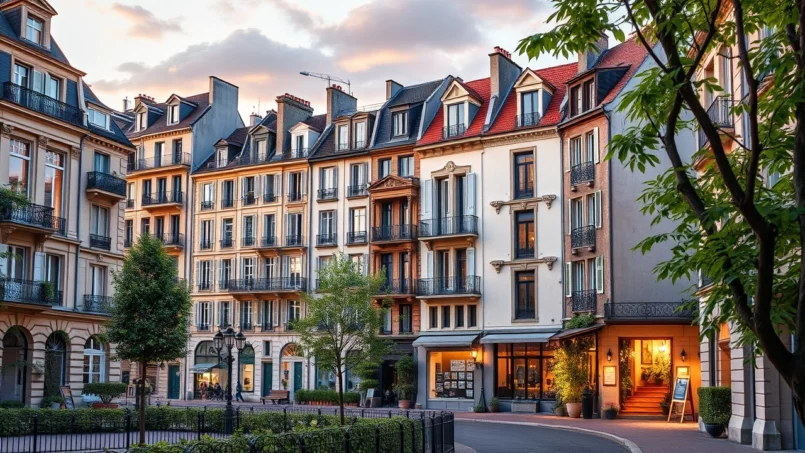
 Published on and written by Cyril Jarnias
Nantes has established itself in just a few years as one of the preferred playgrounds for real estate investors. As the sixth-largest city in France, the economic capital of the west, a green and technological metropolis, it boasts a wealth of assets: strong demographic growth, an ultra-tight rental market, XXL urban projects, and an efficient transport network. The result: housing demand is skyrocketing, rents are holding firm, and prospects for appreciation remain solid despite the stabilization phase observed since 2025.
Investing in Nantes real estate is no longer a simple investment. The market has now become technical and highly segmented by neighborhood, property type, and energy performance. To succeed, it is essential to cross-analyze several factors: demographics, employment, urban planning, price per square meter, taxation, yields, and on-the-ground reality.
This report offers a detailed deep dive into the Nantes market to support a rational and data-driven rental investment project.
A demographic and economic context tailored for rental investment
The first pillar of a successful investment always remains the same: the location. On this point, Nantes ticks almost all the boxes.
The city exceeds 332,000 inhabitants and remains the largest urban area in the greater West. Over ten years, its metropolitan area has gained nearly 36,000 inhabitants, at a rate close to +1% per year. A strong signal for investors: about two out of three Nantes residents are under 40, with a median age around 33. This is exactly the age bracket that fuels the rental market (students, young professionals, young families).
The local economy is equally favorable. Nantes is simultaneously a tertiary, industrial, and digital hub. It boasts:
Nouvelle-Aquitaine is home to over 30,000 companies, a national leader in shipbuilding and strong in aeronautics, agri-food, digital, and healthcare.
Its appeal is such that one in two executives from the Paris region reportedly would be willing to move there. Unemployment remains below national averages, hovering around 5.5–5.8% in the employment zone in recent periods, supporting household solvency and therefore rent payments.
Finally, the Nantes quality of life, praised multiple times (European Green City, innovative city, ranked among the best student cities and the most pleasant cities in Europe), reinforces a key phenomenon for the investor: a positive migration balance, fueled by young professionals, families, and students.
A dynamic but more selective real estate market
After a phase of marked increase (approximately +34% over five years), the market experienced a downturn in 2023 before entering a stabilization phase. In 2025–2026, prices are easing slightly without a sharp reversal, while transaction volumes are rising again and sales periods are shortening.
In January 2026, average prices stand around €3,366/m² for apartments and €4,159/m² for houses. Monthly corrections are marginal (–0.53% for apartments, –0.12% for houses compared to December 2025), a sign of a soft landing rather than a crash.
Data from multiple sources converge: depending on property types and databases used, the orders of magnitude remain close.
| Indicator (Nantes intramuros) | Approximate average level |
|---|---|
| Average overall price per m² (all properties) | €3,500–3,750/m² |
| Apartment (existing stock) | ≈ €3,360–3,850/m² |
| House (existing stock) | ≈ €4,100–4,700/m² |
| Apartment range (min–max) | €2,380–4,710/m² |
| House range (min–max) | €2,990–5,935/m² |
| Observed low price | ≈ €2,500/m² |
| Observed high price | ≈ €4,960/m² |
The market is therefore:
– expensive on a national scale (Nantes is the 7th most expensive city),
– but still below metropolises like Paris, Nice, or Lyon,
– and very tight: the rental tension indicator reaches 9/10, with about 8% more buyer candidates than properties for sale.
Sales periods range between 60 and 90 days for a property correctly priced, versus over 120 days at the low point of the crisis. This is a clear sign of market liquidity, a decisive element for an investor anticipating a medium-term resale.
An overheated rental market and competitive yields
For an investor, the real question is not just the purchase price, but the ability to rent quickly, at a good price, and long-term. However, everything indicates that the Nantes rental market remains one of the tightest in France.
Over 61% of households are renters. Housing is predominantly primary residences (over 90% of the stock), with only 6.5% vacant. Rental supply is scarce compared to demand driven by:
– a majority young population,
– strong demographic growth,
– 60,000 to 65,000 students according to sources, spread across a very dense university and graduate school offering,
– an expanding economy attracting thousands of new workers.
Rents are holding steady, even progressing. The most recent figures show on average:
| Rental Indicator (Nantes) | Average Value |
|---|---|
| Overall average rent | ≈ €13.6–14.8/m² /month |
| Average unfurnished rent | ≈ €13.5/m² |
| Average furnished rent | ≈ €14.5/m² |
| Observed ranges | €10 to €21/m² |
| Average rent for a whole property | ≈ €740/month |
Based on these rents and purchase prices, average gross yields generally range between 4% and 5.5%, depending on the neighborhood and property type. Some analyses mention an average around 5%, with significant variations: around 3.4% in the most expensive sectors and up to 8% in the most profitable micro-markets.
Compared to other major French cities, Nantes ranks high in the table.
| French City | Average Gross Rental Yield (approx.) |
|---|---|
| Marseille | ~5.4% |
| Paris | ~5.2% |
| Nantes | ~5.0% (4.7–5.1% depending on studies) |
| Toulouse | ~4.6–4.8% |
| Bordeaux | ~4.6% |
| Lyon | ~4.4% |
| Montpellier | ~4.8% |
| Nice | ~4.5% |
| Saint-Étienne | ~5.9–6.4% |
The gross Nantes yield is therefore higher than the national average (approximately 4.6–4.8% depending on the quarter) while being situated in a market much more dynamic and secure than some “cheap” but risky markets.
Net, after expenses, property tax, renovation work, and taxation, it is realistic to anticipate a yield 1.5 to 2 points lower than the gross yield. A project at 5% gross will thus often net between 3% and 3.5%, more if taxation is optimized (LMNP, actual tax regime, depreciation…).
Where to invest in Nantes? Mapping neighborhoods with high potential
One of Nantes’ great strengths for the investor is the diversity of its neighborhoods, each with a specific combination of price, rental demand, tenant profile, and appreciation potential. The strategy will obviously not be the same between a furnished studio in the hyper-center and a family-friendly T4 in the first ring.
City Center, Bouffay, Graslin: hyper-liquidity, high prices
The historic heart – Bouffay, Graslin, Commerce, Aristide-Briand, préfecture – concentrates heritage, tourism, commerce, and nightlife. You’ll find Passage Pommeraye, Château des ducs de Bretagne, Cathédrale Saint-Pierre, Opéra Graslin… It is the epicenter of pedestrian, tourist, and student traffic.
Prices here are among the highest in the metropolis:
| Central Sector | Avg. Apartment Price (approx.) | Comment |
|---|---|---|
| Historic Center / Bouffay | ≈ €5,000/m² | hyper-center, strong short-term demand |
| Bouffay / Graslin | ≈ €4,800–5,200/m² | shops, bars, tourism |
| Préfecture neighborhood | ≈ €4,450/m² | bourgeois address |
| Place Aristide-Briand | ≈ €5,260/m² | upscale residential area |
Rental demand is enormous, whether for long-term rental, furnished student housing, shared accommodation, or seasonal rental. Occupancy of tourist furnished rentals frequently exceeds 70% annually in certain micro-sectors.
However, several limitations should be kept in mind:
– many older buildings, often without elevators or parking,
– sometimes poor energy diagnostics (F or G), thus requiring large renovation budgets,
– risks of noise pollution related to bars, nightlife, and passing traffic.
In this sector, the most coherent strategy is to aim for: customer satisfaction.
– well-optimized small units (studios, T1, T2) for students/young professionals,
– or atypical, quality properties (duplex, renovated top floor) intended for a solvent clientele,
– accepting a slightly lower gross yield but near-zero vacancy and high long-term capital gain potential.
Train Station – Euronantes – Malakoff–Saint-Donatien: business and student crossroads
The train station / Euronantes area is another hotspot. The presence of the TGV, modern offices, the Jardin des Plantes, and higher education schools attracts executives, consultants, civil servants, and students.
Prices, without reaching those of the hyper-center, remain high but more reasonable, especially on the Malakoff–Saint-Donatien side.
| Station / Malakoff–Saint-Donatien Sector | Avg. Apartment Price (approx.) |
|---|---|
| Malakoff–Saint-Donatien | ≈ €3,200–3,900/m² |
| New builds in the sector | up to €4,000/m² |
This sector combines: growth opportunities, environmental challenges, and technological innovations.
– proximity to the center and the station,
– excellent transport links,
– presence of schools (IUT, notarial school, Lycée Livet…) and clinics, generating diverse rental demand (students, healthcare staff, young professionals),
– recent new developments, often with good Energy Performance Certificates (EPCs).
It is a privileged terrain for:
– furnished T1/T2 for students or young employees,
– T3/T4 for shared accommodation near schools,
– or T2/T3 for railway executives, consultants, employees of Euronantes offices.
Île de Nantes: urban laboratory and future second hyper-center
A true symbol of Nantes’ transformation, the Île de Nantes concentrates enormous public and private investment: creation of a new university hospital (CHU), development of the “Creative District,” new tram lines, a 14-hectare metropolitan park, health campus, art schools, creative hub, food hall, gardens, offices…
Projections are clear: the population is expected to grow from about 18,000 to over 30,000 inhabitants, while employment will double as well.
On the real estate side, prices are still lower than in the hyper-center, but rising steadily:
| Île de Nantes (indicative values) | Average Level |
|---|---|
| Price of older apartment | ≈ €3,500–4,200/m² |
| Price of new apartment | ≈ €5,000/m² (2024 average) |
| Average gross yield | ~4% (higher when targeting small units) |
This sector’s strengths for an investor:
– a largely recent housing stock, thus good EPCs, few major short-term renovation needs,
– a young clientele: art, design, architecture, paramedical students, young professionals in the creative economy,
– enhanced accessibility in the medium term (new T6–T7–T8 tram lines, Pont des Trois-Continents, river shuttle…),
– an extremely abundant supply of new developments, often eligible for tax breaks (Pinel+, Tight Zone A).
Île de Nantes is particularly suitable for:
– investors in off-plan sales (VEFA) looking for a turnkey product, possibly with the Pinel+ scheme,
– LMNP furnished strategies in small units near schools,
– projects mixing student shared accommodation and professional rental.
The premium for new builds is estimated between 4,200 and 5,500 euros per square meter.
– better energy performance,
– high rental appeal,
– more favorable taxation (lower renovation deductions, but Pinel+ or depreciable LMNP schemes, and reduced technical risks).
Sought-after residential neighborhoods: Hauts-Pavés – Saint-Félix, Monselet, Procé–Mellinet, Talensac
The neighborhoods located just north or west of the center – Hauts-Pavés – Saint-Félix, Monselet, Procé–Mellinet, Canclaux, Talensac – combine calm, greenery, beautiful buildings, and immediate proximity to the hyper-center.
Prices are logically high here:
| Sought-after Residential Sector | Avg. Apartment Price (approx.) | Comment |
|---|---|---|
| Hauts-Pavés – Saint-Félix | ≈ €4,300/m² | targets executives, families, students |
| Procé–Monselet / Canclaux–Mellinet | ≈ €4,500–5,500/m² | Nantes’ “golden triangle” |
| Talensac | ≈ €4,000/m² | iconic, very lively market area |
Rental demand is solid, driven by:
– students preferring a quieter but well-connected environment,
– couples and executive families seeking a good urban life / green spaces compromise,
– a local clientele often financially solvent.
However, for an investor, the gross yield here will generally be a bit lower (rather around 3.5–4.5%), unless betting on:
– well-positioned shared accommodations,
– multi-unit buildings or subdivided properties,
– or properties needing energy renovation to benefit from the EPC discount at purchase and the added value after renovation.
Nantes Nord – Facultés, Petit Port, Pont du Cens: heart of the student market
Nantes Nord houses the main university campus (arts, sciences, law, economics, health) and schools like Audencia or Centrale Nantes. The local demographics are very young: about half the residents are under 29.
This is the ideal territory for investing in student housing: studios, T1, T2, shared accommodation. Rents remain supported by almost structural demand, while prices per square meter remain more affordable than in the center.
Without fixed figures to the cent, the trends are clear:
– prices lower than the hyper-center,
– higher gross yields than in the city center,
– high tenant turnover (so be mindful of management, but low vacancy).
This sector is particularly suitable for:
The article mentions several rental investment strategies: acquiring furnished studios under the LMNP (Non-Professional Furnished Landlord) regime, converting T3 or T4 apartments into shared housing to optimize income, and investing in managed student residences, offering controlled yields thanks to delegated management.
Doulon–Bottière, Rond-point de Paris, Zola, Chantenay, Bellevue: the price / yield balance sectors
Several neighborhoods undergoing urban renewal offer a good compromise between accessible purchase prices, stable rental demand, and capital gain prospects:
– Doulon–Bottière: new developments, modern infrastructure, prices around €3,500/m², strong demographic growth.
– Rond-point de Paris / Jules Verne: young neighborhood, well-connected, recent buildings, high-performing EPCs, ideal for T1/T2 at reasonable prices.
– Zola / Dervallières–Zola: large residential neighborhood to the west, very populous, with a commercial heart at Place Zola and a varied housing stock.
– Chantenay – Sainte-Anne: former working-class neighborhood in transition, “bobo” sector between the Butte Sainte-Anne and Place Jean-Macé with real potential for revaluation.
– Bellevue: neighbor to the hospital and university hubs, heavily targeted by students and healthcare staff, for whom furnished studios show high occupancy rates (up to 92–95%).
In these neighborhoods, prices generally vary between €2,800 and €3,800/m², with gross yields frequently above the Nantes average. The investor accepts a bit more social heterogeneity and sometimes a less polished image, in exchange for better cash flow.
First ring suburbs: Rezé, Saint-Herblain, Vertou and others
At the metropolitan level, the first-ring suburbs constitute a significant reservoir of projects for investors looking for houses or larger apartments:
| 1st Ring Suburb | Avg. Apartment Price (approx.) | Comment |
|---|---|---|
| Rezé | €2,800–3,400/m² | strong demand, easy access |
| Saint-Herblain | €2,500–3,000/m² | major economic hub |
| Vertou | €3,200–3,800/m² | green, family-friendly setting |
Demand focuses especially on:
– houses with gardens (€350,000 to €500,000) sought by families,
– T3/T4s offering a good price / space / transport compromise.
For a long-term investment, these sectors offer:
– very limited rental vacancy,
– more stable tenants (families, settled households),
– revaluation potential linked to the scarcity of houses close to Nantes.
The gross yield is generally a bit lower than in student micro-markets, but long-term visibility is excellent.
What types of properties for which tenant profiles?
The Nantes market is deep enough to accommodate several distinct strategies.
Studios and small units: the fuel of profitability
Studios and T1s, whether rented annually or in shared accommodation with private rooms, constitute one of the most profitable segments. Monthly rents are often between €450 and €600 for a classic studio, and more for premium products.
Yield data by property type at the city level show interesting orders of magnitude:
| Property Type (Nantes) | Average Purchase Price | Average Monthly Rent | Approx. Gross Yield |
|---|---|---|---|
| Studio | ≈ €129,600 | €550–600 | ~5.1% |
| T1 | €112,000–163,000 | €550–750 | ~5.5–5.9% |
| T2 | €170,000–240,000 | €740–950 | ~4.8–5.2% |
| T3 | €250,000–367,000 | €950–1,420 | ~4.6–4.7% |
| T4 and larger | ≈ €380,000 | ≈ €1,260 | ~4.0% |
The larger the unit, the lower the average gross yield, although each case is unique. Small units are therefore preferred to maximize the rent-to-price ratio, at the cost of more active management (tenant turnover, inspections, more frequent minor repairs).
T4s and larger show lower average yields… unless operated as shared accommodation. In Nantes, demand for shared housing is supported by:
– students nearing the end of their studies,
– young professionals,
– mobile healthcare or teaching staff.
The monthly rent for a student room in France, including utilities, typically ranges from 300 to 450 euros.
Coliving (highly equipped shared accommodation with shared services) is also emerging in the metropolis, targeting an audience of international young professionals or staff on assignment.
Family homes: the long-term wealth strategy
Houses with gardens, in Nantes itself or in the first ring, are sought after by families. As an investment, they are more expensive, less profitable on paper, but offer:
– greater tenant stability,
– lower vacancy risk,
– and high capital gain potential in a context of land scarcity.
These properties are better suited for long-term wealth-building strategies than for immediate cash-flow generation.
Managed student residences: regulated yield, delegated management
With 60,000 to 65,000 students and insufficient public supply, private student residences are booming in Nantes. New developments offer:
– furnished studios and T1s,
– common areas (coworking, laundry, gym, shared kitchen…),
– full management entrusted to an operator.
Advertised yields are often between 3.5% and 6% gross depending on location and program quality. The investor benefits from:
– a commercial lease with the manager (often 9 years),
– strong risk-sharing for vacancy,
– the possibility to reclaim VAT under certain conditions with LMNP.
In return, they become dependent on the operator’s financial strength and must study very carefully:
– rent review clauses,
– commercial lease renewal conditions,
– services actually provided.
Tourism, short-term and seasonal rental: a bonus to handle with caution
Nantes is the 7th most visited city in France, with about 2 million tourists per year. The success of events like “Le Voyage à Nantes,” the popularity of the Machines de l’Île, the château des ducs, the Jardin des Plantes, or Passage Pommeraye fuels a dynamic seasonal rental market.
In tourist sectors (hyper-center, Bouffay, Graslin, Île de Nantes, Beaulieu), gross yields approaching or exceeding 7% are mentioned for furnished units operated short-term, provided that:
To maximize tourist rental income, three levers are essential: choose a premium and attractive location, pay attention to the decoration and equipment of the property to offer excellent comfort, and entrust management to professionals (like GuestReady) to optimize occupancy rates and nightly rates.
But the regulatory framework for tourist furnished rentals has tightened significantly across France between 2023 and 2025, with:
– declaration obligations,
– possible caps on rental nights,
– risks of penalties for non-compliance.
For an investor, it is prudent to have a Plan B: the property must remain attractive for classic furnished long-term rental if the regulatory framework were to tighten further.
As elsewhere in France, the energy performance of housing has become a decisive pricing and strategy factor in Nantes.
The figures are clear:
– a property rated A or B sells on average 10 to 15% more than the same poorly rated property,
– conversely, properties rated F or G (“energy sieves”) suffer discounts of 20 to 30%.
A legal constraint is progressively banning the rental of the most energy-consuming homes. G-rated properties are already affected, followed by a schedule of prohibition for F-rated ones.
For the investor, two opposing logics are possible:
– target recent or already well-rated properties to secure rental and value, at the cost of a slightly lower yield,
– target energy-discounted properties (F/G) to fully renovate them with public aid (MaPrimeRénov’, interest-free eco-loans up to €50,000, various grants), with the aim of strong value creation.
The second strategy requires real technical and tax expertise, but it can prove remarkably effective in Nantes, particularly in neighborhoods undergoing renewal.
Financing: rates back to manageable levels, leverage to exploit
After a peak in rates around 4% in 2023, mortgage credit has eased. In 2025–2026, standard fixed rates for good applications over 20 years hover around 3 to 3.5%, a bit more for non-residents (3.5 to 4.5%).
Banks have slightly relaxed their conditions:
The recommended personal contribution is now around 10%, compared to 15 to 20% previously. Borrowing capacity is calculated based on a maximum debt-to-income ratio of 35%. Rental investment applications are also better accepted.
For a couple earning €5,000 net per month, borrowing capacity may have increased, according to estimates, from €160,000 to nearly €185,000 under constant rate conditions.
Public aid can complement this leverage, especially for a primary residence acquisition (Zero-Interest Loan for new builds, Action Logement loans), sometimes representing 15 to 20% of the financing plan. For rental investment, the main levers are fiscal (LMNP, possibly Pinel+ on eligible new builds).
Taxation: furnished, LMNP, capital gains, IFI… how to optimize a Nantes investment
Investing in real estate in Nantes also means navigating a complex but opportunity-rich tax environment.
Unfurnished rental: rental income and schemes for existing properties
Unfurnished rental generates rental income subject to income tax and social charges (17.2% in principle). In return, the owner can:
– deduct loan interest,
– deduct expenses (renovation, property tax, insurance, management fees…),
– opt for the actual expense regime if they exceed the thresholds of the micro-property scheme.
For investors who deeply renovate an older property in targeted municipalities, the Denormandie scheme (extended until December 31, 2026) may apply, subject to renovation work (at least 25% of total cost, significant energy improvement), rent/income ceilings, and a lease commitment period.
In Nantes, the key to unfurnished rental now lies in tax optimization via the actual expense regime and rigorous management of renovation work. Tax break schemes like Pinel (whose classic version is disappearing) are no longer the central element, unlike past practices.
Furnished rental: LMNP, depreciation, and optimization
Furnished rental, very relevant in Nantes (students, young professionals, short stays), gives right to the BIC (Business and Industrial Profits) regimes and especially the Non-Professional Furnished Landlord (LMNP) status for small portfolios.
This status, accessible if furnished rental income does not exceed €23,000 annually or 50% of total income, allows one to:
– choose between micro-BIC (50% flat-rate deduction on revenue) and the actual expense regime,
– under the actual expense regime, depreciate the property (excluding land value) over about twenty years and furniture over 5 to 10 years,
– deduct all actual expenses (loan interest, management fees, renovation, insurance, property tax…).
Properly set up with an accountant, the actual expense LMNP regime often allows one to completely neutralize taxation on rental income for many years while generating cash flow. It’s a particularly powerful strategy for a furnished rental investment in Nantes, especially in small units.
Capital gains, IFI, and wealth
In case of resale, capital gains on real estate are taxed at 19%, plus social charges (17.2% in principle, less for some non-EU residents). But, over time, allowances apply, leading to:
– a full exemption from capital gains tax after 22 years of ownership,
– a full exemption from social charges after 30 years.
For significant wealth, the Real Estate Wealth Tax (IFI) applies above €1.3 million of net real estate wealth, with a mechanism for deducting outstanding loans, and a 30% discount on the primary residence.
Nantes, while not a “low cost” city, nevertheless presents lower entry prices than Paris or the French Riviera, allowing an investor to diversify their wealth there without too quickly coming into contact with the IFI.
Risks and points of vigilance: a solid market but not without flaws
Even with indicators in the green, investing in real estate in Nantes requires keeping several risks in mind:
Several major risks must be anticipated: the energy and regulatory risk imposes costly renovations to rent out thermal sieves; the interest rate risk, with a potential future rise, can reduce buyers’ borrowing capacity and limit capital gains; the rental risk requires planning for a vacancy rate (8-10%); the management risk demands specific skills or the use of a property manager (8-12% of rents); and the risk of overpaying, especially in heavily marketed new builds, can create a price differential difficult to compensate for at resale.
The key remains the same: detailed study of the area, comparison of price per square meter with numerous references, critical analysis of yield projections, realistic consideration of renovation work, and taxation.
Building a coherent investment strategy in Nantes
Given the richness of the Nantes market, several typical strategies can be considered.
“Student yield” strategy: small units and residences near campuses
Targeting:
– neighborhoods Nantes Nord (faculties, Petit Port, Pont du Cens),
– sectors Saint-Félix, Talensac, Tertre, Erdre,
– Île de Nantes near art schools, design, health,
– close periphery of campuses (Longchamp, Rond-point de Vannes, Doulon).
Products:
– furnished studios and T1s,
– T3/T4s configured for shared accommodation,
– possibly units in managed student residences.
Objectives:
– gross yield around 5–6%, even higher with shared accommodation,
– significant turnover but secured by structurally strong demand.
“Wealth-building in center and upscale neighborhoods” strategy
Targeting:
– hyper-center (Bouffay, Graslin, préfecture),
– high-end residential neighborhoods (Procé–Monselet, Canclaux–Mellinet, Hauts-Pavés–Saint-Félix).
Products:
Investment portfolio targeting properties with strong appreciation potential and a good location.
Search for 2 or 3-room apartments, well-located and benefiting from a good Energy Performance Certificate (EPC).
Targeting multi-unit buildings and properties requiring work, located in historic centers.
Interest in single-family homes located in the close periphery of urban centers.
Objectives:
– minimal vacancy, solvent and stable tenants,
– long-term wealth appreciation,
– sometimes more modest gross yield (3.5–4.5%) but overall solidity.
“Urban development and future capital gain” strategy
Targeting:
– Île de Nantes (République neighborhood, Prairie-au-Duc, areas near the future CHU),
– Doulon–Bottière, expanding ZACs (Joint Development Zones),
– Malakoff–Saint-Donatien, neighborhoods undergoing renewal,
– projects like Pirmil–Les Isles or Nantes Erdre with planned densification.
Products:
– Off-plan sales (VEFA) and new developments eligible for Pinel+,
– older, discounted properties to renovate in areas promised a better image,
– property near future tram lines.
Objectives:
– position oneself before prices fully incorporate the effects of new infrastructure (tram, CHU, parks, campus),
– aim for significant capital gain over 10–15 years, with decent rental yield in the meantime.
Conclusion: Nantes, a demanding market but still rich in opportunities
Investing in real estate in Nantes is no longer about buying “anything, anywhere” hoping to ride the price increase wave alone. The market has become selective, scrutinized by better-informed investors, and very sensitive to:
– the precise neighborhood, even the street,
– the energy performance level,
– the quality of transport links (tram, bus, TGV),
– the proximity to employment, study, or healthcare hubs,
– the targeted tenant profile.
The market benefits from demographic growth, a diversified economy creating jobs, and strong attractiveness. The rental market is under tension, supported by major structuring projects (new CHU, tramway extensions, new neighborhoods), offering yields above the average for major French cities.
For an investor ready to seriously crunch the numbers, analyze micro-markets in detail, and anticipate energy renovation challenges, Nantes remains one of the most interesting cities in the country to build or strengthen a solid, profitable, and resilient rental property portfolio.
Disclaimer: The information provided on this website is for informational purposes only and does not constitute financial, legal, or professional advice. We encourage you to consult qualified experts before making any investment, real estate, or expatriation decisions. Although we strive to maintain up-to-date and accurate information, we do not guarantee the completeness, accuracy, or timeliness of the proposed content. As investment and expatriation involve risks, we disclaim any liability for potential losses or damages arising from the use of this site. Your use of this site confirms your acceptance of these terms and your understanding of the associated risks.

Cyril Jarnias is an independent expert in international wealth management with over 20 years of experience. As an expatriate himself, he is dedicated to helping individuals and business leaders build, protect, and pass on their wealth with complete peace of mind.
On his website, cyriljarnias.com, he shares his expertise on international real estate, offshore company formation, and expatriation.
Thanks to his expertise, he offers sound advice to optimize his clients' wealth management. Cyril Jarnias is also recognized for his appearances in many prestigious media outlets such as BFM Business, les Français de l’étranger, Le Figaro, Les Echos, and Mieux vivre votre argent, where he shares his knowledge and know-how in wealth management.





