
 Published on and written by Cyril Jarnias
Tourcoing is no longer just that former textile town squeezed between Lille and the Belgian border. Over a decade, the city has undergone a genuine urban transformation, while remaining one of the most affordable real estate markets in the Lille metropolitan area. For an investor, it is precisely this combination—still reasonable purchase prices, high yields, and massive urban projects—that makes Tourcoing a unique playing field.
The Tourcoing market offers several opportunities (1930s houses to renovate, new-build Pinel programs, regenerating neighborhoods), but it is no longer cheap. To invest without making a mistake, it is essential to choose the right type of property, in the right location, with a suitable tax strategy.
A large, popular city at the heart of the Lille metropolis
With nearly 98,000 to 99,000 inhabitants and an area of 15.2 km², Tourcoing is the third most populous city in the Hauts-de-France region and the second in the European Metropolis of Lille (MEL). It is part of a living area of around 1.2 million inhabitants, at the junction of the Lille-Roubaix hub and the Lille-Kortrijk-Tournai Eurometropolis, which exceeds 2 million inhabitants.
Over 43% of the metropolitan population is under 30, creating a structural demand for small apartments.
At the same time, Tourcoing remains a popular city: the median annual household income is around €22,897, very close to the national median, with a high unemployment rate (up to 23.6% according to some sources, around 13.9% for 15-64 year-olds in other recent data). This conditions the level of rents, tenant profiles, and the wisdom of targeting very “cost-controlled” products rather than high-end ones across the entire municipal territory.
A real estate market still affordable, but rising sharply
Long lagging behind, the Tourcoing real estate market has caught up some of its delay. It’s far from Lille, but the price increase has been spectacular over ten years.
Price levels and recent trends
Sources vary slightly depending on the calculation method and reference dates, but all tell the same story: Tourcoing remains significantly cheaper than Lille, while having increased strongly.
A first look at the order of magnitude:
| Indicator (sale) | Approximate Value |
|---|---|
| Average price per m² (all sales, early 2025) | ~€1,897 to €2,266 |
| Average price per m² FNAIM (Jan. 2026) | €1,935 |
| Median per m² (Dec. 2025) | €2,350 |
| Observed range (Dec. 2025) | €1,265 – €3,330/m² |
| Average increase 2018–2025 | +43.5% |
| Increase over 5 years (some segments) | +30% to +35% |
Over ten years, apartments have gained about 25%, houses nearly 29%. In some data series, apartment prices jumped over 50% in five years, and house prices by about 17 to 32%, depending on the property type (existing or new). The momentum has even accelerated recently: +11.3% over two years for average prices, +13% over twelve months between mid-2024 and mid-2025 for some indices.
The real estate market shows fluctuations, with a temporary 4% drop over three months linked to rising interest rates. Over one year, prices for new-build programs fell 5 to 9%, although they remain more expensive than existing properties.
Existing vs. new-build, houses vs. apartments
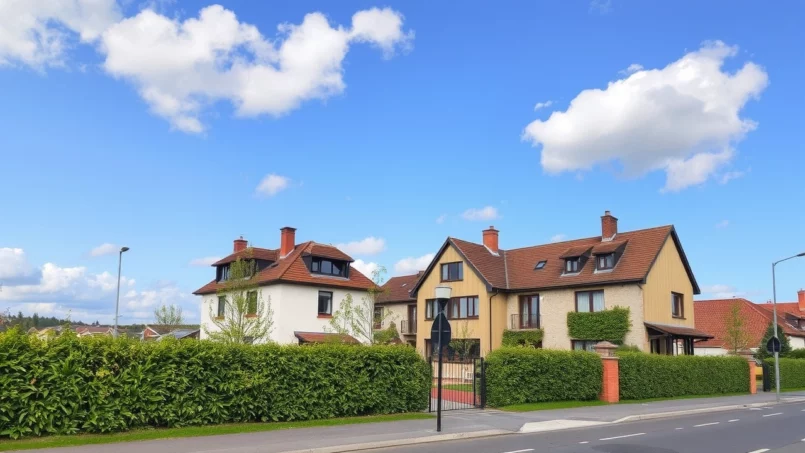
The Tourcoing market is still dominated by existing properties, notably the famous “1930s houses” typical of the North, which would constitute nearly 70% of the house stock. New-builds, more expensive per m², are concentrated in a few targeted developments (Union, Flocon, city center, Bourgogne, etc.), often eligible for Pinel.
Some benchmark prices by segment:
| Segment (Dec. 2025, averages/medians) | Approx. Price per m² | 5-Year Trend |
|---|---|---|
| House (median) | €1,670/m² | +17% |
| Apartment (median) | €2,674/m² | +51% |
| Existing (median) | €1,663/m² | +13% |
| New-build (median) | €2,901/m² | +13% |
The gap between existing and new-build is therefore clear: a difference of nearly €1,200/m² in the median. For an investor, existing properties to renovate, particularly 1930s houses, remain the ace in the hole for achieving high yields, especially if using tax levers (property deficit, Denormandie, MaPrimeRénov’, etc.).
Prices significantly lower than Lille
This is one of Tourcoing’s major assets: prices are 20 to 40% lower than in Lille, depending on sources and neighborhoods. A comparison table illustrates this well:
| City | Sale Price / m² | Rent / m² | Gross Yield |
|---|---|---|---|
| Tourcoing | €1,897 | €14 | 7.19% |
| Lille | €3,707 | €20 | 4.97% |
| Paris | €11,328 | €37 | 3.61% |
| Roubaix | €1,648 | €18 | 7.96% |
| Mulhouse | €1,577 | €13 | 7.62% |
Tourcoing therefore positions itself as an interesting compromise: more expensive than Roubaix or some industrial cities (Saint-Étienne, Mulhouse), but with a more promising metropolitan environment and potential for appreciation linked to major urban projects and the spillover of demand from Lille.
A city of renters, in a “tense zone”
To succeed in a rental investment, you need solid demand. In Tourcoing, it’s definitely there.
The city has about 44,000 to 45,700 homes, over 90% of which are primary residences. About 48 to 51% of residents are homeowners, 49 to 52% are tenants. A local expert, Thomas Gourdin, even mentions a ratio of 60% tenants to 40% owners, based on his market experience. In any case, the message is clear: renting is dominant.
Distribution and main characteristics of housing types, offering perspectives for adaptation to household needs.
Constitute the majority of the stock, representing between 52% and 59% of homes depending on the year.
Their share is steadily increasing, reaching nearly 46% of the total stock in 2022.
Homes with 5 rooms or more represent between 38% and 44% of the stock, opening prospects for shared housing or large families.
Tourcoing is classified as Zone B1 for the Pinel scheme and recognized as a tense zone. Concretely, this means:
– tension between housing supply and demand, particularly for certain segments;
– the possibility to apply Pinel for new-builds or heavy rehabilitation, with rent caps and tenant income limits;
– specific rules on reduced tenant notice periods (1 month) and the tax on vacant homes.
For an investor, this structural tension combined with low prices is a favorable cocktail for both occupancy rate and yield.
Among the most attractive rental yields in France
The yield figures make Tourcoing one of the rising stars of medium-sized cities for rental investment.
Rent levels and trends
In recent years, rents have increased faster than purchase prices, which has mechanically boosted gross yields.
The key benchmarks are as follows:
| Rental Indicator (apartments) | Value |
|---|---|
| Median rent (excluding charges) | ≈ €11–€12/m² |
| Median rent T1 (1-bed) | €14/m² |
| Median rent T2 (2-bed) | €12/m² |
| Median rent T3+ (3+ bed) | €10/m² |
| Furnished rent (average Mar. 2025) | €14/m² |
| Unfurnished rent (average Mar. 2025) | €12/m² |
| Rent increase in 1 year (T2/T3+) | +3.9% / +4.6% |
| Average rent increase over 5 years | +8–11% |
| Increase in avg. rent per m² 2022–2024 | +9.09% |
In absolute value, rents remain affordable for tenants, with average monthly costs often between €450 and €900 depending on the typology:
– around €450–€520 for a T1 depending on sources,
– between €600 and €750 for a T2,
– around €750 to €900 for a T3.
But relative to purchase prices averaging around €1,900/m², these rents generate remarkable yields.
Gross yields: 6 to 8% on average, more with targeting
Various studies converge: the average gross yield in Tourcoing is between 6.3% and 7.7%, with strong variations depending on property type, neighborhood, and strategy (unfurnished / furnished / shared housing).
Key benchmarks: These are key elements, such as dates, places, or fundamental concepts, that allow one to situate and understand a topic in its context. For example, to explain the French Revolution, one could cite as benchmarks the storming of the Bastille (1789), the Declaration of the Rights of Man and of the Citizen, or the figures of Louis XVI and Robespierre. These reference points help structure knowledge and illustrate the discussion.
| Segment / source | Approximate Avg. Gross Yield |
|---|---|
| City average (all sizes) | 8.2% (some calculations) |
| Furnished (average) | 7.19% |
| Unfurnished (average) | 6.39% |
| Furnished range | 5.69% – 8.73% |
| Marlière neighborhood (furnished) | 8.40% |
| Well-purchased 1930s houses | up to ~10% gross |
A detailed study by typology (year 2018) provides an instructive overview:
| Property Type | Average Price | Potential Gross Yield | Annual # of Sales |
|---|---|---|---|
| 4-room house | €134,526 | 7.58% | 305 |
| 2-room apartment | €90,720 | 7.35% | 120 |
| 4-room apartment | €139,985 | 7.18% | 69 |
| 3-room apartment | €118,743 | 7.09% | 133 |
| 2-room house | €122,384 | 6.86% | 23 |
| 5-room house | €143,827 | 6.57% | 254 |
| 3-room house | €117,842 | 6.21% | 153 |
| 5-room apartment | €161,392 | 5.99% | 19 |
| Studio (1-room) | €82,207 | 5.98% | 21 |
We see that 4-room houses and T2/T3 apartments perform particularly well.
Net and net-net yield: what really remains
A good investment in Tourcoing is generally defined as a project showing: attractive profitability, appreciation potential, and adequate risk management.
– at least 5% gross yield,
– at least 3.5% net (after non-recoverable charges, property tax, insurance, maintenance),
– at least 2.5% “net-net” (after taxation).
In practice, owner costs often represent 15 to 25% of rents (average property tax around €1,200, landlord insurance, maintenance and minor repairs, possible rental management fees, non-recoverable condo fees). Good tax management (LMNP for furnished, property deficit or Denormandie for existing properties to renovate) makes the difference and can add back 0.5 to 1 point of net yield.
Which neighborhoods to target for investing in Tourcoing?
The average price of a city has little meaning without a neighborhood-by-neighborhood zoom. In Tourcoing, the range goes from a 100 m² house with a garden for €120,000 in an up-and-coming area, to a very expensive studio in a unique central building.
Data indicates prices ranging from about €1,230/m² in the most affordable neighborhoods to over €2,400–€3,100/m² in the most sought-after sectors, even peaks beyond for very specific properties.
City Center: centrality, projects, and strong rental demand
The city center concentrates shops, cultural facilities (MUba Eugène Leroy, Raymond Devos theater, Saint-Christophe church, Town Hall), the Espace Saint‑Christophe shopping center, and the multimodal hub (metro, bus, tram within a few hundred meters, SNCF train station seven minutes away by bus).
Prices there are logically among the highest in the municipality:
| Type in city center | Approx. Median Price per m² |
|---|---|
| Studio | €2,709/m² |
| 1-bedroom | €2,407/m² |
| 2-bedroom | €2,077/m² |
| 3-bedroom | €1,765/m² |
| 4-bedroom | €1,618/m² |
Rental demand there is strong, especially for smaller homes (T1, T2), sought after by students and young professionals. Several high-end rehabilitation programs are emerging: old buildings transformed into modern residences with good energy performance, sometimes eligible for Pinel or property deficit. Operations like “Tourcoing center rehabilitated” in a 19th-century townhouse, or residences near Colbert metro, illustrate this upscaling.
For an investor, the center allows targeting:
– solid rental demand,
– reduced vacancy periods,
– greater resale potential, but
– with sometimes slightly tighter yields than in emerging neighborhoods.
Gambetta, Phalempins, Brun Pain, Blanc Seau: the safe family values
Around the center, several mixed residential neighborhoods (houses + apartment buildings) offer a good compromise between price, family demand, and accessibility.
Gambetta is a lively, well-connected neighborhood, particularly popular with families for its proximity to schools. Prices per square meter there generally range between €2,100 and €3,100, depending on sources and property types. This area is relevant for targeting T3 or T4 type homes, or even considering shared housing in large houses.
– Phalempins: a popular neighborhood, long penalized by a poor reputation that is fading. A local expert sees strong rental potential due to the family profile, still reasonable prices, and transport links. You can find houses and apartments at prices below the center, while maintaining decent rents.
– Brun Pain – Les Francs: a rather residential, quiet area, popular with young couples and families, with 1930s houses, green spaces, and proximity to the future Union dynamism. Prices vary between €1,800 and €2,400/m² depending on the property. It’s also a favorable ground for buy-fix-and-flip operations, with an optimal horizon of 2-3 years of holding post-renovation.
– Blanc Seau: located to the south, at the gates of highly sought-after towns like Mouvaux and Wasquehal. This “premium” vicinity drives prices upward (often over €2,100/m²) and attracts a more solvent clientele. Yields are a bit lower but the potential capital appreciation is stronger.
Flocon / Blanche Porte, Bourgogne, Union: the major urban projects
The real lever for creating value in Tourcoing lies in the neighborhoods undergoing profound transformation, where today coexist degraded old buildings and brand-new projects.
Over 150 million euros are invested in the urban renewal program for the Flocon / Blanche Porte sector.
– Bourgogne – Pont de Neuville neighborhood: a popular neighborhood of 7,000 inhabitants, massively composed of social housing (nearly 2,446 social rental units). It is the subject of a New Urban Renewal Program (NPNRU) of €274 million, with nearly 948 demolitions, 400 reconstructions (potentially 850 ultimately), nearly 809 planned rehabilitations, and 493 “residentializations.” All accompanied by new facilities (Jacques‑Chirac school group, extension of the community center, 1,000 m² commercial hall, conservatory, local parks). Prices there are currently among the lowest in the city (€1,500–€1,700/m² on average), but the quality of the built environment is improving and attractiveness should strengthen as work progresses.
– Union Eco-district (Tourcoing/Roubaix/Wattrelos): a former industrial wasteland transformed into a mixed district dedicated to innovation, digital images (Plaine Images), housing, and services. It spans about 80 hectares at the inter-municipal level. Many new programs are emerging: new-build housing, contemporary residences with high energy performance, green spaces, soft mobility routes. It is the ideal ground for a Pinel investment or a patrimonial purchase in new-build, with more moderate yields (3.5–4.5% gross on some new T2/T3s) but a deliberate bet on long-term appreciation.
Virolois, Marlière, Croix Rouge: the “mid-market” to watch
Some more discreet residential neighborhoods offer a very interesting price/demand/yield ratio.
The Virolois neighborhood is a quiet, residential sector, often described as a “village within the city.” You can still find houses of about 100 m² with a garden, with prices ranging between €110,000 and €140,000 depending on their condition. With an average price per m² around €2,000, there is still budgetary room to finance renovation work, particularly to improve energy performance and comfort, while preserving a good rental yield.
– Marlière: a neighborhood that displays the best average profitability for furnished rentals, with an 8.40% gross yield. Prices remain contained, rental demand solid, especially for well-renovated T2/T3s. It’s a preferred sector for an investor seeking performance.
– Croix Rouge, Francs – Brun Pain, Epidème: these more affordable neighborhoods, with prices around €1,700–€1,850/m², are interesting for projects with a limited budget or strategies for positive cash flow from purchase, provided a very rigorous selection process to avoid poorly maintained buildings or pockets of vacancy.
Sensitive neighborhoods: to approach with caution
Like any large popular city, Tourcoing also has more delicate sectors. Local professionals notably cite Pont‑Rompu and Bourgogne as areas to approach cautiously for a private investor, due to heavier social issues, tenant turnover, and sometimes increased risks of non-payment or damage.
This doesn’t mean they should be systematically excluded—some specialized investors find very high yields there—but these neighborhoods require sharp local expertise, very rigorous management, and good knowledge of ongoing renewal programs.
Flagship products: 1930s houses, small apartments, and targeted new-build programs
The Tourcoing market is vast enough to offer almost all property types, from a city-center townhouse to a small worker’s house. Three main families certainly stand out for an investor.
1. 1930s houses: the “core target” with strong renovation leverage
This is the signature product of Tourcoing and the entire Lille metropolis. These brick, terraced houses, often narrow but deep, on 2 or 3 levels, represent about 70% of the house stock in some areas. An expert like Thomas Gourdin, co-founder of the “ma1930” agency based in the Union area, has made it his specialty.
Their interest for an investor is threefold:
Acquisition can start between €60,000 and €150,000 depending on condition. Renovation work to bring up to standards is significant, with a typical budget of €600 to €1,200/m². Several tax optimization schemes and renovation aid programs are accessible, like the property deficit, MaPrimeRénov’, the eco-zero-interest loan, and local grants, often allowing for a strong reduction in the tax burden.
The flip side: these houses are old. They concentrate the classic risks of existing properties:
– frequent presence of asbestos and lead, especially pre-1975, with asbestos removal potentially costing €8,000 to €15,000 for 100 m²;
– risks of unstable foundations in some clayey sectors (Pont-de-Neuville, Bourgogne), requiring a serious structural diagnosis;
– sometimes catastrophic energy performance (F or G labels), in a context where energy-inefficient homes are gradually being banned from rental.
2. Small apartments (T1/T2/T3): the bedrock of rental demand
With a very young population, many modest households, and significant student presence, T1, T2, and small T3 apartments constitute the heart of rental demand.
Rents per m² are higher than for larger surfaces (market logic), especially for furnished units:
– T1: about €14/m² median, with monthly rents around €450–€600;
– T2: around €12/m², i.e., €600–€750 for 45–60 m²;
– T3: around €10/m², i.e., €700–€900 for 70–80 m².
On the purchase price side, a well-located existing T2 can still be bought for around €90,000–€120,000 depending on size and neighborhood, with gross yields often exceeding 7%. In new-builds, prices are higher (€135,000–€180,000 for some T2/T3s), and gross yields are more around 3.5–4.5%, but with a Pinel positioning and almost zero construction risk.
The most dynamic investors combine several levers:
Several methods allow for significantly increasing rents. The LMNP (Non-Professional Furnished Landlord) regime allows increasing the rent by 15 to 25% while benefiting from property depreciation. Shared housing in T3 or T4 type properties can boost the total rent by 20 to 40% compared to a classic rental. Finally, targeted renovation of key rooms like the kitchen or bathroom increases the perceived value of the home and can justify a rent increase of 10 to 15%.
3. New-build programs and high-end rehabilitations: patrimonial bet and taxation
Tourcoing is seeing a multiplication of new-build programs and high-end rehabilitations, particularly in the city center, at Flocon, and in the Union:
– contemporary residences a few minutes from the metro;
– old 19th-century townhouses transformed into high-end small condos;
– large mixed-use operations around the train station (the “La Gare” project, rehabilitation of the former Sernam hall with a hotel, Vertbaudet offices, shops…).
These products are generally: everyday consumer goods, luxury goods, technology, food, clothing.
– eligible for Pinel (Zone B1), with a tax reduction over 6, 9, or 12 years in exchange for a capped rent;
– well classified energetically (Energy Rating A–C), securing the investment against future regulations;
– more expensive per m² than existing properties (€2,900–€3,600/m²), with gross yields often between 3.5 and 4.5%.
They appeal more to a patrimonial investor, looking to combine security, low technical management, and tax optimization rather than immediately very positive cash flow.
Taxation and aid: a rich playground for the investor
Investing in Tourcoing also means knowing how to use tax schemes, all the more useful in a city where most of the stock is old.
The main levers are:
– Pinel (Zone B1): for the purchase of new or rehabilitated homes with a high level of energy performance. The investor commits to renting for 6, 9, or 12 years at capped rents to households meeting income conditions, in exchange for a tax reduction proportional to the cost price.
This tax scheme applies to investment in existing properties to renovate, only in eligible geographic sectors. It requires that works represent at least 25% of the total operation cost and aims for an improvement in the home’s energy performance. The tax reduction mechanism is similar to that of the Pinel scheme.
– Property deficit: in the case of an unfurnished rental, non-depreciable works can generate a deficit deductible from overall income (within certain limits), cushioning the tax impact over several years.
The LMNP (Non-Professional Furnished Landlord) regime is particularly suited to small furnished homes (T1, T2). By opting for the real regime, it’s possible to depreciate the real estate property (excluding land) and the furniture. This depreciation can considerably reduce the taxable base over many years. In cities where gross yields often exceed 6-7%, this tax lever effectively transforms gross yield into a net yield truly perceived.
– MaPrimeRénov’, eco-zero-interest loan, MEL and ANAH grants: these tools allow financing a significant part of energy renovation work (insulation, heating, windows). In Tourcoing, in the historic center or some targeted neighborhoods, ANAH grants can go up to €25,000 for an owner-occupier, and MEL grants (Home Improvement Grant) complete the scheme.
All in a local tax context to watch: property tax in Tourcoing is high compared to the regional average, with a municipal rate historically above the average for cities of comparable size. The average amount of around €1,200 per year must be factored into projections.
Risks and points of caution
Tourcoing’s potential should not hide the risks, classic in real estate but accentuated in popular cities.
Among the main points of caution:
– The neighborhood risk: the highest profitability is often found in the most difficult neighborhoods. A very good yield on paper can be wiped out by incessant turnover, non-payments, repeated damage, or chronic vacancy. A thorough visit to the neighborhood, day and night, and the opinion of a local professional are essential.
– The quality of the building: in a predominantly old stock, building pathologies (dampness, roof structure, obsolete systems) are frequent. Risks related to clay soil in some northern sectors of the city (unstable foundations) make a structural diagnosis mandatory.
Homes classified F or G are gradually being banned from rental. In an old real estate stock, it is crucial to anticipate the cost of energy renovation work (€20,000 to €40,000) in the business plan to avoid owning an unrentable property.
– Liquidity upon resale: an expert like Thomas Gourdin reminds us: a property in Tourcoing is generally more profitable than in Lille, but often sells more slowly. In a slow market period, sales times can lengthen beyond 3 months, sometimes with significant negotiations.
– Real costs: neglecting the high property tax, management costs, recurring work (roof, boiler, common areas of buildings) leads to overestimating profitability. Projections must realistically include 15 to 25% costs on rents.
Why Tourcoing still has medium-term potential
Despite the strong price increases of recent years, many analysts and practitioners consider that Tourcoing has not yet exhausted its potential. Several reasons argue for continued revaluation by 2030:
– Spillover of demand from Lille: with prices in Lille flirting with €3,700/m², households and investors are increasingly turning to well-connected peripheral cities like Tourcoing, Roubaix, Wattrelos. This movement is already visible and could intensify.
– Massification of urban projects: NPNRU of Bourgogne, transformation of Flocon/Blanche Porte, rise of the Union, redevelopment of the station area… These projects are profoundly changing the city’s image and urban reality.
Tourcoing already has a very complete transport network for a city its size, including metro line 2, a tramway, a dense bus network, an SNCF station with TGV and connections to Belgium, and the V’Lille bike-sharing service. Its attractiveness is further reinforced by the arrival of new tramway links, notably to Hem and enhanced connections with Lille and Roubaix.
– Metropolitan economic dynamism: membership in the MEL, proximity to hubs like Euratechnologies, Plaine Images, Euralliance, presence of major employers (OVHcloud, Vertbaudet, Booking.com…) and a growing fabric of SMEs: all drivers that pull housing demand.
Some experts’ projections mention potential price increases of 20 to 30% by 2030 in the most promising sectors, subject to the national economic climate.
How to structure an investment strategy in Tourcoing?
For an investor, the question is not only “should one invest in Tourcoing?” but “how to invest there intelligently?”. Some structuring approaches clearly emerge from the field analysis.
– For a modest first investment, targeting an existing T2 to renovate in an intermediate neighborhood (Phalempins, Marlière, Virolois), as a furnished rental with LMNP, often allows combining gross yield >7%, good depth of demand, and a controlled overall budget (€100,000–€150,000 including works).
– For a more ambitious project focused on cash flow, a 1930s house of 90–110 m² to convert into shared housing (3–4 bedrooms) in a popular but decent neighborhood (Brun Pain, some Croix Rouge sectors) can generate significantly higher rents than a “classic” rental, provided a substantial renovation budget and more active management are anticipated.
For a highly taxed investor, acquiring a new or rehabilitated apartment in the city center or the Union, under the Pinel or Denormandie schemes, secures the property quality and strongly reduces taxation for several years, in return for a more moderate gross yield.
– For an opportunistic profile with a 5–10 year horizon, betting on neighborhoods in profound transformation (Bourgogne, Flocon/Blanche Porte, surroundings of the Union) with old houses or buildings to rehabilitate offers interesting capital gain potential, provided technical and social risks are well mastered.
In all cases, the key element remains in-depth knowledge of the area: on the scale of a single street, sale prices can vary from simple to double, and the quality of rental demand can change radically from one block to another.
Conclusion: Tourcoing, a city to decode more than an “automatic good deal”
Investing in real estate in Tourcoing is no longer playing the card of the ultra-cheap city you can buy without much thought. Price levels have increased strongly, gaps between neighborhoods have widened, regulations (energy, rental) have tightened.
On the other hand, the city still offers a yield / appreciation potential combination rarely matched in a metropolis of this size:
Discover the main assets that make this opportunity a strategic choice for investors.
Prices 30 to 40% lower than Lille, offering an attractive entry point to the market.
Gross yields frequently exceeding 7%, promising interesting profitability.
Demand supported by a young and predominantly tenant population, ensuring low vacancy.
Major urban projects already funded and underway, guaranteeing asset appreciation.
A very rich arsenal of tax schemes and grants for those who know how to use them, optimizing your investment.
The difference, now, will be made on the investor’s ability to choose their battles: good neighborhood, good product, good renovation, good tax strategy. Under this condition, Tourcoing can become much more than a simple “low-cost” market: a veritable laboratory for high-performance rental investment in a major French urban area.
Disclaimer: The information provided on this website is for informational purposes only and does not constitute financial, legal, or professional advice. We encourage you to consult qualified experts before making any investment, real estate, or expatriation decisions. Although we strive to maintain up-to-date and accurate information, we do not guarantee the completeness, accuracy, or timeliness of the proposed content. As investment and expatriation involve risks, we disclaim any liability for potential losses or damages arising from the use of this site. Your use of this site confirms your acceptance of these terms and your understanding of the associated risks.

Cyril Jarnias is an independent expert in international wealth management with over 20 years of experience. As an expatriate himself, he is dedicated to helping individuals and business leaders build, protect, and pass on their wealth with complete peace of mind.
On his website, cyriljarnias.com, he shares his expertise on international real estate, offshore company formation, and expatriation.
Thanks to his expertise, he offers sound advice to optimize his clients' wealth management. Cyril Jarnias is also recognized for his appearances in many prestigious media outlets such as BFM Business, les Français de l’étranger, Le Figaro, Les Echos, and Mieux vivre votre argent, where he shares his knowledge and know-how in wealth management.





