
 Published on and written by Cyril Jarnias
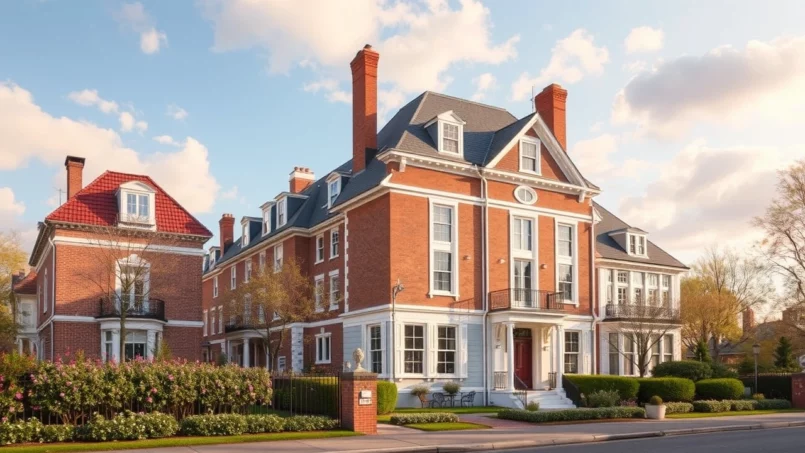
Investing in Greenwich Real Estate means entering one of the most sought-after markets in the United States. Located in Fairfield County, Connecticut, about an hour by train from New York City, this town checks all the boxes of a high-end stronghold: household wealth, renowned schools, well-maintained natural surroundings, low crime, historic heritage, and a real estate market that is both tight and remarkably resilient.
Behind its prestigious image, Greenwich represents a complex investment ecosystem. A French-speaking investor must understand the specific tax and legal issues, the scarcity of real estate supply, and implement sophisticated investment strategies beyond simply buying a property.
Greenwich, Connecticut: A Luxury Market Connected to New York
Greenwich is often described as a benchmark for “luxury living” in the United States. The town combines a vibrant downtown, coastal neighborhoods along the Long Island Sound, a very green hinterland, and a network of public and private schools that attract wealthy families.
Greenwich is located about an hour by train from New York City. This proximity makes it a prime residential choice for many senior executives, financiers, entrepreneurs, and investment fund managers who live there while working in Manhattan, giving it the status of a “high-end satellite” of the metropolis.
This connection, combined with an environment perceived as safer, more residential, and more tax-friendly than some neighboring counties, fuels constant demand, even during periods of economic turbulence.
A Structurally Tight Market: Low Supply, High Demand
To measure the scarcity of supply in Greenwich, simply look at the evolution of single-family home inventory over a few years. Between 2019 and early 2025, the number of homes for sale literally melted away. It went from 454 listings in January 2019 to just 86 at the beginning of 2025, a drop of 81%. In an already expensive market, this drying up of supply intensifies pressure on prices.
In the first half of 2025, despite a slight seasonal uptick, single-family home inventory did not exceed 133 listings, still down 16% from 2024 and far from pre-Covid levels. For investors, this means two things: competition is fierce on the buy side, but the likelihood of a quick resale, if the property is properly positioned, is high.
Only one home was listed under $800,000 in Riverdale in mid-2025.
Sharp Price Increases Since 2019
In terms of prices, Greenwich has taken off. Since 2019, the median sales price for single-family homes has increased by about 75% and the price per square foot by about 62%. In 2024, the median price of a single-family home stood at $2.87 million, up from $2.5 million the previous year. The average price even reached a record high of about $3.57 million.
The median property price jumped to $3.25 million in the first half of 2025, a 19% increase compared to the same period in 2024.
Apartments and condominiums follow the same trend, albeit with a more “modest” entry point: in 2024, the average price of condos and co-ops was about $1.32 million, with a median price of $1 million. For a rental investor looking to enter the market with a budget lower than a single-family home, this segment remains a logical entry point, even if yields are relatively compressed.
Key Figures at a Glance
The table below provides a snapshot of recent residential price trends in Greenwich (single-family homes):
| Indicator | 2019 | 2023 | 2024 | H1 2025 |
|---|---|---|---|---|
| Median price single-family home | – | $2.50M | $2.87M | $3.25M |
| Average price single-family home | – | – | $3.57M | – |
| Price per square foot (home) | – | $705 | $762 | ≈ $825 (all sales) |
| Median change vs prior year | – | – | +14.7% | +19% |
| Median increase vs 2019 | – | – | +75% | > +75% |
These orders of magnitude show a market overheating since Covid, supported by a combination of historically low interest rates (until recently), a desire for more space, and the strong performance of financial markets.
Who Buys in Greenwich, and Why?
Greenwich is not an average suburb. The socio-economic profile of its residents is well above U.S. standards. Per capita income exceeds $130,000, translating to over $520,000 per year for a family of four. Nearly three-quarters of adults hold at least a four-year college degree, and the town has a high concentration of professionals in finance, tech, law, media, and the arts.
This profile directly translates into how transactions unfold:
Approximately 62.5% of transactions are cash-based, limiting sensitivity to interest rates. Demand is driven by highly capitalized buyers, including affluent first-time homebuyers, and comes from both the region and major U.S. metros like Los Angeles, Honolulu, and San Diego. Greenwich sellers primarily relocate to Miami, Boston, and Philadelphia.
This influx of capital is explained by several motivations: seeking stability amid stock market volatility, a desire to secure a tangible asset in a perceived safe environment, perceived advantages in local taxation, and the prestige of an address that has become a symbol of success.
Neighborhoods and Micro-Markets: Where to Invest in Greenwich?
The town has thirteen neighborhoods with very distinct characteristics. For an investor, the key is to align their budget, risk tolerance, and strategy (quick resale, rental, second home) with the right sector.
Old Greenwich, Riverside, Cos Cob: The Coveted Residential Belt
Old Greenwich and Riverside represent the most sought-after coastal facade of the town. Old Greenwich offers a true village lifestyle, with a vibrant center, proximity to Tod’s Point beach, and a beach-town atmosphere. Properties are expensive, but history shows they hold their value very well. Riverside, also waterfront, combines excellent schools, a family-friendly atmosphere, and quick access to Riverside and Cos Cob train stations.
Cos Cob, located slightly inland, is often cited as one of the most “affordable” entry points within the town, with a mix of single-family homes and small apartment buildings. The area is seeing growing local commercial offerings, which boosts its attractiveness for both renters and owner-occupants.
Downtown Greenwich: Urban Core, Condos, and Mixed-Use
The center of Greenwich, around Greenwich Avenue, is the commercial and cultural heart of the town. It features high-end boutiques, restaurants, galleries, and a highly sought-after stock of condominiums and townhouses. The area is walkable, well-served by the Metro-North train, and particularly interesting for investments in apartments to rent to executives or young families.
Downtown concentrates many offices and businesses. Residentially, it combines rare urban density with high standards, resulting in high rents but sustained demand. For an investor, this is typically the sector where a condo or a mixed-use building (with retail on the ground floor and residential above) can generate steady rental income.
Backcountry, Belle Haven, Mid Country: The Ultra-High End
The backcountry (Backcountry Greenwich) is distinguished by vast estates, often on more than five acres, in a wooded and extremely private setting. This segment primarily attracts ultra-wealthy clients seeking discretion, space, and custom development opportunities (extensions, sports facilities, etc.). It is a market for long-term capital appreciation rather than immediate rental yield.
Neighborhoods like Mid Country West, near the prestigious Round Hill Club, concentrate customized properties with particularly high prices, an average value around $5 million, and listings ranging from $2.7 million to over $34 million. Belle Haven, waterfront, is also renowned for its large, often gated estates offering breathtaking views of the Long Island Sound.
Neighborhoods in Transition: Glenville, Pemberwick
Traditionally more working-class, Glenville and Pemberwick are now undergoing redevelopment, with zoning favorable to multi-family and redevelopment opportunities. Entry prices are lower than on the coast or in Mid Country. For an experienced investor, these are natural playgrounds for strategies like “Buy, Rehab, Rent, Refinance, Repeat” (BRRRR) or small-scale development.
Quick Overview of Price Gaps by Neighborhood
Detailed market data reveals enormous gaps between neighborhoods:
| Neighborhood / Area | Price Level (order of magnitude) |
|---|---|
| Mid Country East | Median ≈ $9.1M (most expensive segment) |
| Mid Country West | Average value ≈ $5M; listings $2.7M to $34.6M |
| Downtown Greenwich | Median ≈ $3.85M |
| Anderson Ridge | Median ≈ $622,500 (most affordable area) |
| North Stamford (nearby) | Median ≈ $1.275M (neighboring town for comparison) |
| South Norwalk (nearby) | Median ≈ $677,000 (more accessible neighboring town) |
These figures show just how much Greenwich functions as a mosaic of micro-markets. Investing in a downtown condo, in terms of risk, return, and liquidity, has nothing in common with buying a 15-acre estate in Backcountry.
Selling Fast and at a Premium: A Seller’s Market
In terms of selling times, Greenwich boasts figures that would make many European markets envious. In 2024, the median days on market for single-family homes fell to 22 days, down from 37 in 2023 and… 149 days in 2019. This dramatic compression reflects the imbalance between sustained demand and very limited supply.
In June 2025, 71% of real estate sales closed at or above the asking price.
Spectacular Bidding Wars
Cases of massive overbidding are no longer anecdotal. In 2024, 90 home sales (out of 501) closed at more than 10% above the asking price. Several emblematic sales illustrate the scale of the phenomenon:
| Address (example) | Asking Price (approx.) | Sale Price | Premium over Ask |
|---|---|---|---|
| 34 Francis Lane | $769,000 | $975,000 | +27% |
| Waterfront home in Old Greenwich | – | – | +59% |
| 37 Rockwood Lane | – | – | +38% |
| 403 Stanwich | – | – | +54% |
In the segment of homes under $1 million, the median sale-to-list price ratio is 102%, with a median time of 36 days. For transactions without a financing contingency, the time to a firm contract drops to 16 days. This is a market where an investor must be financially and administratively ready to act quickly and decisively.
How a Transaction is Structured in Greenwich
Beyond the numbers, Greenwich has its own rules of the game when it comes to transactions, which differ significantly from what is known in France or even New York City.
Mandatory Buyer Representation
In Connecticut, and therefore in Greenwich, the law requires buyers to be represented by a real estate agent through a written Buyer Agency or Buyer Broker Agreement. Since a law effective June 1, 1997, an agent can only represent both buyer and seller under a regime of dual or designated agency that is clearly disclosed and accepted.
A foreign investor must sign a representation agreement with a local agent before viewing properties. The compensation for this buyer’s agent is typically paid by the seller through the overall commission, limiting the direct cost to the buyer, although this model is currently the subject of intense debate in the United States.
Central Role of Attorneys
Another important specificity: sales contracts are drafted by attorneys, not real estate agents. The practice of a binder (good faith deposit) is generally not used in Greenwich. Negotiation initially proceeds orally until agreement on the main terms (price, timeline, contingencies). The buyer then submits a non-binding written offer, without a check, which serves as the basis for the seller’s attorney to draft the final contract.
The contract typically provides for a 10% deposit paid by the buyer at signing. It includes contingencies for inspections (building, radon, termites, etc.) and financing. The time to remove the loan contingency is generally three to four weeks, but local banks can sometimes issue an approval in about ten days, or even a week in some cases.
The closing of the sale typically takes place at the seller’s attorney’s office. At this stage, the buyer pays the remaining 90% of the price, and the buyer’s attorney proceeds to record the deed of sale and mortgage with the land records of the relevant municipality.
Ancillary Costs for the Buyer
Beyond the property price, an investor must budget for a set of ancillary expenses. In Greenwich, these include, for reference:
| Cost Item (Buyer) | Order of Magnitude / Range |
|---|---|
| Attorney fees | ≈ $2,500 and up |
| Title insurance | ≈ $275 per $100,000 of value |
| Title search | $200 to $600 |
| Recording fees (deed, mortgage) | $53 first page, $5 per additional page |
| General inspection (structure, radon, termites…) | ≈ $900 and up |
| Oil tank inspection | ≈ $400 |
| Septic tank inspection | $400–$500 |
| Asbestos inspection | ≈ $350 |
| Pool inspection | ≈ $300 |
| Bank fees (processing, origination…) | $500–$800 + appraisal ($500–$600) + misc. |
In the context of a multi-million dollar transaction, these amounts remain marginal, but they must be integrated into the overall financial structure, especially for an investor using leverage.
Costs and Taxes for the Seller
The seller also bears significant costs: attorney fees (again around $2,500 or more), recording fees ($20 for the deed of transfer), but most notably conveyance taxes:
– To the Town of Greenwich: $2.50 for each $1,000 of the sale price.
– To the State of Connecticut: 0.75% up to $800,000, then 1.25% on the amount above.
Real estate commissions run around 5% of the price, but they are, legally, negotiable. Given the price levels, this cost line is obviously one of the heaviest on the seller’s side.
Local Taxation: How Does Property Tax Work in Greenwich?
Property tax is at the heart of net profitability for an investment. In Connecticut, the assessed value of a property is set at 70% of its market value. The calculation formula is fairly simple:
Annual property tax = (assessed value / 1,000) × mill rate
The assessed value therefore corresponds to 70% of the estimated market value. The mill rate is voted on each year by the town’s Board of Estimate and Taxation (BET).
For the 2025‑26 fiscal year, the Greenwich mill rate is 12.041, an increase of about 2.8% compared to the previous year. There are also additional mill rates for sewer maintenance and improvement funds (0.278 and 0.040). The town’s adopted budget for 2025‑26 is approximately $516 million, primarily funded by this property tax, supplemented by non-tax revenues (grants, fees, investment income).
In practice:
The median annual property tax bill in Greenwich, for a home with a median value close to $1 million, falls between $11,000 and $12,000.
2025 General Revaluation: A Point to Watch
Connecticut law requires a revaluation of all real property every five years. In Greenwich, the next revaluation applies to the tax list as of October 1, 2025 (Grand List 2025). It is carried out by the firm J.F. Ryan & Associates and must reflect 70% of market value as of October 1, 2025.
Preliminary assessment notices were sent to property owners in November 2025. These new values will serve as the basis for tax bills in July 2026 (fiscal year 2026‑2027). The municipality insists: the revaluation aims to rebalance values among property owners, not to mechanically increase overall revenue. The mill rate will be adjusted to cover the budget, based on the growth of the Grand List (the town’s total taxable value).
For an investor, it is crucial to understand that:
– Neighborhoods with very high demand – Old Greenwich, Riverside, Cos Cob, walkable downtown – are likely to see their assessed value increase more than average.
– A property’s property tax bill will therefore depend on the relative change in its assessment compared to the overall growth of the Grand List.
Property owners can request an informal hearing with the firm conducting the revaluation and then, if necessary, file a formal appeal with the Board of Assessment Appeals (BAA). As a last resort, an appeal can be made to the Superior Court in Stamford.
Senior Relief and Assistance Programs
For residents 65 years and older who meet certain income conditions, the State of Connecticut offers a property tax credit (“Circuit Breaker”). The Town of Greenwich adds local reduction programs. Applications are generally filed between February 1 and May 15. These programs are more relevant for year-round residents than for a non-resident investor, but they influence the dynamics of seniors staying in their homes and thus the supply.
Investment Strategies Suited to Greenwich
Given the entry price and market characteristics, not all strategies are equal in Greenwich. Here are a few, with their strengths and limitations.
Long-Term Buy and Hold
This is the most natural strategy in such an expensive market, driven by solid fundamentals and a history of rapid appreciation since 2019. The investor buys a quality property in a good area, holds it for a long horizon (10 years or more) betting on:
– the continued appeal of Greenwich for very high earners,
– the structural scarcity of land in the most desirable areas,
– the town’s ability to weather economic cycles.
Gross rental yield is generally moderate, especially for very high-end homes, but capital appreciation can more than compensate. Greenwich is often perceived as a hedge against inflation and financial shocks, particularly for investors shifting from stock or bond assets to real estate.
BRRRR and Value-Add Strategies
In the more affordable segments (Glenville, Pemberwick, parts of Cos Cob, or downtown condos), there are still opportunities for “value-add”: buying a property below its potential value, renovating it, optimizing it (subdivision, basement finishing, energy upgrades), renting it at a higher level, then refinancing.
This real estate investment approach requires in-depth knowledge of local regulations (zoning, density, parking, etc.), flawless execution of work, and precise analysis of rental demand. Although riskier in high-entry markets where mistakes are costly, it offers the potential for higher returns than traditional wealth-building placements.
Pure Rental Investment
The Greenwich rental market is fueled by:
– families in transition (awaiting a purchase or on assignment),
– executives working in New York but not yet ready to buy,
– students and professors drawn by the town’s educational reputation.
The rental supply is limited and gross yields are often lower than in cheaper cities. Significant operating expenses must also be anticipated: taxes, insurance, maintenance of high-end properties, and property management fees.
This strategy can nevertheless suit investors seeking modest but stable cash flow while building long-term capital gains.
Diversification Through Collective Structures
For those who want exposure to the Greenwich market without buying a property directly, several formats exist in the U.S.:
– participation in syndications, where a local sponsor raises capital to acquire and manage a portfolio of assets,
– investments in private real estate funds targeting the East Coast,
– indirect exposure through REITs (Real Estate Investment Trusts) specialized in high-end residential or office markets in the Northeast.
These vehicles allow for risk pooling, access to larger operations (entire buildings, developments), and delegation of management to professionals. In return, the investor gives up direct control of the asset and must carefully analyze the quality of the manager.
Managing Risk: Insurance, Construction Costs, and Economic Climate
Investing in Greenwich also means factoring in several categories of risk.
Insurance and Physical Risks
The coastal nature of some neighborhoods (Old Greenwich, Riverside, Belle Haven, etc.) exposes properties to climate risks: storms, sea-level rise, flooding. Standard insurance policies do not always cover flood damage, hence the importance of taking out specific insurance when the property is located in a risk zone.
Local insurers who know the Greenwich market, its building codes, and its most exposed areas are valuable partners. Appropriate coverage typically includes:
– property damage,
– business interruption (for a rental or commercial asset),
– liability,
– possibly dedicated flood or hurricane coverage.
Insurance costs should be evaluated during the due diligence phase, as they can represent a significant portion of the operating budget.
Construction Costs and Supply Constraints
Construction costs are projected to rise by 8 to 10% by the end of the year, while the United States faces an estimated shortfall of six million homes. These two factors limit the ability to quickly create new supply, especially in a town where land is scarce and expensive.
For an investor considering a development project or major renovation, the likely increase in material and labor costs must be factored in. The rise in costs also tends to protect the value of existing well-located and well-built properties, reinforcing the logic of a buy-and-hold investment.
Macroeconomic and Tax Environment
Financial market performance has a direct influence on the Greenwich market, where a significant portion of the clientele derives their wealth from finance. Sharp stock market corrections could, in the short term, slow down the ultra-high-end sector.
Federal law has made the 2017 tax cuts permanent, increased the SALT deduction from $10,000 to $40,000 (with a phase-out starting at $500,000 in income), and raised the estate tax exemption to $30 million for a couple. These provisions primarily benefit high-income taxpayers, with a moderate impact on the local real estate market.
The Importance of Data and Solid Local Contacts
One of the constants emerging from the study of the Greenwich market is the very high heterogeneity of situations depending on the segment, neighborhood, and property size. To navigate this landscape, the investor is well advised to rely on:
For an accurate and secure evaluation of an investment in New York, it is essential to rely on the following:
Analysis of granular data: local MLS, reports from specialized agencies, price per square foot indicators, and recent sales histories.
Collaboration with experienced professionals: real estate agents, attorneys, tax specialists, insurers, and wealth managers.
Precise understanding of local rules: zoning, density, property tax calculation, quinquennial revaluation, and prevailing negotiation practices.
The Greenwich Association of Realtors (GAR), which brings together more than 800 agents, plays a role in structuring the market and promotes a strict code of ethics, aligned with that of the National Association of Realtors. It is an institutional contact worth knowing for any foreign investor.
Conclusion: A Demanding Market, but Coherent for the Long Term
Investing in Greenwich real estate is neither about seeking “easy” rental yield nor speculating on a quick turnaround. It means accepting a very high entry price, significant operating costs, and intense competition — but in exchange for fundamentals rarely found in one place: the wealth and stability of the population, top-tier schools, safety, a strategic geographic location near New York, quality infrastructure, and structural scarcity of land in the best areas.
For an international investor, Greenwich can serve as a cornerstone in a geographic diversification strategy. This approach is particularly suited for a long-term holding horizon, with the primary objective of capital preservation and appreciation, rather than seeking maximum short-term cash flow.
Provided one properly decodes the micro-markets, surrounds oneself with solid local contacts, and masters the specific tax and legal mechanics of Connecticut, Greenwich offers a rare investment ground: a deep, liquid luxury market driven by global demand and supported by an urban environment that, to this day, continues to attract fortunes seeking security and quality of life.
Disclaimer: The information provided on this website is for informational purposes only and does not constitute financial, legal, or professional advice. We encourage you to consult qualified experts before making any investment, real estate, or expatriation decisions. Although we strive to maintain up-to-date and accurate information, we do not guarantee the completeness, accuracy, or timeliness of the proposed content. As investment and expatriation involve risks, we disclaim any liability for potential losses or damages arising from the use of this site. Your use of this site confirms your acceptance of these terms and your understanding of the associated risks.

Cyril Jarnias is an independent expert in international wealth management with over 20 years of experience. As an expatriate himself, he is dedicated to helping individuals and business leaders build, protect, and pass on their wealth with complete peace of mind.
On his website, cyriljarnias.com, he shares his expertise on international real estate, offshore company formation, and expatriation.
Thanks to his expertise, he offers sound advice to optimize his clients' wealth management. Cyril Jarnias is also recognized for his appearances in many prestigious media outlets such as BFM Business, les Français de l’étranger, Le Figaro, Les Echos, and Mieux vivre votre argent, where he shares his knowledge and know-how in wealth management.





