
 Published on and written by Cyril Jarnias
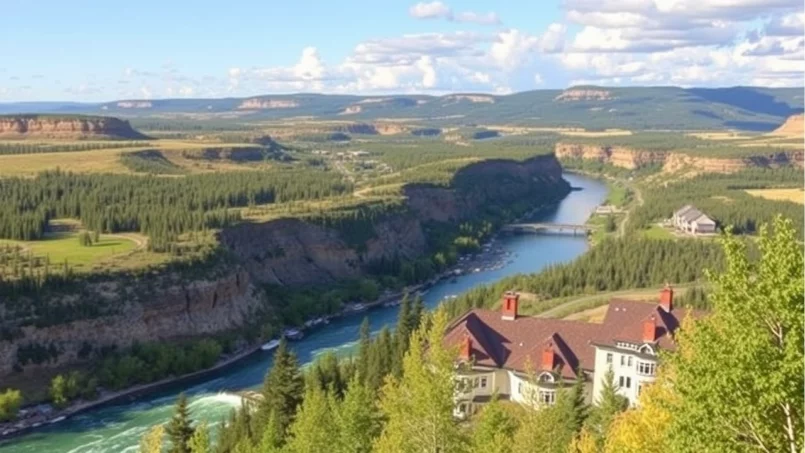
Nestled between Glacier and Yellowstone, on the banks of the Missouri, the city of Great Falls combines spectacular landscapes, a strategic military base, top-tier hospitals, and universities. On paper, it reads like a tourist postcard. For a real estate investor, it’s above all a cocktail of sustainable economic drivers, rising rents, and still-reasonable prices by U.S. standards.
This guide explores the Great Falls real estate market, detailing investment opportunities in traditional and short-term rentals, as well as in residential and commercial sectors. It also provides an analysis of potential returns and associated risks.
Great Falls, Montana: A Highly Promising Local Context for Investors
Great Falls is not a megacity. It’s Montana’s third-largest city, with about 60,000 to 63,000 residents within the city limits and over 80,000 in the metropolitan area (MSA). Yet its role far exceeds its size: a regional economic hub, medical center, military gateway, and entry point to some of the nation’s greatest natural attractions.
The city’s economy rests on a diversified foundation including healthcare, education, agriculture, and tourism. It also benefits from a significant military presence through Malmstrom Air Force Base and the Montana Air National Guard. Institutions like Benefis Health System, the University of Providence, and Great Falls College MSU make it a regional hub for care and education, generating strong demand for renters.
The socio-economic profile is fairly solid: about 27% of adults hold at least a bachelor’s degree, per capita income hovers around $30,765, median family income exceeds $123,000, and the average commute time remains very short at just over 16 minutes. Quality of life is enhanced by a cost of living roughly 4% below the national average, a network of trails along the Missouri (River’s Edge Trail), and a vibrant downtown with museums, iconic bars, and a small cultural scene.
From an investor’s perspective, this translates into rental demand driven by several stable segments: military personnel, healthcare workers, students, retirees, and remote workers attracted by the setting and prices.
A Residential Market Still Affordable but Rising
Compared to other Montana cities like Bozeman, Missoula, or Kalispell, Great Falls remains a lower-cost buying opportunity. Recent figures confirm a growth trajectory, without speculative frenzy.
Prices, Values, and Recent Dynamics
2024–2025 data show a market on the rise, but still far from the excesses of coastal markets or Montana’s “star” destinations.
Here is a summary of key price indicators:
| Indicator (Residential Homes) | Approximate Value |
|---|---|
| Median list price (August 2025) | $379,900 |
| Median sale price (August 2025) | $336,300 |
| Median sale price (November 2025) | $359,900–$360,000 |
| Average home value (October 2025) | $327,711 |
| Median “city” price from another source | $352,250 |
| Median price per sq ft (August 2025, approx. $186–$192/sqft) | ~$1,990–$2,060/m²* |
| Historical median value (2017) | $181,300 |
*Indicative conversion to euros/m² for reference only, based on current exchange rate.
The median home price in Great Falls remains nearly 38% below the national median.
Transaction Volume and Sales Pace
Market dynamics can be read through volumes and days on market. In 2025:
– Approximately 331 to 362 homes are listed for sale depending on the month,
– Monthly sales run around 70 to 74 transactions,
– Inventory represents about 3.7 months of supply, indicating a market slightly favoring sellers but moving toward balance,
– Average days on market range from about 44 to 54 days, after a low of around 30 days in 2021.
These figures show a market that remains solid, with genuine demand, but more room for negotiation than during the post-Covid overheating period.
Real Estate Expert
Affordability: A Market Cheaper Than the Rest of Montana
From a macro perspective, Great Falls remains cheaper than the rest of the state: the median home value across Montana is around $317,000, and some markets (Kalispell, Bozeman, Missoula) have crossed the $500,000–$700,000 mark. Great Falls thus positions itself as a “discount” entry point into a highly sought-after state.
This relative moderation is explained by slower population growth than in “trendy” markets, but also by a more functional positioning: a garrison town, medical and educational hub, rather than an ultra-tourist destination or startup cluster.
Rents, Rental Yield, and Demand: A Tight but Profitable Market
For an investor, rents and vacancy are at least as important as acquisition prices. On both fronts, Great Falls shows favorable signals.
Rent Levels and Recent Trends
Rents are rising noticeably, driven by strong demand and a still-limited housing stock. Aggregated data paint a fairly precise picture:
| Residential Rental Indicator | Approximate Value |
|---|---|
| Average rent (all types, 2025) | $1,500 / month |
| Median rent (other source) | $1,460 / month |
| Average rent (Mashvisor dataset, approx.) | $1,815 / month |
| Average 1-bedroom rent (local source) | ~$1,080–$1,081 / month |
| Average 2-bedroom rent | ~$1,549 / month |
| Recent annual change (1-bedroom) | +3% to +4.5% |
| Annual change (2-bedroom) | +8.7% |
| Average rent 2024–early 2025 (monthly series) | $1,295 to $1,500 depending on month |
| Institutional apartment vacancy (2021) | 1.9% |
Monthly series show average rent rising, with some seasonal fluctuations, but always well below the national average (around $1,800). This gap clearly benefits tenants… but also landlords: rents are gaining ground faster than the cost of living, in an under-supplied context.
Rental Yield and Cash Flow
Based on average purchase prices and rents, gross yields remain attractive for an already well-appreciated U.S. market.
A typical analysis reveals: key points and important trends.
| Strategy / Indicator | Indicative Value for Great Falls |
|---|---|
| Average cash-on-cash return (long-term rental) | ~4% |
| Average rental income (investment source) | $1,815 / month |
| Average Airbnb revenue (e.g., 3BR/2BA) | ~$2,611 / month |
| Top 10% Airbnb revenue (all types, 2024–25) | $4,205+ / month |
| Median Airbnb occupancy rate | ~51% |
With a median price around $340,000 and rent near $1,800, we are looking at roughly 6–6.5% theoretical gross yield before expenses and financing, with an average cash-on-cash return around 4% according to market simulations. Investors able to buy below the median price or add value through targeted renovations can easily improve these ratios.
A Chronic Supply Deficit Supporting Rents
Local market studies are unambiguous: the Great Falls area lacks housing. A 2021 analysis estimated annual demand for about 190 new rental units and 250 for-sale homes in the metro area alone, with an existing deficit across several price segments.
A 2024 assessment for Cascade County estimated a need for 650 new homes per year to stabilize prices. However, in 2025, the city issued only 38 permits for single-family homes, and only about 10% of the total value of building permits ($180 million) went to this segment, far too little to meet demand.
Result: very low vacancy, rising rents, and increased competition among tenants – a typical market context favorable to patient investors.
Property Taxes in Great Falls: A Cost to Factor In, But Tools to Leverage
The United States is not homogeneous when it comes to property taxes. Montana generally has lower tax levels than the national average, but Great Falls and Cascade County sit slightly above the state average. For an investor, understanding this nuance is crucial.
Effective Rates and Average Amounts
Available data allow precise positioning of Great Falls:
| Area / Zone | Median Effective Rate | Median Home Value | Median Annual Property Tax |
|---|---|---|---|
| Great Falls (city) | 1.01–1.03% | ~$240,200–$241,000 | $2,402–$2,436 |
| Cascade County | 1.01% | $227,600–$239,000 | $2,379 |
| Montana (state) | 0.78–0.79% | ~$317,000 | $2,559 |
| United States (average) | ~0.90–1.02% | ~$235,294 | $2,400 |
Within the city, different zip codes show interesting variations:
| Great Falls ZIP | Median Effective Rate | Median Home Value | Median Annual Tax |
|---|---|---|---|
| 59401 | 1.07% | $213,100 | $2,238 |
| 59402 | 0.74% | $72,530 | $588 |
| 59404 | 1.00% | $272,300 (highest) | $2,671 (highest) |
| 59405 | 1.03% | $234,650 | $2,384 |
Obviously, the more expensive areas (59404) naturally carry a higher tax bill. For an investor, these figures remain reasonable relative to the rents collected.
Property Classes and Differential Treatment
Montana uses a classification of 14 property categories with 12 different rates. For an investor, several points are critical.
As of 2026, property taxation in Vancouver changes based on property type. Primary residences benefit from tiered rates and a temporary discount. In contrast, secondary homes and short-term rentals will be subject to a higher uniform rate of 1.90%. Multifamily buildings now follow the same progressive structure as standard residential properties, with a higher tax on values exceeding $2 million. Additionally, vacant residential land will also be taxed at 1.90% to discourage speculative holding.
A major factor for tourism-focused investors: the recent so-called “second-home tax” reform will lower taxes for owner-occupied properties and long-term landlords, but significantly increase the burden for secondary homes and short-term rentals. Projections mention an average 18% decrease for primary residences and long-term rentals over two years, versus an increase that could reach 68% for “non-homestead” properties.
Summary of the reform’s impacts on different rental types, shifting the tax advantage.
Benefits from a strengthened tax advantage under the reform, becoming the most favorable regime.
Bears a substantial additional tax cost, making this model less advantageous.
Exemptions and Relief Programs: Tools to Examine
Several tax reduction or credit programs exist in Montana and Cascade County: homestead exemptions for primary residences, low-income relief, senior citizen exemptions, disabled veteran credits, as well as refundable tax credits for elderly renters and homeowners. These are mainly for occupants, but they can affect households’ ability to pay rent or a mortgage.
For professional investors, another powerful lever lies in tax abatements for renovation or industrial projects:
| Type of Abatement | Main Conditions | Tax Benefit |
|---|---|---|
| Renovation/expansion of commercial building | +5% of taxable value, building unused for 6 months | Degressive exemption over 5 years (100% → 20%) |
| New industry or industrial expansion | $50,000 improvement (existing), $125,000 (new) | Taxation at 50% of value for 5 years, then gradual increase to 100% over 10 years |
These programs, decided after public hearing by the city commission, can transform the economic equation of a warehouse conversion or brownfield project, especially in the downtown or riverfront areas where the city is explicitly seeking to attract capital.
Neighborhoods and Micro-Markets: Where to Invest in Great Falls?
Great Falls has about twenty neighborhoods with very different profiles, from tree-lined family suburbs to semi-industrial fringes, and a historic downtown undergoing revitalization. Choosing the right location is as strategic as in any major metropolis.
Family-Oriented Residential Neighborhoods: Fox Farm, Riverview, Meadowlark, Valley View
Several areas stand out for their attractiveness to households and appreciation potential.
Fox Farm is one of the most sought-after micro-markets: tree-lined streets, very family-friendly atmosphere, large parks, proximity to schools and shopping centers, as well as the Missouri River and prestige golf courses like Meadow Lark Country Club. Demand is strong: a home in the Fox Farm Edition sold in two days for $427,000, and some large properties easily exceed $800,000.
Riverview neighborhood enjoys direct views of the Missouri River and quick access to downtown. Its grid plan includes a mix of historic homes and newer construction. Proximity to Riverview Elementary School and West Bank Park makes it a highly desirable area, especially for families and military personnel.
Meadowlark, Valley View, West Hill, Belview, and Skyline Heights offer a quiet suburban feel, generous lots, open views, and strong community cohesion. Local schools (Valley View Elementary in particular) reinforce the appeal of these neighborhoods for long-term rental strategies targeting stable households.
Proximity to Employment Hubs: Malmstrom, Hospitals, University
For a rental investor, locating near major employers is a golden rule. In Great Falls, three hubs stand out:
The presence of Malmstrom Air Force Base, the Benefis medical hub, and higher education institutions creates structural and diversified demand for rental housing. Military personnel and their families seek long-term rentals, often furnished. Students and healthcare workers prioritize proximity and flexibility, boosting demand for smaller units and shared housing, especially in neighborhoods like the Upper West Side.
Investing within minutes of these hubs – whether in the residential neighborhoods already mentioned, Lions Park, Great Falls South, or Gibson Flats – means positioning oneself on core demand that is relatively uncorrelated with cyclical fluctuations.
Downtown, Riverfront, and Rejuvenating Neighborhoods
Great Falls’ historic core is also receiving special attention from planners and investors. The downtown area concentrates cultural amenities (C.M. Russell Museum nearby, Paris Gibson Square Museum of Art, concert venues like The Newberry), cafes, restaurants, and shops.
Annual target for private investment to generate in Great Falls’ downtown and riverfront area.
For an investor, these areas – Downtown Core & Historic District, West Bank Landing, certain former commercial zones along 10th Avenue South or the Northwest Bypass – offer a medium-term appreciation lever, provided one accepts a bit more complexity (historic regulations, heavy renovation, financial structuring with TIF and GFDA loans).
Neighborhoods to Approach with Caution
Not all areas offer the same potential. Some more industrial or declining fringes, sometimes on the East End or near heavy industrial zones, combine several drawbacks: nuisances, poor image, lower rental demand, potential insurance surcharges (flood zone proximity or environmental risks). These areas may interest very experienced investors in redevelopment and land negotiation, but pose a disproportionate risk for first-time investors.
Short-Term Rentals in Great Falls: Real Opportunity, But Stricter Taxation
Montana attracts over 13 million tourists annually, heading to national parks and wide-open spaces. Great Falls benefits from about one million tourist overnight stays per year, generating nearly $185 million in spending. Naturally, short-term rentals have taken off, and Great Falls is no exception.
The Airbnb Market: Volumes, Prices, and Seasonality
A one-year analysis (September 2024 – August 2025) paints a picture of Airbnb rentals in Great Falls:
– Approximately 162 active listings,
– Over 93% of listings are entire homes,
– Two-thirds of properties are houses, most offering 1 to 3 bedrooms,
– Average capacity is around 4 to 5 guests.
Performance metrics:
| Airbnb Indicator (Great Falls, 2024–25) | Approximate Value |
|---|---|
| Median monthly revenue | ~$2,067 |
| Top 25% monthly revenue | ≥ $3,074 |
| Top 10% monthly revenue | ≥ $4,205 |
| Median occupancy rate | ~51% |
| Top 25% occupancy rate | ≥ 71% |
| Median ADR (average daily rate) | ~$122 |
| Top 25% ADR | ≥ $166 |
| Top 10% ADR | ≥ $231 |
| Average high-season revenue (June–August) | ~$3,154 / month |
| Average low-season revenue (January–February–April) | ~$1,607 / month |
Seasonality is pronounced: the revenue peak occurs in summer, fueled by tourists, festivals, sporting events, and outdoor enthusiasts. Conversely, winter months are markedly quieter, even though the city still sees business travelers and families.
A Still-Light Regulatory Framework, But Tightening Taxes
To date, Great Falls has not adopted a heavy regulatory arsenal for short-term rentals: the framework is described as lightly regulated, and only a very small fraction of listings are officially licensed. This leaves hosts considerable flexibility, with the market still open.
Starting in 2026, a uniform rate of 1.90% will apply to non-primary residences (including short-term rentals), significantly increasing their tax burden. In parallel, properties occupied long-term (primary residences or rentals of more than 6 months) benefit from lower rates and treatment close to ‘homestead’ status.
In short, short-term rental remains profitable in Great Falls, but:
– It will be significantly more taxed than long-term rental,
– It requires active management (seasonal variation, marketing, intensive upkeep),
– It is more exposed to potential future regulatory changes.
The most prudent strategy is to target properties that can operate in hybrid mode (furnished long-term rentals for professionals and military, partial shift to Airbnb during high season) in neighborhoods with strong structural demand.
Financing, Public Tools, and Project Structuring
Investing in Great Falls isn’t just about finding a good deal. The local financial landscape offers a range of tools that can significantly improve net profitability, provided you know how to leverage them.
Private Loans, DSCR, and Hard Money: The Investor’s Toolkit
Data lists no fewer than 47 private lenders operating in Great Falls, with an average hard money loan amount around $348,889, an average rate of 10.7%, terms of 21 months, and origination fees around 3.8%. Loan-to-value (LTV) ratios average around 71%.
For “value-add” investors (fix-and-flip, heavy renovation, new construction), these short-term financings have a key advantage: quick closing. Some lenders can close a deal in 7 to 14 days, or even under 5 days for a few players, whereas a conventional bank loan would take 30 to 45 days and a mountain of paperwork.
Players like Longleaf Lending offer long-term rental loans based on the DSCR (Debt Service Coverage Ratio). This ratio evaluates the property’s ability to generate sufficient rent to cover the loan repayment (debt service).
– Rates starting around 5.75–6.6% for a 30-year rental loan,
– LTV of 70% to 80% depending on the profile,
– Requirement of a DSCR of at least 1.25, sometimes higher depending on risk.
This type of financing is particularly well-suited to the Great Falls market, where rents tend to rise and investors may sometimes show modest personal income but highly profitable properties.
GFDA: A Decisive Lever for Ambitious Projects
Beyond banks and private lenders, the Great Falls Development Alliance (GFDA) plays a central role. Organized as a CDFI (Community Development Financial Institution), it has dedicated funds to close financing gaps (gap financing), finance contaminated brownfields (Brownfields Revolving Loans), support housing (including mobile home parks), and assist business or development projects.
Discover the organization’s key initiatives and commitments.
Implementation of ecosystem conservation programs and reduction of environmental impact.
Development of local projects aimed at improving living conditions and strengthening self-sufficiency.
Promotion and funding of innovative technologies and practices for a sustainable future.
Organization of workshops and campaigns to inform and mobilize the public on key issues.
– Manages High Plains Financial, an entity that distributes long-term SBA 504 loans (up to 25 years) with only 10% down payment and fixed rates,
– Financing projects like AgriTech Park, an expanding rail-served industrial park,
– Participation in the Downtown Development Partnership and downtown revitalization projects,
– Prioritizing housing as a “target industry,” with the goal of building more affordable housing and launching a regional employee housing assistance program (Employer Workforce Housing Program).
For a mid-sized investor or developer, connecting with GFDA (and its vice president of lending, for example) opens the door to more complex structures: combining bank loans, below-market GFDA loans, TIF (tax increment financing), tax abatements, and possibly public grants for energy efficiency or remediation.
Commercial Real Estate and Development: Beyond Residential
Commercial real estate in Great Falls spans a broad spectrum, from small downtown retail spaces to large industrial warehouses on the outskirts. Recorded data indicates wide price dispersion, with some assets reaching several hundred million dollars in value.
Several types of assets stand out:
– Retail (stores), with individually valued assets around $16–$17 million,
– Showrooms and mixed-use buildings, above $25 million,
– Commercial land (sometimes several dozen acres) along major thoroughfares,
– Motels and small hotels that can play a hybrid role between traditional commercial real estate and tourism products.
The regional economic strategy clearly emphasizes: innovation, sustainable development, and business competitiveness.
– Industrial development, with AgriTech Park and the search for new logistics and agri-food facilities,
– Energy (expansion of Montana Renewables, projects by Berkshire Hathaway Energy),
– Tourism and recreation, with targeted investments in hotels, water parks, and conference facilities (Little Shell Tribe resort project).
For an investor, this means certain segments – logistics warehouses, small retail spaces in redeveloping corridors, hotel assets – can benefit from a tailwind as long as they align with these strategic directions.
Recommended Investment Strategies in Great Falls
The Great Falls market lends itself to many approaches, but not all offer the same risk-reward profile given local specifics.
Buy & Hold and BRRRR: Leveraging Structural Rental Demand
The most natural strategy is to buy properties in high-demand neighborhoods (Fox Farm, Riverview, Valley View, near Malmstrom, Benefis, or the university), renovate if needed, rent them long-term, then refinance.
Fundamentals supporting this approach:
– Slow but real value appreciation,
– Steadily rising rents,
– Low vacancy, especially for quality products,
– More favorable taxation for long-term vs. short-term starting in 2026,
– Relative stability of the local economy.
The BRRRR model (Buy, Rehab, Rent, Refinance, Repeat) is particularly well-suited for middle-class neighborhoods with a 1960s–1980s housing stock needing modernization (insulation, boilers, windows, finishes). The investor unlocks value, largely recoups their investment through a DSCR refinance, and retains positive cash flow.
Multifamily Properties: Diversifying Risk and Optimizing Cash Flow
The Great Falls market is still largely dominated by single-family homes, but 2- to 8-unit buildings (and small complexes) are an excellent way to diversify exposure and smooth vacancy. Moreover, Montana’s new property tax rate structure, which aligns multifamily buildings with the standard residential schedule, improves their tax profile.
Small apartment buildings near major employment hubs (hospitals, military bases, universities) are very suitable for a rental portfolio, targeting student, military, and healthcare demand. Their success requires rigorous management from acquisition, including holding through an LLC, separating financial flows, and having a preventive maintenance plan.
Fix & Flip: A Selective Opportunity
With a median price still affordable and high renovation margins on some outdated properties, fix-and-flip is feasible in Great Falls. However, this market is less explosive than in major metro areas: discipline on the numbers is essential.
The investor must closely monitor: market trends, the performance of companies they have invested in, new regulations that may affect their investments, as well as the overall economic environment and political changes.
Key data for evaluating an investment in a specific neighborhood, including financial aspects, timelines, and costs of adaptation work.
Analysis of purchase and resale prices in the target neighborhood, as well as average days on market (DOM) and number of offers received.
Assessment of the cost of work specific to a demanding climate: enhanced insulation, efficient heating system, suitable roofing, etc.
Estimation of the potential impact of property tax reassessments following major renovations.
Hard money loans, relatively accessible and fast, allow financing this type of operation, but their cost (rates often above 9–10%, origination fees) requires comfortable margins and execution without major delays.
Targeted Short-Term Rental: Focus on Quality and Versatility
As we’ve seen, the top Airbnb hosts in Great Falls generate over $4,000 per month during peak periods, with occupancy rates above 80%. But these are highly polished operations: well-located properties (downtown, riverfront, near attractions), careful décor, dynamic pricing strategy, strong digital presence.
Given the tightening tax treatment for non-primary residences, it seems prudent to favor:
– Properties that can be rented year-round to professionals or military personnel, with short-term switching only during high season,
– 2–3 bedroom units, in high demand from families and groups, offering capacity for 4 to 6 people,
– Safe and attractive areas (Fox Farm, Riverview, renovated downtown, Riverfront).
Risks, Limitations, and Suitable Investor Profile
Investing in Great Falls is far from a lottery. But, as everywhere, this market carries risks that must be understood.
Among the main ones:
The labor market in north-central Montana creates only about 60 new jobs per year, according to Department of Labor projections.
In practice, the Great Falls market is particularly suitable:
– For investors with a long-term horizon (at least 7 to 10 years),
– For those seeking moderate but stable cash flow with gradual appreciation,
– For profiles capable of working with local teams (agents, property managers, tradespeople) and using available tools (GFDA, SBA 504 loans, abatements),
– For investors comfortable managing a rental portfolio in a demanding climate (preventing cold-weather and snow damage, etc.).
It is much less suited to speculators looking for quick gains or very thinly capitalized profiles counting on a sudden price “boom.”
Conclusion: Why Great Falls Deserves a Place in a Diversified Real Estate Portfolio
Great Falls checks several boxes rarely combined in a single market:
The Great Falls real estate market has several advantages: an entry price lower than many other cities, strong and diversified rental demand (military, healthcare workers, students, tourists), a low vacancy rate, and steadily rising rents. The local economy is stable, driven by healthcare, defense, and agribusiness. Local authorities are pursuing an active urban and economic development strategy. Finally, a rich financing ecosystem is available, including the CDFI GFDA, DSCR loans, tax abatements, and SBA programs.
This mix makes it a particularly interesting “portfolio foundation” market for an investor looking to position themselves in a tangible asset, potentially undervalued at the state level, with a stable return prospect rather than wild speculation.
The key to success rests on a few simple principles: choose neighborhoods backed by real demand, account for taxes (especially for short-term rentals), anticipate maintenance costs in a harsh climate, surround yourself with local professionals, and take the long view. Under these conditions, investing in real estate in Great Falls can become a solid building block in a well-constructed wealth strategy.
Disclaimer: The information provided on this website is for informational purposes only and does not constitute financial, legal, or professional advice. We encourage you to consult qualified experts before making any investment, real estate, or expatriation decisions. Although we strive to maintain up-to-date and accurate information, we do not guarantee the completeness, accuracy, or timeliness of the proposed content. As investment and expatriation involve risks, we disclaim any liability for potential losses or damages arising from the use of this site. Your use of this site confirms your acceptance of these terms and your understanding of the associated risks.

Cyril Jarnias is an independent expert in international wealth management with over 20 years of experience. As an expatriate himself, he is dedicated to helping individuals and business leaders build, protect, and pass on their wealth with complete peace of mind.
On his website, cyriljarnias.com, he shares his expertise on international real estate, offshore company formation, and expatriation.
Thanks to his expertise, he offers sound advice to optimize his clients' wealth management. Cyril Jarnias is also recognized for his appearances in many prestigious media outlets such as BFM Business, les Français de l’étranger, Le Figaro, Les Echos, and Mieux vivre votre argent, where he shares his knowledge and know-how in wealth management.





