
 Published on and written by Cyril Jarnias
Scarsdale is one of those names that consistently comes up whenever affluent New York suburbs are discussed. A residential village in Westchester County, about thirty minutes from Grand Central by train, it combines one of the highest levels of wealth in the country, a top‑tier school system, and one of the most expensive real estate markets in the region. For an investor, it is both a tremendous opportunity for capital preservation and a demanding playing field where mistakes are costly.
This article covers the essentials for investing in local real estate: market analysis, purchase and rental price levels, neighborhood dynamics, current tax laws, urban development projects, various investment strategies, and key risks to consider.
A supremely privileged market at the gates of Manhattan
Scarsdale is a suburban village in Westchester County, about 20–28 miles north of Manhattan. The town center, with its Tudor facades, shops, cafés, and restaurants, is exactly what affluent households seek when looking for a compromise between quality of life and proximity to New York.
Connectivity is excellent: the Metro‑North Scarsdale station gets you to Grand Central in about thirty minutes. Road access is equally convenient via the Bronx River Parkway and Hutchinson River Parkway, with reasonable drive times to airports (Westchester County Airport in about fifteen minutes, LaGuardia in half an hour to forty minutes, JFK in 45 to 60 minutes).
The median household income in this town exceeds $250,000.
This combination of very high incomes, exceptional education levels, and a high proportion of homeowners (over 92% of homes are owner‑occupied) creates an atypical real estate environment: low turnover, very few traditional financing investors, and a greater sensitivity to the quality of living environment than to pure yield.
Very high sale prices and strong patrimonial value
The various data sets converge on a simple reality: Scarsdale is one of the most expensive residential markets in Westchester County, and therefore in the greater New York area.
Several price indicators give the following order of magnitude:
| Indicator | Indicative Value | Source / Context |
|---|---|---|
| Median home value | around $2.1M | village estimate |
| Alternative median value | $2,296,847 | other appraisal source |
| Recent median sale price | $1.9M | November 2025 |
| Median sale price (other series) | $1,442,500 | aggregate data |
| Median price in zip 10583 (ZHVI) | $1,462,405 | Zillow index |
| Median price per sq ft (approx.) | $571–608/sqft | recent sales |
| Median price per sq ft (listings) | $526–532/sqft | current listings |
Depending on the period analyzed, median prices vary slightly, but you’re consistently looking at a minimum entry price above $1.5 million for a typical house, and often much more for the most sought‑after areas.
The market is described as “somewhat competitive” to “very competitive” depending on the neighborhood. The bidding figures are telling:
– on average, homes receive two to four offers,
– sales typically close around 5% above the asking price,
– in some months (summer 2025), the premium exceeded 8%,
– properties considered “hot” can sell 10% above, or even 13 to 25% above list price in submarkets like East Scarsdale.
The market’s ability to absorb a significant premium is a clear sign of excess demand relative to supply, which is of particular interest to an investor seeking protection against value erosion.
A fast market constrained by low supply
Looking at days on market, the data gives a nuanced but overall dynamic picture:
– average days to “pending”: 23 to 28 days,
– median days on market between 41 and 71 days depending on the period,
– for single‑family homes, 32 days on average in August 2025,
– for “hot” properties, going under contract in 12 to 14 days is not unusual.
Meanwhile, inventory is historically low. Some series mention only 13 single‑family homes for sale at any given time, an “all‑time low.” Others count 61 active listings, or 159 homes put up for sale, which remains minuscule compared to the 5,476 residential units in the village. At times, homes for sale represent just 0.5% of the total housing stock.
This supply deficit is also seen at the county level in Westchester: about 455 homes for sale versus 1,700 before the pandemic. The result: prices hold, or even rise.
Solid long‑term appreciation trajectories
For a long‑term investor, value growth is a key indicator. Over ten years, Scarsdale homes have seen their value increase by about 55%, an annualized rate of 4.5%. This is lower than the top 10% of most dynamic US cities, but quite respectable for a market already very expensive at the start.
The article highlights that the most recent period analyzed is particularly favorable, which is a key point of interest in the context under study.
– over the past twelve months, appreciation close to 12% has been measured, surpassing 95% of US markets,
– the recent quarterly increase (2.11%) translates to an annualized rate close to 8.7%,
– over one year, several sources indicate median price increases between 3.1% and 6%, even 5.6% at the scale of one reference month.
In zip code 10583, the Zillow Home Value Index rose 7.5% year over year, with a projection of about +1.7% over the following year. Alternative predictive models, more volatile, suggest smaller increases in the medium term but converge on an upward trend over ten years.
For a wealth investor, this profile is typical of a “blue‑chip suburb”: you pay a high price to enter, rental yields are not spectacular, but capital value is relatively defensive and grows steadily.
An offering dominated by the high‑end single‑family home
Scarsdale’s residential stock consists largely of large single‑family homes. Statistically, the proportion of homes with four or more bedrooms exceeds that of 98% of US communities. Of the 5,476 housing units counted, about 5,051 are owner‑occupied (a homeownership rate of over 92%), with the remaining 425 rented.
The age of the building stock reinforces the unique character of the market:
– nearly 48% of homes date from before 1939,
– almost 29% were built between 1940 and 1969,
– barely 9% between 1970 and 1999,
– slightly less than 14% after 2000.
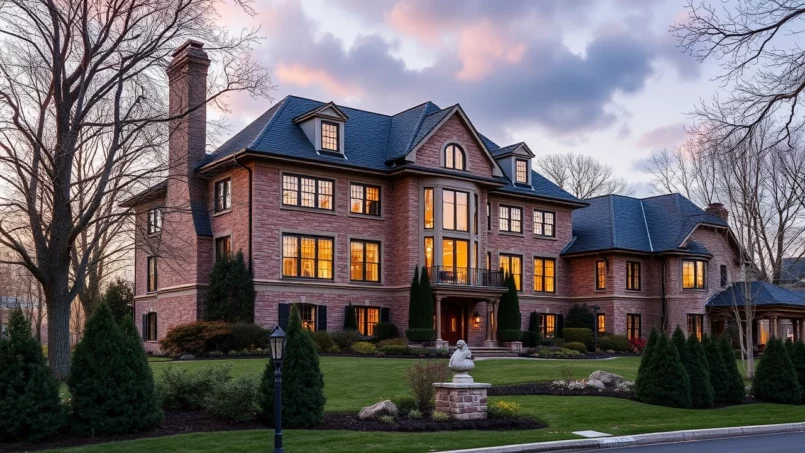
This strong presence of pre‑war homes translates into often spectacular architecture, with numerous Tudor‑style mansions, steep roofs, decorative half‑timbering, and fine masonry, especially in areas like Fox Meadow or Murray Hill. Tree‑lined streets, preserved landscapes, and careful public maintenance reinforce the perception of a high‑end residential environment.
A highly segmented neighborhood geography
Scarsdale is divided into 14 neighborhoods, several of which have become veritable “brands” in real estate.
Among the most well‑known are:
Overview of the main neighborhoods and micro‑residential areas of Scarsdale, detailing their architectural characteristics and atmosphere.
Historic, highly sought‑after neighborhood close to the center and schools, characterized by many Tudor‑style homes.
Known for its tree‑lined streets and Colonial and Tudor homes, offering relative accessibility within the local context.
One of the wealthiest areas, with modern properties on large lots, especially around Heathcote Park.
Known for its large lots, quiet suburban atmosphere, and proximity to the Quaker Ridge Golf Club.
Concentrates some of the most expensive and prestigious properties in the village.
Includes areas like Secor Farms, Crane‑Berkley, Sherbrooke Park, and Arthur Manor.
In terms of prices, the gap between neighborhoods is significant:
| Neighborhood | Median List Price | Estimated Price per Sq Ft | Profile |
|---|---|---|---|
| Murray Hill – Middle Heathcote | ~ $6M | ~ $695/sqft | Most expensive in Scarsdale, large properties |
| Heathcote (overall) | > $3.2M in some sub‑areas | High | Very high‑end, spacious lots |
| East Scarsdale | ~ $3M median sale price (Oct. 2025) | n.d. | Very competitive market, frequent bidding wars |
| Greenacres | $2.2–2.3M | $604–618/sqft | Most “affordable” neighborhood in the village |
| Other neighborhoods | Around $2.6M | ~ $722/sqft for some | Standard Scarsdale luxury market |
East Scarsdale illustrates market tension: a median price of $3M up nearly 35% year over year, sales averaging 13% above asking price, with “hot” properties selling 25% above list and going under contract in about twelve days.
For an investor, this micro‑geography allows fine‑tuning the strategy: target a neighborhood like Greenacres for a slightly lower “entry ticket,” aim for East Scarsdale to maximize appreciation potential, or position in Murray Hill for an ultra‑wealth preservation investment.
Rental market in Scarsdale: very high rents but a limited base
Unlike other markets in the region, Scarsdale is not a typical playground for the mass rental investor: the low percentage of renters (8%), scarcity of multi‑unit buildings, and restrictive zoning policies limit available inventory. However, the rent levels achieved are in line with sale prices.
The various data sets provide the following orders of magnitude:
| Rental Indicator | Indicative Value |
|---|---|
| Number of rental listings | 29 to 37 listings depending on source |
| Monthly rent range | $2,000 – $22,500 |
| Median rent | Around $6,100 |
| Average rent (all categories) | $6,200–$6,370 depending on series |
| Average residential rent (other source) | ~ $9,500 |
| Average apartment size | ~ 655 sq.ft |
By size of unit, we observe:
| Unit Type | Median Monthly Rent | Average Monthly Rent |
|---|---|---|
| Studio | $1,800 | $1,800–$2,600 depending on source |
| 1 bedroom | $3,300 | ~ $2,960–$2,550 |
| 2 bedrooms | $4,200 | ~ $4,150 (up to $3,700 in other series) |
| 3 bedrooms | $6,500 | ~ $7,030 |
| 4 bedrooms | $7,500 | ~ $7,680 (up to ~ $6,995 in some samples) |
The structure of the rental market shows that one‑ and two‑bedroom units make up the largest share of supply (about 26.6% for 1‑bedroom and 31.6% for 2‑bedroom), which essentially corresponds to condos, small multifamily buildings, or divided houses.
A mixed rental trend
Rents, like sale prices, have seen rapid changes, but with signs of recent correction:
The median rent recorded a decrease of nearly 14.75% year over year according to some measures.
This erratic nature is due to the low volume of rental properties: a few high‑end homes being listed or withdrawn can significantly shift averages. This is a key point for the investor: raw statistical analysis must be interpreted with caution.
Only 4.2% of the rental stock, or 84 units, falls under the federal Section 8 program, with an occupancy rate of 89%.
Why are prices so high? Schools, zoning, and environment
Scarsdale’s reputation owes much to its school system. The Scarsdale Union Free School District is consistently ranked among the best in Westchester, New York State, and even the nation. A few indicators speak for themselves:
– over 4,600 students attend the village’s public schools,
– the high school graduation rate approaches 99%,
– math proficiency is also around 99% at the district level,
– the student‑teacher ratio is about 11:1, below the national average,
– Scarsdale High School shows strong participation in Advanced Placement (AP) programs and high average SAT/ACT scores (SAT around 1400, ACT around 31),
– several elementary schools (Quaker Ridge, Fox Meadow, Edgewood, Heathcote, Greenacres) receive the highest rating (10/10) on GreatSchools, with math proficiency rates of 88% to 97%.
Studies converge: the higher the perceived quality of schools, the stronger the real estate premium. Each additional dollar invested in public schools can translate into a $20 increase in the value of surrounding homes. In a village where over 94% of students attend the local public school, this leverage effect is particularly powerful.
Academic studies and market analyses
Beyond education, two structural factors come into play:
– a safe environment, with very low crime rates (violent crime around 0.33 per 1,000 residents, property crime around 6.52 per 1,000 residents), especially in the northern part of the village,
– a very well‑maintained physical setting: 10 neighborhood parks, 24 parks maintained by the village, a municipal pool complex, numerous tennis and paddle courts, trails like the Bronx River Pathway, and natural spaces like the Greenburgh Nature Center.
Only 0.2% of Scarsdale’s land area is occupied by multifamily housing; the rest is reserved for single‑family homes.
This combination of strong solvent demand, a deliberately limited supply due to zoning, and high quality of life explains why Scarsdale sits well above the regional average. For comparison:
| Location | Approximate Median Price | Comparative Profile |
|---|---|---|
| Scarsdale | ~ $2.1M | Ultra‑wealthy suburb, strong zoning constraints |
| Westchester County (overall) | ~ $831,881 | Rich but more diverse suburb |
| Port Chester | ~ $592,242 for single‑family home | More permissive zoning, significant multifamily supply |
| New Rochelle | More affordable and diversified market | Dynamic mid‑sized city |
| Eastchester, Hartsdale, Tuckahoe, Ardsley | Lower prices, middle/upper‑middle class profiles | More accessible alternatives |
| Greenwich (CT) | Comparable or higher than Scarsdale | Another suburban luxury hub |
For the investor, the conclusion is twofold: gross yield potential is less spectacular than in more popular markets, but capital protection and demand stability are among the best in the region.
Local taxes: a significant cost to include in the business plan
It is impossible to talk about real estate investment in Scarsdale without addressing local property taxes. The village and school district are known for their high rates, which is no surprise given the quality of services and amenities.
The key figures to keep in mind are:
| Tax Indicator | Indicative Value |
|---|---|
| Median effective tax rate | 1.83% to 1.97% of market value |
| Median annual property tax | $23,954 to $25,605 per home |
| Median market value (Scarsdale) | ~ $1.234M |
| Median home value (other sources) | $1.0939M – $2.2968M depending on method |
Compared to the national average (rate around 1.02%, median bill around $2,400), Scarsdale is far above. Even compared to the New York State average (effective rate of 2.39% and median bill of $5,420), the village stands out for the absolute level of the tax bill, mainly due to very high market values.
The tax bill is composed of several layers:
Public spending in Scarsdale is funded by several distinct entities.
Represents the largest share of public expenditure funding.
Contributes to funding municipal services and infrastructure.
Contributes to funding county‑wide services and projects.
Fund specific services such as the library, fire department, and sanitation.
Payment deadlines are spread throughout the year (county tax in spring, village tax in two installments, school tax in fall and early the following year). Late payments automatically incur penalties, and the responsibility for payment lies with the property owner, even if the notice is not received.
Several exemptions exist (STAR program from the state for school tax, reductions for seniors, people with disabilities, veterans, etc.), but they are conditional on the owner’s profile and do not always transfer upon sale. For an investor, it is crucial to verify whether the relief a property receives is tied to the departing owner or to the home itself, in order not to overestimate future net cash flow.
The property assessment mechanism, based on a Residential Assessment Ratio (RAR) and a non‑annual reassessment system, also creates a growing gap between tax value and market value in a context of rapid price increases. Many specialized companies offer to assist owners in challenging their assessment; some claim average savings of over $1,000 per year, and sometimes much more on large properties.
For an investor, incorporating local taxes means accepting a high “tax entry ticket” in exchange for an educational, safety, and institutional environment among the best in the country.
Investment strategies suited to Scarsdale
Given these characteristics, not all real estate investment strategies are equally relevant in Scarsdale. The village is not the Bronx or an urban redevelopment neighborhood; it is a mature, ultra‑residential market with low turnover and high prices. Nevertheless, several approaches remain viable.
Buy and hold for long‑term wealth
The most natural strategy is to acquire a property to hold for the long term, either as a primary residence or as a wealth investment potentially rented out.
In this context, factors to analyze are:
– historical appreciation trajectory (about 4.5% per year over ten years, with recent acceleration),
– socio‑economic stability (high incomes, low unemployment, high proportion of professionals in finance, law, medicine),
– the quality of the school district, which supports family demand,
– the supply constraint due to zoning, which limits new construction,
– local taxes, which weigh on holding costs.
For an investor who values capital preservation over current yield, Scarsdale is typically a location to consider as a “real estate safe.” The combination of scarce supply, highly solvent clientele, safe environment, and top‑tier schools creates structural demand that is difficult to dent, even during economic turbulence.
Furnished or high‑end long‑term rentals
Even though the share of renters remains low, there is significant rental demand, driven by:
– professionals in career transition,
– expatriate families looking for housing near schools without buying immediately,
– households wanting to test suburban life before purchasing.
Average rents on the order of $6,000 to $9,500 per month for a house, with peaks well above for large properties, can cover a substantial portion of expenses, but net profitability must be calculated rigorously, including:
– property tax (often $20,000 to $60,000 per year on large homes),
– costs for insurance, maintenance (especially on older homes), and possibly property management,
– the vacancy risk, which is higher on very expensive properties.
Short‑term rental strategies (like Airbnb) should be approached with caution, given frequent regulatory constraints in affluent residential suburbs and residents’ sensitivity to such usage.
Targeted fix and flip
At first glance, the high price level and the age of the building stock might appeal to fix‑and‑flip enthusiasts. Theoretically, buying an older home in need of renovation, undervalued due to its condition, updating it, and reselling can generate significant margins, especially given general figures for distressed properties (30–60% discount and margins possibly reaching 30–60% after renovations in certain contexts).
In practice, the Scarsdale approach involves several specific constraints that must be considered.
– competition from owner‑occupants, willing to pay high prices even for fixer‑uppers in the best neighborhoods,
– the expected level of finish in such a high‑end village, which drives up renovation costs,
– the need to master planning permissions and architectural requirements, especially for Tudor‑style homes or in the most visible areas.
For an experienced investor able to work with reliable contractors and manage high renovation budgets, there are nonetheless occasional opportunities, for example in:
– pre‑war homes requiring major upgrades (electrical, plumbing, insulation),
– properties poorly presented on the market with potential for quick cosmetic improvement,
– homes in micro‑areas undergoing gentrification (certain pockets of Heathcote, Quaker Ridge, or Secor Farms).
In this context, Days on Market (DOM) data and premiums over list price are crucial for calibrating the After Repair Value (ARV) and the capital lock‑up period.
Niche commercial and multifamily real estate
Even though Scarsdale is dominated by single‑family homes, the commercial environment and pockets of multifamily represent another aspect of investment.
The aggregate value of commercial properties linked to Scarsdale exceeds $115 million.
For a specialized investor, these assets offer indirect exposure to Scarsdale’s extremely affluent clientele: upscale local shops, professional offices, services for the local population. Yields are potentially more attractive than on single‑family homes, but the number of opportunities is limited and selection must be very thorough.
For those who want to take a position in the real estate dynamics of the New York region without buying directly in Scarsdale, it is possible to use vehicles like REITs (Real Estate Investment Trusts) or private syndications specializing in multifamily properties in Westchester.
Major REITs such as Vornado Realty Trust, SL Green, Empire State Realty Trust, or AvalonBay have a significant presence in the New York area, even if they don’t specifically target Scarsdale. However, they allow investors to benefit from the resilience of commercial or residential real estate in the metropolis, with added liquidity and diversification.
“Real estate syndication” players also target multifamily operations in affluent New York suburbs, allowing passive investors to partner in large‑scale projects, often with a professional management philosophy and long‑term yield.
Urban projects and long‑term dynamics
Beyond static characteristics, it is useful to observe major ongoing projects that may influence property values in the medium and long term.
Scarsdale Pool Complex redevelopment
The municipal pool complex, over fifty years old and running a financial deficit, is the subject of a major rehabilitation project. Studies indicate that a simple upgrade to code would be economically unsound, with reconstruction costs estimated at over $13M.
An extensive consultation process has been undertaken, including surveys, public meetings, and market studies. Several options have been presented, and an initial program direction has been chosen, aiming to create a better‑sized, more financially sustainable, and more attractive facility (with popular elements like water play areas, a “lazy river,” shaded zones, etc.).
For a residential investor, this type of project further enhances the village’s appeal to families, improving local leisure offerings. In an already highly sought‑after market, every quality municipal investment helps consolidate long‑term value.
The Freightway site saga
Another major issue: the transformation of the Freightway site, an aging parking garage adjacent to the Scarsdale train station. The structure, about fifty years old, requires significant investment, estimated at $2.5M in the short term and up to $25M over 8 to 10 years.
The potential of this land, right in the town center and directly connected to the station, led the village to initiate a request for proposals from developers, with the idea of a mixed‑use development: housing (potentially multifamily), retail, offices, public spaces, improved pedestrian circulation, and better connections to the village.
Several major national names (AvalonBay, Toll Brothers, etc.) responded with proposals including public squares, pedestrian bridges, contextual architecture, etc. Due to a lack of local consensus, the project was put on hold in 2020, but a recent report calls for reviving the discussion, particularly to include multi‑unit housing and better connect the site to the center.
This file is one to watch closely for the investor, as it represents a rare opportunity to see an additional supply of multi‑unit housing emerge in a village with historically very restrictive zoning. Depending on its final form, the project could introduce new property types, such as apartments, and potentially offer investment opportunities within a transit‑oriented development (TOD) framework.
The example of One Dromore: affordable housing and energy transition
The recent opening of One Dromore Apartments illustrates how, on the fringes of historic Scarsdale, targeted operations can introduce affordable housing and high‑performance energy buildings.
This 45‑unit project, Passive House certified and fully electric, is aimed at households earning between 40% and 80% of the area median income, with strong demand (over 5,500 applications for 45 units). Located near shops and transit, it shows how Westchester’s urban planning is beginning to integrate social and energy diversity issues, even in very wealthy communities.
For an investor, this type of program provides indications about possible long‑term public policy directions: affordable housing quotas, incentives for sustainable construction, public‑private partnerships with specialized operators. These are factors to consider when thinking ten or fifteen years ahead.
Market cycles, purchase timing, and outlook
At the cyclical level, the recent situation in Scarsdale and Westchester is marked by a dual phenomenon: demand remains strong, especially for properties under $2.5M, while supply is constrained, worsened by many owners’ reluctance to give up mortgage rates near 3% obtained before the rate hike.
Local analyses anticipate, barring a major macroeconomic shock, a continuation of this configuration in the coming years: a seller’s market, upward pressure on prices (especially in the most sought‑after segments), and difficulty in bringing inventory back to pre‑pandemic levels.
In terms of timing, trends observed nationally are also seen in Scarsdale:
The real estate market is highly seasonal. The most active and competitive periods (bidding wars, high prices) are spring and summer. To benefit from less competition and potentially more flexible sellers, favor winter and early spring (October to February). Fall can also offer negotiation opportunities, as activity slows from mid‑August and many sellers want to close before the year‑end holidays.
For a disciplined investor, combining favorable timing (off‑peak season), strong financial preparation (ability to act quickly on an attractive property), and precise neighborhood targeting can slightly improve the entry point in a market where negotiation margins are structurally limited.
Points of vigilance and best practices for the investor
Investing in real estate in Scarsdale is no casual matter. The level of prices and taxes makes every decision consequential. Some key areas of vigilance are necessary.
On the technical side, many homes date from before World War II. Before buying a fixer‑upper, it is essential to:
Before buying a fixer‑upper, have a comprehensive inspection done by a professional (structure, roof, foundations, systems). Obtain certifications or opinions on the condition of the roof, sewer lines, and possible presence of pests. Carefully distinguish cosmetic work (painting, floors, kitchen) from structural work (framing, masonry, drainage) whose cost can skyrocket. Also factor in the high cost of skilled labor, especially in a community with high standards.
On the financial side, beyond property tax, you must anticipate:
– the likelihood of a future municipal reassessment, which could close part of the gap between tax value and market value,
– the impact of monetary policy on long‑term rates: even if the Fed becomes more accommodative in the medium term, normalization will not necessarily bring rates back to the 2020–2021 lows,
– risks related to climate hazards (flooding, high winds, heat) and their consequences on insurance premiums and necessary work.
On the legal and regulatory front, the complexity of zoning and local sensitivity to changes in the urban fabric require working with:
A selection of specialized experts to support your real estate projects in Westchester, from transaction to management.
Attorneys specializing in Scarsdale real estate to secure your transactions and contracts.
Consultants who can challenge assessments to optimize your tax burden.
Property management agencies and insurers familiar with Westchester luxury properties.
Contractors accustomed to local architectural standards and inspection requirements.
Finally, on the strategic level, it is useful to keep in mind that return on investment in Scarsdale often plays out more on value preservation and capital appreciation than on abundant rental cash flow. For an investor looking to optimize a diversified portfolio, exposing part of their capital to such a solid market, while investing the remainder in higher‑yield but riskier markets, is a coherent approach.
Conclusion: Scarsdale, an insider’s market for patient capital
Scarsdale is not a market for short‑term profitability hunters. Entry tickets are high, taxes weigh heavily, and competition for the best homes remains fierce, fueled by a local and international ultra‑high‑income clientele often willing to overpay for location and schools.
In return, few residential markets offer such a combination of:
– demographic and economic stability,
– systemic educational excellence,
– programmed scarcity of real estate supply,
– safety and quality of life,
– steady and robust appreciation trajectory.
This real estate investment suits profiles with a long‑term horizon, capable of absorbing local taxes and accepting a modest current yield. It consists of acquiring a share of an extremely rare asset: a model suburb where demand for beautiful homes, close to excellent schools and just a few dozen minutes from Manhattan, remains constant.
The key to success in such an environment lies in preparation: fine analysis of neighborhood micro‑markets, judicious choice of purchase timing, precise integration of taxes and renovation costs, and close collaboration with professionals who intimately know the streets, schools, customs, and local sensitivities. Under these conditions, Scarsdale can become a solid pillar of a sophisticated wealth strategy.
Disclaimer: The information provided on this website is for informational purposes only and does not constitute financial, legal, or professional advice. We encourage you to consult qualified experts before making any investment, real estate, or expatriation decisions. Although we strive to maintain up-to-date and accurate information, we do not guarantee the completeness, accuracy, or timeliness of the proposed content. As investment and expatriation involve risks, we disclaim any liability for potential losses or damages arising from the use of this site. Your use of this site confirms your acceptance of these terms and your understanding of the associated risks.

Cyril Jarnias is an independent expert in international wealth management with over 20 years of experience. As an expatriate himself, he is dedicated to helping individuals and business leaders build, protect, and pass on their wealth with complete peace of mind.
On his website, cyriljarnias.com, he shares his expertise on international real estate, offshore company formation, and expatriation.
Thanks to his expertise, he offers sound advice to optimize his clients' wealth management. Cyril Jarnias is also recognized for his appearances in many prestigious media outlets such as BFM Business, les Français de l’étranger, Le Figaro, Les Echos, and Mieux vivre votre argent, where he shares his knowledge and know-how in wealth management.





