
 Published on and written by Cyril Jarnias
A few minutes from the Gare Saint-Lazare, on the Left Bank of the Seine, Asnières-sur-Seine has established itself in just a few years as one of the favorite playgrounds for investors in the Paris region. Cheaper than Paris, better connected than many suburbs, and boosted by a wave of XXL urban projects, the town now ticks most of the boxes for a rational real estate investment: potential for value appreciation, sustained rental demand, a dynamic new-build market, and professionals and families seeking an alternative to the capital.
The question is no longer whether Asnières-sur-Seine is interesting for investment, but rather where, how, and with what strategy to enter the market intelligently.
A Tight but Still Affordable Real Estate Market
The first striking figure when looking at Asnières-sur-Seine is the price gap with Paris. While Parisian apartments flirt with, or even exceed, €10,000/m², housing in Asnières remains on average about 30% cheaper, according to compiled sources: around €6,300 to €7,300/m² for the entire stock, €7,214/m² for apartments, and €8,617/m² for houses in the higher estimates.
The average price per m² increased by 62% between 2014 and 2024, rising from about €4,200 to €6,800.
The latest published median values confirm this breathing room:
| Indicator (January 2026) | Median Price €/m² | Change 1 Year | Change 5 Years |
|---|---|---|---|
| All Property Types Combined | 6,393 | Stable | −1% |
| Apartments | 6,366 | Stable | −1% |
| Houses | 6,991 | −1% | Stable |
At the same time, the gap between new and existing properties is widening: in late 2025, existing properties hovered around €6,220/m² (−3% year-over-year and −7% over five years), while new builds exceeded €6,580/m² (+3% year-over-year and +10% over five years). For certain new developments, particularly in the town center, apartment prices rise to €7,500–7,800/m², with a new studio requiring an entry ticket of around €230,000.
For investors, this consolidation phase is rather good news: after a very pronounced upcycle, Asnières-sur-Seine offers an entry point where prices have stopped soaring while still being supported by robust fundamentals.
Young Demographics and Sustained Long-Term Rental Demand
One of Asnières-sur-Seine’s major assets lies in its demographic dynamism. The municipality has crossed the threshold of 85,000 inhabitants and some estimates place it around 87,000 to over 90,000 residents depending on the period and sources, making it one of the most populous towns in the Hauts-de-Seine department. Over ten years, the population has grown by about 5.4%, ranking the town among the most dynamic municipalities in the Paris region.
The population is young (median age ~35) with a high proportion of young couples and families (more than a third of households have children). A majority (54.4%) of residents are tenants, indicating a solid and constant demand for private rental housing.
A few key structuring benchmarks complete this picture:
| Demographic & Economic Data | Approximate Value |
|---|---|
| Population | 85,000–90,000 inhab. |
| Recent Growth | +5.4% |
| Median Age | 35 years |
| Number of Households | 42,786 |
| Share of Tenants | 54.4% |
| Median Annual Income | €33,939 |
| Average Annual Household Income | ≈ €30,500 |
| Unemployment Rate (ages 15–64) | 11.4% (decreasing) |
This sociodemographic base largely explains the market tension: there are about 20% more buyers than properties for sale, and the real estate tension indicator reaches 10/10. The shortage in the rental market is no less significant: major platforms list between 200 and nearly 300 apartments available for long-term rent, while demand comes from both professionals working in La Défense or Paris and a growing student population.
High Rents and Above-Average Yields for Hauts‑de‑Seine
In return for already significant purchase prices, Asnières-sur-Seine offers solid rents. For the standard residential stock, average rents are around €22/m² for apartments and €27/m² for houses, with variations depending on size, neighborhood, and condition. For apartments, observed rents generally range between €16 and €34/m².
In relation to market values, this yields average gross returns of around 3.7 to 4.7%, with higher peaks for well-calibrated products. Some orders of magnitude from available data:
| Type of New Property | Minimum Estimated Price | Average Monthly Rent | Indicative Gross Yield |
|---|---|---|---|
| Studio | ≈ €230,000 | ≈ €750 | ≈ 5.2% |
| 2-room (T2) | — | ≈ €950 | ≈ 4.8% |
| 3-room (T3) | — | ≈ €1,200 | ≈ 4.5% |
Looking at the entire stock, several sources converge: an average gross yield around 3.7%, another estimated at 4.3%, and up to 4.71% for Asnières-sur-Seine within the departmental panorama. The Hauts‑de‑Seine department averages around 4.56%, while the national French average reaches 4.84%.
The Asnières-sur-Seine real estate market is characterized by a moderate gross yield (between 3.7% and 4.3%), rather than massive cash flows. Its performance is primarily based on the combination of a correct yield and a high probability of capital appreciation on the invested amount. To optimize this standard yield, analysis highlights two main levers.
– Furnished rental (LMNP), which can increase rents by 15 to 25% and offer a favorable tax framework thanks to depreciation.
– Shared housing or co‑living, particularly relevant in well-connected neighborhoods, often allowing for an increase of 20 to 40% in rental income for the same square footage.
Simulations based on a median price of €6,702/m² show that a 25 m² studio can generate about €3,200 net of charges per year, or nearly €1,700 after taxes for a taxpayer in the 30% marginal tax bracket. A 50 m² two-bedroom yields about €6,400 net of charges, and a 70 m² three-bedroom yields about €9,000 net of charges, before taxation.
A Dense Housing Stock, Predominantly Apartments
To understand where to invest, one must first look at the composition of the Asnières property stock. The town has about 42,700 to 44,000 dwellings, of which nearly 89.3% are occupied as primary residences. Secondary residences represent just over 2%, and vacant housing hovers around 8.5%, which remains relatively moderate for an inner-ring suburb.
The predominance of collective housing is clear: about 86.5% apartments versus 13.5% houses. The structure of primary residences by size also illustrates the very urban profile of the market:
| Number of Rooms (Primary Residences) | Estimated Volume | Share of Stock |
|---|---|---|
| Studios | 5,387 | 14.1% |
| 2 Rooms | 10,469 | 27.4% |
| 3 Rooms | 11,386 | 29.8% |
| 4 Rooms | 6,801 | 17.8% |
| 5 Rooms and more | 4,165 | 10.9% |
Therefore, investors mainly find small and medium-sized units, particularly T2s and T3s, which are in high demand by young professionals and families at the beginning of their residential path. Studios, however, maintain an important place and remain sought-after, especially since the renewed attractiveness of student housing and small units near transport.
In 2025, the town recorded a very low sales volume for houses (40 transactions) compared to apartments (368). This scarcity is reflected in prices: houses sell on average for €7,840/m² (-9.3% year-over-year), while apartments, which are traded much more, stabilize around €6,080/m² (-0.7%).
Highly Differentiated Neighborhoods, from High-End Family Areas to Up-and-Coming Sectors
Investing in Asnières-sur-Seine does not mean the same thing whether you buy in the highly sought-after Bac‑Bécon‑Flachat sector, in the commercial center, in the more popular north, or near the future hubs of the Grand Paris. The price gaps between neighborhoods are significant, but they also reflect different tenant profiles and prospects for value appreciation.
Town Center and Bac‑Bécon‑Flachat: High-End Showcase and Asset Security
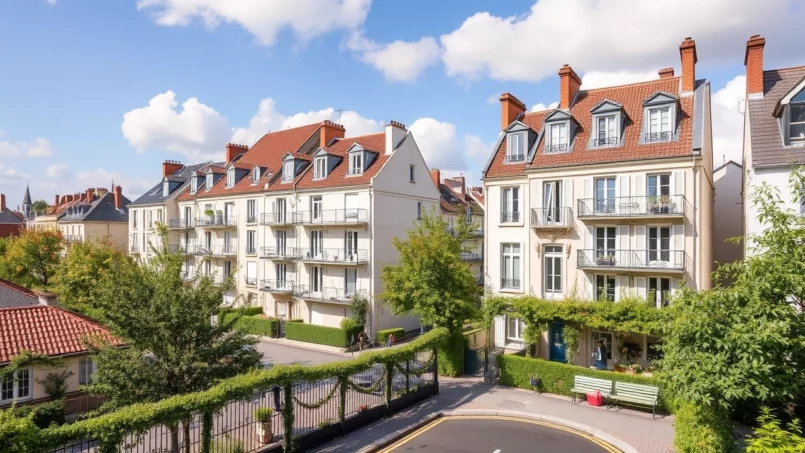
The heart of the town and the Bac‑Bécon‑Flachat sector – sometimes extending towards Colombes – constitute the residential showcase of Asnières-sur-Seine. Here you find beautiful Haussmann-style buildings, bourgeois houses, and well-integrated new developments. There are numerous shops: over 360 stores recorded in the hyper-center, vibrant neighborhood life, schools, and cultural and sports facilities.
Prices are naturally among the highest in the municipality. Data by sector shows, for example:
| Expanded Sector | House Price €/m² | Apartment Price €/m² |
|---|---|---|
| Bac‑Bécon‑Flachat‑Gare | ≈ 8,640 | ≈ 7,242 |
| Centre‑Mairie (Town Hall Center) | ≈ 8,967 | ≈ 7,318 |
| Bac‑Bécon‑Flachat‑Colombes | ≈ 9,006 | ≈ 6,913 |
| Centre‑Voltaire (Central Part) | ≈ 8,270 | ≈ 6,902 |
For an investor, these neighborhoods offer primarily strong asset security and near-zero vacancy rates, rather than exceptional yields. Small units near the Asnières or Bécon-les-Bruyères stations rent very quickly to professionals commuting daily to Paris or La Défense. Recent sales illustrate this high-end positioning: for example, a 149 m² house on Rue Steffen changed hands for around €1.21 million, which is over €8,100/m², while a house on Avenue Flachat sold for nearly €7,700/m².
Voltaire, Grésillons, and Hauts d’Asnières: Playgrounds for Profitability and Upgrading
In contrast to these premium sectors, the more popular neighborhoods like Voltaire, Grésillons, or parts of the Hauts d’Asnières display more moderate prices but are in the midst of a transformation cycle. The Voltaire neighborhood, for example, historically comprised of buildings from the 1950s‑70s, now benefits from strong public investment, improved connectivity, and attracts families, students, and young professionals alike.
Average price per square meter for apartments in the Voltaire-Grésillons sector in Asnières-sur-Seine, illustrating the potential for revaluation in the local real estate market.
Philosophe, Gare, Mairie, Alma: Mixed, Well-Connected, and Highly Sought-After Sectors
Neighborhoods like Philosophes, Gare, Mairie, or Alma cumulatively offer several advantages: a pleasant, often residential urban fabric, good accessibility (Metro Line 13, RER C, Transilien stations), and an image increasingly prized by the upper-middle classes. The Alma‑Philosophes sector regularly exceeds €6,600/m² for apartments, with houses potentially going much higher.
Neighborhoods near the future stations of Line 15 are conducive to high-end shared housing or furnished T2-T3 rentals, targeting young professionals and graduate students. A study on the extension of Line 13 showed that property prices and household incomes increased significantly within a 500 to 1000-meter radius around new stations, a gentrification phenomenon also expected around the Line 15 stations.
Exceptional Accessibility Further Enhanced by the Grand Paris
If Asnières-sur-Seine attracts so much, it’s primarily because it combines a level of connectivity worthy of a Paris arrondissement with softer rents and prices. The town already benefits from a very dense network:
– Metro Line 13 (stations Les Courtilles, Les Agnettes, Gabriel‑Péri).
– RER C (station Les Grésillons / Asnières-sur-Seine).
– Transilien lines J and L (station Asnières, Bécon‑les‑Bruyères nearby).
– Terminus of the T1 tram line at Les Courtilles.
– An extensive bus network connecting Paris and neighboring towns.
Concretely, it takes just a few minutes by train to reach the Gare Saint‑Lazare, and about twenty minutes to get to the heart of the capital. For workers in La Défense, Asnières-sur-Seine represents the perfect compromise, located between the business district and the Parisian office districts, with quick access to both hubs.
Geographic Advantage of Asnières-sur-Seine
On top of this already solid base comes the anticipated revolution of the Grand Paris Express. The future fully automated Line 15 West will serve, among others, the Les Agnettes and Les Grésillons stations, connecting with Line 13 and RER C. Ultimately, this metropolitan loop is expected to absorb tens of thousands of daily trips and strengthen connections with La Défense, major employment hubs, and airports.
Studies on the impact of major transport projects in the Paris region, such as the RER, show that such an improvement in accessibility generally translates into:
– An increase in employment in well-connected towns (up to +12.8% between 1975 and 1990 for towns connected to the RER).
– A significant reduction in average commute times (−5.8 minutes on average to Paris for served towns).
– A gradual upgrading of the socioeconomic profile of residents near stations.
In short, Asnières-sur-Seine ticks most of the boxes for “transport‑oriented development”: density, mixed-use, quality of existing and future connectivity. For a long-term investor, this reinforces the likelihood that the value of properties located near transport hubs will continue to grow, even if part of this increase is already factored into current prices.
A City in the Midst of Urban and Ecological Transformation
Asnières-sur-Seine is not just a well-connected town; it is also a territory that has undertaken a profound transformation of its urban landscape since the early 2000s. The industrial wastelands that bordered the Seine or certain northern sectors are gradually giving way to mixed-use eco-districts, blending housing, offices, shops, public facilities, and large parks.
Several emblematic projects structure this transformation:
Presentation of three major urban renewal and eco-district projects, transforming former industrial sites into mixed and sustainable neighborhoods.
Former 8.65-hectare industrial site redeveloped since 2005. Complete 145,000 m² neighborhood with ~1,000 housing units (25% social housing), 73,000 m² of offices, shops, a 7,000 m² park, school, daycare, gym, and sports fields. Landscape design focused on water and vegetation.
16-hectare eco-district with 2,000 new housing units, 45% green spaces, a 1.5-hectare urban park, and urban farming rooftops (~6,800 m²). Includes a hotel, serviced residences, shops, and benefits from demanding environmental certifications (NF Habitat HQE, Effinergie+).
16-hectare zone west of the railway network, mixing housing, offices, a hotel, shops, educational facilities (14-class school group), sports installations, and residences. Over 300 housing units already delivered, with a strong proportion of intermediate and social housing.
In addition to these large complexes, there are more targeted operations, such as the conversion of the “Asnières Université” site, a 1.6-hectare wasteland that will host about 250 housing units, a planted walkway, a 700-place middle school, shops, and potentially urban farming devices on rooftops.
For investors, these projects play on several levels:
– They create new opportunities to buy new-build properties, often at more attractive launch prices than future resales.
– They contribute to improving the image of entire neighborhoods, with a halo effect on the surrounding existing stock.
– They enhance the appeal for very diverse audiences: families, young professionals, seniors, students, tourists.
The rise of eco-districts and the emphasis on energy performance finally address a decisive issue for rental investment: starting in 2025, homes rated F or G on the Energy Performance Diagnosis are gradually banned from being rented. Betting on a recent, well-insulated stock, or on deeply renovated existing properties, thus becomes a criterion for long-term security.
Comparison with Neighboring Towns: An Attractive Price/Yield Compromise
To assess the interest of Asnières-sur-Seine, it must be repositioned in the Paris region landscape. In terms of both prices and yields, the town falls within a median range of western Paris: more expensive than the more popular towns of Seine‑Saint‑Denis or certain sectors of Val‑d’Oise, but significantly more affordable than the very high-end areas of the 92 or the western inner suburbs.
Some illustrative comparisons:
| Town (Apartments) | Average Price €/m² | Average Rental Yield |
|---|---|---|
| Asnières-sur-Seine | ≈ 7,214 | ≈ 4.3–4.7% |
| Levallois-Perret | ≈ 9,706 | ≈ 3.3–3.5% |
| Neuilly-sur-Seine | ≈ 11,400 | ≈ 3.2–3.9% |
| Courbevoie | ≈ 7,534 | ≈ 3.7–4.6% |
| Clichy | ≈ 7,521 | ≈ 3.9–4.7% |
| Colombes | ≈ 5,455 | ≈ 4.5–5.0% |
| Gennevilliers | ≈ 4,844 | ≈ 4.6–5.2% |
A clear positioning emerges: Asnières-sur-Seine is less expensive than Levallois-Perret, Neuilly, or Boulogne‑Billancourt, for comparable commute times, while offering a slightly higher yield than these very patrimonial strongholds. It is midway, in both price and yield, between the very expensive but low-yield towns and the more popular, indeed higher-yield towns, but often perceived as riskier.
This intermediate place corresponds to the profile of investors who are savers seeking a balance between security and yield. They must be ready to hold their property long-term to benefit from dual compensation: regular rents and potential capital gains, the latter being amplified by urban transformations and the effects of the Grand Paris project.
The diversity of neighborhoods, housing typologies, and tenant profiles in Asnières-sur-Seine allows for several investment strategies, each with its strengths and constraints.
Unfurnished Long-Term Lease: The Stable Base
The unfurnished annual lease remains the most widespread and simplest to manage form. It is particularly suitable for family-sized units (T3, T4) in residential neighborhoods (Bac‑Bécon‑Flachat, Philosophe, Mairie, Gare), where tenants often settle for several years.
In this configuration, a gross yield around 3.5–4% is generally considered acceptable for Asnières-sur-Seine, especially if the long-term appreciation prospect is strong. The main requirement is to buy well, avoiding overpaying for a property on the pretext that it’s ultra-well located, and factoring in all charges (property tax, condo fees, insurance, maintenance, potential management fees), which can represent 15 to 25% of the rents collected.
Furnished Rental (LMNP): Optimizing Taxation and Rents
For modest-sized units (studios, T2) or divisible T3s, the furnished non-professional rental regime (LMNP) often emerges as the most optimized form. It allows both:
Furnished rental allows for increasing the rent by 15 to 25% compared to an unfurnished lease. By opting for the actual tax regime, the owner can deduct charges as well as depreciation of the property and furniture, which significantly reduces the taxable base.
In a market like Asnières-sur-Seine, where gross rents already oscillate at high levels, this tax lever can make the difference between a break-even operation and one with a genuinely positive cash flow, even with significant borrowing. Sectors close to train stations, the metro, grandes écoles, or office hubs (La Défense, Seine riverbank) are particularly suited to this strategy.
With a young population, many early-career professionals, and a limited supply of large units, structured shared housing very logically finds its place in Asnières-sur-Seine. A well-located T4 or T5, reconfigured into 3 or 4 comfortable bedrooms, often allows:
– To rent each bedroom at a high individual rate.
– To increase rental income by 20 to 40% compared to a traditional family lease.
The Voltaire, Grésillons, Gare, and Mairie neighborhoods offer good connectivity and shops, with still reasonable purchase prices (excluding the hyper‑premium segment), making them relevant locations for rental setups. This opportunity is conditional upon strict compliance with current regulations: minimum surface area, housing decency, electrical standards, and potential thresholds for a change of use to tourist furnished rentals if short-term rental is considered.
Short-Term Rental and Student Market: Niches to Handle with Caution
The seasonal rental market and platforms like Airbnb are real in Asnières-sur-Seine, with over 700 active listings recorded and interesting performances (median occupancy rate around 57%, average annual revenue nearing €18.5k per property). Small units or well-located T2/T3s around the town center, the Seine riverbanks, the train station, or event hubs offer good occupancy rates, especially in high season.
The regulatory framework in Île-de-France imposes registration obligations, limited durations for primary residences, and heavy constraints for converting secondary residences. Only a little over a third of listings are believed to have a compliant license. It is recommended to consider short-term rental as a complementary strategy, always checking local regulations, rather than as a single profitability pivot.
Regarding the student market, however, the potential is clearly affirmed. The town hosts about 6,000 students, and several dedicated residences dot the territory: Les Estudines Paris Asnières, Studéa Asnières, Les Estudines Sarah Bernhardt, residences Grésillons or Barbusse, often located along the Seine quays or near metro stations. While these residences occupy part of the market, a large segment of demand turns to studios or shared housing in the private market, close to transport and partner schools (INSEEC, CNAM, osteopathy schools, graphic design schools, etc.).
For an investor, targeting the student clientele can therefore be relevant, particularly in very well-connected neighborhoods (Gabriel‑Péri, Les Agnettes, Les Courtilles, Les Grésillons) and for units around 18 to 25 m².
Market Timing, Local Taxation, and National Framework: What an Investor Must Consider
Beyond prices and rents, three sets of parameters complete the analysis grid for an investment in Asnières-sur-Seine: market rhythm, local taxation, and the national legal framework.
A Very Fluid Market… and Seasons to Exploit
With over 3,000 sales recorded since 2023 and a median marketing time of around 55 days, Asnières-sur-Seine behaves like an extremely fluid market. Statistically, December appears as the most favorable time to sell (less competition, motivated buyers before year-end), while June offers better buying conditions (more listings on the market, increased negotiation margin).
Knowing how to take advantage of these seasonal windows can translate into a few percentage points gained on the acquisition or sale price, which, on a budget of €300,000 to €400,000, is not negligible.
Property Tax, Residence Tax, and Local Levies
As everywhere in France, local taxation is based on the cadastral rental value of properties, indexed annually. In Asnières-sur-Seine, the residence tax on primary residences is now abolished but remains due for secondary residences, with even a 60% surcharge in effect, which weighs on patrimonial strategies centered on tourist furnished rentals.
The property tax on built properties is calculated on half of the cadastral rental value.
For an investor, it is essential to factor these charges into profitability simulations, as well as, where applicable, the CFE (business property contribution) if the furnished rental activity is considered professional beyond certain thresholds.
National Legal Framework: Purchase, Ownership, Rental
At the national level, France offers a relatively clear investment framework, even for non‑residents: no nationality restrictions on purchase, legal security ensured by the notary, known taxation (income tax, social charges, property tax, potential IFI beyond €1.3M net real estate wealth).
Duration in days of the legal cooling-off period for a private buyer after signing a preliminary sales agreement.
On the rental side, the owner must choose between unfurnished rental (property income) and furnished rental (BIC – Industrial and Commercial Profits), each subject to micro or actual regimes, with allowances or possibilities for deducting charges. Furnished non-professional rental often allows for optimizing the yield/taxation pair in Asnières-sur-Seine, provided obligations are met (minimum furniture, contracts, potential registration for tourist furnished if short-term, etc.).
Finally, environmental regulation increasingly influences renovation and ownership strategies. Homes with poor energy performance (DPE labels F and G) are gradually being removed from the rental market, which encourages either to invest from the outset in recent or renovated stock, or to integrate the cost of insulation and compliance work into the purchase equation.
How to Build a Solid Investment Strategy in Asnières-sur-Seine?
Given all these parameters, real estate investment in Asnières-sur-Seine appears particularly suited to a long-term investor profile, seeking a compromise between yield and security. A coherent strategy could be articulated along several axes.
1. Choose the Right Neighborhood / Product Pair
Each neighborhood has its signature, and the choice of product must take this into account. A studio or small T2 under LMNP in the town center, near the station or metro, will be perfect for targeting solo professionals and students. A T3 or T4 in a residential and green environment (Bac‑Bécon‑Flachat, Mairie, Philosophe) will appeal more to families with children.
Conversely, a T4 to reconfigure into high-end shared housing in Voltaire, Grésillons, or near the future Grand Paris hubs can maximize profitability while fully benefiting from the expected value increase with the arrival of new transport infrastructure.
2. Do Not Underestimate Charges and Taxation
In Asnières-sur-Seine as elsewhere, the most common mistake is to calculate the gross yield and stop there. However, between property tax, condo fees, potential property management fees (7 to 10% of rents), insurance, routine maintenance, and occasional work, it’s easily 15 to 25% of rents that evaporate before even talking about tax.
For a successful real estate investment, professionals recommend aiming for at least a 5% gross yield.
3. Anticipate Resale at the Time of Purchase
In a town where demand remains sustained and sales times short, investment must also be thought of in terms of liquidity. Buying a well-located property, of standard size (avoid overly atypical products), and without major defects (dark ground floor, heavy nuisances, catastrophic DPE with no room for improvement) ensures a smooth resale, particularly in up-and-coming neighborhoods that will gain in quality over the years.
Examples of recent transactions also show that buyers are willing to pay significant prices for well-calibrated products. On Rue de Strasbourg, a 4-room, 73 m² apartment sold for nearly €630,000, or over €8,600/m², reflecting a strong premium for a quality location and property.
4. Benefit from Major Projects Without Overpaying for Them
Finally, the key to a good deal in Asnières-sur-Seine probably lies in the ability to benefit from the Grand Paris effect and major urban projects… without buying at the peak of the speculative wave. Studies on metro line extensions show that the clearest price increase occurs after commissioning, and not solely upon project announcement.
In neighborhoods of Asnières-sur-Seine like Les Agnettes or Les Grésillons, still relatively affordable, it is advisable to think long-term (5 to 10 years) rather than quarter-by-quarter. These sectors, in the midst of (re)construction and promised excellent connectivity as part of the Grand Paris, will likely offer interesting investment opportunities in the coming years.
Ultimately, investing in Asnières-sur-Seine comes down to betting on a town in Paris’s “inner belt” that has already largely begun its metamorphosis, but where all indicators suggest the dynamic is far from over. For the patient investor, capable of choosing locations, optimizing their rental mode, and remaining demanding on fundamentals (property quality, energy performance, location, taxation), Asnières-sur-Seine offers investment terrain that is both solid and promised to strong appreciation prospects in the years to come.
Disclaimer: The information provided on this website is for informational purposes only and does not constitute financial, legal, or professional advice. We encourage you to consult qualified experts before making any investment, real estate, or expatriation decisions. Although we strive to maintain up-to-date and accurate information, we do not guarantee the completeness, accuracy, or timeliness of the proposed content. As investment and expatriation involve risks, we disclaim any liability for potential losses or damages arising from the use of this site. Your use of this site confirms your acceptance of these terms and your understanding of the associated risks.

Cyril Jarnias is an independent expert in international wealth management with over 20 years of experience. As an expatriate himself, he is dedicated to helping individuals and business leaders build, protect, and pass on their wealth with complete peace of mind.
On his website, cyriljarnias.com, he shares his expertise on international real estate, offshore company formation, and expatriation.
Thanks to his expertise, he offers sound advice to optimize his clients' wealth management. Cyril Jarnias is also recognized for his appearances in many prestigious media outlets such as BFM Business, les Français de l’étranger, Le Figaro, Les Echos, and Mieux vivre votre argent, where he shares his knowledge and know-how in wealth management.





