
 Published on and written by Cyril Jarnias
Poitiers checks practically every box that investors look for: a leading university city, a very tight rental market, still reasonable prices compared to major metropolitan areas, above-average yields compared to the national average, and a cascade of urban development projects that support long-term property value. Add to that the presence of Futuroscope, a diversified economic fabric, and high-speed TGV access to Paris and Bordeaux, and it’s clear why investing in real estate in Poitiers is attracting more and more investors, both local and from the Paris region or Bordeaux.
To succeed in your real estate investment in Poitiers, it is crucial to analyze price trends, choose neighborhoods based on your strategy (yield, long-term asset growth, or development), understand the student market well, and, where applicable, the financing mechanisms for non-residents. This article guides you with recent data and concrete advice.
A university city, young and well-connected: the foundation of rental demand
Poitiers is located in the Vienne department, in the Nouvelle-Aquitaine region, on a promontory overlooking the Clain valley. The municipality has just under 90,000 inhabitants, the urban area over 130,000, and the functional zone exceeds 280,000 people. But what stands out is especially the youth of the population: over 30% of residents are under 30, nearly 40% under 25, and about one in five inhabitants is a student.
Number of students hosted by the University of Poitiers, contributing to a rental market structure where nearly 68% of households are tenants.
In terms of accessibility, Poitiers benefits from a decisive asset: the Atlantic high-speed rail (TGV) line. The city is situated between Paris and Bordeaux, with travel times ranging from about 1 hour 20 minutes to 1 hour 40 minutes to Paris depending on sources, and around 1 hour 20 minutes to Bordeaux. Poitiers–Biard Airport strengthens this connectivity, with regular links to Lyon and several British cities, while the Vitalis bus network, express lines, and a planned Bus Rapid Transit system structure internal mobility.
The combination of accessibility, a large student population, and a diversified job market (healthcare, education, tourism, services, the Futuroscope technopole) creates an extremely solid foundation for rental demand. In several neighborhoods, rental vacancies are almost non-existent and market pressure is described as “very strong” by professionals.
A real estate market on the rise, but still competitive
The numbers confirm this attractiveness. According to the latest consolidated data, the average price per square meter in Poitiers is around €2,200 to €2,350 for all properties combined, with a range extending from about €1,150 to nearly €3,800/m² depending on areas and property quality. Apartments trade on average slightly higher than houses.
Here is a summary overview of sale prices at the city level:
| Indicator | Indicative Value |
|---|---|
| Overall average price per m² | ≈ €2,240 |
| Average apartment price | €2,260–€2,454/m² |
| Average house price | €1,990–€2,030/m² |
| Low range (entire city) | ≈ €1,150/m² |
| High range (entire city) | ≈ €3,800/m² |
Looking more closely by property type (2026 data), the hierarchy is clear: small apartment units, particularly sought after by students, are the most expensive per square meter.
| Property Type | Average Price per m² (approx.) |
|---|---|
| Studio (1-room) | ≈ €2,830/m² |
| 2-room Apartment | ≈ €2,540/m² |
| 3-room Apartment | ≈ €2,340/m² |
| 4+ room Apartment | ≈ €2,150/m² |
| 3-room House | ≈ €2,130/m² |
| 4-room House | ≈ €2,020/m² |
| 5-room House | ≈ €2,000/m² |
| 6+ room House | ≈ €2,000/m² |
Over five years, prices have jumped by about 41%, and over the last three years, the increase is close to 29% according to some datasets. More recently, annual increases are around 4 to 6%, with even monthly growth peaks close to 9% in early 2025 for properties for sale. Rents follow the same upward trend, with an increase of about 6% in one year and nearly 9% in some recent months.
The city of Poitiers has the advantage of being significantly cheaper than metropolitan areas like Bordeaux, Nantes, or La Rochelle, while offering higher rental yields. This attractive differential of low prices and high profitability explains why it attracts many investors, especially those from neighboring cities and the Paris region.
Rental yields above the national average
From an investor’s point of view, rental profitability is a key parameter. Poitiers is well above the French average. While the average gross yield in France is around 4%, the city shows, according to sources, an average gross yield close to 6%, with a typical spectrum between 4.8% and over 7% depending on neighborhoods and property type.
For furnished rentals, particularly suited to the student market, the average gross yield exceeds 6.3% and can reach 7.5% in the best cases, or even more with roommate setups or in highly sought-after neighborhoods like Beaulieu or Saint-Éloi. Conversely, unfurnished rentals offer an average gross yield of about 5.6%.
A quick summary table helps position Poitiers:
| City | Apartment Price €/m² | Apartment Rent €/m² | Average Gross Yield |
|---|---|---|---|
| Poitiers | ≈ €2,260 | ≈ €11–€12 | ≈ 6.0% |
| Limoges | €1,664 | €10 | 6.96% |
| La Rochelle | €4,430 | €13 | 3.57% |
| Niort | €1,606 | €10 | 6.65% |
| Angoulême | €1,599 | €10 | 6.99% |
| Châtellerault | €1,257 | €10 | 8.17% |
Poitiers does not dominate all cities in the region in terms of pure gross yield (Châtellerault, for example, does even better), but it offers an excellent compromise between profitability, market depth, economic dynamism, and capital gain prospects.
For reference, here are some rough rent estimates, excluding fees:
| Type / Location | Indicative Average Rent |
|---|---|
| Studio (20 m²) | ≈ €400 / month |
| Studio downtown | ≈ €440–€500 / month |
| 2-room (≈ 40 m²) | ≈ €540 / month |
| 3-room (≈ 60 m²) | ≈ €700 / month |
| 4-room House (≈ 80–90 m²) | €700–€1,000 / month |
Furnished rents are on average 15 to 20% higher than unfurnished, and even more so for well-located short-term rentals in the hyper-center.
A rental market under very strong pressure
The structural figures of the housing stock confirm that Poitiers is a city of tenants. Out of just over 54,000 primary residences, barely 30.5% are owner-occupied, compared to nearly 68% tenants. Studios and small apartments represent a very significant share of the stock: studios account for over 18% of primary residences, 2-room apartments for over 21%, and 3-room apartments for about 23%. In other words, nearly 63% of primary residences are three rooms or less, a typical profile for a student and young professional market.
The rental vacancy rate in Poitiers in 2023, falling to nearly zero in the most sought-after student neighborhoods.
Another interesting phenomenon: some students, fearing they won’t find an equivalent apartment, keep their rental over the summer instead of vacating it, which further reduces turnover and tightens supply.
Concretely, searches focus on three main typologies.
Exploration of basic principles and theories to expand scientific knowledge without specific immediate application.
Undertaken work to acquire new knowledge for a specific practical objective.
Systematic work based on existing knowledge to create new materials, products, or processes.
– Studios and 1/2-room apartments for students wanting to live alone.
– 2/3-room apartments for two or three roommates.
– 3/4-room apartments for larger roommate groups, often around the medical, pharmacy, and law faculties, as well as the university hospital (CHU).
Roommate setups are particularly profitable for landlords: a 4-room apartment rented for €900 to a family can sometimes turn into €1,200 total rent by renting it by the room to four students. For students, roommates allow access to more spacious and better-equipped housing for a similar individual budget, around €350 per month.
Neighborhood mapping: where to invest in Poitiers based on your strategy?
The strength of Poitiers for an investor is to offer very different contexts from one neighborhood to another: heritage hyper-center, redevelopment areas, purely student zones, or more affluent family neighborhoods. The choice of area will determine both the yield, the type of tenant, and the long-term appreciation potential.
Downtown / Plateau: the historic heart, safe and liquid
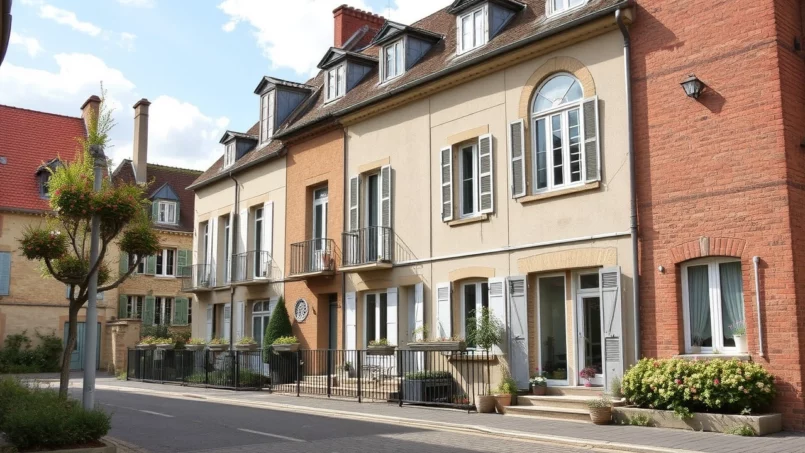
The historic downtown – often associated with the “Plateau,” around City Hall Square, Notre-Dame-la-Grande, and Saint-Pierre Cathedral – concentrates the core of Poitiers’ architectural heritage: medieval buildings, half-timbered facades, Haussmann-style buildings, private mansions, largely pedestrianized cobblestone streets. It’s the preferred area for tourists, students who want to live “in the city,” and young professionals.
The characteristics for an investor are very clear:
– Predominantly tenant population, students or young professionals.
– Stock dominated by studios and 2-room apartments.
– Very strong rental pressure, including during crisis periods.
– Stable demand for standard leases, but also for furnished short-term rentals (Futuroscope tourists, business travel, cultural weekends).
Price-wise, downtown is at the top of the Poitiers range. Available data indicates an average price around €2,500 to €2,650/m², with strong variations depending on size and character of the property:
| Type (Downtown) | Average Price per m² |
|---|---|
| Studio | ≈ €2,930/m² |
| 1/2-room apartment | ≈ €2,800/m² |
| 3-room apartment | ≈ €2,220–€2,470/m² |
| 4-room apartment | ≈ €1,950/m² |
For very beautiful classified properties, on the most expensive streets (Place du Maréchal Leclerc, Rue des Cordeliers, Rue des Grandes Écoles, Rue Magenta…), prices approach or exceed €3,000/m², with some exceptional properties flirting with €3,800/m².
The average gross yield for a furnished studio in Lyon, which can be increased with an optimized strategy.
This area is perfectly suited for a long-term asset strategy: liquidity upon resale is excellent, rental demand is resilient, and property value is supported by limited supply and public investments in the center (pedestrianization, renovation of the Halles Notre-Dame, facade beautification, new cultural facilities).
Train station / Chilvert neighborhood: yield/asset value trade-off
A ten-minute walk from the historic center, the train station and Chilvert neighborhood is undergoing full transformation. It combines two major assets: immediate access to the TGV (useful for commuters to Paris or Bordeaux) and an urban redevelopment program with new businesses, startup incubators, and renewal of the residential stock.
It has a more family-oriented population, professionals aged 30–50, but also working people who work in Paris or Bordeaux while residing in Poitiers. The built environment consists of small apartment buildings, townhouses often subdivided, with interesting potential for reconversion into smaller units or roommate setups.
Prices are more moderate than in the hyper-center: most data places this neighborhood between €2,000 and €2,500/m². Rental pressure is already very strong, especially for 2 and 3-room apartments, formats well-suited for working tenants or student roommates.
The average gross yield in this area, furnished, is around 6.5%. It’s therefore an excellent compromise between yield and medium-term capital gain potential, as the neighborhood’s redevelopment continues and demand for housing near the station keeps growing.
Saint-Éloi / Breuil-Mingot and Beaulieu: the yield logic
To the east and northeast of the center, the neighborhoods of Saint-Éloi – Breuil-Mingot and Beaulieu embody the pure “yield” strategy. These are relatively recent areas, predominantly residential, with a high proportion of housing built from the 1990s onward, often with good energy ratings.
Purchase prices are significantly more affordable than in the center:
| Neighborhood | Price range per m² |
|---|---|
| Saint-Éloi / Breuil-Mingot | ≈ €1,500–€1,800/m² |
| Beaulieu (apartments) | ≈ €2,260/m² on average |
The tenant base is mixed: students (the location is ideal relative to various campuses), young couples, families, and intermediate professions, predominantly tenants. Above all, demand is very strong, with very little rental vacancy. In some developments, units are re-rented in a few days, sometimes without even a public listing, through co-option and word of mouth.
The profitability figures speak for themselves:
– Saint-Éloi: average gross yield furnished around 7%, with very limited rental risk.
– Beaulieu: city record with estimated gross profitability on furnished rentals at about 7.6% on average.
In other words, these are the neighborhoods to prioritize if your priority is pure profitability, even if it means aiming for slightly less spectacular long-term asset appreciation than in the hyper-center. 2 and 3-room typologies are particularly suitable, but 4-room apartments or small houses for family or student roommates also work well.
Gibauderie and Montbernage / Pont-Neuf: student and hospital hubs
Gibauderie, to the east of the city, and the Montbernage / Pont-Neuf area, close to downtown, constitute two major hubs for the student market. Gibauderie benefits from an ideal location between downtown and the medical, pharmacy, and law campuses, as well as proximity to the university hospital (CHU) which employs nearly 8,000 people (staff and residents). Construction there is mostly recent, often in small condominiums, easy to manage.
The price per square meter that studios can reach in this micro-neighborhood, illustrating the ultra-proximity premium to the faculties and the university hospital.
Montbernage / Pont-Neuf, on the other hand, is a transitional neighborhood between downtown and the law and medical campuses. It has evolved significantly in recent years and attracts students, young professionals, and families. Prices per m² remain contained:
| Neighborhood | Average Price per m² (approx.) |
|---|---|
| Montbernage – Pont-Neuf | ≈ €2,200–€2,250/m² |
| Studios Montbernage | ≈ €2,780/m² |
| 1/2-room apartments Montbernage | ≈ €3,050–€3,650/m² |
Average gross yields furnished in these two sectors are around 7%, with studio rents around €430 excluding fees. Montbernage additionally has the best average property quality score in the city (3.6/5), strengthening its balanced investment profile: good yield, decent asset quality, proximity to downtown, access to Blossac Park and the train station.
West Faubourg, Couronneries, Trois Cités: more specific profiles
The West Faubourg stands out for a greener, more residential living environment, with a higher proportion of houses and an average income level above the city average. Prices are higher than in purely “yield” neighborhoods, but rents follow, especially for large houses rented to student roommates (a formula appreciated by some student groups).
The Couronneries and Trois Cités neighborhoods, historically more working-class, are the focus of ambitious urban renewal programs, particularly in Couronneries where the Kennedy tower was demolished and replaced with modern housing, and where major energy renovation works have been carried out. They are often classified as “development neighborhoods” for investment: starting prices are lower, potential profitability significant, but the investor must accept a longer appreciation horizon and an environment still in transition.
Investment strategies suited to the Poitiers market
Once you have neighborhoods in mind, you need to define a coherent strategy that matches your profile and objectives. In Poitiers, three main approaches emerge.
If your priority is to secure a liquid asset with long-term appreciation potential, the historic downtown center, certain highly sought-after streets (Maréchal Leclerc, Cordeliers, Grandes Écoles…), or character houses near the center are to be favored.
It can be strategic to accept a slightly lower gross rental yield (e.g., 4.5–6%) in exchange for better long-term capital gains and easier resale. Character properties and well-renovated ones are particularly suited for high-end furnished rentals, short-term rentals, or a mix of both (furnished annual lease combined with seasonal rentals).
2. Yield strategy: student peripheries and development neighborhoods
To maximize profitability, neighborhoods like Saint-Éloi / Breuil-Mingot, Beaulieu, Gibauderie, Montbernage / Pont-Neuf, or even certain sectors of Couronneries and Trois Cités are the most indicated. The purchase price / rent ratio is extremely favorable there, with gross yields often exceeding 7% furnished.
Prioritize 2 and 3-room apartments for a single tenant or a pair of roommates, and 4-room apartments or small houses for structured roommate groups. Student demand is evolving towards larger surfaces and quality amenities (fitted kitchen, good insulation, high-speed internet, workspaces), allowing for higher rents and reducing vacancy risks.
3. Balanced strategy: train station, Chilvert, mixed faubourgs
For an investor seeking a compromise between yield and asset growth, the train station / Chilvert neighborhood, part of Montbernage, or the West Faubourg represent good candidates. Profitability remains higher than what is found in many metropolitan areas (around 6–6.5% gross), with a more mixed tenant profile (professionals, families, students) and appreciation potential in the medium term driven by urban projects (redevelopment, new shops, improved mobility).
Renovation, Energy Performance Diagnostics (DPE), and works: a key issue for value and profitability
As everywhere in France, the energy quality of housing is becoming a central parameter for investment. The Climate and Resilience Law provides for a progressive ban on renting energy inefficient properties (DPE F and G rated), with a schedule that tightens each year. This means that purchasing an old, poorly insulated property must include a renovation plan, especially in a university city where tenants are increasingly sensitive to thermal comfort and utility costs.
Renovation costs, in France, vary enormously depending on the nature of the work:
– Light refurbishment / cosmetic update: €250 to €750/m².
– Intermediate renovation: €750 to €1,500/m².
– Major renovation (structure, energy): €2,000 to €4,000/m².
For a 50 m² apartment in Poitiers, a full cosmetic update (painting, flooring, simplified kitchen and bathroom) costs between €15,000 and €35,000. A thorough energy renovation (insulation, windows, heating) significantly increases the budget. These investments improve the DPE rating, allow for rent increases, promote tenant retention, and increase the property’s resale value.
The investor must therefore choose between:
Two strategies are available to the buyer: purchase a property already renovated, with a good Energy Performance Diagnostic (DPE) and little work needed, even at a higher price; or seize a cheaper opportunity requiring significant work. In the second case, it is crucial to establish a realistic budget including a 10 to 20% margin for unforeseen expenses and to systematically inquire about available financial aid, such as the zero-interest eco-loan (éco-PTZ), energy saving certificates, reduced VAT, etc., while keeping in mind that some national aid programs may be temporarily suspended or under modification.
The issue is also regulatory: before undertaking major works, you must check the Local Urban Plan (PLU), submit a preliminary declaration or building permit if necessary (opening load-bearing walls, extension, facade modification, etc.), and obtain approval from the condominium association for work on common areas.
Financing, including for non-residents: what possibilities?
Investing in real estate in Poitiers remains financially accessible thanks to lower per square meter prices than in many regional hubs. However, using credit remains the norm, including for non-resident investors.
French banks grant real estate loans to foreigners, including those outside the EU, provided they present solid applications. For a non-resident, constraints are generally stricter than for a resident:
– Personal contribution often between 20 and 50% of the price, with a standard around 30%.
– Total debt ratio limited to 33–35% of gross income (sometimes lowered to 28% for certain profiles).
– Common loan term of 15 to 25 years.
– Competitive fixed rates on a European scale (around 3.5–4% for long-term loans in 2025).
Banks offer various loan formulas (fixed rate, capped variable rate, mixed rate, interest-only loan), but require in return a complete application including proof of income, bank statements, credit report, proof of assets, and sometimes sworn translations. Opening a French bank account and borrower’s insurance are generally mandatory.
In the case of a rental investment, loan interest is deductible from rental income (under the real income regime), which allows for tax optimization of the operation. For high-net-worth investors, debt can also reduce the potential base for the Real Estate Wealth Tax (IFI).
Rental taxation: student furnished rentals, LMNP, and other schemes
French taxation may seem complex, but it offers real levers for the investor, especially in a student city like Poitiers where furnished rentals are very common.
In the case of a furnished rental (typical scenario for a studio or 2-room apartment rented to a student), rents are taxed under the category of Industrial and Commercial Profits (BIC). Two regimes are possible:
For furnished rentals, two main tax regimes exist. The Micro-BIC applies if annual receipts are below a ceiling (currently > €70,000). It benefits from a flat-rate allowance of 50% on rents. The real income regime, on the other hand, allows deduction of all real expenses (loan interest, property tax, works, etc.) and depreciation of the property and furnishings. The latter regime can often offset a large part of the tax on rental income, or even generate a deficit that can be carried over against other property income.
Most small furnished rental investors in Poitiers fall under the status of Non-Professional Furnished Landlord (LMNP), which remains accessible as long as rental receipts do not exceed €23,000 per year or 50% of household income. This status is particularly suited to a portfolio of apartments intended for students.
In the case of an unfurnished rental, you move into the property income regime:
– Micro-property below €15,000 annual rent, with a 30% allowance.
– Real income regime above that or by election, with deduction of real expenses.
In Poitiers, investment in new builds is possible via schemes like Pinel (or its successor), subject to compliance with zoning and rent ceilings. Other schemes such as Denormandie (for renovation in specific zones) or Loc’Avantages (tax reduction for rents below market rate) may also apply, particularly in renovation neighborhoods like the Couronneries.
For non-residents, taxation becomes more complex with the combination of French taxation (income tax + social charges or solidarity tax) and taxation in the country of residence, governed by international tax treaties. It is then highly recommended to be advised by a specialized tax consultant.
Short-term rentals and Airbnb: a niche to handle with caution
The presence of Futuroscope, the city’s tourist and cultural dimension, and TGV access have naturally fostered the growth of short-term rentals in Poitiers (Airbnb type). Analyzed data for the Poitiers archdiocese reports several thousand active listings, with a median annual revenue above €6,000–€7,000, a median occupancy rate of about 48%, and average nightly rates around €55–€90 depending on the property’s performance.
In the city itself, around 650 listings are active, dominated by over 80% entire homes, often studios or 2-room apartments. The best listings (top 10%) show occupancy rates above 80% and monthly revenues regularly exceeding €2,000.
For an investor, the hyper-center or proximity to a train station can represent an interesting additional layer of profitability. However, this investment strategy comes with specific conditions to consider.
– An excellent location (downtown, immediate proximity to the train station, tourist sites).
– A superior level of amenities (decoration, equipment, bedding, etc.).
– Time or a concierge service to manage check-ins/check-outs, cleaning, and customer relations.
– Regulatory monitoring: even if regulation is less strict than in Paris or Bordeaux, registration, tax, and property use rules must be respected, and the city could tighten its framework in the future if pressure increases.
In Poitiers, short-term rentals should therefore be seen as a strategic complement for certain well-located properties, rather than as a sole model, especially if thinking long term.
Preparing your project well: from search to preliminary sale agreement
The acquisition process in France is highly regulated and follows fairly standardized steps, whether you are a resident or not. In a city like Poitiers, where some very well-located properties sell in less than 30 days, it’s useful to plan ahead.
The typical process is as follows:
Investing in student rental property follows a structured process. It begins with defining the budget, borrowing capacity, and strategy (asset growth, yield, roommates, etc.). It is advisable to obtain a pre-approval from a bank for a comfort letter. Neighborhood prospecting, ideally with a local professional who knows the going rents, precedes submitting a written purchase offer, often conditional. Next, signing a preliminary sale agreement, outlining price, timelines, and conditions precedent (loan, inspections), is followed by a legal 10-day cooling-off period. A security deposit (5 to 10% of the price) is paid to the notary. Compiling the loan application, including the bank’s appraisal, leads to obtaining the final loan offer. Finally, after funds are assembled (contribution and loan) and home insurance is subscribed, the final deed is signed at the notary’s office, typically 2 to 3 months after the preliminary agreement.
Throughout this period, the notary handles legal checks, ensures the property is free of problematic encumbrances, that the condominium is in order, and that the inspection reports (DPE, asbestos, lead, electricity, gas, etc.) are attached.
For a rental project, it is essential to plan several aspects in parallel: the choice of tax regime (such as LMNP real income, micro-BIC, or property income), the management mode (direct or via an agency), planning of works and the rental timeline, as well as precisely defining the target tenant (students, young professionals, families, etc.).
Frequent mistakes and best practices for investing in Poitiers
Even in a favorable market like Poitiers, certain mistakes are common among individual investors:
For a successful student rental investment, it is crucial to avoid several pitfalls: not relying solely on gross yield while overlooking fees, property tax, and unexpected costs; underestimating the importance of the DPE in light of tightening regulations and tenant sensitivity; choosing a surface area that is too large when demand concentrates on studios and small apartments; investing without analyzing the neighborhood, its projects, and its social environment; and finally, neglecting property management, a source of problems and reduced profitability.
Conversely, success factors are well identified:
To maximize profitability and a property’s attractiveness, it is crucial to: choose a very precise location (immediate proximity to a faculty, a strategic bus stop, a major facility, or downtown); adapt the property to its target tenant (functional studio for a single student, optimized 3-room apartment for roommates, house with garden for a family); invest in a good level of amenities (fitted kitchen, storage, fiber internet, good lighting) to improve rent and occupancy duration; carry out smart modernization works (bathroom, kitchen, paint, floors) without sacrificing comfort for yield alone; and rely on local professionals (agents, managers, tradespeople, notaries) who know the micro-markets and the rents actually being charged.
Conclusion: a market still undervalued relative to its potential
Investing in real estate in Poitiers means betting on a city that combines several drivers rarely found together at this price level: a major university, a diversified higher education landscape, a leading university hospital, a tourist hub around Futuroscope, efficient high-speed rail access, and an active urban policy (eco-districts, renewal of working-class neighborhoods, downtown beautification).
The number of cities cited as references for higher rental market prices: Angers, Tours, and some Western agglomerations.
The key, for the investor, is not to get carried away by the high gross yields advertised here and there, but to build a coherent, well-calculated project suited to their profile: heritage hyper-center, yield neighborhood like Saint-Éloi or Beaulieu, balanced hub around the train station or Montbernage. By combining good on-the-ground analysis, optimized taxation (notably via furnished LMNP), and serious management, Poitiers today offers one of the most interesting playgrounds in Western France for those looking to build a durably profitable rental property portfolio.
Disclaimer: The information provided on this website is for informational purposes only and does not constitute financial, legal, or professional advice. We encourage you to consult qualified experts before making any investment, real estate, or expatriation decisions. Although we strive to maintain up-to-date and accurate information, we do not guarantee the completeness, accuracy, or timeliness of the proposed content. As investment and expatriation involve risks, we disclaim any liability for potential losses or damages arising from the use of this site. Your use of this site confirms your acceptance of these terms and your understanding of the associated risks.

Cyril Jarnias is an independent expert in international wealth management with over 20 years of experience. As an expatriate himself, he is dedicated to helping individuals and business leaders build, protect, and pass on their wealth with complete peace of mind.
On his website, cyriljarnias.com, he shares his expertise on international real estate, offshore company formation, and expatriation.
Thanks to his expertise, he offers sound advice to optimize his clients' wealth management. Cyril Jarnias is also recognized for his appearances in many prestigious media outlets such as BFM Business, les Français de l’étranger, Le Figaro, Les Echos, and Mieux vivre votre argent, where he shares his knowledge and know-how in wealth management.





