
 Published on and written by Cyril Jarnias
Saint-Nazaire has long been summed up, in the collective imagination, by its shipyards and its major industrial port. Yet, in about fifteen years, the city has profoundly changed. Between the reclamation of its waterfront, the rise of marine energy, university growth, and major urban projects, it has become one of the most closely watched real estate markets on the Atlantic coast.
Saint-Nazaire is of interest to investors due to a robust economy, still affordable entry prices, rising rents, and yields often higher than those in major neighboring cities like Nantes or La Baule. However, this potential comes with specific rules to master, such as the rental permit, energy constraints, local taxation, and coastal risks, to invest with peace of mind.
This article provides a comprehensive overview of the real estate market in Saint-Nazaire, with a particular focus on rental investment, key neighborhoods, yields, taxation, and risks to anticipate.
A maritime territory in full transformation
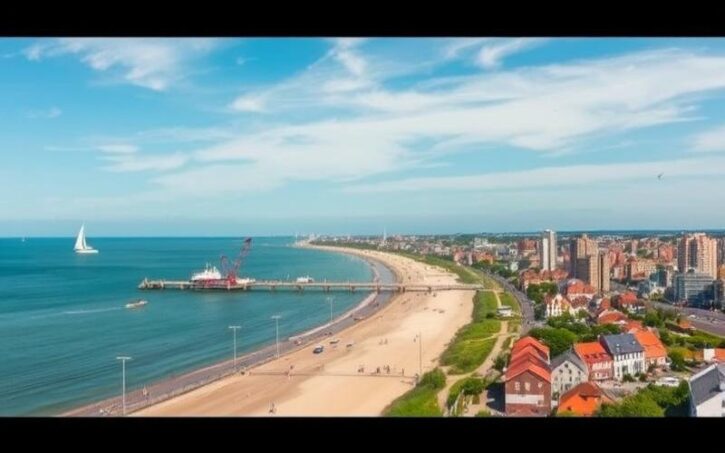
Saint-Nazaire is a port city in Loire-Atlantique, on the Atlantic coast, at the mouth of the Loire River. With over 70,000 inhabitants and a catchment area exceeding 150,000 people, it ranks fourth among cities in the Pays de la Loire region, behind Nantes, Angers, and Le Mans.
The city’s area in square kilometers, including nearly 20 km of coastline and about twenty beaches.
Historically largely destroyed during World War II, Saint-Nazaire was rebuilt in the 1950s. This past explains the presence of many buildings from that period, now modernized or undergoing renovation, which form an important base for the rental stock. For about ten years, the city has embarked on a new phase of transformation: redevelopment of the port-city, revitalization of industrial neighborhoods (Méan-Penhoët, Petit Maroc, Plaisance, Trébale), development of eco-districts like La Chesnaie, and major “Maritime and Coastal Ambition” calls for projects.
This urban movement is supported by a clear positioning: to make Saint-Nazaire an innovative, green, student-friendly, and attractive port city, and no longer just a factory town focused on its shipyard.
A solid economy that secures rental demand
For an investor, the first question is the territory’s ability to create jobs and attract residents. On this front, Saint-Nazaire ticks many boxes.
The historical pillars remain extremely powerful. The Chantiers de l’Atlantique directly employ about 3,000 people and generate over 7,000 indirect jobs. This site is one of the few shipyards in the world capable of building ships over 300 meters long, like the Queen Mary 2 or recent large cruise liners. In aeronautics, the Airbus Atlantic site brings together about 2,600 employees specialized in fuselages. The Grand Port Maritime Nantes Saint-Nazaire represents over 1,500 direct jobs in logistics, maritime transport, and maintenance.
Saint-Nazaire’s industry has diversified beyond shipbuilding into aeronautics, marine renewable energy, mechanical engineering, and logistics. The offshore wind farm and its maintenance have created several hundred jobs. The city also hosts many SMEs and startups in digital and industrial services. With over 20% of the workforce employed in industry, a rate well above the national average, this diversification explains the resilience of local employment.
Employment figures confirm this dynamism. Between 2020 and 2024, it is estimated that about 8,000 jobs were created in the Saint-Nazaire area. The total number of positions has increased by around 5% in a few years, with unemployment below the national average (between 8 and 9% depending on sources). This vitality mechanically translates into sustained demand for housing for employees of major industrial companies, as well as for the myriad of subcontractors, temporary workers, consultants, and executives on assignment.
The Saint-Nazaire campus of the University of Nantes, which includes the IUT (University Institute of Technology), Polytech, health training programs, AFPA, and GRETA, hosts about 5,000 students. The Saint-Nazaire IUT is particularly renowned in several technical fields, attracting a constant flow of young adults looking for studios, 2-room apartments, or shared housing. This student population, energized by the Conseil de la Vie Étudiante Nazairienne (CVEN), contributes significantly to the tightness of the city’s rental market.
The whole forms a secure foundation for the investor: a major industrial city in western France, driven by export sectors, future-oriented industries (offshore wind, marine energy, digital), and a growing university hub. All these arguments limit vacancy risk and support rents over the long term.
A dynamic real estate market, still affordable
Despite this economic dynamism, Saint-Nazaire remains significantly more affordable than major regional cities and the highly sought-after coast of La Baule or Pornichet. This combination of affordability and yield is one of the keys to its attractiveness for investors.
Price levels: a rising market but below major cities
The most recent data indicate an average price of around €2,966/m² as of January 1, 2026, according to the FNAIM index, a level generally consistent with the many figures hovering around €2,800 to €3,000/m² for existing properties. Over five years, apartment and house prices have increased by about 47%, but with a recent cooling phase: some sources mention a slight decline of about 1.7% between 2024 and 2025.
In practice, prices vary quite significantly depending on the type of property and the neighborhood. The following table gives an order of magnitude of the levels observed in early 2026 for existing properties (excluding prestige waterfront).
| Property Type | Average Price (€/m²) | Observed Range (€/m²) |
|---|---|---|
| Apartment (overall) | ~2,885 | 1,918 – 3,727 |
| House (overall) | ~3,088 | 2,041 – 3,973 |
| 1-room Apartment | ~3,258 | — |
| 2-room Apartment | ~3,098 | — |
| 3-room Apartment | ~2,903 | — |
| 4+ room Apartment | ~2,685 | — |
| 3-room House | ~3,231 | — |
| 4-room House | ~3,133 | — |
| 5-room House | ~3,050 | — |
| 6+ room House | ~3,034 | — |
For comparison, an apartment trades around €5,000/m² in Nantes and exceeds €10,000/m² in Paris. On the nearby coast, La Baule and Pornichet hover around €5,000 to €5,500/m² for new builds. Saint-Nazaire therefore remains significantly below, even though new builds in Saint-Nazaire can reach or exceed €4,500/m² for the highest-quality developments (new residences in Parc Paysager, Jardin des Plantes, or on the waterfront).
The city is located in an area that is still affordable on a regional scale, which is particularly attractive for investors coming from more expensive markets. This situation suggests potential for medium-term appreciation, driven by the completion of urban projects and the upgrading of certain areas.
Price trends: marked increase, then stabilization
Price trends over the last decade tell a two-part story. In April 2009, the average square meter was around €2,400, already below the national average at the time (about €3,200/m²). Since then, several upward phases have followed, with a clear acceleration since 2020, in the wake of increased appeal for medium-sized coastal cities after the health crisis.
Over the last five years, the overall increase in real estate prices is on the order of 40 to 50% depending on the segment.
For the investor, this trajectory offers a dual interest: an already realized increase that validates the area’s attractiveness, and a probability of stabilization or more moderate growth in the medium term, which is rather reassuring against the risk of a bubble. Furthermore, prices remain lower than those of many cities of similar standing on the Atlantic coast.
Strongly rising rents and high demand
The second pillar of profitability in Saint-Nazaire is the rental market dynamic. The rental market is both tight and undergoing a full revaluation.
Recent data show a median rent for apartments around €11/m², with a range of €7 to €18/m² depending on location, size, and condition of the property. For houses, the average reaches about €12.3/m², between €9 and €16/m². Between 2023 and 2025, rents reportedly surged by about 12% in a single year, and cumulative increases over five years exceed 20% for the smallest units.
Median rent levels observed for apartments (excluding charges) over the last twelve months.
Median rent for a studio.
Median rent for a 2-room apartment.
Median rent for a 3-room apartment.
Median rent for a 4+ room apartment.
| Housing Type | Median Rent (€/m²) | 1-year Change | 5-year Change |
|---|---|---|---|
| 1-room | 13 | +9.4% | +22.5% |
| 2-room | 11 | +1.8% | +10% |
| 3+ room | 10 | +3.6% | +7.4% |
This tightness translates in practice into very short rental times: a well-located and properly presented property often rents in a few days. The vacancy rate remains limited, around 8.2% of empty homes, which is low for a city of this profile. Nearly 50% of residents are tenants, confirming the importance of the rental stock in the market’s functioning.
The number of new homes delivered in a recent year, well below the target of 1,200 set by the Local Housing Program.
In this context, furnished rentals and shared housing particularly stand out. Furnished properties rent on average 15 to 20% higher than unfurnished units of equivalent size. Well-calibrated shared housing (3 or 4-room apartments converted to accommodate 3 or 4 bedrooms) frequently exceed 7% gross yield, or even more in some neighborhoods with contained purchase prices.
Yields higher than major cities
One of the major arguments in favor of Saint-Nazaire is its profitability. The average gross rental yield is estimated around 5.5 to 6.4%, with significant variations depending on neighborhoods and strategies. In certain so-called “yield neighborhoods” like La Bouletterie, Méan-Penhoët, or La Chesnaie, lower purchase prices (between €2,000 and €2,400/m²) regularly allow reaching 6.5 to 8% gross yield, sometimes more for shared housing or short-term rentals (in permitted zones).
Difference in gross rental yield in percentage points in favor of Saint-Nazaire compared to Nantes or Paris.
The order of magnitude can be summarized as follows:
| City | Average Price (€/m²) | Average Gross Yield |
|---|---|---|
| Saint-Nazaire | ~3,000 | 5.5 – 6.5% (up to 8%) |
| Nantes | ~5,000 | 3 – 5% |
| Paris | ~10,000 | 2 – 3% |
The net yield of course depends on the chosen tax regime, expenses, renovation work, and management, but the starting point is clearly in favor of Saint-Nazaire. This is even more true for investors who can optimize their taxation with furnished rentals (LMNP) or by combining renovation and schemes like Denormandie.
Neighborhoods to invest in Saint-Nazaire
The city presents a contrasted urban landscape, where high-end waterfront, a commercial city center, revitalizing popular neighborhoods, and quiet suburban areas coexist. For an investor, the choice of neighborhood conditions both the yield and the prospects for appreciation.
Waterfront, Saint-Marc, Villès-Martin: high-end coastal areas
The urbanized coastline, particularly around Saint-Marc-sur-Mer, Villès-Martin, or the waterfront near Jardin des Plantes, concentrates the city’s highest prices. Values there are generally between €3,800 and €4,500/m² for existing properties, or even more for prestige villas with sea views. There are many single-family homes, sometimes Belle Époque villas, and increasingly contemporary, very bright constructions.
This sector targets more patrimonial investors who prioritize location quality and the hope of long-term capital gains, or high-end seasonal rentals. Gross yields there are logically more modest than in popular neighborhoods, but rental demand remains solid, particularly for family homes and furnished properties near beaches.
City Center / Ville-Port / Hyper-centre: the commercial and student heart
The city center, the Ville-Port area, the hyper-centre around Jardin des Plantes or the City Hall offer an interesting compromise. Prices revolve around €3,000 to €3,500/m², with strong demand from young professionals, students, and seniors seeking proximity to shops, transport (SNCF train station, STRAN buses), the urban waterfront, and cultural facilities (Théâtre Simone Veil, media library, cinema, Ruban Bleu, etc.).
These are preferred areas for investments in furnished studios and 2-room apartments, but also for 3 or 4-room apartments suitable for shared housing. Demand is constant, both for yearly rentals and for urban seasonal rentals near the renovated submarine base, museums, bars, and waterfront restaurants.
Among the highly sought-after micro-sectors, Jardin des Plantes stands out for its sea view and high standing. The train station neighborhood, north of the center, is also very dynamic, with a dense commercial fabric and a business district project around the TGV high-speed train service.
“Yield” neighborhoods: Méan-Penhoët, La Bouletterie, Chesnaie
For investors seeking high gross yields, the neighborhoods classified as “yield” areas are worth a close look. Méan-Penhoët, La Bouletterie, and La Chesnaie have purchase prices between €2,000 and €2,400/m² on average, well below the Saint-Nazaire average. The trade-off lies in a sometimes more popular image and the need to carefully select buildings (condition, co-ownership, neighborhood).
In some sectors, gross yields can reach 6.5 to 8%, particularly for 3 or 4-room apartments rented as shared housing to industrial workers or apprentices. These properties also lend themselves to energy renovations, allowing for public aid and future added value linked to urban renewal projects.
However, note a crucial point: Méan-Penhoët, La Bouletterie, and part of the old city center (République / Paquebot) are subject to a mandatory “rental permit”. This requires filing an application and obtaining authorization before any rental, under penalty of fines up to €5,000 (and €15,000 in case of repeat offense). The same spirit guides the “division permit” in certain streets, intended to limit abusive divisions into micro-apartments.
Residential and developing sectors: Parc Paysager, Immaculée, west of the city
Other, more residential neighborhoods offer a good compromise between quality of life and profitability. Parc Paysager, a large green lung near the center, concentrates many new developments, often eligible for Pinel, with prices around €4,300 to €4,800/m² in the most recent residences. Immaculée, to the north, is known for its suburban setting and proximity to large commercial zones.
To the west, large developments are creating new neighborhoods mixing houses and small apartment buildings, with public amenities. These sectors, close to major employers, attract families looking for a house with a garden. They are suitable for long-term rental investment (quality unfurnished or furnished rental), with a prospect of gradual appreciation.
Petit Maroc, submarine base, Ville-Port: areas with high potential
Around the renovated submarine base, the Petit Maroc neighborhood, and Ville-Port, the city has launched major “Maritime and Coastal Ambition” projects. A national maritime hub is emerging there (SNSM training center, marine center, event and retail spaces), new housing, office spaces, and a redevelopment of public spaces.
Prices there are already higher than in popular neighborhoods, but the potential for appreciation remains significant as these projects are delivered. For an investor seeking capital gains and a position in mixed assets (housing, retail, offices), this sector deserves a detailed analysis.
Which types of properties to prioritize?
The structure of the Saint-Nazaire housing stock lends itself to several investment strategies, from student studios to family houses, including shared housing or seasonal furnished rentals.
Statistics show that nearly half of the homes are apartments, many from the 1950-1970 reconstruction. Houses represent the other half of the stock, with a wide range from small townhouses to high-end coastal villas.
We can identify a few major categories of interesting products for the investor:
Overview of different types of housing suitable for rental investment, categorized by target market and yield potential.
Ideal for students and young professionals in Ville-Port, train station, or near campus areas. Perfectly suited for furnished rentals.
In Méan-Penhoët, Bouletterie, or Chesnaie. Potential for conversion to shared housing for industrial workers, apprentices, or young graduates.
In recent developments (Parc Paysager, city center, Saint-Marc). Eligible for the Pinel scheme in zone B1 and have excellent energy performance.
Located west or on the periphery, intended for family rentals. Offer good rental stability and long-term appreciation potential.
On the waterfront or in Saint-Marc-sur-Mer. Target a patrimonial clientele for high-end seasonal rentals or second homes.
The rise of hybrid uses (coliving, telework, private student residences, third places) and the transformation of former industrial premises into lofts or atypical housing complete these scenarios for more opportunistic investors.
Land, local taxation, and national aids: what you need to know
Investing in Saint-Nazaire also means integrating a particular fiscal environment, both local (property taxes, waste collection tax, CFE) and national (Pinel, Denormandie, LMNP, upcoming reforms).
Property tax: updated bases as of 2026
The property tax is due each year by the owner as of January 1, whether they occupy the property or not. In Saint-Nazaire, the municipal rate for property tax on built properties increased from around 38.45% in 2022 to about 41.10% in 2023. To this are added inter-municipal contributions and the TEOM (waste collection tax), which climbed about 10% to 15% over the same period.
This is the estimated average increase in property tax per home at the national level, following the reform scheduled for 2026.
For the investor, it is therefore essential to integrate the property tax (and its possible future increase) into net profitability calculations. To date, the annual charge often equals about one month’s rent.
Complementary local taxes: secondary residence tax, Gemapi, CFE
The residence tax has been abolished for primary residences but remains due for secondary residences and certain furnished tourist rentals. The municipal rate in Saint-Nazaire was around 13.31% in 2023. Non-resident owners or those who keep a pied-à-terre are particularly concerned.
In addition, there is the Gemapi tax, dedicated to managing aquatic environments and flood prevention. It represents a small fraction of local contributions but makes sense in a coastal city exposed to submersion risk and sea-level rise.
Turnover threshold below which a CFE (Business Property Tax) exemption may apply for furnished rental landlords.
National schemes: Pinel, Denormandie, LMNP, Malraux, etc.
Saint-Nazaire benefits from a particularly interesting status for national rental investment schemes:
Several tax schemes are applicable in Saint-Nazaire for rental investment. The Pinel law in zone B1 concerns new builds or off-plan sales, with rent and income ceilings, and offers a tax reduction. The Denormandie law, via the ‘Action Cœur de Ville’ program, applies to existing properties to be renovated (renovation costs ≥ 25% of the price) in the city center, with tax advantages similar to Pinel. The LMNP (Non-Professional Furnished Landlord) real regime is suitable for furnished rentals (studios, 2-room apartments, shared housing), allowing significant depreciation. Other schemes (Censi-Bouvard, Malraux, Historical Monuments) are possible for specific rehabilitation projects or serviced residences.
The challenge for the investor is to intelligently combine these tools with local specificities: prioritize Denormandie in an old building in the center undergoing revitalization, use Pinel for a new 2-room apartment in a well-located residence in Parc Paysager, or prefer the LMNP real regime for a 3-room apartment purchased below €2,300/m² in a yield neighborhood and fully renovated.
Risks and constraints: energy, rental permit, coastline
A successful investment in Saint-Nazaire also requires anticipating the risks and constraints specific to the city.
Energy performance and rental bans
As everywhere in France, properties rated F or G on the Energy Performance Diagnostic (DPE) are under the legislator’s scrutiny. Rent increases are already regulated for these properties, and the most energy-inefficient homes (exceeding 420 kWh/m²) are gradually banned from rental. Since 2025, a property rated G above this threshold can no longer be offered for rent.
A large portion of Saint-Nazaire’s housing stock, built between 1960 and 1980, has low energy performance. Insulation work, window replacement, ventilation, or heating upgrades are often necessary. These renovations can be partially financed by public aid like MaPrimeRénov’, zero-interest eco-loans, or reduced VAT rates. They allow increasing the property’s value and its rental income potential.
It is estimated that an average renovation budget of €25,000 can increase annual rents by €2,000 to €3,000 and revalue the property by 15 to 20%. In Saint-Nazaire, where the price base is still relatively low, this renovation lever can be particularly profitable, especially in popular neighborhoods slated for revitalization.
Rental permit and division permit
To combat substandard housing and slumlords, the CARENE (local authority) and the city have instituted a “rental permit” in certain neighborhoods: Méan-Penhoët, La Bouletterie, and part of the old city center around République / Paquebot. Before any rental, the owner must file an application and obtain authorization, which helps verify compliance with decency and health standards. In case of non-compliance, the fine can reach €5,000, or even €15,000 for repeat offenses.
The creation of several micro-apartments by dividing a large property is regulated by a “division permit.” This administrative step, essential for investors, must be anticipated to avoid abusive divisions.
Coastal risks and corrosion
Saint-Nazaire is directly exposed to coastal risks: sea-level rise, storms, possible submersion in certain low-lying areas (Ville-Port, some waterfront sectors). Added to this is a more discreet but real phenomenon: accelerated corrosion of materials by salty air, which requires appropriate choices (stainless steels, marine paints, more frequent maintenance of facades and railings).
For an investor, this means it is necessary to precisely analyze the property’s situation regarding natural hazards (risk prevention plans, altitude, immediate proximity to water) and integrate into the business plan a slightly higher maintenance cost for coastal properties.
Saint-Nazaire and seasonal rentals: potential and regulation
Tourism plays a growing role in the local economy, even though the city remains primarily an industrial hub. The proximity of La Baule, Pornichet, Guérande, or the Brière natural park, combined with the redevelopment of the waterfront and the submarine base transformed into a cultural and leisure hub, attracts more and more visitors.
The market is already well developed with several hundred active listings on platforms like Airbnb. Most rentals are entire apartments, primarily 1 and 2-room units. The clientele is mostly French, with a significant proportion of German travelers. Occupancy rates peak seasonally in summer, while demand is more regular the rest of the year, supported by business travel.
The median monthly revenues for these rentals are around $900 to $1,000, while the top 10% of properties can significantly exceed $2,300 in monthly revenue over a rolling year. The associated gross yields, factoring in high seasonality and higher management costs, can exceed 8 or 9% in the most sought-after areas, particularly near beaches, Ville-Port, or the submarine base.
Registration with the town hall is mandatory for any furnished tourist rental. Although local regulation is currently less strict than in major tourist cities, it could evolve if the market becomes unbalanced. To invest prudently, it is advisable to stay informed of local legislative changes and consider diversifying uses, such as mixed rental (student/tourism).
How to build an investment strategy in Saint-Nazaire?
Considering all these elements, several strategy profiles emerge for investing in Saint-Nazaire.
A prudent investor, seeking stability and recurring income, might look towards quality 2 or 3-room apartments in the city center, Ville-Port, train station area, or Parc Paysager, rented unfurnished or furnished to couples, young professionals, or families. The gross yield will generally be around 4.5 to 6%, with limited vacancy and near-certain medium-term appreciation, driven by urban projects.
To maximize the profitability of a rental investment in Saint-Nazaire, focus on neighborhoods like Méan-Penhoët, La Bouletterie, or La Chesnaie. The strategy involves acquiring a property at a contained price (often below €2,400/m²), such as a building needing renovation or a large apartment convertible for shared housing. By carrying out energy renovation work and opting for the LMNP (Non-Professional Furnished Landlord) real regime, it is possible to achieve a gross yield of 7 to 8% and strongly reduce income tax on rental earnings.
A saver facing high tax pressure and concerned with tax reduction might consider new developments eligible for Pinel B1 or Denormandie in the old center. Even if the gross yield is a bit lower there, the tax reduction and the intrinsic quality of the homes (energy performance, ten-year guarantees, attractiveness for tenants) partly offset this gap, with very comfortable occupancy rates.
For a patrimonial investment, it is advisable to target rare properties such as houses or villas on the waterfront (Saint-Marc-sur-Mer, Villès-Martin) or large character homes in the city center. This strategy accepts more modest gross yields to bet on location value and long-term appreciation.
Regardless of the chosen scenario, some principles remain constant: analyze the neighborhood in detail (prices, rental demand, urban projects), anticipate the impact of energy standards on older properties, integrate local taxation and rental/division permits into the setup, and rely, if necessary, on local professionals who know the Saint-Nazaire market well.
Saint-Nazaire is no longer just a “working port” but a coastal city establishing itself as a full-fledged real estate market, combining yield, growth prospects, and quality of life. For the investor able to look beyond industrial clichés, it now offers one of the most promising playgrounds in the Greater West of France.
Disclaimer: The information provided on this website is for informational purposes only and does not constitute financial, legal, or professional advice. We encourage you to consult qualified experts before making any investment, real estate, or expatriation decisions. Although we strive to maintain up-to-date and accurate information, we do not guarantee the completeness, accuracy, or timeliness of the proposed content. As investment and expatriation involve risks, we disclaim any liability for potential losses or damages arising from the use of this site. Your use of this site confirms your acceptance of these terms and your understanding of the associated risks.

Cyril Jarnias is an independent expert in international wealth management with over 20 years of experience. As an expatriate himself, he is dedicated to helping individuals and business leaders build, protect, and pass on their wealth with complete peace of mind.
On his website, cyriljarnias.com, he shares his expertise on international real estate, offshore company formation, and expatriation.
Thanks to his expertise, he offers sound advice to optimize his clients' wealth management. Cyril Jarnias is also recognized for his appearances in many prestigious media outlets such as BFM Business, les Français de l’étranger, Le Figaro, Les Echos, and Mieux vivre votre argent, where he shares his knowledge and know-how in wealth management.





