
 Published on and written by Cyril Jarnias
Investing in real estate in Nanterre is no longer just a bet on a suburb close to Paris. It’s stepping into an already very tight market, driven by its immediate proximity to La Défense, a massive job hub, a major university center, and a series of urban projects transforming the city’s face. With prices still significantly lower than in Paris but up 21% over five years, Nanterre positions itself as one of the most strategic playgrounds for investors in the Île-de-France region.
Good to know:
Paris presents solid assets for rental investment with an average yield of 4.5%, a high proportion of tenants (nearly 70% of households), and extreme market tightness (score 10/10), reinforced by the Grand Paris Express construction projects. However, risks must be considered: high unemployment, significant local taxation, regulatory constraints on rentals, and strong disparities between neighborhoods.
Nanterre, a market driven by its location and demographics
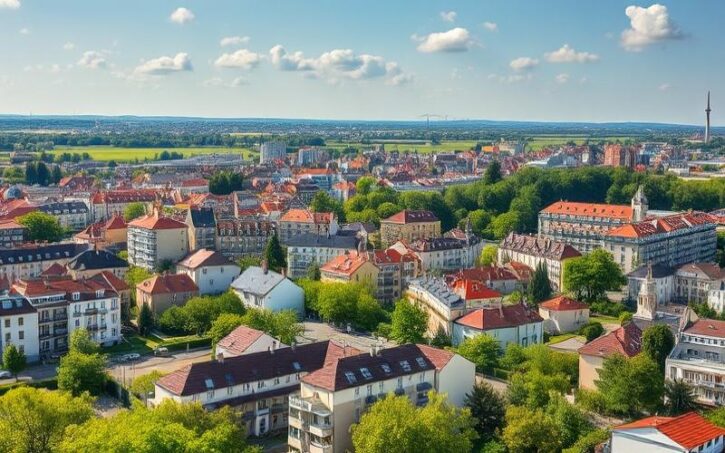
Nanterre is the prefecture of the Hauts-de-Seine department, located in the western suburbs of the capital, about ten kilometers from Paris and at the heart of the La Défense area. With 96,277 inhabitants, a density of nearly 79,000 inhabitants per km² and a population growth of +5.9%, the city stands out for its vitality, boosted by a very young profile: the median age is 34 and half the population is under 30.
33000
Number of students at Paris Nanterre University, fueling a permanent pool of tenants.
Economically, Nanterre doesn’t just live in the shadow of La Défense: it is part of it. The city constitutes, after Paris, one of the main job basins in Île-de-France, with over 96,000 jobs and more than 95,000 employees commuting in daily. It hosts the headquarters or major sites of groups like EDF, TotalEnergies, AXA, Capgemini, Atos, as well as many SMEs and over 8,000 registered businesses.
This solid economic base, combined with a dynamic regional job market, ensures a constant flow of working professionals, executives, students, and families seeking housing near transportation. This largely explains the very high proportion of tenants (nearly 69.4% of residents), a key indicator for any investor.
A tight residential market, rising but still competitive prices
The real estate market in Nanterre is described as “dynamic” by available data, and that’s no understatement. The number of buyers is 20% higher than the number of properties for sale, resulting in a maximum real estate tightness score: 10/10. Practically, this means shorter sales times, reduced room for negotiation, and upward pressure on prices.
Sale prices: between opportunities and catching up to Paris
Prices in Nanterre have seen notable growth: +21% over five years, even +28 to +40% over ten years according to some historical series. Yet, they remain well below those of the capital, where the square meter hovers around €9,500 to €11,000 on average, not to mention central neighborhoods and prime sectors.
In Nanterre, current levels fall within the ranges below.
Average Sale Prices in Nanterre (whole city)
| Property Type | Average Price per m² | Observed Range (€/m²) |
|---|---|---|
| All properties combined | €6,033 | — |
| Apartment | €5,608 | €3,920 – €7,532 |
| House | €6,560 | €4,017 – €10,019 |
We’re still in the €3,000 to €7,000/m² range depending on neighborhoods and property quality, which is two to three times cheaper than many Parisian sectors, even when compared to outer arrondissements. On the other hand, Nanterre is gradually approaching the prices of highly sought-after towns in the first ring like Boulogne-Billancourt or Levallois-Perret: the price “gap” with Paris tends to be shrinking.
A predominantly rental and urban housing stock
The residential stock comprises about 42,000 to 43,000 homes according to sources and 38,326 recorded households. The structure is typically urban: over 85% apartments versus barely 13 to 14% single-family homes. Of the 35,988 primary residences, the distribution by home size is fairly balanced but with a very interesting target core for the investor:
Distribution of Primary Residences by Number of Rooms
| Typology | Number of Homes | Share of Primary Stock |
|---|---|---|
| Studios | 3,383 | 9.4% |
| 2-room | 7,737 | 21.5% |
| 3-room | 11,660 | 32.4% |
| 4-room | 8,529 | 23.7% |
| 5-room and more | 4,678 | 13.0% |
2 and 3-room apartments represent over half the stock, which perfectly matches the demand from students, young professionals, and young couples, the core target of private rentals. The presence of 9.4% studios fuels a segment particularly sought after for furnished rentals, often with high yields.
69.4
Percentage of primary residences occupied by tenants, of which 44% are social housing, illustrating a deep and stable rental market.
A favorable regional macro context
At the Île-de-France regional level, the market is emerging from a correction phase and entering a cycle of stabilization, even a slight recovery. Prices for older apartments in the Paris region are picking up, with an annual increase of about 0.1% in early 2025 and forecasts of 1 to 5% growth across the region according to notaries. In the Hauts-de-Seine department, the average price for older apartments is around €5,910/m², close to the levels observed in Nanterre, confirming the consistency of local prices.
Tip:
Mortgage interest rates stabilized around 3% to 3.2% in 2025, after the peak of the rate hike. For an investor, this offers financing conditions that have become more manageable again, without returning to the exceptionally low levels of the 2016–2021 period.
High rents for the inner suburbs, a generally decent yield
To assess the appeal of investing in real estate in Nanterre, one must cross-reference purchase prices with rent levels. Here again, the city displays characteristics close to those of a tight metropolitan market, with high rents per m² and a very low vacancy rate on a regional scale (less than 3% in Île-de-France).
Rent levels: Nanterre well positioned
Available data gives an average rent per square meter of about €21.3/m² for apartments, with a wide range from €15 to €32/m² depending on quality, location, and property condition. For houses, the average rent climbs to €27.5/m², with values potentially reaching €34/m².
We can summarize these levels as follows.
Average Monthly Rents in Nanterre
| Property Type | Average Rent per m² | Range (€/m²/month) |
|---|---|---|
| Apartment | €21.3 | €15 – €32 |
| House | €27.5 | €20 – €34 |
In practice, this translates into typical gross rents like:
– studio: €650 to €900 per month
– 2-room, 40 m²: €900 to €1,200 per month
– 3-room: €1,200 to €1,500 per month
Example:
A simulation illustrates this potential: for a 25 m² studio bought for €125,275 and rented for €750/month, the gross yield reaches 7.2%. For a 40 m² 2-room bought for €200,440 and rented for €1,100/month, it’s 6.6%. These figures, above average, demonstrate the appeal of micro-opportunities on well-located properties.
Rental yield: overall figures and a concrete case
For the entire city, two references are to be noted:
– overall average gross rental yield: about 4.6%
– other measure of average gross yield: 3.82% (according to some listing samples)
Reality in practice lies between these two bounds, with significant variations depending on property type, neighborhood, and rental model (unfurnished, furnished, co-living, student rental, etc.).
Example:
A 66 m² (4-room) apartment located on Allée René Laennec in Nanterre was sold for €331,200. Its potential rent is estimated at €2,026 per month, generating a theoretical gross yield of about 6.8% and an estimated net yield of 5.5%. A five-year projection, incorporating property appreciation and the leverage effect of credit, anticipates an annual performance of 20%. This yield profile depends on specific conditions like purchase price, management model, taxation, and financing.
Comparison with Paris and the rest of France
In Paris, gross residential yields are often between 2% and 3%, sometimes a bit more in the most affordable outer arrondissements (18th, 19th, 20th) where one can aim for 4.0 to 4.5% under good conditions. Nanterre, with its 4 to 4.6% average gross yield and higher potential in some segments, sits in an interesting zone for an investor looking to balance rental security and profitability.
At the national level, gross residential yields around 4.6% on average (across all cities) place Nanterre slightly above Parisian profitability and rather in the upper average of major metropolitan areas, without reaching the 5 to 8% sometimes found in riskier secondary cities (Saint-Étienne, Roubaix, Perpignan, etc.). This is clearly a profile of “decent yield + high liquidity + appreciation potential.”
Neighborhoods with very different profiles: where to invest?
Investing in real estate in Nanterre doesn’t mean buying anywhere at the same price. The city is fragmented into several neighborhoods with distinct dynamics: some already highly valued, others more working-class but offering better yields, others still undergoing major transformation with significant urban projects.
Among the neighborhoods mentioned or documented: Centre, Chemin de l’Ile, La Boule – Champs Pierreux, Parc Nord, Parc Sud, Petit Nanterre, Plateau – Mont Valérien, République, Université, Vieux Pont – Sainte Geneviève.
Parc Sud: expensive, upscale sector, moderate yield
Parc Sud clearly positions itself at the high end of the Nanterre market. Average prices here are well above the city average, around €7,843/m², making it a sector almost comparable to some well-placed neighborhoods in the first ring.
A few indicators illustrate this profile.
Parc Sud Neighborhood
| Indicator | Value |
|---|---|
| Average sale price per m² | €7,843 |
| Number of properties for sale | 2 |
| Average property size | 70 m² |
| Average property condition (score /5) | 3.8 |
| Average furnished rent per m² | €18/m² |
| Average unfurnished rent per m² | €18/m² |
| Gross furnished yield | 2.56% |
| Gross unfurnished yield | 2.32% |
This is a sector for appreciation more than for cash flow. Prices have moreover continued to rise recently, with a monthly increase of over 1% at a reference period, while rents aren’t keeping pace at the same rate, compressing yields. This neighborhood may interest a long-term investor betting on location and property quality, but it will be less suited for a yield-focused strategy.
Petit Nanterre: more affordable prices, higher yield
Conversely, Petit Nanterre shows lower prices and more attractive yields, with a more working-class atmosphere and redevelopment potential in some sectors.
Petit Nanterre Neighborhood
| Indicator | Value |
|---|---|
| Average sale price per m² | €5,225 |
| Number of properties for sale | 5 |
| Average property size | 83 m² |
| Average property condition (score /5) | 3.6 |
| Average furnished rent per m² | €22/m² |
| Average unfurnished rent per m² | €18/m² |
| Average gross furnished yield | 3.86% |
| Average gross unfurnished yield | 3.58% |
| Furnished yield range | 3.36% – 4.23% |
The difference with Parc Sud is clear: by accepting a less “premium” environment, one gets a better yield, especially furnished. For an investor ready to target a clientele of middle classes, families, or co-living, this neighborhood can be a good compromise.
Centre, Plateau – Mont Valérien, Vieux Pont: variations depending on home size
Data by property typology also shows price gaps between neighborhoods. For example:
Real Estate Prices by Neighborhood in Suresnes
Summary of median prices per square meter for different property types in the main neighborhoods of Suresnes.
Centre
Studio: ~€8,130/m² | 2-room: ~€5,757/m²
Plateau – Mont Valérien
1-room: ~€5,968/m² | 2-room: ~€6,842/m² | 3-room: ~€6,417/m²
Vieux Pont – Sainte Geneviève
Studio: ~€6,972/m² | 2-room: ~€6,055/m² | 3-room: ~€5,756/m²
These gaps reflect both the attractiveness and scarcity of certain property types. Very central small units, for example, often command a higher price per square meter but also rent at high rates, which can sometimes preserve a decent yield despite the purchase price.
Université, Les Groues, La Boule – Champs Pierreux: the future sectors
Sectors close to Nanterre-Université and the future Les Groues eco-district should be closely watched. Urban transformation projects here are massive: Les Groues, ultimately 76 hectares, 5,000 homes, 230,000 m² of offices, 60,000 m² of shops, 12,000 new residents and as many new jobs, all backed by the future Nanterre-La Folie station (RER E and line 15 of the Grand Paris Express).
Attention:
In La Boule – Champs Pierreux, the construction of an eco-district with several hundred homes and a new multimodal station (tram and metro) represents a capital gains opportunity in the medium/long term for patient investors, despite temporary inconvenience from construction sites.
New developments: betting on new builds and the Grand Paris
The new-build market in Nanterre is particularly active. Over twenty new developments are recorded, concentrated especially in transforming neighborhoods (Parc Nord, Les Terrasses de l’Arche, Chemin de l’Île, La Boule, Les Groues, areas around Hôpital Max Fourestier, etc.).
Flagship example: West Village and its different residences
The West Village project, located near La Défense, illustrates the logic of these operations: contemporary architecture, environmental label (NF Habitat – HQE), energy performance aiming for a DPE B compliant with RT 2012 / RE 2020, extensive outdoor spaces (balconies, terraces, winter gardens), and extended typologies from 2-room to 5-room.
6098
Average price per square meter in this real estate development, with significant variations between units.
Within West Village, several sub-residences like Lexington or Tribeca each target a different positioning: Lexington offers duplexes from 2-room to 4-room in a quiet building opening onto a garden, Tribeca groups 2-room and 3-room apartments aimed notably at an executive clientele working in La Défense.
Other notable developments
Other projects structure the new-build supply:
Our Residences in Nanterre
Discover our selection of new-build real estate developments in Nanterre, offering a diversity of typologies and neighborhoods to meet all your investment or residential projects.
La Boule – Champs Pierreux
Residence of 43 homes, from 2-room to 5-room, including duplexes.
Hôpital Max Fourestier
Residence of about forty homes, also including some duplexes.
Les Groues
Program eligible for the Pinel scheme (while in force), offering apartments from 2-room to 4-room.
Central Square
Located in the La Boule neighborhood, this program offers 27 homes starting from €314,000.
Jardin Hanaé
About twenty homes from 2-room to 5-room, compatible with furnished rental operation (LMNP/LMP).
In total, the current new-build supply represents several hundred units, with a majority of 2-room and 3-room:
Approximate inventory of available new apartments
| Typology | Number of available units |
|---|---|
| 2-room | 73 |
| 3-room | 158 |
| 4-room and more | 156 |
For an investor, new builds offer clear advantages: reduced notary fees (2 to 3% versus 7 to 8% for older properties), exemption from property tax for two years, energy performance limiting risks related to future rental restrictions on energy-inefficient properties, ten-year and two-year warranties, etc. In return, gross yields are often lower than for older properties, because purchase prices are higher, especially in well-located developments.
Accessibility, transportation, and long-term appreciation
Nanterre’s DNA is intimately linked to transportation. The city is already very well connected, and it will be even more so with the Grand Paris Express, the extension of the RER E, and new tram lines.
Today, Nanterre is served by three RER A stations (Nanterre-Préfecture, Nanterre-Université, Nanterre-Ville), by the Transilien line L, and by numerous bus lines. La Défense station is only one RER stop away for some neighborhoods, and it usually takes about fifteen minutes to reach central Paris.
Good to know:
From tomorrow, Nanterre’s accessibility will be greatly improved by the connection of Nanterre-La Folie to the RER E (link La Défense – Gare du Nord in 10 minutes) and to line 15 of the Grand Paris Express (quickly serving Saint-Denis Pleyel, Saint-Cloud, and the Hauts-de-Seine loop). Furthermore, the extension of tram lines, notably T1, and the creation of new stations at La Boule will reinforce this attractiveness.
Now, all studies converge: proximity to major transport (RER, metro, tram) and reduced travel time to major job basins generate substantial value premiums, both in sale prices and rents, and result in lower vacancy rates. In comparable metropolitan areas, price increases of 15 to 20% are observed within a 500-meter radius around new stations in the five years following their opening.
For the investor, this means that targeting now the sectors that will directly benefit from these new infrastructures (Les Groues, La Boule, areas around Nanterre-La Folie) can be a relevant medium-term capital gains strategy.
Taxation, additional costs, and investment frameworks
Investing in real estate in Nanterre also requires mastering the French fiscal and regulatory environment, whether it’s local taxes, taxation regimes for rental income, or assistance schemes for homeownership and investment.
Local taxes: property tax and residence tax
As everywhere in France, property owners pay an annual property tax, calculated on the cadastral rental value of the property, to which the rates voted by the municipality, department, and intercommunality apply. The residence tax on primary residences has been almost completely eliminated for the majority of households but remains due on secondary residences.
Tip:
In Nanterre, taxes (residence tax and property tax) are moderate in absolute value, generally between €10 and €20/m² per year each. However, they have seen significant increases in the past, such as the residence tax which rose by 65% between 2002 and 2014. Best practice for an investor is to inquire precisely with the tax office about the exact amount of taxes applicable to the targeted property, and to systematically integrate these charges into their net rental yield calculation.
Acquisition costs, charges, and income taxation
The main items to anticipate are: expenses, income, investments and unforeseen costs.
– notary fees: 7 to 8% for older properties, 2 to 3% for new builds;
– co-ownership charges: often €20 to €50/m² per year for a standard building, more for residences with services;
– household waste removal tax (included in the property tax);
– property management fees (5 to 10% of annual rent if delegated to an agency);
– non-occupant owner’s home insurance;
– potential renovation and compliance work (particularly important in older properties to remain compliant with energy and technical requirements).
Rental income is taxed under different regimes:
– for unfurnished rentals, under the micro-foncier regime (flat-rate deduction of 30% for gross income < €15,000/year) or the actual expense regime (deduction of actual charges, loan interest, renovation, etc.);
– for furnished rentals, under the micro-BIC regime (50% deduction for revenue < €77,700/year) or the actual BIC regime (deduction of charges and depreciation of the property and furniture).
Good to know:
In Nanterre, where small units are numerous and rents per m² are high, opting for furnished rental under the actual expense regime is often relevant. This choice maximizes the deductibility of charges and spreads the tax burden over several years.
Assistance schemes and specific advantages for the area
Nanterre is classified as a Zone A bis, like Paris and the inner suburbs. This zoning has several favorable consequences for investors and first-time buyers:
– eligibility for the enhanced zero-interest loan (PTZ), which can finance up to 50% of the price of a new collective housing unit for first-time buyers under income conditions;
– possibility to benefit from a reduced VAT at 5.5% (instead of 20%) in certain development perimeters (ANRU zones, priority neighborhoods);
– temporary exemption from property tax on built properties for new homes (generally for two years).
The Pinel scheme for new-build rental investment ended in early 2025, but many developments marketed previously remain legally eligible if reserved in time. Otherwise, other regimes (LMNP, LMP, energy renovation schemes with aids like MaPrimeRénov’) can be utilized.
Purchase process: securing your investment
The acquisition process in France follows a fairly standard sequence: offer, preliminary contract (compromis or promesse de vente), 10-day cooling-off period, fulfillment of suspensive conditions (notably loan approval), then signing of the final deed at the notary’s office.
For an investment in Nanterre, several points deserve particular attention:
Attention:
Before any purchase, it is crucial: to analyze the DPE (properties rated G are banned from rental since January 2025 and F ratings will be progressively restricted) and other technical diagnostics; to inquire about voted or upcoming work in the co-ownership, particularly in large complexes from the 1960s-1970s; to check for easements, nearby urban planning projects (transportation, eco-districts, nuisances) and preemption risks; and to anticipate financing by obtaining a bank agreement in principle beforehand, which is a decisive advantage in a tight market.
The notary’s role is central: they legally secure the transaction, verify the chain of ownership, mortgages, easements, risks, and receive funds. It is possible to appoint one’s own notary in addition to the seller’s, with no extra fee cost (the fee is shared).
Risks and points of vigilance: not everything is rosy
While the assets for investing in real estate in Nanterre are numerous, ignoring the risks would be a mistake.
Contrasting socio-economic context
The city shows an unemployment rate of 15.8% among 15–64 year olds, higher than the national average, even if this data can vary by source and year. Certain pockets of the city remain marked by social difficulties, a stock of sometimes run-down older housing, and a certain image still associated with the old industrial belt and large housing estates.
For the investor, this doesn’t necessarily mean an insurmountable rental risk – on the contrary, these neighborhoods often show strong demand for affordable housing – but it requires a detailed study of micro-location, the target clientele, and the type of lease to favor.
Very tight market… but more expensive to buy into
The real estate tightness score of 10/10 in Nanterre means it’s a market of “competing” buyers, with a power balance rather favorable to sellers. Negotiation margins are reduced, decision times are short, and the risk of overpaying for a property exists if one gives in to haste.
Good to know:
After a rise of over 20% in five years, the strongest catch-up phase is probably over. Regional forecasts now indicate moderate price growth, estimated between 1% and 3% per year depending on scenarios. This trend, although positive, calls for caution and does not justify buying at any price anticipating perpetual increase.
Regulatory and energy constraints
As everywhere in France, regulation increasingly governs rentals:
Attention:
Renting out a property is subject to several regulatory obligations: prohibition on renting properties rated DPE G (since 2025), with an extension to F ratings expected; rent caps in certain zones, notably in the Paris region, subject to verification of applicable perimeters; and obligation to provide technical diagnostics (electricity, gas) and comply with decency standards.
Therefore, an investment in older properties in Nanterre requires properly integrating the potential cost of energy renovation: well-rated properties (A to C) sell with a premium of 10 to 15%, while those rated F or G already suffer discounts of 20 to 30% and can no longer be rented without major renovation.
What strategies for investing in Nanterre according to your profile?
Given all these elements, several investment strategies emerge.
Tip:
For a long-term patrimonial investor, target neighborhoods like Parc Sud, Centre, Plateau – Mont Valérien, or certain sections of Vieux Pont – Sainte Geneviève. They offer a pleasant living environment and high liquidity, although gross yields are generally lower there. The ideal is to select a very well-located property, close to an RER station or a future metro station, in a recent or renovated building, and benefiting from a good Energy Performance Diagnostic (DPE).
For an investor oriented towards “balanced yield”, sectors like Petit Nanterre, certain parts of the Université neighborhood, or intermediate zones close to major thoroughfares can offer a good compromise, with yields above the 4% average, especially furnished or in co-living, while remaining in a liquid market.
Good to know:
For an opportunistic investor, the sectors of Les Groues, La Boule – Champs Pierreux, and the surroundings of Nanterre-La Folie are strategic grounds, notably in new builds or older properties to renovate. The trade-off should focus on the entry price, the investment horizon (construction sites will last several years), and the ability to withstand a period of works and nuisances before the full valuation of the neighborhood.
Finally, for an investor specialized in furnished or student rentals, the Nanterre-Université sector is a must: proximity to the campus, direct transport to Paris, high turnover but almost inexhaustible demand. Small units (studios, 1-room, 2-room) should be targeted as a priority, with particular attention to sound insulation and comfort, criteria very sensitive for this type of clientele.
In summary: an already mature market, still evolving
Investing in real estate in Nanterre means accepting to enter a market already well established, neither “bargain” nor overheated like central Paris, but still in a catch-up phase. The combination of a young demography, a very dominant rental stock, exceptional proximity to La Défense and Paris, transportation infrastructure under full development, and major urban projects places the city in a unique position in Île-de-France.
Good to know:
Average gross yields in Nanterre range between 4% and 4.6%, offering a good balance between rental security and profitability superior to Paris. Opportunities for higher yields exist on small units, in certain working-class neighborhoods, or via student furnished rentals, but they require more active management and present increased rental risk.
The key to success, in this context, lies in a few simple principles: analyze each micro-neighborhood in detail, don’t overpay under the pressure of a tight market, integrate the long-term energy and regulatory dimension, and choose a strategy consistent with your investment horizon and risk tolerance. By respecting these safeguards, Nanterre can establish itself as a cornerstone of a well-constructed Île-de-France real estate portfolio.

Cyril Jarnias is an independent expert in international wealth management with over 20 years of experience. As an expatriate himself, he is dedicated to helping individuals and business leaders build, protect, and pass on their wealth with complete peace of mind.
On his website, cyriljarnias.com, he shares his expertise on international real estate, offshore company formation, and expatriation.
Thanks to his expertise, he offers sound advice to optimize his clients' wealth management. Cyril Jarnias is also recognized for his appearances in many prestigious media outlets such as BFM Business, les Français de l’étranger, Le Figaro, Les Echos, and Mieux vivre votre argent, where he shares his knowledge and know-how in wealth management.





