
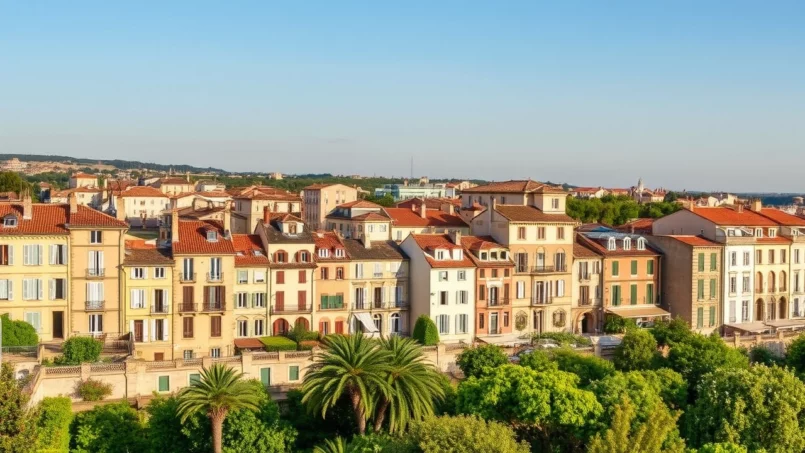
 Published on and written by Cyril Jarnias
Investing in Real Estate in Nîmes is no longer an exotic gamble. The city ticks all the boxes investors look for: still affordable prices, decent rental yields, high demand pressure, a growing job market, solid tourism, a majority-renter population, and major urban projects underway for the years to come.
The Nîmes rental market shows significant price variations depending on the neighborhood and offers various strategies (unfurnished, furnished, co-living, seasonal). It is essential to have a good grasp of the regulatory framework to invest in the right location and anticipate the level of profitability.
A Dynamic Yet Still Accessible Real Estate Market
With a population between 148,000 and 155,000 inhabitants and more than 80,000 households, Nîmes falls into the category of major regional cities, without reaching the pressure of a Montpellier or Toulouse. It is precisely this intermediate positioning that makes it an interesting playing field for investors.
Price Level: More Gentle Per Square Meter Than Its Neighbors
Recent data shows an average price around €2,600 to €2,900/m² depending on the source and property type. The differences between apartments and houses remain contained but real.
| Indicator (Sale) | Indicative Value |
|---|---|
| Overall average price per m² (all sources combined) | ≈ €2,600 – €2,900 |
| Average apartment price (local source) | €2,180/m² |
| Average house price (local source) | €2,663/m² |
| Apartment median (MeilleursAgents) | €2,906/m² |
| House median (MeilleursAgents) | €2,794/m² |
| Low / High range (entire city) | €1,5xx – €7,1xx/m² |
For comparison, Montpellier frequently exceeds €3,500–€4,500/m² for apartments, and some areas on the coast go much higher. Nîmes therefore offers a lower entry price, with the potential for higher yields.
This is the percentage price increase over five years, confirming the attractiveness of the real estate market.
On the Rental Side: Clear Growth and Sustained Demand
In the rental segment, Nîmes shows rents rising faster than inflation over several years, with marked pressure.
| Indicator (Long-term Rental) | Indicative Value |
|---|---|
| Median apartment rent (all sizes) | €12/m² excluding charges |
| Average apartment rent (local data) | €11.5/m² (€8–€18/m²) |
| Average house rent | €10.2/m² (€7–€13/m²) |
| T1 (studio) median | €18/m² |
| T2 median | €12/m² |
| T3+ median | €10/m² |
| 5-year rent increase T1 | +29.9% |
| 5-year rent increase T2 | +12% |
| 5-year rent increase T3+ | +9.6% |
Adding to this is a key fact for an investor: 57.5% of residents are renters. Coupled with a moderate vacancy rate (around 8% vacant housing) and a market described as very tight, this secures the likelihood of finding a tenant quickly, especially in the good areas.
Rental Yield: What You Can Really Expect in Nîmes
Nîmes’ strength lies in its relationship between purchase price, rental level, and appreciation prospects. Average gross yields there are above the French average, with pockets of very high profitability in certain neighborhoods or rental formats.
Overall Yield and National Comparison
At the city level, several indicators align:
| Yield Type | Nîmes (approx.) | France (recent average) |
|---|---|---|
| Average overall gross yield | ≈ 5.1–5.7% | 4.84% |
| Furnished gross yield | 5.63% | – |
| Unfurnished gross yield | 5.04% | – |
| City center yield (Numbeo) | 3.97% | – |
| Outside center yield (Numbeo) | 3.86% | – |
The variations between these figures are explained by methodologies (rents including charges or not, factoring in purchase costs, furnished status, etc.), but the message remains the same: Nîmes is at the high end of the national range, without reaching, however, the extreme levels of cities like Saint-Étienne or some very inexpensive towns.
The Gard department shows an average yield of 4.56%, placing Nîmes above the departmental average.
By Property Type: Studios Win, Large Houses More for Long-term Wealth
A detailed analysis by property type shows that smaller units clearly stand out in gross yield, especially among apartments.
| Property Type | Average Price (€) | Price €/m² | Average Monthly Rent (€) | Approx. Gross Yield |
|---|---|---|---|---|
| Studio Apartment (1 room) | 51,748 | 1,930 | 385 | 8.93% |
| 2-room Apartment | 101,959 | 2,280 | 499 | 5.87% |
| 3-room Apartment | 135,082 | 1,998 | 680 | 6.04% |
| 4-room Apartment | 125,996 | 1,512 | 751 | 7.15% |
| 5-room Apartment | 150,233 | 1,369 | 780 | 6.23% |
| 3-room House | 179,541 | 2,491 | 760 | 5.08% |
| 4-room House | 205,311 | 2,266 | 900 | 5.26% |
| 5-room House | 247,077 | 2,185 | 930 | 4.52% |
Studios come out on top with nearly 9% gross yield, largely thanks to strong demand from students and young professionals and a still very reasonable entry price. Small and medium-sized apartments (T2–T3) offer interesting profitability, with a balance between risk, vacancy, and wealth appreciation.
Large houses are often purchased with a long-term wealth-building or family focus. This strategy prioritizes long-term capital appreciation potential, especially in sought-after residential neighborhoods, over high immediate rental yield.
Which Rental Strategies to Optimize Yield?
The same property can generate very different yields depending on the strategy chosen. In Nîmes, four main models coexist:
| Rental Strategy | Typical Gross Yield in Nîmes |
|---|---|
| Unfurnished long-term rental | 4–5% (up to 5.5%) |
| Furnished rental (LMNP) | 5–6% (peaks around 7%) |
| Co-living | 6–7% (even 8%) |
| Seasonal / Airbnb rental | 7–10% |
Furnished rentals stand out clearly from unfurnished ones thanks to rents that are 15 to 25% higher on average and a more advantageous tax regime (BIC, depreciation, LMNP). Co-living, very popular in some student or central neighborhoods, can boost rents by 20 to 40% compared to a classic rental.
Finally, the seasonal market, driven by tourism exceeding 2 million visitors per year, can offer the highest gross yields, at the cost of significantly heavier management and more demanding regulations.
Where to Invest in Nîmes? Mapping Key Neighborhoods
One of Nîmes’ assets is the diversity of its neighborhoods, with very distinct profiles depending on whether you are targeting wealth appreciation, gross yield, or student / tourist clientele.
The Historic Center (Écusson, Arènes, Esplanade, Placette)
The ancient heart of the city, with the Arena, the Maison Carrée, the Tour Magne, and the narrow streets of Écusson, concentrates a significant share of Nîmes’ real estate value. You’ll find everything from charming old small apartments to renovated buildings.
Prices per square meter generally range from €2,500 to over €3,200/m², with some addresses exceeding this threshold.
| Historic Center Sub-sector | Indicative Average Price €/m² | Profile |
|---|---|---|
| Écusson / Hypercenter | €2,500–€3,200+ | Very touristy, ideal for seasonal |
| Arènes | ≈ €3,319 | Heritage value, events, shops |
| Esplanade | ≈ €2,418 (apart.) | Central, near train station and amenities |
The center clearly appeals to those targeting either high-end heritage assets or short-term furnished rental strategies (Airbnb, tourists, business travel). Studies estimate seasonal yield in Écusson between 6 and 9%, peaking at 10% for the best properties. For classic rentals, gross yields are around 4.8–4.9%.
The constraints are well-known: higher price per m², parking difficulties, sometimes old condominiums requiring work, and for seasonal rentals, a regulatory framework to be scrupulously respected.
Gambetta, Richelieu, Séguier, Casernes: Transforming Neighborhoods
Immediately adjacent to the center, several areas are experiencing a gentrification dynamic, combining still reasonable prices and strong rental demand.
Average price per square meter in the Gambetta neighborhood, up about 30% over five years.
Richelieu, more contrasted, is still in a renovation phase. Prices roughly oscillate between €1,800 and €2,500/m². Yields there are estimated between 6 and 7%, with strong medium-term appreciation potential thanks to ongoing development projects.
Séguier and Casernes stand out with a particularly marked price increase: +30% for the former, about +50% for the latter over five years, with yields around 4.9%. They are clearly on investors’ radar for betting on revaluation.
High-End Residential Neighborhoods: Jardins de la Fontaine, Jean-Jaurès, Guarrigues, Courbessac
For wealth-building investors seeking stability, quality of life, and solvent clientele, these neighborhoods are safe bets.
In the upscale Jardins de la Fontaine area, real estate prices are high, between €2,700 and €3,500/m² (average €3,161/m²). Although rental yield is moderate at around 4.8%, it is offset by strong price resilience and a limited vacancy rate.
Jean-Jaurès, along the eponymous grand boulevard, has similar characteristics: prices from €2,500 to €3,000/m², yield close to 4.8%, clientele of managers and families.
In the hills and residential outskirts, Guarrigues and Courbessac stand out with their houses with gardens, appreciated by families. Guarrigues is around €3,000/m² for houses, Courbessac around €2,500/m². These areas are well-suited for long-term family home investments, rather than seeking high gross yield.
High-Yield Neighborhoods: Pissevin, Mas de Mingue, Developing ZACs
Some peripheral areas offer yields that would make a Parisian investor envious, at the price of higher risk.
Pissevin holds the local record for average gross yield on furnished properties at 13.51%. Prices there are significantly below the city average, but the neighborhood’s perception, unemployment rate, and social issues require particularly rigorous selection of buildings, management, and tenant profiles.
Price per square meter for some new or recent developments in up-and-coming areas of Nîmes.
An investor seeking maximum yield can find good opportunities there, provided they accept more intensive management, a higher risk of vacancy, and careful selection of the micro-area.
Student and Co-living Neighborhoods: Gambetta, Vauban, Serre Paradis, Pasteur
With approximately 13,000 to 25,000 students depending on sources and the presence of institutions like the University of Nîmes, the IUT, the medical school, or Vatel school, Nîmes has a captive pool of renters.
Students are mainly concentrated in the city center, Gambetta, some outer districts, and areas near campuses (Vauban, Serre Paradis, Pasteur, Beausoleil / Aérodrome Ouest). Rents for a student studio start around €350 and go up to €900 for very well-located or equipped units. A room in a co-living setup generally rents for €380 to €430.
These neighborhoods are perfectly suited for:
– furnished studios under LMNP,
– large T4 or T5 apartments converted for co-living,
– small rental properties comprising several studios / T1 bis.
Tourism, Airbnb & Seasonal Rentals: A Powerful Lever… to Handle with Caution
The weight of tourism in Nîmes’ economy is far from anecdotal. More than 2 million visitors per year, a unique Roman heritage in Europe, flagship events like the Feria de Nîmes, recurring cultural festivals: all factors that fuel a very active short-term market.
The Short-Term Rental Market in Numbers
The most recent data lists nearly 1,373 active listings on Airbnb, for a total of about 2,900 vacation rentals in Nîmes. A vast majority (nearly 90%) are entire homes, mostly apartments (64%), with houses representing just over 30% of the market.
| Airbnb / Seasonal Indicator | Indicative Value |
|---|---|
| Number of active Airbnb listings | ≈ 1,373 |
| Share of entire homes | ≈ 89.4% |
| Average capacity | 3.6 travelers |
| Average annual revenue per listing | ≈ €11,500 |
| Average occupancy rate | ≈ 38% |
| Average nightly rate (ADR) | ≈ $128 (~€120) |
| Top 10% of listings (monthly revenue) | ≥ $2,895 |
Seasonality is very pronounced: the peak is between June and August, with occupancy rates that can climb beyond 50% and daily rates rising. January is conversely the quietest month.
Regulation: An Increasingly Strict Framework
The city applies a high level of regulation for short-term rentals. A significant share of listings is declared and licensed (about 65% according to some data). Beyond this figure, investors should mainly remember that they will need to:
Before renting out your property, it is essential to check local rules, notably declaration obligations with the town hall, any potential change-of-use requirements, and applicable quotas. You must also respect maximum allowed rental durations if they exist. Finally, comply with obligations regarding safety, traveler registration, and taxation, such as declaring under Business and Industrial Profits (BIC) and, where applicable, VAT for certain hotel-like services.
For an investor who does not wish to manage it themselves, specialized concierge companies are already established in the local market.
Tax Framework & Recommended Structures for Investing in Nîmes
An interesting gross yield does not necessarily mean good net profitability. Between taxation, condominium fees, property tax, management costs, insurance, and maintenance, optimizing the investment structure plays a key role.
Unfurnished Rental: Security but Heavier Taxation
Unfurnished rental, falling under the category of “property income“, offers relative peace of mind: three-year renewable lease, low turnover, simplified management. The gross yield in Nîmes is around 4 to 5%, sometimes a bit more in certain neighborhoods.
Tax-wise, two main regimes coexist:
– Micro-foncier (simplified) if annual gross rents do not exceed €15,000: a 30% flat-rate deduction on rents, with no possibility to deduct actual expenses.
– Standard regime above this threshold or by option: deduction of all expenses (loan interest, maintenance, property tax, insurance, management, etc.), possibility to create a property deficit deductible from overall income under conditions.
For an investor in Nîmes financing a large portion of their purchase and doing renovation work, the standard taxation regime is often more advantageous. This is particularly true in neighborhoods where the old housing stock needs upgrading, like Gambetta, Richelieu, or some outer districts.
Furnished Rental & LMNP: The Ultimate Tax Weapon in Nîmes
In Nîmes, furnished non-professional rental (LMNP) appears as the most coherent option to combine good rental levels, strong demand, and tax optimization. Furnished rents exceed unfurnished ones by 15 to 25% on average, for gross yields around 5.5 to 6% city-wide, even more for studios.
Tax-wise, furnished rental falls under the BIC (business and industrial profits) regime:
– Micro-BIC if annual revenues remain under a generous threshold: a 50% flat-rate deduction on rents including charges.
– Standard regime by option or if the threshold is exceeded: possibility to depreciate the property (excluding land), furniture, and a large part of acquisition costs, in addition to deducting current expenses.
Applying the LMNP strategy to studios or small apartments located in student neighborhoods, near the city center or job hubs, often allows for a nil or low tax result for many years, while generating positive cash flow. This result, often spectacular, is the core of this investment approach.
Co-living, Seasonal Rentals & Tax Implications
Co-living and seasonal rentals remain, from a tax perspective, a form of furnished rental. The BIC regime and LMNP / LMP statuses apply in the same way. The difference lies in the amount of rents (often higher) and tenant turnover, which increases management costs, cleaning, maintenance, and possibly concierge fees for seasonal rentals.
In addition to income tax, investors are subject to social contributions whose rate varies based on their residence: 17.2% for non-residents outside Europe and 7.5% for those affiliated with a European social security system. Tax treaties with many countries (like the UK, USA, Canada, or Mexico) allow for avoiding total double taxation through tax credit mechanisms.
Capital Gains, IFI & Holding Horizon
For those targeting long-term capital gains, the French framework remains incentivizing: beyond 22 years of ownership, capital gains are tax-exempt, and after 30 years, social contributions are also canceled. In the early years, the overall tax on capital gains can reach high levels (19% income tax + 17.2% social contributions in the general case), but the discount scale strongly favors long-term holding.
Regarding the Real Estate Wealth Tax (IFI), the entry threshold is set at €1.3 million of net real estate assets in France, with a 30% discount for the primary residence. In the Nîmes context where the median price per square meter remains relatively moderate, the IFI only concerns a minority of investors, mainly those holding multiple properties or exceptional assets (mansions, large estates).
Financing an Investment in Nîmes: Rates, Ratios & On-the-Ground Realities
Even if the core of yield lies in the price/rent couple, financing conditions play an equally decisive role in cash flow and overall performance.
Cost of Credit & Borrowing Capacity
Recent data places 20-year fixed rates around 3.1–3.7% in Nîmes and more broadly in France, with an average of about 3.66% for a 20-year loan for local households. Rates for 10 to 25 years generally range between 2.7 and 3.2% depending on the term.
The price-to-income ratio in Nîmes, illustrating the significant financial effort required to purchase a home.
Simulations by specialized players show that with a gross yield of about 5.1%, a 20% down payment, and a 20-year loan, it is possible to achieve a slightly positive cash flow, especially with optimized furnished rentals.
Concrete Example: A Profitable 4-room Apartment in the City
A real case illustrates this potential. A 4-room, 68 m² apartment located on Rue de Varsovie was acquired for €105,000 and rented for €801 per month including charges. On this basis, gross yield exceeds 8.5%, and net yield is close to 4.9%, with an estimated 5-year IRR near 18% in the studied scenario (including tax, financing, and fees).
By targeting properties for renovation in dynamic neighborhoods, it is still possible to make very high-performing real estate investments in Nîmes, although this opportunity is not generalizable to the entire market.
Major Urban Projects: An Appreciation Lever to Watch
An aspect often underestimated by investors is the depth of Nîmes’ territorial project. The metropolis is deploying an ambitious development program, “Nîmes Métropole 2030/2032”, aiming to transform the conurbation into a productive, innovative, and better-connected “eco-metropolis”.
More than €600 million has already been invested since the start of the current mandate, in areas as varied as urban renovation, transport, flood prevention, new economic districts, and cultural and sports facilities.
Business Zones & New Districts
Among the major projects likely to influence real estate value:
Discover the main urban and economic projects shaping Nîmes’ future, blending economic development, environmental innovation, and quality of life improvements.
Vast development zone of nearly 150 hectares around the TGV station, aiming to create between 1,800 and 4,000 jobs over 15-20 years in industry, services, and tourism.
Conversion into a mixed-use eco-district (Marché Gare, Parc du Mas de Cheylon, Mas des Rosiers) combining offices, shops, activities, and housing with a strong environmental dimension.
Project combining over 2,000 new housing units, green spaces, and public facilities for a renewed living environment.
Development of 90,000 m² around a 15,000-seat stadium, including housing, shops, offices, and a school.
New infrastructure intended to host over 150,000 visitors per year, strengthening the city’s event appeal.
In the medium term, these operations should strengthen the attractiveness of certain sectors (Saint-Césaire, areas near new transport infrastructure, neighborhoods undergoing renewal), with a positive impact expected on prices and rents.
Mobility & Environment: Assets for Residential Value
Nîmes is also betting on transport and quality of life: extension of key bus lines (T4, T5), fleet modernization towards clean buses, bike plan with expansion of the Némovélo system (over 46,000 trips recorded, expansion planned), improvement of rail service (reopening of the Rhône’s right bank to passengers), road infrastructure (A9, A54), proximity to several airports (Nîmes, Montpellier, Marseille).
A €126 million plan aims to permanently secure areas exposed to flooding. This initiative improves risk perception and guarantees the long-term viability of investments in these sectors.
For an investor, following the map of these projects means anticipating the next “up-and-coming” areas where residential and business demand should concentrate.
How to Build an Investment Strategy Adapted to Nîmes?
Given all this data, investing in real estate in Nîmes can serve several objectives: generating cash flow, preparing for retirement, diversifying wealth, creating complementary income, or benefiting from long-term capital gains. The challenge is to align the choice of property, neighborhood, rental mode, and financial structure with this personal project.
A yield-focused investor will primarily seek:
To optimize your rental investment, focus on three strategies: 1) Studios or small T2s as furnished rentals or co-living in high-demand neighborhoods (city center, Gambetta, student areas). 2) Properties for value-add in transitioning sectors like Richelieu, Séguier, Casernes, Montcalm-République, or Esplanade, which are being upgraded. 3) Possibly, acquisitions in popular neighborhoods such as Pissevin or Mas de Mingue, accepting higher risk but with extremely rigorous vetting on building quality, immediate environment, and tenant profiles.
A wealth-building investor will favor:
– high-end apartments or houses in Jardins de la Fontaine, Jean-Jaurès, Guarrigues, Courbessac, or certain sectors of Camplanier, Montaury, Terres de Rouvière,
– housing suited for families or working professionals, in quality unfurnished or furnished rentals, aiming for minimal vacancy and gradual appreciation,
– possibly a mix with a future primary residence, benefiting from value increases over the coming years.
Regardless of the profile, some basic rules emerge from studies:
For a rental investment in Nîmes to be considered solid, aim for a minimum gross yield of 5%, a net yield of at least 3.5%, and a net-net yield (after financing, taxes, and expenses) of at least 2.5%. Always factor in real maintenance and management costs, estimated between 15% and 25% of rents. Absolutely avoid energy sieves (rated F or G), whose rental will be gradually prohibited. Finally, do not overpay for a property citing market pressure: profitability is built as much at the time of purchase as by the rental level.
Finally, the city remains sufficiently large and segmented to justify guidance from a local professional (agent, property finder, notary, manager), capable of refining the most suitable strategy down to the micro-neighborhood for each person’s project.
Investing in real estate in Nîmes is thus an opportunity to benefit from a still affordable market, driven by strong rental demand, genuine urban momentum, and a developing economic environment. Provided you carefully choose your sector, rental mode, and tax structure, the Roman city can prove to be a very high-performing playing field for patient and rigorous investors.
Disclaimer: The information provided on this website is for informational purposes only and does not constitute financial, legal, or professional advice. We encourage you to consult qualified experts before making any investment, real estate, or expatriation decisions. Although we strive to maintain up-to-date and accurate information, we do not guarantee the completeness, accuracy, or timeliness of the proposed content. As investment and expatriation involve risks, we disclaim any liability for potential losses or damages arising from the use of this site. Your use of this site confirms your acceptance of these terms and your understanding of the associated risks.

Cyril Jarnias is an independent expert in international wealth management with over 20 years of experience. As an expatriate himself, he is dedicated to helping individuals and business leaders build, protect, and pass on their wealth with complete peace of mind.
On his website, cyriljarnias.com, he shares his expertise on international real estate, offshore company formation, and expatriation.
Thanks to his expertise, he offers sound advice to optimize his clients' wealth management. Cyril Jarnias is also recognized for his appearances in many prestigious media outlets such as BFM Business, les Français de l’étranger, Le Figaro, Les Echos, and Mieux vivre votre argent, where he shares his knowledge and know-how in wealth management.





