
 Published on and written by Cyril Jarnias
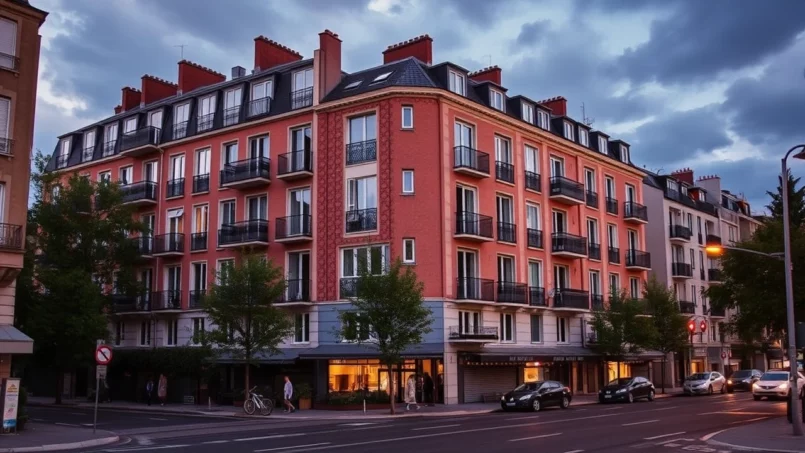
Located at the gates of Paris in the Hauts-de-Seine department, Clichy combines many of the features investors are looking for today: a very well-connected town, a strong economic fabric, a young and predominantly renting population, and a real estate market undergoing a full transformation. Straddling the line between a “working-class suburb” and a “natural extension of the 17th arrondissement,” it offers a rare compromise between still affordable prices (relative to central Paris) and genuine appreciation potential.
Before diving into a real estate investment in Clichy, it is essential to understand the local market, its key figures, its various neighborhoods, and the applicable tax rules. This preliminary analysis is valid whether you’re aiming for a standard rental investment, a furnished rental (LMNP), co-living, or short-term stays (Airbnb type).
Clichy, at the gates of Paris but with discounted prices
Nestled within the inner suburbs and bordering the 17th arrondissement, Clichy is located about 4.3 miles from the center of Paris. It benefits directly from proximity to La Défense and the major business hubs of western Paris, while also being part of the Boucle Nord de Seine, one of the driving territories of Greater Paris.
Number of inhabitants for an area of only 3.08 km², making it a very dense municipality.
In terms of prices, the town stands at a level significantly lower than its “premium” neighbors, which constitutes a primary lever of attractiveness for the investor.
Clichy compared to its most expensive neighbors
The price differential with neighboring towns is significant, particularly for the standard apartment, which remains the majority product.
| Town / Area | Avg. Apartment Price (€/m²) |
|---|---|
| Neuilly-sur-Seine | ≈ 10,287 to 12,231 |
| Levallois-Perret | ≈ 8,723 to 10,353 |
| Paris 17th | ≈ 12,037 |
| Clichy | ≈ 7,521 (median 8,137) |
| Saint-Ouen-sur-Seine | ≈ 6,625 |
| Asnières-sur-Seine | ≈ 6,835 |
| Gennevilliers | ≈ 4,528 |
Clichy is thus about 30% below Levallois-Perret and Neuilly, while being immediately adjacent to Paris’s 17th arrondissement. In other words, the town offers a “discounted price” gateway to a very central sector of Greater Paris, with medium/long-term catch-up potential, especially since the appreciation dynamic is already underway.
A tight and rising real estate market
Market data confirms that Clichy is clearly a town of landlord-owners and tenants, more than owner-occupiers.
Market tension and demand structure
The main indicators lean in favor of sellers and landlords:
| Key Indicator | Value in Clichy |
|---|---|
| Number of households | 30,388 |
| Share of tenants | ≈ 69.7% |
| Real estate tension index | 10 / 10 |
| Buyers vs. properties for sale | +20% more buyers |
| Price growth over 5 years | +21% (up to +51% for older properties) |
| Average annual growth (projections) | ≈ 8% / year mentioned |
Nearly 7 out of 10 residents are tenants and the tension index is maximal (10/10), meaning concretely several serious candidates for each rental, reduced vacancy periods and, on the sales side, often limited bargaining power for buyers.
The unemployment rate in this population is about 14.4%.
Price levels: apartments, houses, older properties, new builds
Various sources converge on a high but less extreme range than central Paris. For apartments, the most common product, the following ballpark figures can be noted:
| Property Type | Avg. / Median Price (€/m²) | Observed Range (€/m²) |
|---|---|---|
| Apartments (all combined) | ≈ 7,521 (median ≈ 8,137) | ≈ 5,055 – 9,532 |
| Older apartments | ≈ 6,357 – 6,930 | ≈ 5,433 – 7,055 |
| New apartments | ≈ 8,784 – 8,611 | ≈ 7,490 – 9,202 |
| Houses | ≈ 8,678 (median ≈ 8,631) | ≈ 4,782 – 13,419 |
New builds command a clear premium of around 25 to 35% compared to older properties, pushing some investors towards older buildings, even if it means undertaking work to optimize yield and energy performance through mechanisms like tax-deductible property deficits (déficit foncier) or LMNP with depreciation.
Price evolution and outlook
Over five years, the overall increase is around +21%, with a much sharper jump in certain older segments (up to +51.2% mentioned for some groups). In the shorter term, adjustments are observed: a temporary drop of around 8% over six months at one point in 2025, a sign of a market able to breathe after sustained increases.
Projections indicate that structural growth should continue, fueled by various factors.
– Scarcity of land in the inner suburbs.
– The ramp-up of public transport (Metro Line 14, future Grand Paris Express).
– Major redevelopment projects (Seine-Liberté, Entrée de Ville, Bac d’Asnières, Berges de Seine – Beaujon).
– Rental pressure in the Île-de-France region, where there are on average 12 to 15 applications per rental.
A massive rental stock dominated by small units
For an investor, the structure of the housing stock is essential, as it determines the type of products to target and the tenant profile.
A town of small and medium-sized apartments
The stock of primary residences is distributed as follows:
| Typology (Primary Residences) | Number of Units | Share of Stock |
|---|---|---|
| Studios | 5,021 | 18.4% |
| 2-room apartments | 9,169 | 33.6% |
| 3-room apartments | 8,023 | 29.4% |
| 4-room apartments | 3,793 | 13.9% |
| ≥ 5-room apartments | 1,283 | 4.7% |
2-room and 3-room apartments therefore constitute the bulk of the supply, with a significant proportion of studios. Large apartments are clearly in the minority, reflecting both urban morphology (a dense, historic town) and demographics (a high proportion of one- or two-person households, many young professionals).
Small units located near public transportation are logically highly sought after by investors, as they offer strong rental appeal and good liquidity.
– Long-term furnished rentals (LMNP).
– Organized co-living in 3/4-room apartments.
– Short-term rentals (Airbnb) within a regulatory framework to be secured.
Occupancy, vacancy, and ownership structure
The distribution of the stock is as follows:
| Occupancy Status | Number of Units | Share of Stock |
|---|---|---|
| Primary residences | 27,288 | 89.8% |
| Secondary residences | 760 | 2.5% |
| Vacant units | 2,340 | 7.7% |
And regarding households:
| Household Status | Share of Households |
|---|---|
| Owners | ≈ 29.4% |
| Tenants (incl. social housing ~29%) | ≈ 68.6 – 69.7% |
| Occupying rent-free | ≈ 2% |
In other words, the overwhelming majority of the stock is occupied as primary residences, and nearly 7 out of 10 households are tenants. This profile confirms the town’s rental vocation and argues for good market depth for the investor, whether they target “prime” assets or more affordable ones.
High rents and intermediate yields
Rents in Clichy are at a high level in absolute value, but consistent with the Parisian inner suburbs. The question is what this means in terms of yield.
Rent levels: apartments and houses
Available data gives the following ballpark figures:
| Property Type | Avg. Rent (€/m²/month) | Range (€/m²/month) |
|---|---|---|
| Apartments | ≈ 24.7 | ≈ 19 – 33 |
| Houses | ≈ 26.4 | ≈ 18 – 38 |
| Overall average cited | ≈ 26 | ≈ 22 – 30 |
Concretely, a well-located studio rents easily for around €700 to €900 for 25–30 m², and a 2-room apartment for around €950 to €1,200 depending on condition, building, and distance to the metro. A real example cited in the data: a 2-room, 30 m² apartment on Boulevard Jean Jaurès purchased for €210,000 and rented for €870/month, or about €29/m².
Average gross yield and disparities by neighborhood
Various sources place the average gross yield between 3.7% and 3.9%. But this figure masks strong disparities depending on the sector and strategy:
| Sector / Indicator | Approximate Gross Yield |
|---|---|
| Overall Clichy average | ≈ 3.9% |
| City Center | ≈ 5% |
| Berges de Seine – Beaujon | ≈ 4.5% |
| Entrée de Ville / Porte de Clichy | ≈ 6% |
| LMNP example (30 m², bd Jean Jaurès) | 4.6% gross / 3.4% net |
We see that certain micro-sectors, particularly around Porte de Clichy, offer gross yields close to 6%, which is notable just a few metro stops from Châtelet on Line 14. Conversely, very new developments or more expensive neighborhoods show more contained yields, but bet on asset appreciation.
Net income simulations for various sizes
Based on a median price of €7,786/m² and observed average rents, calculations of net income after expenses (and then after tax with a 30% marginal tax rate and 17.2% social charges) were performed:
| Typology | Key Assumptions | Annual Net Income (After Expenses) | Net Income After Taxes* |
|---|---|---|---|
| Studio 25 m² | Price ≈ €7,786/m², avg. market rent | ≈ €2,978 | ≈ €1,572 |
| 2-room 50 m² | Same | ≈ €5,957 | ≈ €3,145 |
| 3-room 70 m² | Same | ≈ €8,340 | ≈ €4,404 |
– Assumption: French tax-resident landlord, 30% marginal tax rate, 17.2% social charges, standard or furnished rental regime allowing for management of the taxable base.
Simulations in the Île-de-France context show that the investment strategy in Clichy is very often oriented towards building long-term wealth. Net cash flow after financing is not always positive, especially with heavy use of credit, but the investor makes a trade-off between immediate profitability and long-term asset building.
– “Reasonable” net yield (3–4.5% depending on strategy).
– Prospects for value appreciation thanks to urban dynamics.
– Rental security linked to structural demand and central location.
Clichy’s neighborhoods: where to invest according to your profile
Clichy is not homogeneous. Between the historic hyper-center, the Seine riverbanks, pockets of social housing, and the new neighborhoods around Porte de Clichy, the ambiance and figures change significantly.
City Center and Town Hall: the safe bet
The city center, around the town hall, the covered market, and the Rond-Point de la République, concentrates over 9,000 inhabitants, rather young (average age 36) and mostly managers and intermediate professions. It features a dense retail fabric, lively neighborhood life, and a mixed built environment (old, 70s-80s, recent developments).
– Average price: about €6,900/m² for apartments in some surveys.
– Gross yield: around 5%.
– Tenant profiles: young professionals, couples, some families with children in local schools.
This is the zone often recommended to “limit risk”: good resale liquidity, low vacancy, an environment perceived as more stable. Pre-war brick buildings needing renovation offer interesting opportunities for those targeting tax-deductible deficits (déficit foncier) or LMNP with major works.
Entrée de Ville – Porte de Clichy: yield + appreciation lever
The Entrée de Ville, around Porte de Clichy, is a key sector for investors. Separated from Batignolles by the périphérique but increasingly connected thanks to urban developments, it fully benefits:
Main urban developments and infrastructure around Porte de Clichy and Clichy-Batignolles.
New stations Porte de Clichy and Pont Cardinet, connecting Paris and Clichy with an enhanced transport axis.
160-meter tall building accommodating about 9,000 daily users, modernizing Paris’s judicial infrastructure.
Mixed-use development on the other side of the municipal border: offices, housing, cinema, shops, and a 10-hectare park.
On the Clichy side itself, this sector is undergoing vast renovation operations, with many new or very recent housing units (sometimes with reduced VAT in certain programs). The gross yield here is estimated at around 6%, while also hoping for price increases as the “wall” of the périphérique loses its border effect.
Berges de Seine – Beaujon and Bac d’Asnières: redevelopment and eco-districts
The Berges de Seine – Beaujon sector is historically strongly marked by social housing, but is a star area for reconstruction and densification programs. It is a sector in transition, with over 1,000 new housing units planned and a progressive transformation of industrial wasteland into housing, offices, and public spaces.
Overview of key indicators and assets of the sector, particularly on the redeveloped Seine riverfront.
Around €7,200/m² according to latest market data.
Approximately 4.5% for investments.
Rejuvenated Seine riverfront, eco-district label for the Bac d’Asnières project, and housing/office/green space mix.
Proximity to major road arteries: RD19, RD17 and RD911.
For the investor, these neighborhoods can offer medium-term opportunities: prices often a bit lower than the hyper-center, appreciation potential linked to urban transformation, development of co-living around major axes and the periphery.
Northern Quarter, Trouillet and other developing pockets
The Northern Quarter is described as pleasant, lively, with many places to go out. Trouillet, one of the oldest neighborhoods, is the subject of major works to densify the supply of new housing. These zones, more heterogeneous in terms of buildings, can appeal to investors looking for a compromise:
– Prices slightly below the hyper-center.
– Correct yields with a varied local clientele (families, young professionals).
– Capital gains potential if degraded blocks are redeveloped.
The sectors around the Rond-Point de la République and the hyper-center complete the picture of “safe bets” in terms of demand, even if the yield there will often be a little lower than in catch-up zones.
Transportation: the true backbone of value
One of the main drivers of Clichy’s attractiveness is its exceptional connectivity for an inner suburban town.
Metro, RER, trains, and buses: a complete network
Clichy is connected to several heavy rail networks:
The neighborhood is very well served by public transport. Metro line 13 serves Mairie de Clichy, Porte de Clichy, and Saint-Ouen. Line 14, recently extended, passes through Porte de Clichy and Pont Cardinet, offering a fast connection to Saint-Lazare, Châtelet-Les Halles, and Gare de Lyon. The area is also accessible via RER C and the L line of the Transilien network towards La Défense and Saint-Lazare. A network of buses, the T3 tramway (on the Paris side), and quick access to the périphérique complete travel options.
Longer term, Clichy will also indirectly benefit from the Grand Paris Express (Line 16 Clichy–Montfermeil, although the station by that name concerns another area in Seine‑Saint‑Denis) and the strengthening of northwest/center interconnections.
For an investor, the strong rental demand in the region primarily comes from employees working in Paris, La Défense, or surrounding job hubs. It is therefore strategic to prioritize acquiring properties, especially small units, located in the immediate vicinity of a metro station or train station.
Remote work and Greater Paris: new behaviors, same constraints
The generalization of remote work has certainly changed practices, but in Île-de-France the mobility constraint remains strong. Professionals now appreciate being able to alternate remote work and office presence without long commutes. Clichy checks this box: close, well-served, but a bit cheaper than Intra-Muros.
The Grand Paris Express reinforces this trend by creating new hubs around major stations. This is particularly true for the northwest zone (Paris center – La Défense – Plaine Saint‑Denis triangle), in which Clichy and Saint‑Ouen play an increasingly structuring role.
Economic dynamism and resident profile: a foundation for rental demand
Beyond transportation, a sustainable rental investment needs a solid economic base and a solvent population. In Clichy, these elements are well present.
A major employment basin
The town hosts an impressive number of corporate headquarters and large groups:
– L’Oréal (global headquarters).
– Bic.
– Amazon France.
– Monoprix.
– Société Parisienne de Canalisations.
– Trace Partners and thousands of SMEs.
Number of jobs concentrated in the town, which is therefore not just a ‘bedroom community’ but a full-fledged activity hub.
For the investor, this means: investing with caution and evaluating the risks associated with each opportunity. It is crucial to diversify your portfolio and stay informed of market trends to maximize returns while minimizing potential losses.
– Local rental demand (employees working in Clichy).
– “Commuter” demand (employees working in Paris/La Défense but looking for slightly lower rent).
– Non-negligible potential for corporate furnished rentals or co-living for young professionals.
A young, active, but diverse population
Some demographic and socio-economic indicators:
| Indicator | Value in Clichy |
|---|---|
| Total population | ≈ 63,000 – 65,000 inhab. |
| Median age | 35 years |
| Population growth | +4.6% |
| Density | ≈ 20,500 inhab./km² |
| Median annual income | ≈ €27,265 |
| Unemployment rate (15–64) | ≈ 14.4% (slight downward trend) |
| Single-person households | ≈ 45.1% |
This profile shows a young, urban, rather dynamic territory, but with a share of low-income households and non-negligible unemployment. The investor must therefore:
– Carefully select tenants.
– Verify the solidity of income.
– Adapt the product (finish level, rent level) to the target audience.
Investment strategies in Clichy: older properties, new builds, furnished, co-living, Airbnb
Once the macro diagnosis is established, the central question is: how to invest in Clichy to optimize the yield / risk / taxation trio?
Older properties for renovation: optimizing yield and taxation
Investing in older properties, particularly in city-center brick buildings or 50s-70s condominiums, presents several advantages:
– Price per m² lower than new builds (up to –30%).
– Potential for rent increases after renovation.
– Ability to leverage tax schemes such as:
– Tax-deductible property deficit (déficit foncier) (for standard unfurnished rental, standard regime).
– Furnished Non-Professional Landlord (LMNP) under the standard regime with depreciation of the property and furnishings.
– Better resistance to vacancy if the location is central and close to transport.
However, beware of expense levels: data indicates that condominium fees in very old buildings are about twice as high as in recent residences, which can erode profitability.
New builds and Pinel: wealth-building, but lower yield
Clichy is in Zone A bis for the Pinel scheme, which theoretically allows for attractive tax reductions in exchange for rent ceilings (€17.55/m² in Pinel 2021 benchmarks).
In practice:
Average gross yield of a Pinel rental investment, versus 4.2% for a standard rental, for a €200,000 property.
This strategy can suit a highly taxed investor, prioritizing tax reduction and long-term patrimonial security, but it is not optimal for those seeking cash flow.
Furnished Non-Professional Landlord (LMNP): the yield / taxation compromise
The status of Furnished Non-Professional Landlord (LMNP) is particularly relevant in Clichy for studios and 2-room apartments close to transport.
– Key LMNP reminders:
– Income taxed as Commercial and Industrial Profits (BIC).
– Option for the standard regime with depreciation of the property (excluding land) and furnishings.
– Rent 15–25% higher than unfurnished for a properly furnished unit.
– Expenses and loan interest deductible.
The example of the 30 m² apartment on Boulevard Jean Jaurès illustrates this logic well:
– Purchase price: €210,000.
– Rent: €870/month.
– Gross yield: 4.6%.
– Net yield: 3.4%.
– Annualized yield over 5 years: 9.3% (including property appreciation).
The combination of higher rents, depreciation, and the prospect of rising prices makes this strategy attractive for an investor who accepts slightly more active management (more frequent tenant turnover, furnishings to maintain).
Co-living and co‑living: boosting rents on larger units
With a young population and a high proportion of low-income households, co-living is developing notably:
– Around the périphérique and the Bac d’Asnières.
– In well-laid-out 3/4-room apartments near transport.
Percentage of additional rent that a well-structured co-living arrangement can generate compared to a standard rental of the same property.
In a context where large apartments are rare in Clichy (less than 5% of units with 5 rooms or more), this strategy can be very profitable, provided you:
– Carefully select the location (metro within a 10-minute walk).
– Anticipate regulatory constraints (number of occupants, minimum surface area, DPE energy rating).
– Manage life in co-living (house rules, insurance).
Short-term rentals like Airbnb: a real market, but regulated
Airbnb data for Clichy shows a market already well developed:
| Airbnb Indicator in Clichy | Observed Value |
|---|---|
| Active listings | 617 |
| ADR (avg. daily rate) | $116 |
| Avg. occupancy rate | 57% |
| Avg. monthly revenue | $1,898 |
| Revenue peak (June, etc.) | ≈ $2,670 |
| Top 10% of listings | > $4,198 / month |
| Share of entire homes/apartments | 88.8% |
| Listings with 1 bedroom | 56.4% |
| Most common capacity | 2 guests (34%) |
| Most common minimum stay | 30+ nights (38%) |
We observe a rather “mid-stay” market (stays of a month or more), with a very international clientele (70% foreign visitors), young (strong share of Generation Z).
For the investor, this segment can offer an excellent gross yield, but it requires:
– Mastery of local rules (registration, change of use authorization if applicable).
– Professional management (cleaning, check-in, dynamic pricing).
– Vigilance on seasonality (lower revenue in winter).
Urban planning, projects, and quality of life: the backdrop of appreciation
Numbers and yields are not enough: the urban development trajectory and quality of life determine a property’s value over 10 or 20 years.
A territory transforming within the framework of Greater Paris
Clichy benefits from strong development potential thanks to:
– Former industrial wastelands being converted or in the process of conversion (Seine-Liberté, Bac d’Asnières, entrance of town neighborhoods).
– Interventions to eliminate substandard housing, enabling the creation of new real estate programs, public spaces, and facilities.
– An urban planning policy coordinated at the inter-municipal level via the Boucle Nord de Seine PLUi (Local Inter-municipal Urban Plan), which came into force in 2025, setting the main directions until 2035 (environmental transition, social mix, economic innovation…).
The town of Clichy offers a digital tool called ‘Clichy en 3D’ to visualize ongoing and upcoming development projects. This tool is particularly useful for investors looking to anticipate changes in the town’s various neighborhoods.
Green spaces, heritage, and facilities
Clichy is not just a territory of offices and buildings. The town has nearly 38 hectares of green spaces, about 14.6% of its area, including:
– Parc Roger Salengro.
– Parc des Impressionnistes.
– Jardins du Pavillon Vendôme.
It also boasts remarkable heritage (Pavillon Vendôme, Maison du Peuple, Art Deco facades of the Printemps warehouses, Saint‑Médard and Saint‑Vincent‑de‑Paul churches) and a good base of educational and cultural facilities:
– 22 primary schools, 4 middle schools, 3 high schools.
– A recent conservatory, a cinema/performing arts venue.
– A future Normandy School of Management campus.
These elements contribute to residential attractiveness, particularly for families, and thus to the stability of medium-term rental demand.
Taxation, financing, and risks: what an investor must master
Investing in Clichy means investing in France: the tax framework (especially for rentals), financing aids, and specific risks must be integrated into the strategy.
Rental taxation: unfurnished, furnished, non-resident
The general scheme is as follows:
– Rental income from a property located in France is taxable in France, whether the owner is a resident or not.
– It must also be declared in the country of residence, with a potential tax credit according to tax treaties.
– In France, income from an unfurnished rental falls under property income (micro-REIT < €15,000 or standard regime).
– Income from a furnished rental falls under BIC (Commercial and Industrial Profits) (micro-BIC or standard regime) with LMNP or LMP status depending on revenue volume.
Specifically on furnished rentals:
– Micro-BIC: flat-rate deduction (often 50%) on rents up to a certain threshold.
– Standard regime: possibility to deduct actual expenses and depreciate the property and furnishings, which, in Clichy, is often very interesting for neutralizing taxation for several years.
Foreign investors must also contend with:
For non-residents, income tax follows a specific scale (20% then 30% depending on net income threshold). Social charges differ: 7.5% for EU/EEA residents affiliated with another social security scheme, and 17.2% for other non-residents.
Optimization tools: LMNP, déficit foncier, PTZ, Pinel
In practice, several tax and financial levers can be combined in Clichy:
– LMNP under the standard regime for studios and 2-room apartments near transport: ideal for combining good yield and low taxation in the first years.
– Tax-deductible property deficit (déficit foncier): interesting for a very old property needing major works, for unfurnished rental.
– Pinel scheme (Zone A bis): relevant for highly taxed investors who prioritize tax reduction over immediate profitability.
– Interest-free loan (PTZ): can be used in some cases, especially if the investor occupies the property before renting it (schemes to handle with caution).
Financing and the role of mortgage brokers
The level of interest rates and bank requirements make deals increasingly technical. In Clichy as elsewhere, many investors rely on mortgage brokers to:
To succeed in the current market context, it is essential to optimize the loan rate and term. You must also build strong financing applications to face the increased selectivity of banks. Finally, renegotiating existing loans can free up investment capacity useful for financing works or a new purchase.
Several specialized players are located in the town (Meilleurtaux, Empruntis, Immoprêt, ACE Crédit, Vousfinancer, etc.), reflecting the intensity of real estate activity in this territory.
Risks not to underestimate
Like any tight market, Clichy is not without risks:
– Prices already high on a national scale, despite the discount compared to Paris, making entry costly.
– Condominium fees significant in older buildings, potentially representing 15–25% of rents.
– Unfavorable DPE (F or G) on part of the older stock: these units are gradually being excluded from the rental market, with sometimes heavy renovation costs (€20,000–€40,000 and more).
– Marked differences between micro-neighborhoods: some blocks remain marked by concentrations of 80s social housing or a degraded image, which weighs on tenant profiles and valuation.
– Macroeconomic uncertainties: potential rate hikes, tightening credit conditions, cyclical slowdown.
On this last point, the prudent investor will size their project to:
– Withstand occasional vacancy periods.
– Absorb potential increases in fees and taxes.
– Not depend exclusively on immediate cash flow to balance their personal financial situation.
How to build a coherent investment strategy in Clichy
Once all these elements are in hand, the ideal strategy will mainly depend on your profile, risk tolerance, and investment horizon.
Wealth-building investor, long horizon
Goal: secure and increase capital, accepting moderate but stable return.
Typical approach:
For an investment in Toulouse, target central neighborhoods (city center, town hall-Gambetta) or quiet sectors near major arteries. Prioritize 2 or 3-room apartments in sound buildings, constructed after 1970 or already energy-renovated. Two tax regimes are suitable: unfurnished rental under the standard regime with déficit foncier, or LMNP for a long-term project with few tenant changes. Targeted gross yields are between 3.5% and 4.5%, with a probability of property appreciation over 10 to 15 years.
Yield-oriented investor, comfortable with risk and management
Goal: maximize cash flow and/or net profitability in the medium term.
Typical approach:
To optimize a rental investment in Paris, target neighborhoods under redevelopment like Porte de Clichy, Berges de Seine – Beaujon, Bac d’Asnières, and well-served northern neighborhoods. Prioritize furnished studios or 2-room apartments, as well as 3/4-room apartments for co-living. To significantly increase yields (by 20 to 40%), consider the LMNP regime under the standard system or co-living. If your risk tolerance is high and you master the legal framework, consider medium or short-term rentals on a property with strong tourist or business potential. However, anticipate more demanding management, involving rigorous tenant selection, potential turnover, furnishing, and frequent property inspections.
Non-resident investor
Goal: diversify outside their country, benefit from the solidity of the Île-de-France market, possibly prepare for a move or a pied-à-terre.
Typical approach:
– Work with a notary and a tax advisor familiar with non-resident issues.
– Simplify management via a real estate agency or property manager.
– Avoid overly complex schemes (Airbnb without local presence, poorly managed co-living) in favor of standard long-term furnished rentals.
– Ensure the net profitability accounts for layers of taxation (France + country of residence) and social charges.
Conclusion: Clichy, a town to watch as a “Paris bis” under construction
Investing in real estate in Clichy means betting on a territory still in catch-up compared to its high-end neighbors, but already solidly anchored in the metropolitan dynamics of western Paris. Prices are less crazy than in Levallois or Neuilly, the yield is higher than in central Paris, rental demand is massive and relatively diverse, and urban projects outline a rather favorable long-term trajectory.
It is not a market of 8% gross yield where one hopes for spectacular immediate cash flows. It is a tight metropolitan market, where the core of performance is played out:
The success of a real estate investment rests on four essential criteria: location quality (proximity to transport, environment), pertinence of analysis (neighborhood, property type), tax optimization (regimes like LMNP), and anticipation of urban evolution (neighborhoods in transformation, new development projects).
By combining detailed analysis of figures, strategic neighborhood choice, and rigorous management, Clichy can constitute a very relevant piece in an Île-de-France real estate portfolio, especially for those seeking an asset that is both profitable and endowed with real appreciation potential in the shadow – increasingly less distant – of Paris’s 17th arrondissement and La Défense.
Disclaimer: The information provided on this website is for informational purposes only and does not constitute financial, legal, or professional advice. We encourage you to consult qualified experts before making any investment, real estate, or expatriation decisions. Although we strive to maintain up-to-date and accurate information, we do not guarantee the completeness, accuracy, or timeliness of the proposed content. As investment and expatriation involve risks, we disclaim any liability for potential losses or damages arising from the use of this site. Your use of this site confirms your acceptance of these terms and your understanding of the associated risks.

Cyril Jarnias is an independent expert in international wealth management with over 20 years of experience. As an expatriate himself, he is dedicated to helping individuals and business leaders build, protect, and pass on their wealth with complete peace of mind.
On his website, cyriljarnias.com, he shares his expertise on international real estate, offshore company formation, and expatriation.
Thanks to his expertise, he offers sound advice to optimize his clients' wealth management. Cyril Jarnias is also recognized for his appearances in many prestigious media outlets such as BFM Business, les Français de l’étranger, Le Figaro, Les Echos, and Mieux vivre votre argent, where he shares his knowledge and know-how in wealth management.





