
 Published on and written by Cyril Jarnias
Investing in real estate in Colmar is not just betting on an Alsatian postcard. It’s entering a tight, highly touristic market with prices still reasonable on a national scale, but where the slightest targeting error can sink profitability. A city of nearly 68,000 inhabitants, the capital of Alsace wines, situated between the Rhine and the Vosges, Colmar attracts families, students, retirees, tourists… and a growing number of investors.
The gross rental yield can exceed 6% in developing areas or for seasonal rentals like Airbnb.
A Dynamic Market Where Demand Exceeds Supply
Colmar is currently a clear seller’s real estate market. The data converges: the number of buyers exceeds the number of available properties by about 9%, and the average time to sell is around 60 days. In other words, a property correctly priced and in good condition doesn’t stay on the market long.
The city benefits from a strategic location between Strasbourg and Mulhouse, less than 3 hours from Paris by TGV high-speed train, and close to Germany and Switzerland. This strong employment basin has about 7,000 companies and two industrial zones (Colmar-Nord and Colmar-Est). Colmar also has a university center with over 2,000 students, a rich cultural fabric (museums, theater, cinema, sports facilities), and massive tourism, attracting between 2 and 2.5 million annual visitors thanks to assets like La Petite Venise, the old town, and its Christmas markets.
This attractiveness is reflected in demographic figures. The population is growing (+4.7%), the activity rate for 15-64 year-olds is over 73%, and nearly a third of residents are under 25. The flip side: high unemployment (nearly 20%), and a median annual income of only €24,448, with a price-to-income ratio around 7.8. In short, a large portion of households are forced to remain tenants.
Colmar has approximately 34,500 dwellings, of which 90.9% are primary residences but only 35 to 38% are owner-occupied. According to sources, 62 to 63% of households are tenants, and in the city center this proportion climbs to over 73%. Add to that a moderate vacancy rate (7.4%) and a high share of social housing (28.3%), and you get a private market where every well-placed property finds a buyer quickly, provided it meets current expectations.
Price Levels: A Still Affordable but Highly Contrasted Market
Studies don’t all give the same raw figures, but the orders of magnitude converge. We can outline the following portrait for price per square meter in Colmar.
Price Overview
On average, the square meter trades around €2,400–2,600, with significant variations depending on property type, neighborhood, condition, and whether it’s old or new. Several datasets help position the market:
| Indicator | Estimated Average Value | Observed Range |
|---|---|---|
| Average price all properties (€/m²) | ~€2,460 to 2,580 | €1,600 – €3,700+ |
| Average price apartment (€/m²) | ~€2,380 – €2,430 | €1,550 – €3,500+ |
| Average price house (€/m²) | ~€2,520 – €2,650 | €1,660 – €3,650+ |
| Median high-end price (€/m²) | ~€3,700 | €1,930 – €5,270 |
| Old property price (€/m², indicative) | ~€2,580 | — |
| New property price (€/m², indicative) | ~€4,570 | — |
In 2023, averages were around €2,600/m² for houses and €2,485/m² for apartments. More recent estimates for early 2026 mention €2,231/m² for apartments and €2,401/m² for houses, with a slight year-on-year decrease (-1.1% for all properties combined) after several years of increase.
Over the long term, the real estate market remains bullish with estimates ranging from +12% to +49% over 5 years. However, this trend is nuanced: very old and dated properties are stagnating or declining slightly, while new and renovated properties are pulling averages up.
Old vs. New: A Price Gap, A Strategic Challenge
The divide between new and old is particularly marked in Colmar. New developments, especially on the outskirts or in regenerating neighborhoods, are generally listed between €4,000 and €5,000/m², while old properties are rather between €2,400 and €2,700/m².
A table helps visualize this differential according to dwelling size.
| Apartment Type | Old (€/m²) | New (€/m²) |
|---|---|---|
| Studio / 1 room | ~€2,780 | ~€4,870 |
| 2 rooms | ~€2,650 | ~€4,980 |
| 3 rooms | ~€2,460 | ~€4,680 |
| 4 rooms | ~€2,270 | ~€4,240 |
| 5 rooms | ~€2,370 | ~€4,700 |
Same logic for houses: an old 5-room house is around €2,940/m², compared to nearly €4,980/m² for a new 5-room house.
For an investor, the choice between an old property to renovate and a new one presents distinct trade-offs. The old property to renovate, often cheaper per square meter, can offer a better gross yield, especially if one can benefit from aids like MaPrimeRénov’ or Anah to improve energy performance. Conversely, new developments, generally well-located, are more justified from a patrimonial and management comfort perspective (less work, energy appeal), and allow access to advantageous tax schemes (Pinel B2, LMNP). However, gross rental yield is generally lower there.
Prices by Size: Expensive Studios, Larger Units More Affordable per m²
The price structure by number of rooms is classic: the smaller the dwelling, the higher the price per square meter. For the apartment stock, for example, we observe:
| Apartment (entire city) | Average Price (€/m²) |
|---|---|
| Studio / 1 room | ~€4,290 |
| 2 rooms | ~€4,020 |
| 3 rooms | ~€3,580 |
| 4 rooms | ~€3,110 |
| 5 rooms | ~€3,500 |
| 6 rooms | ~€3,120 |
| 7 rooms and + | ~€2,980 |
For the existing stock alone, these levels are lower (around €2,400–2,800/m²). For houses, 5 and 6-room properties often command a higher price per meter than smaller ones, as they target a family clientele seeking a garden or superior comfort.
Finally, location within the city plays a strong role: a well-placed T1 in the center can approach €4,000/m², while a T3 on the outskirts, in a 1970s condominium needing renovation, will trade well below €2,500/m².
Neighborhood Mapping: From the Historic Center to Booming Outskirts
The main trap in Colmar would be to think in terms of the “global city” without going into neighborhood details. Price and rental profile gaps are such that two investments a few hundred meters apart can have radically different logics.
Historic Center and Petite Venise: The Premium Heart, King of Seasonal Rentals
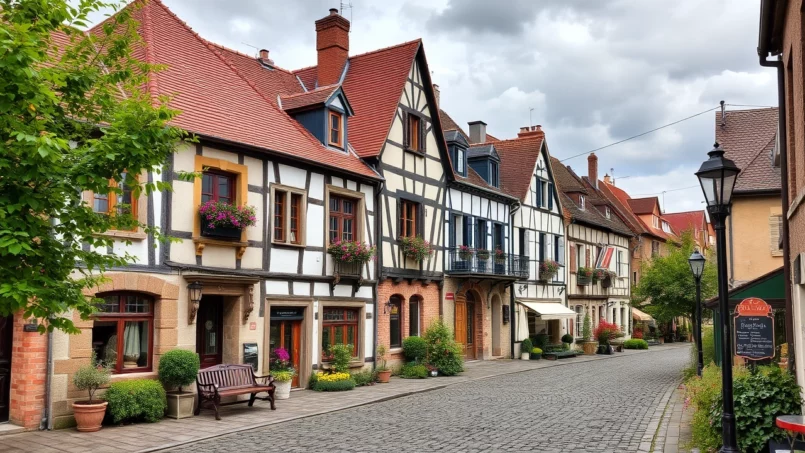
The old center – Old Town, Petite Venise, Quartier des Tanneurs – combines all superlatives: half-timbered houses, cobbled streets, canals, iconic monuments (Maison des Têtes, Koïfhus, Maison Pfister…). This is the “Venice of Alsace” whose images circulate endlessly on social media.
Price-wise, we’re clearly in the upper range: between €2,500 and €4,000/m² for old properties in good condition, with peaks of €4,500–5,000/m² for fully renovated character properties with exceptional views or locations. Price tables even mention €3,500 to €5,000/m² for the most sought-after historic core.
The housing stock there is dominated by apartments (small and medium). 1 to 3-room dwellings represent a large part of the supply, many located in old buildings without elevators, sometimes on 4 or 5 floors. Heritage constraints are very strong: protected sector, oversight by Bâtiments de France, architectural prescriptions for façades, roofs, joinery. Work must be supervised by professionals accustomed to this context, which increases renovation costs (often €1,200 to €1,500/m² for a good level of finish).
In return, rental demand is twofold. On one side, a strong tourist clientele, with a very developed short-term rental market: over 1,300 active Airbnb listings, a median occupancy rate around 64% annually, an average of 234 nights rented per year and an average annual revenue around €23,000 for furnished tourist rentals. December, with the Christmas markets, yields monthly revenue peaks that can exceed €4,500–5,000 for the best listings. On the other side, students, young professionals, and relocated executives, looking for furnished or unfurnished rentals in a good location.
Potential gross yield for seasonal rentals in the hyper-center, subject to rigorous management.
For a more cautious or remote investor, traditional furnished rental (LMNP) remains a solid option, with occupancy close to 100% for well-renovated small units. Net yield will rather be between 3 and 4.5% depending on purchase price and expenses, but with limited rental risk and long-term appreciation potential.
Saint-Joseph – Mittelharth: A Catching-Up Sector, Ideal for Value-Add
Northwest of the center, the Saint-Joseph – Mittelharth area is often cited as one of the best “price / potential” compromises. A former bourgeois residential neighborhood, with many buildings from the 1930s to 1950s and large apartments, it has undergone a marked transformation in recent years.
Prices remain modest compared to the center: between €2,200 and €2,800/m² depending on condition, with a revaluation hope estimated at about +25% over five years by some local players. For example, one can find 90–100 m² T4s purchased around €210,000, renovated for €600 to €800/m² (i.e., €40,000–€80,000 in work), then rented for about €950/month, i.e., a net yield around 4.2%, with already +15% latent capital gain according to reported concrete cases.
The clientele is essentially families or mid-level executives, attracted by comfortable surfaces, balconies or terraces, proximity to green spaces (Parc du Champ de Mars) and good schools. The train station is accessible on foot in about ten minutes, which strengthens interest for households working in Strasbourg or Mulhouse.
For an investor, the winning strategy often relies on buying a somewhat dated property (kitchen, bathroom, poor DPE energy rating), with negotiation on energy and structural flaws. Renovation aids (MaPrimeRénov’, Anah grants, preferential rate loans) can cover a large part of a work package allowing a move from an F/G label to D/C, creating an immediate capital gain of 10 to 15% according to estimates and securing the property against future rental bans for thermal sieves.
Les Maraîchers and the South: High-End Residential for Families
Les Maraîchers, to the southwest, illustrates the upscaling of certain Colmar sectors. This rather recent neighborhood, highly sought after by executives and liberal professionals, combines modern houses, gardens, calm, and good access. The population is more affluent, with a median income around €34,000 per year and unemployment well below the city average.
Prices reflect this “premium family” positioning:
| Indicator Les Maraîchers | Average Value | Observed Range |
|---|---|---|
| Apartment (€/m²) | ~€3,075 | €2,200 – €4,270 |
| House (€/m²) | ~€3,576 | €2,560 – €4,970 |
| Single-family house price (overall) | €280,000 – €400,000 | depending on size/condition |
Gross rental yields are mechanically lower there, often between 3 and 4%, but rental vacancy is very low, and the patrimonial value of the area is solid. Demand focuses on well-appointed T3–T4s, with parking and outdoor space, for monthly rents consistent with a high standard of living.
More broadly, the entire “South neighborhood” presents itself as an area in positive tension. January 2026 data shows a median around €3,827/m², up 19% year-on-year and 30% over five years, with houses reaching over €4,300/m² and apartments near €3,900/m². It’s a prime sector for a long-term investment, but not well-suited for those seeking high gross yields.
Europe – West – Schweitzer: High-Yield Opportunities, but Social Vigilance Required
To the west, the Europe / Schweitzer neighborhoods constitute a vast mostly residential area, long marked by strong social issues. It’s a sector where the proportion of modest households, social housing tenants, and single-parent families is very high, with a poverty rate around 50% and unemployment exceeding 40% in the Europe-Schweitzer priority zone.
These figures can be frightening, but for a savvy investor, they mainly translate into the opening of an opportunity field in a requalification phase. The city and its partners (State, region, social landlords, Banque des Territoires, etc.) have conducted a vast urban renewal program: demolition of dilapidated buildings, rehabilitation of over 800 dwellings, creation of facilities (Centre Europe, school renovations, improvement of public spaces). The conversion of the Plaine Pasteur, a large 5.5-hectare space between the hospital and the Europe neighborhood, is at the heart of this strategy: creation of a multifunctional park, landscape enhancement, new facilities and future mixed housing program.
Potential gross yield for a 25 m² studio in west Colmar, with a purchase and renovation cost of about €65,000 and a monthly rent of €450.
This potential obviously comes with constraints: neighborhood image, security issues, sometimes higher tenant turnover, possible vacancy if the property is poorly managed or overpriced, financially fragile clientele. Therefore, it is necessary to:
– target well-maintained condominiums, ideally after renovation,
– pay attention to the quality of the dwelling (brightness, equipped kitchen, clean bathroom),
– stay reasonable on rent to limit unpaid rent,
– carefully analyze condominium fees and the state of the building.
In the medium term, all urban renewal operations and the enhancement of Plaine Pasteur could better anchor this sector in the Colmar market, with a gradual price revaluation. This is typically an area for seasoned investors, seeking high yield, ready to assume a more active involvement.
Sainte-Marie, Bel Air, Train Station, Outskirts: Intermediate Profiles
Other neighborhoods offer an interesting compromise between price, rental demand, and appreciation prospects.
– Sainte-Marie: lively neighborhood in renewal, well-connected to train stations and close to the center. Prices are around €2,000–€2,400/m². It’s good ground for traditional rentals, especially on T2–T3s.
– Bel Air – Florimont: growing, with per-meter costs still accessible (about €2,200/m² for apartments). Its positioning close to the center and green spaces attracts new residents each year.
– Train station neighborhood: strategic area for mobility (commuters to Strasbourg, Mulhouse, Freiburg). Prices remain more affordable than in the hyper-center, around €2,700–€3,000/m² for recent or well-renovated dwellings. It’s good ground for furnished rentals for traveling executives or students.
– Neighboring municipalities (Wintzenheim, Ingersheim, Horbourg‑Wihr, etc.): These villages or small towns 5–10 minutes by car from Colmar have prices generally 20 to 30% lower than central Colmar, often between €2,200 and €2,700/m² depending on property type. They lend themselves well to long-term family rentals, with recent houses or well-maintained apartments.
Long-Term Rental Market: Demanding but Selective
With over 60% of tenant households and a low share of secondary residences (1.7%), Colmar is primarily a city of residents. For an investor, this translates into structurally sustained rental demand, provided that housing in line with expectations is offered.
Rent Levels and Gross Yields
Rents are overall in the average for cities of comparable size, but with neighborhood differences. Recent data indicate:
– a median around €10/m² excluding charges for apartments,
– slightly higher rents for houses (about €15/m² on average, reflecting more the scarcity of well-located houses than a generalized norm),
– a slight year-on-year decrease in rents (-0.8% approximately for apartments), in a context where sale prices had risen sharply, mechanically compressing yields.
By apartment type, trends are as follows:
| Apartment Type | Median Rent (€/m² excl. charges) | Year-on-year Change |
|---|---|---|
| Studio (T1) | ~€13 | +2.5% |
| T2 | ~€10 | -2.7% |
| T3 and + | ~€9 | -0.4% |
The city center and Les Maraîchers stand out with rents around €9–€10/m², sometimes more for exceptional properties, while western neighborhoods are slightly behind. In practice, a 40 m² T2 in the center will often rent for between €550 and €650 excluding charges, a 65–70 m² T3 between €750 and €900, a 90 m² family T4 between €1,000 and €1,200 depending on features and location.
The average gross yield of investments analyzed in Colmar is between 5.7% and 6.4%.
– 3–4% net in premium neighborhoods (renovated hyper-center, Les Maraîchers),
– 4–5% net in intermediate sectors (Saint‑Joseph, Sainte‑Marie, Bel Air, train station),
– 6–9% gross (and 5–7% net) in some western areas under renewal, for well-negotiated small units.
For the city center, gross yield figures cited around 5% confirm that it’s a more patrimonial than purely “cash flow” market.
Strong Demand… But Increasingly Demanding
The main message from field feedback is clear: just because demand is strong doesn’t mean you can rent anything at any price. In Colmar, many properties remain vacant for months, sometimes years. Recurring causes are:
In city centers, especially tourist ones, old dwellings often have major drawbacks: noise pollution (from bars, traffic, and tourists), lack of natural light (especially for ground-floor units with dark courtyards or facing other buildings), and absence of modern amenities like an equipped kitchen or a proper bathroom. Add to that the lack of private parking in a context where parking is already tight, especially in summer or during year-end holidays, and difficult access to upper floors in old 4 to 5-story buildings often without elevators.
The other major filter is energy performance. As everywhere in France, “thermal sieves” (labels F and G) are increasingly penalized, both regulation-wise (rental restrictions) and economically (purchase discounts, difficulty renting at a good price). In Colmar, a city with a rather cool winter climate, these issues are particularly sensitive. Poorly insulated properties become opportunities for investors capable of managing heavy energy renovations (insulation, windows, heating), often estimated at €30,000–€40,000, but largely aided (MaPrimeRénov’, eco‑PTZ, local aids) and value-creating.
Finally, the scarcity of parking plays a key role. An apartment without parking but located in a condominium with parking or with a nearby garage will rent much better than an identical property with no solution, even five minutes’ walk from a private parking lot.
Short-Term Rentals and Tourism: Tapping into a Strong but Regulated Market
Colmar has become one of the strongholds of seasonal rentals in France, thanks to its image as a “Christmas postcard” and its tourist markets. This attractiveness is reflected in short-term rental figures.
A Highly Profitable Seasonal Market… for the Best Located
Aggregated data on Airbnb-type rentals show:
– about 1,300 to 1,800 active listings depending on the period,
– a vast majority of entire homes (over 90%),
– a dominance of small dwellings: 1 bedroom (nearly 60% of listings), 2 bedrooms (about 28%), rare large dwellings,
– a median occupancy rate around 45–64% annually depending on sources,
– an average annual revenue near €19,000 to €23,000 per listing, with an average monthly revenue around €2,000.
Seasonality is very marked:
Analysis of revenue, occupancy rates, and average prices by time of year for an Airbnb rental in Paris.
December, May, and August: Average monthly revenue ~$3,700. Occupancy rate >60%. Price per night: $169–230.
January to March: Average monthly revenue ~$1,100–$1,200. Occupancy rate ~30–33%. Price per night: $120–125.
Best performance: Monthly revenue can reach $5,300. Occupancy rate >70%. Rates >€200 per night.
Performance varies enormously depending on positioning. The top 10% of listings combine over 80% occupancy and prices starting at $200–250 per night, while the least performing quarter settles for 25–30% occupancy at $80–90.
With an entry ticket for a T1/T2 of €150,000 to €180,000 in the center, seasonal revenue of €20,000–€25,000 allows, on paper, double-digit gross yields. But these figures must be put into perspective by costs (platforms, cleaning, linen, energy, tourist tax, BIC taxation), which eat away 30 to 40% of revenue. In the end, the best short-term operations hover around 8–10% net before tax, which remains high, but at the cost of demanding management.
A Strict Regulatory Environment
The success of seasonal rentals has led to increasing regulation. Local rules are described as strict: mandatory registration, licenses in some cases, possible caps on nights or dwellings per person, strengthened taxation. Data shows about 88% of listings are already compliant, proving effective control.
Furnished rentals are subject to specific national rules, including tax classification, choice between Micro-BIC or Réel regimes, and status (LMNP or professional). The investor must also plan for the collection of the tourist tax. It is crucial to anticipate potential regulatory tightening (quotas, bans) and prioritize properties that can easily be converted to long-term rental if necessary.
A so-called “hybrid” strategy is developing: rent short-term in very high season (Christmas, summer) and offer furnished leases of a few months (students, remote workers) the rest of the year. Colmar, with a growing share of remote workers and long-term visitors, lends itself rather well to this.
Investment Strategies: Tailoring the Setup to Your Profile
Investing in real estate in Colmar is not just about choosing a neighborhood. You also need to articulate property type, rental mode, taxation, and financing.
Long-Term in Old Properties to Renovate: A Classic That Still Works
The most robust configuration in the medium term remains the purchase of a well-located old apartment (center outside the hyper-touristic area, Saint‑Joseph, Sainte‑Marie, train station, some “gentrifiable” western sectors), with correctable flaws: poor DPE, outdated kitchen, poor room layout.
By working with an architect or an agency specialized in renovation, it is possible to:
– optimize the surface area (creating an extra bedroom in a large T2, for example),
– improve brightness,
– integrate a real equipped kitchen,
– address acoustic and thermal issues.
Gross yield of a rental investment after heavy renovation, calculated on a 60 m² property with a rent of €800/month.
New Builds and Tax Schemes: Aiming for Security and Energy Performance
Colmar is classified as a Pinel B2 zone. Concretely, this means some new developments can, under conditions, qualify for a Pinel tax reduction for rentals with capped rents. The interest is twofold: benefit from a property with recent environmental standards (RE2020, RT2012), thus very comfortable for tenants, and limit the need for work for many years.
However, entry tickets for new builds are high (€4,000–€5,000/m²), which limits gross yield. This strategy suits especially:
– highly taxed investors seeking a tax reduction,
– those prioritizing management simplicity,
– patrimonial profiles wanting a “clean” asset in an attractive city.
Another option, often more flexible: the status of non-professional furnished landlord (LMNP), especially for properties intended for students, young professionals, or seniors. It allows deducting the depreciation of the property and furniture from rental income, strongly reducing taxation for many years.
Short-Term Rentals: A Powerful Lever but to Handle with Caution
In very touristy neighborhoods, seasonal rental may seem obvious. However, the investor must consider several aspects:
Before getting started, it is crucial to consider: current local regulations and their possible evolution, strong existing competition (over 1,000 active listings), very marked seasonality with strong dependence on the Christmas period, as well as all management costs including concierge, cleaning, linen, platform commissions, and customer review management.
Data shows that the best-performing listings are run by professional managers grouping several dozen dwellings, with high-quality service and a real revenue management strategy. For a remote individual, it is often reasonable to go through a concierge or a manager, which decreases net yield but secures operations.
In practice, short-term rental is relevant for:
– small, ideally located dwellings (T1/T2 hyper-center, view, charm),
– atypical properties (duplexes, townhouses, upscale dwellings),
– or as a secondary use of a family secondary residence.
It is less suited for an investor looking for a low-involvement “turnkey” solution.
Financing, Additional Costs, and Taxation: Don’t Underestimate the Overall Bill
As everywhere in France, acquisition costs represent a significant part of the project. For an old property, notary and transfer taxes often add up to 7 to 8% of the price. For a new development, these fees are reduced (2 to 3%), but the base price is higher and VAT (20%) is included.
In parallel, financing rules have tightened. Banks generally require: a larger personal contribution, additional guarantees, and a stable financial situation.
– a minimum down payment of 10 to 20% of the price (plus fees),
– a maximum debt ratio of 35% including insurance,
– a repayment capacity consistent with income (employees, self-employed, retirees).
Interest rates, after a peak, are stabilizing between 3.5 and 4.5% for 20–25 year loans, which remains manageable but mechanically reduces borrowing capacity compared to the 2018–2021 years.
On the taxation side, an investor must deal with:
– income tax on rents (micro or real regime),
– social contributions,
– property tax, expected to increase in the coming years after the revision of cadastral bases, with a risk of an average increase of about €60 per year on some properties,
– possibly IFI for net real estate assets exceeding €1.3 million.
Structures like LMNP real regime, or the use of civil companies (SCI) or schemes like Malraux or Monument Historique in the old center, can optimize the tax bill, provided you are accompanied by professionals.
How to Choose Your Investment in Colmar: Some Concrete Benchmarks
Beyond the numbers, investing in real estate in Colmar requires asking some structuring questions.
What Priority: Yield, Security, Appreciation?
– If the primary goal is patrimonial security and long-term appreciation, priority sectors will be: renovated hyper-center (outside excessive prices), Les Maraîchers, some parts of the south, prized wine-growing communes nearby (Turckheim, Wintzenheim…).
– If the goal is moderate but stable yield, take a close look at Saint‑Joseph – Mittelharth, Sainte‑Marie, Bel Air, train station area, as well as well-connected neighboring communes.
– To maximize gross yield, while accepting stronger rental risk, western neighborhoods (Europe, Schweitzer, Ladhof) and some peripheral sectors under renewal offer the best opportunities, especially for small units.
Which Type of Tenant to Target?
Colmar offers several well-identified segments:
Adaptation of rental supply to specific needs of different resident profiles in Colmar.
Studios and T2s close to the center, university, and train station, well-equipped with good internet connection.
T3 to T5 with outdoor space and parking, near schools and parks, in residential neighborhoods (Saint‑Joseph, Les Maraîchers, south, outskirts).
T1/T2 or atypical dwellings in the hyper-center or Petite Venise, and charming houses in the wine-growing outskirts.
Quiet dwellings with elevator, near shops and healthcare services, in central but peaceful sectors.
The consistency between property type, neighborhood, and rental target conditions the success of the operation.
What Level of Renovation Work to Accept?
The Colmar market is full of “average” properties: old, poorly maintained, badly laid out, energetically obsolete. These are often the best levers for value creation, but they require:
To successfully carry out a renovation project, it is essential to have a substantial and realistic renovation budget, to plan time for managing the worksite, and to inquire about available financial aids. In the case of a property in a historic sector, a thorough understanding of heritage constraints is also indispensable.
Conversely, a new development buys time and serenity, but at the price of a lower yield.
In Summary: A Market That is Touristic, Residential, and Increasingly Selective
Investing in real estate in Colmar means playing on several boards simultaneously. The city combines:
– a strong long-term residential base, with a majority of tenant households and a housing supply sometimes unsuited to current expectations,
– a major tourist attractiveness, which fuels a very active seasonal rental market, but also long stays for remote workers and international visitors,
– contrasted urban dynamics, mixing a patrimonial hyper-center under pressure, gentrifying residential neighborhoods, and sectors in deep requalification to the west.
To succeed in a real estate investment in Colmar, it is crucial to analyze the market in detail beyond its attractive image. You must cross-reference price data, socio-demographic profiles, urban planning projects, and the energy performance of the property. Then, you need to develop a coherent strategy that aligns the neighborhood, the rental type, and the financial setup.
Those who accept working finely on these parameters, even if it means being accompanied by local professionals, will find in Colmar a market that is lively, resilient, and still reasonably valued, capable of offering both good yields and solid long-term patrimonial assets.
Disclaimer: The information provided on this website is for informational purposes only and does not constitute financial, legal, or professional advice. We encourage you to consult qualified experts before making any investment, real estate, or expatriation decisions. Although we strive to maintain up-to-date and accurate information, we do not guarantee the completeness, accuracy, or timeliness of the proposed content. As investment and expatriation involve risks, we disclaim any liability for potential losses or damages arising from the use of this site. Your use of this site confirms your acceptance of these terms and your understanding of the associated risks.

Cyril Jarnias is an independent expert in international wealth management with over 20 years of experience. As an expatriate himself, he is dedicated to helping individuals and business leaders build, protect, and pass on their wealth with complete peace of mind.
On his website, cyriljarnias.com, he shares his expertise on international real estate, offshore company formation, and expatriation.
Thanks to his expertise, he offers sound advice to optimize his clients' wealth management. Cyril Jarnias is also recognized for his appearances in many prestigious media outlets such as BFM Business, les Français de l’étranger, Le Figaro, Les Echos, and Mieux vivre votre argent, where he shares his knowledge and know-how in wealth management.





