
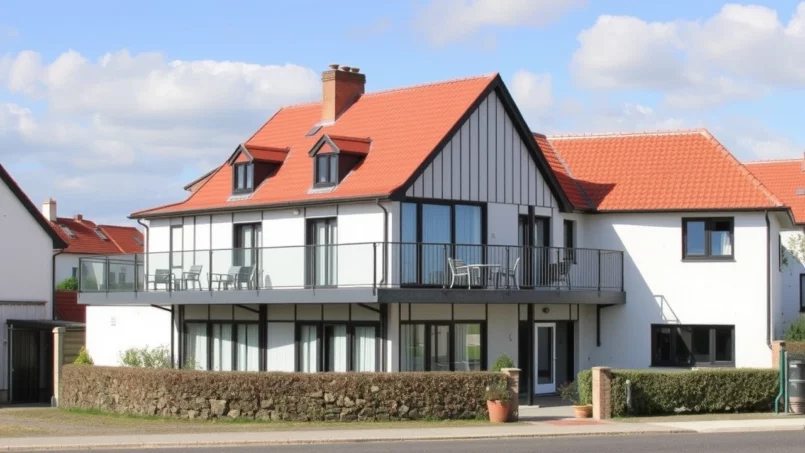
 Published on and written by Cyril Jarnias
Cherbourg-en-Cotentin currently ticks many of the boxes sought by investors: a dynamic port city, still accessible prices, solid rental yields, powerful tax incentive schemes, a booming tourist market, and significant urban redevelopment efforts. All this in the heart of the Cotentin peninsula, in the Manche department of Normandy, a few hours from Paris and facing England.
Investing in real estate in Cherbourg-en-Cotentin requires precise analysis. It is necessary to distinguish high-potential sectors, understand price differences between neighborhoods, master tax incentive schemes (Pinel and Denormandie), account for the rise of short-term rentals, and monitor ongoing major urban projects.
This article provides an in-depth market analysis, exclusively based on research report data, to help build a well-founded investment strategy.
A dynamic real estate market in a city undergoing transformation
Cherbourg-en-Cotentin is the main city in the Manche department and the heart of the Cotentin employment basin. The municipality has approximately 78,000 to 79,000 inhabitants according to recent sources, with about 42,000 to 45,000 housing units, and a density of around 1,150 inhabitants per km² at the municipal level… and much higher in central neighborhoods.
The population structure is rather balanced: a median age around 41, a notable proportion of families, but also a strong presence of single-person households. Students currently represent only about 2.3% of the population, but the city aims for 3,000 students on its university campus by 2030, which is already increasing interest in small units.
The low rental vacancy rate, reflecting sustained rental demand.
An industrial, port, and tourist city
The economic attractiveness of Cherbourg-en-Cotentin is based on a solid industrial and port foundation. The Cotentin is presented as the 4th economic hub of Normandy, with over 10,000 businesses. Key drivers include: Naval Group, LM Wind Power, CMN, and the entire marine renewable energy (MRE) sector being structured around the port.
The port of Cherbourg is simultaneously military, a fishing port, a marina, and a ferry terminal, with links to the United Kingdom and Ireland. It also welcomes around sixty cruise ships per year, over 100,000 cruise passengers, and is being equipped to provide shore power for ferries and cruise ships by 2026. The Cité de la Mer, located in the former transatlantic passenger terminal, attracted over 400,000 visitors in 2022. In the Manche department, there are nearly 21.5 million tourist overnight stays annually across all types of accommodation.
The local ecosystem generates continuous and varied rental demand, coming notably from employees of major industrial sites, sailors, contractors on assignment, passing tourists and cruise passengers, as well as students and young professionals settling in the region.
A market described as “tight” and rising
Indicators of real estate tension confirm this dynamism: it is estimated there are about 5% more buyers than properties for sale, with a tension index of 7/10. In this context, prices have risen sharply: +63% in five years according to one investment analysis, and between +19% and +36% over five years according to other median price sources.
Time on market tends to shorten, even though activity peaked in 2021 before a slight dip in 2022 and then stabilization. The national context (rising interest rates, slight price correction in France, stabilization expected in 2025) has not broken the local momentum but requires more precise profitability calculations.
Price levels: Where does Cherbourg-en-Cotentin stand?
There are multiple price figures, but they all converge on one diagnosis: Cherbourg-en-Cotentin remains largely affordable on a national scale, while being above the departmental average, proof of its role as a structuring hub.
Sale prices: A still accessible level
Several sources provide a precise idea of the market:
| Indicator (all property types) | Approximate Value |
|---|---|
| Average price /m² (all properties) | €2,360 – €2,410 |
| Median price /m² (all properties) | ~€2,380 – €2,450 |
| Low range /m² | ~€1,770 – €1,800 |
| High range /m² | ~€4,350 |
| Increase over 5 years (by source) | +19% to +63% |
Zooming in by property type:
– Apartments: average prices between €1,870 and €2,440/m² according to databases, with a median around €2,200 – €2,400/m². Over the past year, some indicators show a rise of over 10% for apartments.
– Houses: average prices around €2,130 – €2,570/m², with medians near €2,190 – €2,380/m². The annual progression is more moderate, around +1.5% to +3%.
In some sources, the price per square meter for a house is slightly lower than for an apartment, a situation that can reverse in very tight markets. For an investor, this differential opens up arbitrage opportunities, such as dividing a house into a shared rental or a mid-term capital gains sale.
Prices based on property size
A classic phenomenon is observed: the smaller the property, the higher the price per square meter.
| Number of rooms (all properties) | Estimated average price /m² |
|---|---|
| Studio / 1 room | ~€4,200 |
| 2 rooms | ~€3,600 |
| 3 rooms | ~€2,600 |
| 4 rooms | ~€2,400 |
| 5 rooms | ~€2,160 |
| 6 rooms | ~€2,020 |
| 7 rooms and more | ~€1,960 |
For a rental investor, this curve shows that smaller units are more expensive to purchase but also benefit from higher rents per m², which partly explains the interesting yields for studios and one-bedrooms in Cherbourg-en-Cotentin.
Significant disparities between neighborhoods
Price differences by neighborhood are significant, with a classic gradient: historic center, redeveloped port areas, and upscale neighborhoods at the top of the scale, and peripheral working-class sectors at the bottom.
Median sale prices per m² for apartments in different city neighborhoods, providing an overview of the local real estate market.
Median price per m²: €5,500. Historic and commercial heart of the city.
Median price per m²: €4,200. Quiet, green residential area.
Median price per m²: €3,800. Developing area, well-served by transport.
Median price per m²: €4,700. Sea view, maritime atmosphere.
| Neighborhood / Sector | Average apt. price /m² |
|---|---|
| Roule / Amont Quentin | ~€2,615 |
| Bucaille / Saint-Sauveur | ~€2,436 |
| City Center | ~€2,400 – €2,440 |
| Val de Saire / Maupas | ~€2,300 |
| Equeurdreville center | ~€2,180 – €2,480 |
| Les Provinces Quarter | ~€1,730 – €1,830 |
| La Glacerie | ~€1,900 – €2,130 |
| Sèche Mare / Val L’Abbé | ~€2,020 |
The same graduation is found by postal sectors, with the former merged municipalities (Équeurdreville-Hainneville, Tourlaville, La Glacerie, Querqueville, etc.): overall, prices remain close to the city average, with some micro-sectors being more affordable or more sought-after.
For an investor, these 20 to 30% differences between neighborhoods can be used to build a strategy: target a valued central neighborhood for long-term capital gains, or conversely, a sector undergoing renewal to maximize current yield.
An active rental market with good yields
The rental market in Cherbourg-en-Cotentin is described as “dynamic”, driven by a high proportion of tenants, low vacancy, rising rents, and solid demand, especially for small units.
Rent levels: A favorable price/rent ratio
Average rents for the traditional long-term rental stock are around the following values:
| Property Type | Average monthly rent /m² | Observed range |
|---|---|---|
| Apartment | ~€10 – €11.3 | €7 to €14/m² |
| House | ~€10.7 – €11.7 | €8 to €16/m² |
| Studio (center) | ~€400 /month | |
| 2-room apt. (center) | ~€500 /month |
Specific listings provide an idea of the “on-the-ground” market: a 50 m² 2-bedroom around €780, a 65 m² at €730, a 45 m² studio over €800, or a 60 m² 3-bedroom at €875. Variation is noticeable depending on location, condition, and amenities (elevator, outdoor space, parking).
Rental Yields: Cherbourg-en-Cotentin above average
Yield data is particularly interesting for an investor:
In Paris, the average gross yield is between 4.99% and 6.1%. For a studio (1-bedroom), with an average purchase price of €66,665 and a monthly rent of €409, the gross yield is estimated at 7.1%. For a two-bedroom, with an acquisition price of around €99,990 and a monthly rent close to €498, the gross yield reaches about 5.7%.
For comparison, the average gross yield in the Manche department is around 3.66%. Cherbourg-en-Cotentin is therefore significantly above, confirming its status as a “top performer” in the region, without reaching the extremes of some small towns (Mortain at over 10% yield, for example, but with a much less deep market).
The combination of moderate prices, reasonable rents, and manageable rental tension explains this performance. Many investors can thus target gross yields around 6% on small units, while hoping for mid-term asset appreciation.
A housing stock structure favorable for investment
The primary residence stock is distributed as follows:
| Housing Type (Primary Res.) | Estimated number | Share of stock |
|---|---|---|
| Total primary residences | ~38,300 | 89.5% of housing |
| Studios | 1,915 | 5.0% |
| 2-room apartments | 4,941 | 12.9% |
| 3-room apartments | 9,115 | 23.8% |
| 4-room apartments | 10,417 | 27.2% |
| 5-room apartments and more | 11,873 | 31.0% |
Studios and 2-room apartments represent less than 18% of primary residences, even though these are the preferred types for students and young professionals. The city has set an ambitious target of 3,000 students, 59% of whom say they prefer studios and 1-bedrooms. This gap offers real potential for creating or redirecting supply towards these formats, notably through renovating old buildings and subdividing larger units.
Neighborhoods and property types to target
Cherbourg-en-Cotentin is a composite city, resulting from the merger of several municipalities and a mosaic of very different neighborhoods. Certain sectors appear particularly interesting for rental investment, whether for long-term, furnished, or seasonal rentals.
Historic city center: Character, demand, and Denormandie
The historic center, built around the old town and docks, offers remarkable architectural heritage, notably with its blue schist facades and 2 or 3-story buildings. It concentrates shops, services, cultural facilities (theaters, museums, cinema), parks and gardens (public garden, Parc Emmanuel Liais), and a large share of tourist traffic.
This sector is at the heart of the “Action Cœur de Ville” program and the Territory Revitalization Operation (Opération de Revitalisation de Territoire – ORT). Concretely, this means it is eligible for the Denormandie scheme, which allows for a tax reduction when purchasing an old property to renovate, subject to renovation work and renting at a capped rent.
For an investor, this is the ideal place for:
Purchasing an old apartment to rehabilitate allows you to benefit from the Denormandie scheme, offering a 12%, 18%, or 21% tax reduction depending on the rental commitment period. This property can be targeted at a mixed clientele: young professionals, students downtown, or professionals on assignment, in furnished or unfurnished rentals.
Prices here are in the upper range of the city but remain far from major regional metropolises, leaving room to finance energy efficiency or comfort renovations.
Val de Saire, Maupas, Bucaille: Quiet residential, maritime identity
Val de Saire is presented as a quiet residential neighborhood on the edge of the center, connected to it by a footbridge. It is mostly composed of small terraced townhouses, appreciated by families and couples, with prices slightly above average. Maupas, neighboring, is subject to urban renewal programs that improve the living environment and housing quality.
The Bucaille neighborhood claims a strong maritime identity, with many two-story townhouses. Rental demand is strong there, and prices per m² are above average for houses, making it an interesting target for a family investment or shared housing for young professionals.
Octeville, Equeurdreville-Hainneville, Tourlaville: Expanding hubs
Several former municipalities integrated into Cherbourg-en-Cotentin stand out:
Octeville is an expanding residential neighborhood, close to the center, offering many natural spaces and good amenities, with strong rental demand and tourist appeal. Equeurdreville-Hainneville provides a pleasant living environment, is well-served, rich in heritage, and sees its housing stock densifying and modernizing thanks to new projects including social housing. Tourlaville, a coastal sector with under-exploited potential, combines traditional and modern housing and is energized by urban renewal projects, notably in the Charcot-Spanel neighborhood.
These sectors often offer slightly lower prices than the city center for more generous square footage, which can be interesting for shared rental strategies, family rentals, or a mid-term primary residence with a view to resale.
Les Provinces and La Glacerie: Redevelopment potential
The Les Provinces neighborhood, a former large social housing complex, is undergoing major change. It benefits from renovation operations but remains a sector where prices per m² are below average (around €1,700 – €1,800/m²). It’s a playground for investors seeking high gross yield, provided they have a good understanding of the micro-market and master rental risks.
The La Glacerie sector is recommended for lower-cost investment. Prices there are still moderate, the environment is improving, and it benefits from good road access and shops. For an investor, it’s an opportunity for accessible entry with the hope of gradual appreciation as urban renewal operations progress.
Querqueville and periphery: Price/lifestyle balance
Querqueville, west of Cherbourg-en-Cotentin, combines coastal proximity, a more peaceful residential environment, and convenient access to major road infrastructure. Prices are close to the city average, even slightly lower for houses, while offering an attractive setting for young families and professionals.
Nearby towns like Martinvast, Nouainville, Sideville, or Tollevast have comparable or slightly higher prices per m² than Cherbourg-en-Cotentin, showing the overall attractiveness of the territory.
Pinel and Denormandie: Powerful tax levers in Cherbourg-en-Cotentin
Cherbourg-en-Cotentin benefits from a double advantage: the possibility to use the Pinel law (for new builds) and the Denormandie scheme (for renovated older properties). This combination is rare for a city of this size and deserves careful analysis.
Pinel: Last call for new builds in Zone B1
The city is classified in Zone B1, making it eligible for the Pinel scheme for new developments until December 31, 2024. Pinel tax reduction rates vary based on the rental commitment period and, for properties meeting enhanced criteria (Pinel “plus”), can reach 21% of the property price over 12 years.
Concretely, several Pinel-eligible new developments exist or have existed recently:
Discover our range of new residences, designed to adapt to your life projects, whether it’s a primary residence, second home, or rental investment.
Apartments from studio to 4-bedroom, available in the city center or in urban extensions like Équeurdreville-Hainneville and Tourlaville.
Residences combining apartments, houses, and duplexes, offering great flexibility to meet all types of real estate projects.
For an investor taxed in France, a well-calibrated Pinel investment in Cherbourg-en-Cotentin can combine:
– Tax reduction (up to 21% of the price, within a limit of €300,000 and €5,500/m²),
– Capped rent but compatible with local levels (the city is in B1, with caps above observed average rents, leaving room),
– New, energy-efficient housing stock (an asset in the face of regulatory constraints on “energy sieves”).
Denormandie: The key tool for older properties in the city center
The Denormandie scheme is particularly well-suited to Cherbourg-en-Cotentin, due to its “Cœur de Ville” label and ORT. The mechanism allows, by purchasing an old property to renovate in an eligible area (mainly city center and redevelopment neighborhoods) and carrying out work representing at least 25% of the total cost, to benefit from a tax reduction similar to Pinel:
– 12% reduction for a 6-year rental commitment,
– 18% for 9 years,
– 21% for 12 years.
Renovation work must aim for significant energy performance improvement: gains of 30% for single-family houses, 20% for collective housing, or interventions in at least two key categories (e.g., roof insulation and heating system replacement). Furthermore, the applied rent and tenant income are subject to caps, which generally remain compatible with Cherbourg-en-Cotentin’s real estate market levels.
Combined with lower purchase prices for older properties (especially if needing renovation) and the appreciation potential of a city center undergoing revitalization, Denormandie is one of the most relevant levers for a long-term investor ready to manage renovation work.
Short-term and Airbnb rentals: A source not to be ignored
Beyond unfurnished or furnished long-term rentals, Cherbourg-en-Cotentin stands out with a very promising short-term rental market, notably via Airbnb.
Excellent AirDNA indicators
AirDNA data gives the city a score of 93/100 for short-term rental investment, which is exceptional. There are over 500 active listings, nearly 90% of which are for entire homes. Market characteristics are clear:
– Market dominated by apartments/condos (61.4%),
– Predominance of 1-bedroom units (53.9% of listings),
– Average capacity around 3.1 people, with a majority of units sized for 2 travelers,
– Most frequent minimum stay: 2 nights,
– A non-negligible segment (nearly 20%) geared towards monthly stays (30 nights and more),
– Most common cancellation policy: flexible.
Monthly revenue at the top of the distribution for high-season rentals exceeds $1,700.
A still flexible regulatory environment
For now, Cherbourg-en-Cotentin remains in a “light” regulatory environment for Airbnb-type rentals, unlike some major cities. However, in the long term, Normandy, like other tourist regions, is subject to discussions on regulating tourist furnished rentals to preserve residential housing supply.
Investing in short-term rentals in Paris remains interesting, notably thanks to a clientele that is mostly French (89%, often Parisian), ensuring resilience against international tourism shocks. However, one must anticipate a possible tightening of future regulations, such as caps on nights, registration obligations, or compensation requirements.
Choosing between long-term and short-term rental
From a purely financial standpoint, seasonal rentals can generate gross yields higher than classic rentals, at the cost of more intensive management (check-in, cleaning, booking management) and regulatory risks.
Several hybrid strategies are emerging:
– Rent short-term during high season (May to September) and medium/long-term furnished off-season,
– Target the professional clientele on assignment (nuclear engineers, MRE technicians, etc.) for stays of a few weeks to several months, via platforms or mobility lease contracts,
– Use short-term rentals to smooth occupancy for small units in the hyper-center, while staying under the radar of local regulations.
Financing, additional costs, and real profitability
Buying a property in Cherbourg-en-Cotentin involves dealing with the standards of the French credit market, additional costs, and new regulatory constraints.
Purchase costs: Do not underestimate fees
Costs associated with a rental investment are distributed as follows:
| Cost item | Order of magnitude |
|---|---|
| Notary fees (resale) | ~7–8% of purchase price |
| Notary fees (new build) | ~2–3% |
| Bank arrangement fees | often ~1% of loan amount |
| Loan guarantee (mortgage, surety bond) | a few thousand euros |
| Renovation work | highly variable, often major for Denormandie |
| Property tax | varies by neighborhood and size |
| Rent guarantee insurance (optional) | ~2–3% of annual rent |
| Condo/homeowners association fees | higher in older buildings/with elevator |
| Property management fees | ~6–8% of collected rent |
In practice, for a 100 m² property at €2,360/m², you need to add about 8% in various fees (notary, guarantee…) to the net seller price, not counting potential renovation work.
Mortgage credit: National context and local impact
Nationally, mortgage rates have stabilized after the sharp rise in 2022–2023. Average rates for 20-year loans are mentioned around 3.2–3.6%, with possible projections towards 3–4% in 2026. Cherbourg-en-Cotentin is no exception: households’ borrowing capacity mechanically decreases, but the relative moderation of local prices partly compensates for this phenomenon.
The basic rule remains the same:
Basic rule
– Recommended personal contribution of at least 10% of the price (or more for non-residents),
– Maximum debt ratio around 35% of income,
– Loan term of 20 to 25 years to smooth the burden.
For an investor, the yield calculation must include:
– The loan payment (principal + interest),
– Recurring charges (property tax, maintenance, insurance),
– and potential tax benefits (Pinel, Denormandie, property deficit, depreciation under LMNP regime, etc.).
Net yield: The importance of management and taxation
A gross yield of 6% does not mechanically translate to a 6% net yield. After accounting for fees, charges, potential vacancy, and taxation, you can aim for:
This is the net yield, as a percentage, often observed for a classic unfurnished rental, depending on the tax bracket and the effect of schemes like the property deficit.
In a city like Cherbourg-en-Cotentin, where the average gross yield is already above the departmental average, optimizing the tax structure and the operating mode (unfurnished, furnished, short-term, mobility lease) can make a significant difference.
Structural strengths and risks to consider
Cherbourg-en-Cotentin presents a unique combination of strengths for investment, but also some risks that must be integrated into the analysis.
Major strengths
The main strengths of the city for an investor can be summarized:
Summary of the city’s economic, demographic, and real estate strengths, offering solid investment potential.
Key sectors: naval, nuclear, marine renewable energies, and tourism (cruises). Multi-activity port with significant planned investments (quay extension, new sites).
4th economic hub of Normandy and first city of the Manche department. Employment basin of nearly 180,000 inhabitants, supporting stable residential demand.
Moderate prices per m² (≈ €2,400), offering a good price/quality of life ratio. Attractive gross yields, averaging over 6%, notably on small units.
Over 55% tenants, limited rental vacancy, and rising rents. Growing student population, consolidating demand.
Improvement momentum via ‘Action Cœur de Ville’, ORT programs, and urban renewals (Maupas, Les Provinces…). Large residential development zones underway.
Cruise port, Cité de la Mer, and coastline. Exceptional AirDNA score for seasonal rentals, structured but not saturated Airbnb market.
Points of vigilance and specific risks
Some factors should, however, encourage caution:
Demographic evolution, although stabilized, requires reclaiming the city center. The territory is exposed to coastal risks (flooding, erosion) which can impact insurance and property value. Dependence on a few major employers (nuclear, naval, MRE) constitutes a sectoral risk. Potential regulation of tourist furnished rentals could limit operational freedom. Finally, neighborhood heterogeneity implies trade-offs between attractive yield and increased risks (vacancy, unpaid rent) in certain sectors.
How to structure a project in Cherbourg-en-Cotentin concretely?
For an investor, beginner or experienced, the approach will benefit from being structured around a few key points.
Clarify your strategy: Yield, capital gains, or a mix?
Cherbourg-en-Cotentin allows for several strategic choices:
– Aim for high yield on small units (studios, 1-bedroom) in the city center or near employment hubs,
– Seek a yield/asset balance on well-located 2/3-bedroom units, under Pinel or Denormandie,
– Bet on the future appreciation of neighborhoods undergoing redevelopment (bassins, Les Provinces, Maupas, coastal Tourlaville),
– Develop a multi-asset strategy: combination of classic furnished rental, short-term, and mobility leases depending on the property and season.
Choose the right neighborhood and property type
The choice of neighborhood should consider: accessibility to transport, proximity to shops, safety, quality of schools, and living environment.
– The target rental clientele (students, young professionals, families, professionals on assignment, tourists…),
– Proximity to structuring hubs (city center, port, hospital, campus, industrial zones),
– and the long-term appreciation potential (urban projects, brownfield redevelopment, etc.).
The most relevant property types in Cherbourg-en-Cotentin, according to available data, are:
The choice of property type is crucial to optimizing rental and yield. Studios and 1-bedrooms are highly sought after by students and young professionals, offering above-average gross yield and being particularly suited for furnished rentals and mobility leases. 2-bedroom apartments, popular as a middle ground, are easy to rent and interesting under the Denormandie scheme for a couple or single person with a good income level. Finally, 3/4-bedroom apartments, in demand by families (notably in residential neighborhoods like Val de Saire, Bucaille, or Equeurdreville), can also be adapted for shared housing.
Use tax incentive schemes intelligently
For a French tax resident, optimizing the tax aspect can significantly boost the net yield:
Maximum annual deductible amount under the property deficit scheme for a major energy renovation on an energy-inefficient property.
For a non-resident, tax schemes remain interesting but must be assessed in light of the tax treaty between France and the country of residence, with the support of a specialized advisor.
—
Cherbourg-en-Cotentin is currently at a pivotal moment: affordable enough to offer reasonable entry points, dynamic enough to deliver yields above the Manche average, and sufficiently structured in terms of urban projects and tax incentives to allow sophisticated investment setups.
Investing here requires a good grasp of the detailed neighborhood geography, taking the time to analyze each micro-market, and getting equipped on the tax levers. But for those willing to do this preparatory work, Cherbourg-en-Cotentin clearly appears as an opportunity destination in the Norman real estate landscape.
Disclaimer: The information provided on this website is for informational purposes only and does not constitute financial, legal, or professional advice. We encourage you to consult qualified experts before making any investment, real estate, or expatriation decisions. Although we strive to maintain up-to-date and accurate information, we do not guarantee the completeness, accuracy, or timeliness of the proposed content. As investment and expatriation involve risks, we disclaim any liability for potential losses or damages arising from the use of this site. Your use of this site confirms your acceptance of these terms and your understanding of the associated risks.

Cyril Jarnias is an independent expert in international wealth management with over 20 years of experience. As an expatriate himself, he is dedicated to helping individuals and business leaders build, protect, and pass on their wealth with complete peace of mind.
On his website, cyriljarnias.com, he shares his expertise on international real estate, offshore company formation, and expatriation.
Thanks to his expertise, he offers sound advice to optimize his clients' wealth management. Cyril Jarnias is also recognized for his appearances in many prestigious media outlets such as BFM Business, les Français de l’étranger, Le Figaro, Les Echos, and Mieux vivre votre argent, where he shares his knowledge and know-how in wealth management.





