
 Published on and written by Cyril Jarnias
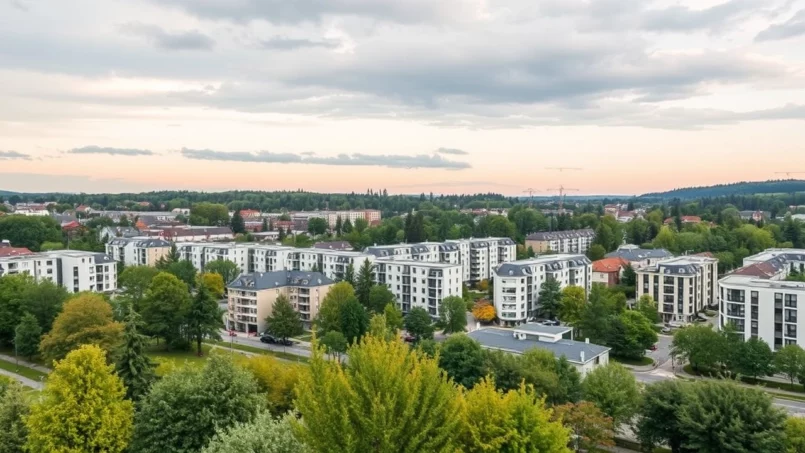
Seven miles west of Boston, the city of Newton concentrates just about everything high-end investors are looking for: public schools among the best in Massachusetts, direct transit access, a highly residential environment, a stock of historic homes… and prices that perfectly reflect this rarity. Nicknamed “The Garden City,” the town of nearly 88,500 residents is structured into 13 distinct villages, each functioning like a small downtown. For an investor, this means a market that is tricky to read without mastering local nuances, but also solid potential driven by deep and sustained demand.
This article analyzes the Newton real estate market in detail, covering prices, rental yields, supply and demand dynamics, and the specifics of each village. It also addresses practical aspects of financing and taxation, while identifying potential risks. The goal is to provide a comprehensive foundation for a realistic assessment of this type of investment.
A Premium Market, Structurally Tight
Newton is considered one of the most desirable and most competitive markets in Massachusetts. The diagnosis is always the same, regardless of the source: few listings, many buyers, high prices that continue, overall, to climb.
The city has about 31,700 housing units, of which nearly 56% are single-family homes, and 66% of homes are owner-occupied. This is a very high homeownership rate, more than double that of Boston (about 33.6%), which helps freeze a portion of the housing stock and perpetuates the scarcity of supply for both sales and rentals.
Nearly half of the housing stock (about 50%) was built before 1939, and only 11% after the year 2000. In other words, many older homes, often charming but sometimes costly to renovate, and little recent construction to ease the market.
Price Levels: A Millionaire’s Market
The figures give a clear idea of the market’s caliber:
| Indicator (Citywide) | Approximate Value |
|---|---|
| Average home value (Zillow, 2025) | $1.46–1.54 M |
| Median sale price (December 2025) | $1.4 M |
| Median single-family home price (2023) | $1.67 M |
| Average single-family home price (2024) | $2.14 M |
| Median price per sq ft (approx., 2024–2025) | $583–603/sq ft |
| Highest price paid in 2023 | $6.25 M |
In practice, this means a very large share of transactions are concentrated in the very high end: in 2023, 57.2% of homes sold exceeded $1.5 M, and 33% sold for over $2 M. The “luxury” subcategory (above $2 M) is actually growing faster than the rest of the market, with estimated growth around 8.5%.
The cumulative appreciation of home values in Newton over ten years was approximately 105%.
Sustained Momentum Despite Interest Rate Levels
The rise in mortgage rates (up to 7.2% in mid-2024, falling back to around 6.1–6.3%) has a two-fold impact. On one hand, it slows down some buyers dependent on credit. On the other, it keeps many homeowners “locked in” to their previous low-rate loans, which further limits the number of properties brought to market.
The city has only about two months of housing inventory for sale, a level well below that of a balanced market (5–6 months), maintaining high competitiveness among buyers.
– Homes go under contract in twenty to forty days depending on the season and segment.
– In June 2025, nearly 48% of sales closed above the asking price.
– Of 77 sales recorded that month, 77% found buyers in under 30 days.
– The gap between list price and final price is small: depending on the period, the sale-to-list price ratio hovers around 99–100%.
In certain highly sought-after niches (“hot homes”), it is not uncommon to see a listing sell for 2 to 5% above the asking price in less than two weeks.
Where to Invest? Understanding Newton’s 13 Villages
One common pitfall for an outside investor is to view Newton as a homogeneous market. In reality, each village has its own identity, price levels, and dynamics.
Price Overview by Village (Sales)
The following table provides an overview of median prices and per sq ft levels in the main villages, based on 2025 data:
| Village / Neighborhood | Median Price (Sale) | Median Price / sq ft | Avg Days on Market |
|---|---|---|---|
| Oak Hill | $3.1 M (listing) | n/a | n/a |
| Chestnut Hill | $2.295 M | $799/sq ft | 75 days |
| Waban | $2.398 M | $633/sq ft | 30 days |
| Newton Centre | $2.093 M | $651/sq ft | 68 days |
| Newtonville | $1.94 M | $527/sq ft | 50 days |
| West Newton | $1.599 M | $615/sq ft | 20 days |
| Auburndale | $1.599 M | $605/sq ft | 21 days |
| Newton Highlands | $1.435 M | $649/sq ft | 20 days |
| Newton Upper Falls | $1.275 M | $573/sq ft | 22 days |
| Newton Corner | $1.25 M | $558/sq ft | 36 days |
| Nonantum | $1.495 M | $560/sq ft | 27 days |
| Bowen – Thompsonville | $744 K | $574/sq ft | 21 days |
You can immediately see the wide spectrum. Oak Hill and Chestnut Hill clearly position themselves in the very high end, while Bowen – Thompsonville represents, on paper, one of the most affordable entry points in the city.
Focus on a Few Strategic Villages
Newton Centre serves as the geographic and cultural heart of the city. Its lively downtown, served by the D line of the “Green Line,” concentrates shops, restaurants, the public library, city hall, and access to Crystal Lake. It is also one of the most competitive sectors in the market: homes regularly exceed $2 M and often sell above the asking price. For an investor, this is the prime territory for high-end properties and modern condos close to services.
Chestnut Hill, straddling Newton, Brookline, and Boston, exemplifies a family-friendly and academic luxury real estate market. The neighborhood, renowned for its stately homes, proximity to Boston College, upscale shopping centers, and large green spaces, has some of the highest prices in Newton. The median price is about $2.3 million, with a price per square foot around $800. This area is typical for premium properties and high-value rentals, particularly sought after by households connected to the academic or medical worlds.
Waban offers an extremely residential setting, marked by abundant greenery, a discreet but chic village center, and proximity to Newton-Wellesley Hospital. Highly sought after by families, it combines access to the Green Line, large lots, and highly rated elementary schools. The entry ticket far exceeds $2.3 M.
At the opposite end of the spectrum, Bowen – Thompsonville remains more discreet. Primarily residential, without a true village center, this area of about 3,000 residents has a median price significantly lower than the rest of Newton. It interests investors looking for a less expensive entry point, even though the housing stock is less liquid and sales rarer.
These two neighborhoods offer a mix of historic homes and recent construction, with accessibility facilitated by the Mass Pike for West Newton and the D line for Newton Highlands. They benefit from stable demand and continuous price appreciation, while remaining slightly more affordable than the high-end sectors of Newton Centre or Chestnut Hill.
Auburndale and Newton Upper Falls represent interesting options for those seeking a bit more space or a gentler price per sq ft while staying within Newton. Auburndale, along the Charles River, benefits from direct access to I-95 and the Mass Pike, as well as the commuter rail line. Newton Upper Falls, marked by its industrial heritage and the presence of Echo Bridge and Hemlock Gorge Reserve, is also one of the few sectors where the average home value remains slightly below the city average, which can open up windows of opportunity.
Finally, Nonantum, the densest village in Newton, retains a strong identity, driven by its Italian-American heritage and active community life. The market is more restricted for single-family homes (only one home sale in 2023), but condos trade around one million dollars.
Buying to Rent: What the Rental Market Says
For an investor, Newton is not limited to resale. The rental market, also very tight, offers a supplementary yield, even though it generally remains lower than what you find in more affordable cities.
Rental Levels: An Unapologetic High End
Rental estimates vary by source and time period, but all converge on one point: Newton is one of the most expensive rental markets in the Boston area.
| Indicator (Rental) | Approximate Value |
|---|---|
| Average rent (all properties, 2025) | $3,100–3,400/month |
| Median rent (all types, Nov 2025) | $3,435/month |
| Premium vs. national average | ~ +70 to +79% |
| Average rent for a rental home | ~ $4,500/month |
| Average rent for a 2-bedroom | ~ $3,200–3,700/month |
| Average rent for a 3-bedroom | ~ $3,900–5,300/month |
The range of rents is very wide, from a few hundred dollars for rooms or very specific situations up to $20,000–25,000/month for prestige properties.
Overview of recent rent trends for single-family homes, particularly in sought-after areas near Boston.
Single-family home rents have increased by about 6.1% year-over-year, a rapid rise.
For families seeking Newton’s schools and proximity to Boston, rents of $4,000 to $6,000 per month in a desirable village are common.
Rent Differences by Village
Village medians provide a more detailed picture:
| Village | Median Monthly Rent |
|---|---|
| Waban | $5,400 |
| Newton Centre | $5,225 |
| Oak Hill | ~ $6,800 (trend) |
| Chestnut Hill | $4,425–5,800 |
| Bowen – Thompsonville | $4,465 |
| Newton Highlands | $3,800–4,450 |
| West Newton | $3,600–3,850 |
| Nonantum | $2,800–3,500 |
| Newton Corner | $2,900–3,000 |
| Newton Upper Falls | $3,100 |
| Auburndale | $3,300 |
| Newton Lower Falls | $2,875 |
Here you can measure the premium attached to the most sought-after areas (Waban, Newton Centre, Oak Hill, Chestnut Hill) compared to somewhat more accessible zones like Nonantum, Newton Corner, or Newton Lower Falls.
Vacancy, Availability, and Rental Market Temperature
Availability indicators show that the extreme shortage observed around 2022 has eased slightly, but the market remains far from saturated.
The actual vacancy rate for rental housing is 0.6%, down from the previous year.
For a landlord investor, this translates to a limited vacancy risk, especially in the family segments (2–4 bedrooms) well located near schools and transit. On the other hand, gross yields remain modest when comparing rent levels to acquisition prices above $1.5 or $2 M.
What Types of Properties to Favor?
Newton’s housing stock is diverse: large Victorian homes, colonial houses from the interwar period, small apartment buildings, recent condos, new units integrated into mixed-use developments…
High-End Single-Family Homes
These shape the Newton image. They account for more than half of the housing stock and sell, at the median, around $1.7–2 M, with an average exceeding $2.1 M in 2024.
For a wealth preservation investor, these homes offer a dual appeal:
– a high probability of long-term appreciation (the 10- and 15-year history attests to this);
– strong resale liquidity, especially in the most sought-after villages.
On the other hand, the immediate rental yield is generally low. Even with a rent of $6,000/month for a home worth $2 M, the gross yield remains around 3.5%, before accounting for property taxes (high), maintenance (often significant for older homes), and any renovations.
Condos and Townhouses
The condo market has grown significantly in Newton, particularly in the central villages and near the Mass Pike or the Green Line. Average figures for 2024 indicate:
– average price for condos / townhouses: approximately $1.38 M;
– price per sq ft around $458/sq ft.
Condos sell for less than single-family homes, which lowers the entry ticket, and their maintenance is often shared through HOA fees. They attract a clientele of young couples, childless professionals, or seniors wishing to stay in Newton while leaving their large homes.
For an investor, these properties can offer a bit more gross yield than homes, especially if well located near transit or village centers. However, the fees, sometimes high, must be factored into the profitability calculation.
Multi-Family Buildings and Affordable Housing
The multi-family housing stock (2–4 units and more) represents just over a quarter of the housing. In 2023, the observed medians were as follows:
| Property Type (2023) | Median Sale Price |
|---|---|
| Duplex (2-family) | $1.275 M |
| Triplex (3-family) | $1.625 M |
| Condo (unit) | $835 K |
Small apartment buildings particularly interest investors seeking rental cash flow, especially in villages like Newton Corner, Nonantum, or West Newton. Prices per sq ft remain relatively high, but pooling rents across multiple units helps smooth vacancy risk.
The city is actively developing affordable housing projects through programs like 40B (Comprehensive Permit) and municipal initiatives. Concrete examples include the conversion of the West Newton Armory into 43 100% affordable units and the addition of 140 affordable units in the Northland Newton Development in Newton Upper Falls. For investors or developers, these projects offer a strategy to blend market-rate and capped rents, with access to specific financing.
Financing an Investment in Newton: Players and Levers
Given the prices, few acquisitions in Newton are made without financing, even though about 70% of transactions are nevertheless cash or near-cash, particularly in the luxury segment.
Main Types of Financing Available
The local market is served by both large national banks, regional institutions, and a galaxy of specialized players:
– generalist banks: Bank of America (with specialists for Newton loans), East Cambridge Savings Bank (first-time homebuyer programs with closing cost credits), MassHousing (preferential rate programs);
– brokers and local teams: Boston Mortgage Solutions, The Milestone TEAM, etc.;
– private lenders and hard money lenders: Newton Capital, LLC, Longleaf Lending, RFG, who finance operations like property flipping, renovation (fix-and-flip), or construction;
– platforms like Zillow, which offer lender comparison tools.
Financing needs vary and include standard rental property acquisition, funding for major renovation or new construction projects, and cash-out refinancing. Specific solutions also exist for self-employed borrowers or those with complex income, such as bank statement-based programs.
Examples of Private Loan Terms
Newton Capital, LLC well illustrates the flexibility of certain private lenders:
– loan amounts from $50,000 to $5 M;
– terms of 6 to 24 months, interest-only amortization;
– LTV up to 80% (or even 90% with additional collateral);
– rates starting around 10%;
– origination fees between 1.5 and 5%;
– ability to close a deal in 3 to 14 days.
Longleaf Lending offers, in turn, long-term rental loans (up to 30 years), with rates starting at 6.6%, while RFG positions itself on 100% financing for “ground-up” projects or fix-and-flip deals, up to 75% of after-repair value (ARV).
For an investor in Newton, this type of financing is suitable for purchases at a discount followed by major renovations. It then allows for a resale or refinancing via a long-term loan (such as DSCR loans), based on the new property value and its rental income potential.
Practical Financing Tips
In a market with limited inventory and strong competition, sellers favor the safest and fastest deals. It is better to:
– be pre-approved before even starting to make offers;
– prepare in advance all required documents (tax returns, bank statements, renovation business plan, etc.);
– seriously compare at least three loan offers (rates, fees, prepayment terms);
– lock your rate (“rate lock”) as soon as possible, especially during volatile periods.
For construction or major renovation projects, it is strongly recommended to set aside a contingency fund of 5 to 10% of the work budget, as surprises are common in an old urban fabric like Newton.
Local Taxation: A Major Point of Caution
Property taxes in Newton are among the highest in the Boston area, which mechanically weighs on the net profitability of investments.
Tax Levels and Impact on an Investment
For fiscal year 2026, municipal tax rates are:
| Property Type | Property Tax Rate (FY 2026) |
|---|---|
| Residential | $9.69 / $1,000 of value |
| Commercial | $18.06 / $1,000 of value |
With a median price around $1.5 M, this translates into substantial annual bills. For example, a home assessed at $1.5 M will incur about $14,500 to $16,000 in municipal tax per year, depending on the reference year. Median estimates speak of a charge around $10,000–11,000 per year, which is well above the national median.
Percentage of the City of Newton’s revenue coming from property tax, a crucial element for investor yield calculations.
Practical Tax Management and Optimization
Taxes are billed quarterly, with typical due dates of August 1, November 1, February 1, and May 1. The first two bills are based on the previous year’s assessment; the next two adjust according to the final assessment for the current year.
Exemption or reduction programs exist for certain categories (primary residence, seniors, veterans, disability, etc.), but they mainly concern occupants rather than typical investors. However, it is always useful to check, with the documents in hand, with the Assessors Office to see available options and the relevance of a possible abatement application if the tax value seems overestimated.
Urban Projects, New Construction, and Future Supply
Newton is not a static city. Numerous large-scale residential projects are underway or in preparation, often driven by mechanisms that encourage density in exchange for affordable housing (Chapter 40B, obligations under the MBTA Communities Act, etc.).
Some Structuring Operations
Among the flagship projects likely to influence the local market:
Overview of the main real estate and housing projects currently underway or planned in Newton, illustrating strategies of densification, mixed-use, and sustainability.
Mixed-use project on 22+ acres: 822 housing units (including 145 affordable), 90,000 sq ft of commercial space, and 1,000+ parking spaces. Aims for LEED Gold and Passive House certifications, with a significant network of green spaces and a park with a splash pad under construction.
Transformation of an MBTA station parking lot into a major residential project: more than 500 housing units and commercial spaces. Example of transit-oriented densification, directly bordering the Green Line.
Conversion of a former military building into 43 100% affordable housing units for households earning below 60% of AMI. Project contributing to neighborhood redevelopment, not intended for private investors.
Series of programs (40B, special permits) including Crafts Street, Dunstan East / Newton Crossing, 528 Boylston, etc. Total pipeline of more than 2,000 multi-family housing units in the long term.
For the investor, these projects have a dual effect. In the short term, they help maintain pressure on land, with some sites remaining under construction for years. In the medium term, they increase the housing supply, particularly rentals, and can therefore influence rents in certain segments. But, given demand and very strict zoning constraints on density, all signs indicate that the balance will remain durably favorable to sellers and property owners.
Profitability and Risk Profile: What Newton Truly Offers
With high purchase prices and significant taxes, Newton is not the ideal playground for an investor seeking double-digit gross yields. Its strength lies elsewhere: in the resilience of demand, long-term stability, and the socio-economic profile of its residents.
A Market Driven by Solid Fundamentals
Several structural drivers support asset values:
– immediate proximity to Boston and its job hubs (biotech, healthcare, finance, universities);
– a public school system among the top-rated in the state, with 21 public schools rated “good and higher” and numerous prestigious private schools;
– a population with high income (average individual income around $95,000) and education levels, with a high proportion of executives and medical or academic professionals;
– a very constrained supply due to zoning rules that limit dense housing construction;
– an attractive residential heritage, with a high percentage of character homes.
These elements explain why, despite rapid price increases, demand continues to grow, including from households from New York or other metro areas seeking a compromise between quality of life and access to Boston.
Well-Identified Risks
Investing in Newton is not without risks, but they are largely identifiable and manageable:
Several factors can impact investment profitability and liquidity: occasional price corrections are possible in a high-rate environment, rising taxes erode margins, zoning constraints limit development possibilities, flood risks affect insurance costs, and some market segments have low liquidity.
Newton, More of a Capital Appreciation Market Than a Cash-Flow One
If we compare Newton to more “productive” markets in terms of rental yield (cities with lower prices but proportionally higher rents), the price-to-rent ratio remains high, resulting in gross yields often around 3–4% for standard residential properties, sometimes higher on well-negotiated multi-family buildings.
On the other hand, the appreciation history and quality of demand suggest that Newton can play the role of a cornerstone asset in a portfolio, offering:
– long-term inflation protection;
– somewhat dampened volatility compared to more speculative markets;
– relatively easy exit, especially for well-located properties (near a good school, the Green Line, or village centers).
Concrete Investment Strategies in Newton
Depending on the investor’s profile, several approaches are possible.
A long-term investor with strong capital capacity can target single-family homes or townhouses in Newton Centre, Waban, West Newton, or Chestnut Hill, with a “buy and hold” logic over 10 to 20 years. Rental profitability will be modest, but the combination of appreciation + debt amortization can generate solid overall returns.
For an investor prioritizing cash flow, small apartment buildings or condos in the villages of Newton (Corner, Nonantum, Auburndale, Upper Falls) offer a lower entry ticket. Rental demand there is strong, driven by young households and professionals seeking proximity to Boston without downtown rents.
Operators like property flippers or developers, finally, will find in Newton fertile ground for transformation operations: renovation of old homes, raising or reconfiguring existing buildings, participating in 40B projects or mixed-use operations in partnership with the city. In this case, mastering the regulatory context, choosing the right financing (private loans, bridge loans, construction loans), and working with local project management and property management teams are decisive.
Surrounding Yourself: Agencies, Property Managers, and Experts
The technicality of the Newton market argues in favor of local support. Several specialized players are mentioned in the available data: experienced agents (like Mike Panza, Cindy Laughrea, Ingvild Brown, or teams like Dwell360 and Centre Realty Group), as well as a dense network of management companies (CJL Rentals and Property Management, Boston Residential Group, Crowninshield, CL Boston Property Management, Green Ocean Property Management, etc.).
Estimated monthly cost to delegate management of a rental property in Newton, which can vary depending on complexity.
Conclusion: Newton, a Demanding Safe Bet
Investing in real estate in Newton means accepting to enter a market where every mistake is costly, but where the quality of the fundamentals has few equivalents on the East Coast. The entry ticket price, taxation, and high competition demand great discipline: carefully choosing your village, property type, financial structure, and surrounding yourself with experienced local players.
For those seeking an “easy” market with high immediate returns, Newton will not be suitable. On the other hand, for an investor who prioritizes long-term security, wealth appreciation, and the socio-economic solidity of tenants, the city remains, figures in hand, one of the most attractive locations in Massachusetts. In a context where the demand for housing in Newton is expected to sustainably exceed supply, and where schools, proximity to Boston, and quality of life remain its best selling points, the “Garden City” still has solid years ahead for patient and well-prepared investors.
Newton Real Estate Market Analysis
Disclaimer: The information provided on this website is for informational purposes only and does not constitute financial, legal, or professional advice. We encourage you to consult qualified experts before making any investment, real estate, or expatriation decisions. Although we strive to maintain up-to-date and accurate information, we do not guarantee the completeness, accuracy, or timeliness of the proposed content. As investment and expatriation involve risks, we disclaim any liability for potential losses or damages arising from the use of this site. Your use of this site confirms your acceptance of these terms and your understanding of the associated risks.

Cyril Jarnias is an independent expert in international wealth management with over 20 years of experience. As an expatriate himself, he is dedicated to helping individuals and business leaders build, protect, and pass on their wealth with complete peace of mind.
On his website, cyriljarnias.com, he shares his expertise on international real estate, offshore company formation, and expatriation.
Thanks to his expertise, he offers sound advice to optimize his clients' wealth management. Cyril Jarnias is also recognized for his appearances in many prestigious media outlets such as BFM Business, les Français de l’étranger, Le Figaro, Les Echos, and Mieux vivre votre argent, where he shares his knowledge and know-how in wealth management.





