
 Published on and written by Cyril Jarnias
Investing in Real Estate in Princeton means entering a very specific micro-market that is simultaneously expensive, tight, very stable, and driven by nearly unique engines in the United States: a world-class university, an outstanding public school system, a high concentration of high-income households, and constant demand for both purchases and rentals. This is not a speculative market with high gross returns, but rather an “equity” and wealth preservation market, where the structural scarcity of supply supports prices year after year.
Princeton, on the American East Coast, is a high-end enclave well-served by train between New York and Philadelphia. It offers a vibrant downtown, high safety, and a highly educated population, but its real estate prices are well above the national average. A successful investment in this locality requires a detailed analysis of price cycles, supply dynamics, rental pressure, as well as a precise understanding of tax laws and regulatory frameworks, especially in historic districts.
An Expensive, Tight Market… and Remarkably Resilient
It all starts with one observation: Princeton sits far above national averages and even the average levels of New Jersey. The market is described as “competitive” or “somewhat competitive,” which translates into several converging indicators: multiple offers on purchases, contained selling times, and prices that, over the long term, increase faster than average.
Price data shows a wide range depending on sources and periods, but a constant underlying factor: values are high.
| Price Indicator (Princeton) | Approximate Reported Value |
|---|---|
| “Typical” home value | ≈ $937,000 |
| Median listing price (all types) | ≈ $1.45M |
| Recent median sale price | ≈ $1.4M |
| Median price (other sources, various periods) | $721,107 to $1.8M |
| Median price per sq ft | $150 to $555 / sq ft |
Depending on the period, the median sale price has been cited at $960,000, $995,000, or even $1.2M. One report even mentions a median price of $1.6M in May 2025, an 18% year-over-year increase at that time. Conversely, another source isolates a month where the median price dropped to $325,000, which seems more like a sample effect or a different market with the same name than the structural reality of Princeton.
Over three years, the median price per square foot in Princeton increased by about 25%, far outpacing the overall market rise.
A More Stable Real Estate Micro-Economy Than the Region
One of the key points to understanding Princeton is the notion of a “micro-market.” Where other cities in the region are more heavily impacted by cycles (rapid rises, brutal corrections), Princeton remains supported by structural factors:
The presence of prestigious institutions like Princeton University, with its thousands of employees benefiting from housing allowances, and top-rated schools, combined with a walkable, cultural, and safe environment attracting a national and international audience, creates strong demand. This demand runs up against physical and regulatory constraints on land that drastically limit the ability to build new housing.
This “stability engine” explains why brutal price drops are rare, and why corrections, when they occur, remain contained compared to other East Coast markets.
Selling Fast, But Not at Any Price: Market Speed
Time on market confirms the overall tightness. Depending on sources and periods, the average days on market before an offer ranges from 26 to just over 70 days. Most recent analyses converge around 30 to 50 days for an “average” property, with “hot homes” selling in 21 to 34 days.
| Market Speed (Princeton) | Observed Data |
|---|---|
| Average days on market (range) | 26 – 76 days |
| Typical recent timeframe | ≈ 30 – 53 days |
| Timeframe for “hot” properties | 21 – 32 days (sometimes up to 40-49 days) |
| Average number of offers per property | ≈ 3 |
| Sale price to list price ratio | ≈ 101% to 102% |
In practice, the investor should understand that:
In the current real estate market, most properties sell close to the listing price, often slightly above. ‘Good deals,’ characterized by a prime location, good condition, or a rare product, typically trigger multiple offers and bidding wars of 2 to 5%. The market is highly segmented: for properties under $1 million, competition is described as ‘crazy’; between $1 and $2 million, it’s ‘super, super competitive’; above $2 million, tension remains real but leaves buyers more time to analyze their decision.
On an annual scale, volumes indicate an active market, but constrained by lack of supply. For single-family homes, sales at the end of the third quarter went from 219 units in 2022 to 147 in 2023, 132 in 2024, and then 156 in 2025. In other words, demand hasn’t disappeared, but it is hitting a structurally limited inventory.
Scarce Supply, Especially in “Mid-Range” Budgets
Supply scarcity is the other essential facet of the Princeton market. Two complementary phenomena are observed: a decline in the total number of properties brought to market compared to the 2010s, and an increasing concentration of listings in the most expensive segment.
| Year (all property types) | Number of properties coming to market |
|---|---|
| 2015 | 393 |
| 2020 | 362 |
| 2022 | 337 |
| 2023 | 273–274 |
| 2025 | 299 |
Not only is the volume lower than pre-pandemic peaks, but more than half of available properties are priced above $2M. In the single-family home segment, the distribution by price bracket clearly illustrates this shift upward:
| Price Segment (Single-Family Homes, Q3 2025) | Number of Sales |
|---|---|
| Under $1M | 28 |
| Between $1M and $2M | 77 |
| Over $2M | 51 |
In 2012, the majority of sales were still under $1 million, whereas in 2025 this segment becomes marginal. For an investor, this means:
In Princeton itself, the entry-level market becomes inaccessible, and low-price ‘value-add’ opportunities are becoming scarce. The recommended strategy is therefore to move to peripheral markets like Ewing, Hamilton, or Pennington to apply more opportunistic approaches, such as BRRRR (Buy, Rehab, Rent, Refinance, Repeat) or ‘fix & flip’ strategies.
Moderate Rental Yield, but Very High Income Security
The Princeton rental market is robust, driven by high-income households, employees of major employers, and a massive contingent of students and researchers. Available data shows high rents and relatively low vacancy.
| Rental Indicator (Princeton) | Reported Value |
|---|---|
| Median monthly rent | ≈ $3,750 |
| Average monthly rent (other source) | ≈ $4,140 |
| Number of rental listings recorded | ≈ 107 |
| Annual change in number of rentals | –52.85% (sharp decline in supply) |
| Annual increase in median rent | +7.17% |
The drop of more than 50% in rental inventory over a year, combined with a significant increase in median rents, reveals tangible pressure for tenants… and therefore security for landlords. Rents are driven upward by several factors:
Main demographic, economic, and real estate factors characterizing the locality.
Median household income at $170,000, with a price-to-income ratio of about 4.7.
Over 80% of adult residents hold at least a bachelor’s degree.
Presence of Princeton University and major employers in healthcare and technology sectors.
Structurally low supply, including new construction, despite many ongoing development projects.
The most sought-after rental neighborhoods include downtown and Princeton North. In the latter, the median rent is around $4,800 per month, with a price per square foot of about $635 for purchases and a median home price around $1.29M.
University Pressure: A Quiet but Powerful Driver
The university is a determining factor in rental demand. About 70% of graduate students are housed in university housing, but despite the construction of new complexes like Meadows (an additional 379 units), up to a quarter of doctoral students and post-docs must seek off-campus housing. However, off-campus rents far exceed what a student budget allows, even with relatively generous funding ($38,000 to $42,000 annual stipend).
Zillow estimates the median rent for apartments near Princeton University at $3,750 per month.
| Type of Rental Unit | Estimated Average Monthly Rent |
|---|---|
| Studio | ≈ $1,800 |
| 1 bedroom | > $2,300 |
| 2 bedrooms | ≈ $2,900 |
For an investor, this structural pressure, reinforced by graduate student population growth over ten years (about +500 students), translates into:
– stable or even growing rental demand, including in the immediate outskirts (Plainsboro, West Windsor, Montgomery…);
– controlled vacancy, especially for well-located smaller units;
– potential for furnished or semi-furnished rentals targeting international students, visiting researchers, and young professionals.
However, be warned: gross profitability in Princeton itself will remain moderate given the very high purchase prices. The main appeal is income security and long-term capital appreciation.
A Highly Creditworthy and Very International Demographic Profile
Beyond the numbers, Princeton is a textbook example of an affluent college town. The population is around 49,500 residents, with a very specific profile:
– 23.1% under 18, highlighting the weight of families;
– 36% foreign-born residents, reflecting global appeal;
– diverse ethnic structure: just over half the population identifies as white, over 30% as Asian, around 7% Hispanic, and nearly 6% Black.
Over 82% of residents aged 25 and older have at least a college degree.
This combination – high income, very high education level, telecommuting – sustains strong demand for:
– single-family homes with gardens on the outskirts near the center;
– modern, well-insulated townhouses;
– recent, eco-efficient apartments with shared coworking spaces.
For an investor, this is a demanding clientele, but creditworthy and fairly stable, who value quality of life as much as proximity to schools and transportation.
Neighborhoods with Very Different Profiles
Investing in Princeton does not mean the same thing depending on the target neighborhood. There is a true patchwork of micro-markets with their own dynamics.
Princeton North, considered one of the best areas to live or invest in, combines proximity to schools, shops, parks, and strong rental demand. The median price exceeds $1.28M, with rents around $4,800, making it a prime neighborhood for long-term rentals to executives, healthcare professionals, or professors.
Downtown Princeton offers a different profile: lower median rents (around $2,400), but particularly low vacancy due to walkability to restaurants, cafés, McCarter Theatre, or the Princeton University Art Museum. For smaller units, the market is especially dynamic.
This historic African American neighborhood, now designated, is undergoing full rehabilitation. The AHO-7 zone requires mixed-use projects including a significant share of affordable housing, while preserving heritage. Investment here offers appreciation potential but is subject to strong preservation constraints.
Other areas – Riverside, Springdale, Littlebrook, Princeton Ridge, Princeton Junction, Carnegie Lake… – represent as many different niches, from golf-course living on the edge of Springdale to modern homes in the woods of Princeton Ridge, to the family-oriented suburban neighborhoods of Littlebrook, considered an interesting “emerging” zone for investment.
Local Taxes: a Cost to Factor in from the Start
New Jersey is known for its heavy property taxes, and Princeton is no exception. The median effective tax rate hovers around 2.43 to 2.51%, more than double the U.S. average (≈1.02%), though it remains slightly below the state average.
| Tax Indicator (Princeton) | Approximate Value |
|---|---|
| Median home value | ≈ $646,500 |
| Local median effective rate | 2.43 – 2.51% |
| Median annual property tax | $16,541 – $17,054 |
| Average property tax 2023 (Princeton) | ≈ $21,372 |
| New Jersey median effective rate | ≈ 2.88% |
| U.S. median property tax | ≈ $2,400 / year |
Zip codes 08540 and 08542 fall within this range, with bills easily exceeding $17,000 per year, and for high-end properties, reaching or exceeding $30,000. For a rental investor, this mechanically reduces net profitability and reinforces the importance of:
– precisely calibrating the rent level;
– taking advantage of tax deductions on mortgage interest, depreciation, and expenses;
– optimizing the structure (LLC, financing, possible 1031 Exchanges for U.S. investors).
There is an appeal process for assessments (with the county Board of Taxation), but testimonials show it does not always succeed, even in cases of sharp increases. The probability of additional increases in the coming years is considered high, making taxes a critical parameter in any business plan.
A City That Builds, but Under Heavy Constraints
Contrary to the image of a static town, Princeton is experiencing intense construction and renovation activity. Old houses are regularly razed to make way for new properties, often of very high standing. The prices of these new constructions highlight the positioning:
– average listing price for new homes around $2.5M;
– average sale price of these new constructions near $2.9M;
– “teardowns” (lots with a house to demolish) that sell quickly, often above the asking price.
At the same time, large multifamily complexes are being built or planned, with a dual logic: meeting the demand for modern housing for seniors, young professionals, and families, and producing the affordable housing units mandated by the state’s Fair Share Housing justice.
Examples include:
– Avalon Princeton Circle (formerly Thanet Property), 221 apartments;
– Princeton Senior Living, 80 senior housing units;
– The Alice, 125 units at the edge of the Princeton Shopping Center;
– Avalon Princeton on Harrison Street, under construction, 200 units;
– a project for 64 affordable housing units on Herrontown Road, the former SAVE site;
– a series of mixed-use housing/commercial projects on Nassau Street, Witherspoon Street, Terhune Road, John Street, etc., some of which are 100% affordable (former fire station buildings).
Number of affordable housing units Princeton was required to produce for the period 1999-2025, a goal now exceeded.
For the investor, this dynamic has several implications:
– the arrival of a larger new rental inventory in the coming years, mainly apartments;
– a concentration of these new buildings along commercial corridors and already developed areas, following a “Smart Growth” logic (growth on already built-up areas, not on natural spaces);
– possible increased pressure on older, less well-located or less energy-efficient housing, which may need to upgrade in quality to remain competitive.
Historic Heritage: Strong Constraints, but Real Added Value
A large part of Princeton, especially the center and certain neighborhoods like Witherspoon-Jackson or Jugtown, is subject to historic preservation regulations. A Historic Preservation Commission (HPC) reviews renovation, demolition, or construction projects in these areas or their protection perimeters.
For the property owner-investor, this means: looking beyond immediate returns and considering factors such as long-term appreciation, property management, and the impact of the real estate market on investments.
Any significant exterior modification in a historic district requires the submission of a preservation plan, a formalized process with a file, fees ($75), review timelines, and sometimes a public hearing. Demolitions are highly regulated and generally only permitted if the building has no reasonable use. For routine maintenance work (identical replacement), simplified administrative approvals may be obtained.
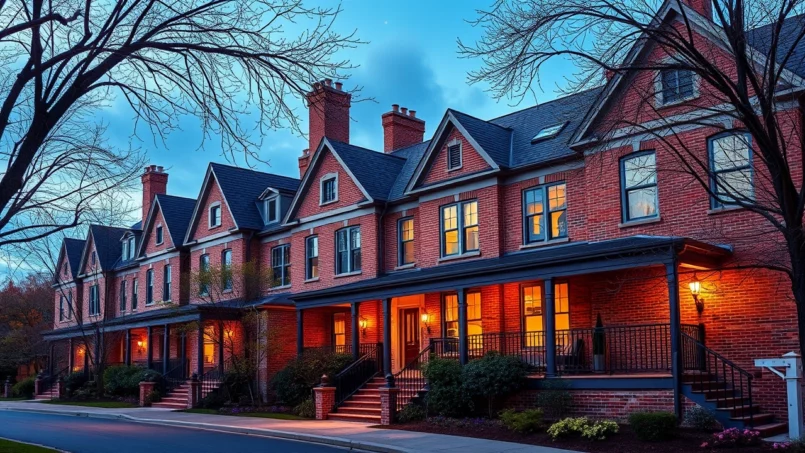
These constraints may seem off-putting at first glance, but they also strongly contribute to the long-term value of the affected neighborhoods: architectural homogeneity, tourist appeal, a “timeless” atmosphere around the university’s Gothic buildings, brick facades, and colonial architecture. For high-end “buy and hold” strategies, being listed in a recognized historic district is often a guarantee of value stability.
Possible Investment Strategies in Princeton
In this very specific context, not all investment models are relevant. Given the price levels and taxation, Princeton is most suitable for wealth-building approaches with a long-term horizon, possibly coupled with sophisticated structures.
Buy and Hold Residential
This is the strategy best suited to the heart of Princeton: acquire a single-family home, condo, or townhouse in a good location, rent it long-term or occupy it, betting primarily on capital appreciation.
Advantages:
– value growth prospects above the national average over 10 years;
– very liquid market in good locations, even during downturns;
– stable and creditworthy tenant profile (researchers, executives, doctors, families).
Points to watch:
The gross return on a rental investment can be modest after deducting expenses like property tax, maintenance, and upgrades. You must also anticipate the likelihood of investing in energy efficiency improvements, interior refreshment, and, for properties in the city center, compliance with specific heritage rules.
High-End Long-Term Rentals
Targeting properties close to the center, transportation (Princeton Junction) or Princeton University, and positioning them in a premium segment (high-end furnished, included services) allows securing a business clientele: executives on assignment, expatriate families, visiting professors, doctoral students finishing their theses.
Given an average rent around $3,750–$4,000 and constant demand, this niche can generate interesting returns, especially if the property was acquired before the recent price surge or through optimized tax structuring.
Small Units for Students and Young Professionals
Even though the university houses a majority of its graduate students, there remains a permanent deficit for young researchers, international visitors, and doctoral student couples. Well-located studios or one-bedroom units can achieve occupancy rates close to 100%.
The main risk for a rental investor concerns local regulations, which must be studied meticulously, especially for co-living or short-term rentals (Airbnb type). However, for conventional rentals (12-month leases), the market is very strong because demand far exceeds supply.
More Opportunistic Strategies: BRRRR, Fix & Flip, Wholesaling
These models, relying on buying low, renovating, and then quickly reselling or refinancing, are much harder to implement in Princeton itself, where:
– the inventory of “distressed” properties is limited;
– acquisition prices are already very high;
– renovation costs (skilled labor, quality materials, heritage constraints) drive budgets upward.
In contrast, the neighboring towns of Mercer County, like Ewing, Hamilton, or parts of Trenton, offer median prices around $250,000–$350,000 and rents near $2,000 per month, providing price-to-rent ratios more compatible with these strategies. An investor can then adopt a “ring” logic: wealth building in Princeton, returns in the peripheral municipalities.
Infrastructure, Services, and Living Environment: Assets That Monetize
Princeton’s attractiveness also lies in its environment. The town is regularly cited for:
– its pedestrian-friendly center, cafés, bookstores, shops, and varied restaurants (over 100 dining and retail establishments);
– its cultural institutions, from the McCarter Theatre Center to the Princeton University Art Museum;
– its green spaces, like Institute Woods, Mercer Meadows, Community Park, or the Springdale golf course;
– top-tier healthcare with Princeton Medical Center.
Princeton is well connected to New York (about 1 hour by train from Princeton Junction) and Philadelphia via the same rail line, and is served by major highways (Route 1, I‑95). Compared to expensive New York neighborhoods, it represents a more affordable alternative, with a price per square foot lower than Brooklyn (over $1,100/sq ft) or Bronxville (up to $752/sq ft).
These characteristics reinforce an underlying trend: the migration of former New York residents to New Jersey, some of whom settle in Princeton, attracted by this compromise between urban life and a green setting.
Investing in Princeton is not without risks, but they are of a different nature from those encountered in more cyclical or speculative markets.
The main points to watch are:
– property taxes, heavy and likely to continue increasing;
– the entry cost, very high, which limits diversification and exposes to concentration risk;
– the strict regulatory environment in historic districts, which can slow down or complicate renovation projects;
– partial dependence on university employment and major local employers, even if the economic base remains diversified.
In return, the advantages are considerable:
– strong structural demand, driven by the university, schools, demographics, and migration from New York;
– high legal and institutional security;
– scarcity of available land, supporting prices long-term;
– quality of life, safety, and public services that ensure lasting appeal to a clientele with high purchasing power.
For a patient investor with a long horizon (10 years and more) and the capacity to absorb moderate current returns in exchange for a high probability of capital preservation and growth, Princeton constitutes a market of choice.
Conclusion: Who Is Real Estate Investment in Princeton Really For?
Ultimately, investing in real estate in Princeton is not a strategy for a fast cash-flow hunter. It is a wealth-building positioning in a rare college town, both very American in its infrastructure and surprisingly “European” in its urban fabric, its emphasis on walking and culture.
This market is primarily aimed at:
This type of investment is mainly for three categories: high-income individual investors or families looking to establish a lasting wealth base in the United States; expatriates and senior executives who value the quality of education and living environment over immediate maximum rental yield; and institutional investors or family offices seeking stable residential assets in top-tier university towns.
For all, the key will be the same: take the time to understand the mosaic of neighborhoods, the real tax burden, the preservation rules, ongoing development projects, and the logic of local players (university, municipality, developers). It is at this price that an investment in Princeton real estate can realize its full potential, not as a simple investment, but as a true anchor in one of the most unique and sought-after residential markets on the American East Coast.
Disclaimer: The information provided on this website is for informational purposes only and does not constitute financial, legal, or professional advice. We encourage you to consult qualified experts before making any investment, real estate, or expatriation decisions. Although we strive to maintain up-to-date and accurate information, we do not guarantee the completeness, accuracy, or timeliness of the proposed content. As investment and expatriation involve risks, we disclaim any liability for potential losses or damages arising from the use of this site. Your use of this site confirms your acceptance of these terms and your understanding of the associated risks.

Cyril Jarnias is an independent expert in international wealth management with over 20 years of experience. As an expatriate himself, he is dedicated to helping individuals and business leaders build, protect, and pass on their wealth with complete peace of mind.
On his website, cyriljarnias.com, he shares his expertise on international real estate, offshore company formation, and expatriation.
Thanks to his expertise, he offers sound advice to optimize his clients' wealth management. Cyril Jarnias is also recognized for his appearances in many prestigious media outlets such as BFM Business, les Français de l’étranger, Le Figaro, Les Echos, and Mieux vivre votre argent, where he shares his knowledge and know-how in wealth management.





