
 Published on and written by Cyril Jarnias
Moving to the United States Virgin Islands means stepping into a postcard landscape… but also one of the richest culinary heritages in the Caribbean. For an expat, eating well isn’t just about finding “a good restaurant near home”: it’s a path to integration, a way to learn the islands’ history, meet locals, talk culture… and sometimes even improve your English and local dialect, all over a plate of fish and fungi.
This guide provides a concrete overview of local cuisine, island by island. It tells you what to taste, where to go, how to behave at the table, and what experiences to have to discover authentic food, beyond the standard imported dishes.
Understanding the DNA of Local Cuisine
The cuisine of the United States Virgin Islands is a true historical palimpsest. In a single plate, you find traces of indigenous peoples (Ciboney, Arawaks, Caribs), African heritage, successive European colonizations (notably Danish), modern American influence, Indian laborers who arrived after the abolition of slavery, and more recently, the Ital (Rastafarian) plant-based philosophy.
This history is read in the ingredients, but also in the way of cooking.
Caribbean cuisine is the result of historical blending. Indigenous peoples left behind the use of local ingredients like corn, guava, and tobacco, as well as cooking techniques over wood fires. Enslaved Africans brought hearty dishes like fungi (corn-based), callaloo (herb soup), and methods for preparing salted fish. European colonists introduced beef, onion, garlic, wheat, sugar cane, and fruits like mango. Indian laborers contributed curries and roti, which became an iconic sandwich. Finally, American and tourist influence added burgers, pasta, and cocktails, enriching a table that remains deeply Caribbean.
For an expat, grasping this cultural mosaic helps understand why a meal can combine a goat curry of Indian inspiration, a Danish guava dessert (red grout), a rum punch of Creole tradition, and leafy greens straight from the African pharmacopeia.
Must-Knows You Absolutely Need to Know
Before diving into island-by-island details, it’s useful to memorize a few pillars of local cuisine. They’ll appear everywhere, from street stalls to fine dining restaurants.
Iconic Dishes
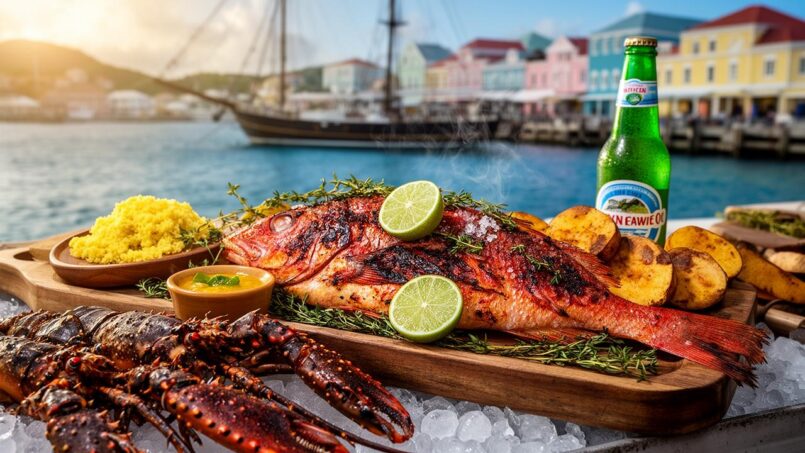
The absolute symbol of island cuisine is fish and fungi, considered the national dish. The fish, often red snapper or a reef fish called “pot fish,” is served boiled or fried, sometimes topped with a spicy Creole sauce. Alongside it, fungi – which has nothing to do with mushrooms – is a preparation of cornmeal cooked slowly with okra until it reaches a homogeneous, elastic texture. Historically, this dish originated from rations imposed on slaves (corn and salted fish), transformed through ingenuity into a national emblem.
Callaloo is a thick green stew made from taro leaves, enriched with okra, peppers, and sometimes meat or seafood. Served with fungi, boiled plantain, or salted fish, it embodies the African heritage of the Virgin Islands.
Pates (pronounced “pat-ays”) are the daily street food: large fried turnovers filled with ground beef, salted fish, conch, or vegetables. For a busy expat, it’s the simplest snack to discover local cuisine without ceremony.
Roti, imported from India via Caribbean migrations, has become a sandwich-of-the-day. A soft flatbread wraps a curry of chicken, goat, shrimp, or vegetables. Between two appointments, it’s a very direct way to feel the islands’ cultural diversity.
Johnny cakes (or journey cakes) are small, dense, and fluffy fried breads, once designed to last a full day of work in the fields. Today, they’re served as a side to grilled chicken, saltfish, a savory breakfast, or simply with butter. Their texture, between a fritter and a biscuit, is at the heart of local culinary identity.
Literally “fish from a trap,” it refers to reef fish caught in pots and cooked whole. Served boiled, fried, or braised, they remind us that the archipelago lives turned toward the sea.
Pot Fish
You’ll also often come across hearty dishes like cow heel soup, oxtail stews, goat curry, rice and peas scented with coconut milk, or plates of saltfish prepared as “run down” (in a coconut milk sauce) or as a warm salad with onions and bell peppers.
Typical Sweets and Desserts
On the sweet side, the star is red grout, a kind of reimagined Danish pudding, made with guava and tapioca, flavored with cinnamon and nutmeg. It’s traditionally served on Transfer Day, commemorating the passage of sovereignty from Denmark to the United States.
Desserts are abundant: coconut tarts, banana fritters, rum cakes, key lime pies, coconut sugar cookies, artisan ice creams flavored with mango, soursop, guava, or papaya. On St. Croix, you’ll hear about a spectacular seven-layer Vienna cake, filled with various local fruit jams (guava, pineapple, lime) and glazed with a white icing.
Local peanut brittle stands out for its texture, which resembles a hard sugar lollipop studded with peanuts rather than classic nougatine, giving a very distinctive regional touch.
Local Drinks and Cocktails
Rum is everywhere, especially Cruzan Rum, distilled on St. Croix since the 18th century. Caribbean classics like the Painkiller, rum punch, or Rumrunners fill bar menus. Some places go further with “extra virgin” rum tastings and complex house cocktails.
Non-alcoholic drinks are also part of the discovery. Bush tea – an herbal infusion of lemongrass, mint, or other medicinal plants – is consumed as much for pleasure as for its supposed virtues. Mauby, a lightly fermented drink made from mauby bark, sugar, and spices, has a bitter taste that surprises newcomers. Sorrel, an infusion of red sorrel flowers with ginger, cloves, orange peel, and sometimes a bit of rice for fermentation, is strongly associated with the holidays.
On St. Croix, a sea moss drink, made by boiling seaweed for a long time then mixing it with milk and spices, is reputed to be an aphrodisiac. And you can’t miss fresh coconut water, fruit juices (mango, passion fruit, tamarind, guava), and fruit “punches,” sometimes enhanced with rum.
Getting Your Bearings Island by Island: St. Thomas, St. John, St. Croix
The three main islands each have their own personality, including on the plate. For an expat, understanding this culinary geography helps in choosing where to live, where to go out, and how to organize gourmet weekends.
St. Thomas: Urban Hub and Varied Dining Scene
St. Thomas concentrates port traffic, large marinas, and much of the tourist activity. You’ll find very accessible restaurants as well as high-end tables, often with sea views.
Around the capital Charlotte Amalie, expats quickly discover Gladys’ Cafe, an institution serving stewed chicken with a house-made pepper sauce. Nearby, 758 Bar & Restaurant highlights local “rice and peas” and hosts DJ nights, a good way to combine culinary discovery with social immersion. The Frenchtown neighborhood has become a gourmet hotspot: Oceana, set in a former Danish manor house facing the sea, offers a reimagined bouillabaisse with fish delivered by local fishermen, while De Frenchtown Bar attracts fans of slow-cooked oxtail during “Oxtail Thursdays.”
The waterfront and marinas host addresses where you come as much for the menu as for the view. Caribbean Fish Market, facing Cowpet Bay, serves shrimp penne, surf and turf, and daily catches prepared with international influences. Cutlass & Cane, at Yacht Haven Grande, practices “elevated” cuisine inspired by local recipes, with shareable plates like jerk wings or reinvented Caesar salads. In the same area, Momma’s Shack delights at breakfast with johnnycake, saltfish, and banana fritters.
For a decidedly fine-dining experience, Blue 11, at Yacht Haven Grande marina, offers tasting menus in 7, 9, or 11 courses, orchestrated by an award-winning “Caribbean Chef of the Year.” Seafood takes center stage, in a very contemporary approach.
Discover spots to taste everyday local life through simple, authentic cuisine.
Near Lindbergh Bay Beach, famous for its pates (especially shrimp), pot fish, yellow rice, and well-liked potato salad.
At Barbel Plaza, offers no-fuss dishes like fried fish, stewed mutton, or curry chicken for lunch.
Focuses on veggie burgers for a quick and tasty option.
At Crown Bay Marina, stands out with its tropical-flavored chicken wings.
Home-cooking enthusiasts will head to De’Coal Pot, on the east end of the island, for goat roti, Creole chicken, and a Caribbean “home cooking” atmosphere, or to Petite Pump Room, at the Blyden Marine Terminal, which serves midday saltfish in butter sauce, stewed oxtail, and other typically local daily specials.
St. John: Small Island, Big Creativity
The smallest of the three, St. John feels like a permanent laboratory. The culinary scene evolves quickly, driven by a mix of longtime residents, creative chefs, and expats.
In Cruz Bay, Extra Virgin Bistro is often cited as the best table on the island. The restaurant draws inspiration from the Mediterranean while relying on fresh herbs from its on-site garden and local seafood. House-made pasta, fresh bread, and three-course tasting menus show how a chef can reconcile local roots with European techniques. La Tapa, open since the 1990s, offers small-plate cuisine blending the Caribbean and Spain, ideal for sharing and discovering several flavors in one meal.
Morgan’s Mango, another Cruz Bay staple, has served since 1992 a fusion cuisine from across the Caribbean, with dishes like coconut-crusted grouper, very creamy seafood paella, or a house-style osso buco. Nearby, St. John Brewers combines a craft brewery with dining: house-made pizzas, oven-baked chicken wings, and beers brewed on-site create a convivial environment where residents, expats, and tourists alike mingle.
Seafood lovers can book at 18°64° The Restaurant, at Mongoose Junction, to enjoy raw seafood platters, lobster rolls, and hand-rolled sushi. For a romantic evening, you can reserve at ZoZo’s at Caneel Bay, which offers a fine-dining tasting menu on the site of the now-closed legendary resort.
In Coral Bay, the island’s more bohemian side, food remains firmly rooted in Caribbean fare. Skinny Legs, a laid-back grill and bar, serves burgers and pub food with a village mentality. Johnny Lime, specializing in smoked barbecue (pork, chicken, brisket, even smoked lobster some nights), gathers locals and passersby around bingo or quiz nights. Ekaete Pink Corner goes full Caribbean: jerk pork, ribs, curries, rotis, and house-made ice cream follow one another, though opening hours remain unpredictable. Surf Club Cantina, with its fish tacos and house-made tortillas, offers a Mexican-inspired alternative with a bay view.
For a quick, very local meal, the food truck The Roti King, in the Lumberyard parking lot in Cruz Bay, has become a reference. Its owner has perfected his rotis over nearly twenty years, offering chicken, goat, and vegetarian versions. Finally, Lime Inn, a Cruz Bay institution, has shifted its menu toward tacos inspired by its “floating sister” Lime Out, while keeping a New England clam chowder.
St. Croix: Agricultural Heart and Stronghold of Traditions
Larger and a bit more isolated, St. Croix is often described as the culinary capital of the archipelago. The island combines more developed agriculture, historic rum production, and a dense network of small spots where Crucian cuisine remains very much alive.
In Christiansted, Savant is a benchmark: listed among the best Caribbean restaurants by the specialized press, it works with local fishermen and farmers. On the menu are combinations like wood-grilled calamari, filet mignon stuffed with goat cheese, curries, daily fish… The fact that a U.S. president dined there underscores the place’s reputation. La Reine Chicken Shack, on the other hand, is the exact opposite in terms of décor but a true institution for Crucians: a large open space along Centerline Road, a wood pit where chicken roasts slowly all day, pork ribs, stewed saltfish, and, most importantly, johnny cakes reputed to be the best on the island.
Harvey’s, long a favorite spot of basketball player Tim Duncan, served pot fish and fungi and sea moss drink in a local canteen atmosphere. Even though the restaurant has closed, it remains in memory as a symbol of unpretentious Crucian cuisine. Other spots carry on this heritage: Armstrong’s Homemade Ice Cream, a family-run ice cream parlor that still uses a Danish recipe with fruits like gooseberry; or Rosa’s Booth, a tiny family stand in Frederiksted open for over fifty years, known for its pates (conch, saltfish, beef) and “fracos,” shaved ice doused with fruit syrup.
Expatriates seeking modern cuisine are not left out. AMA at Cane Bay, on the north coast, embodies a new wave: Crucian chef, sustainable sourcing, a terrace overlooking the sea, and a menu where corn polenta may sit alongside local shrimp and lobster in a “shrimp and grits” style, truffle popcorn, and a brunch of brioche pancakes with cinnamon glaze. Ci Bo Né, in the west, claims a farm-to-table spirit: wild fish, crab cakes, pan-seared scallops celebrate the direct link between bay, farm, and table. Salt Great Pond, with its terrace overlooking a lagoon, offers creative plates like compressed watermelon salad or house-made bagels with mango cream cheese.
On the living-side, Ziggy’s Island Market & Gas Station surprises: a gas station by day, a very popular lunch table with Crucian barbecue, conch fritters, shrimp curry, or Cuban sandwiches, plus a Sunday brunch by a resident chef. Shupe’s rethinks the artisan burger facing the sea; Toast Diner serves Venezuelan arepas stuffed with plantain or saltfish, while Goat Soup & Whiskey stands out for its daily soups and a particularly renowned clam chowder.
Eating Like a Local: Markets, Products, and Seasonality
Discovering local gastronomy without visiting markets would mean missing the essential. For an expat, these places offer not only prices often better than imported goods from the mainland, but also direct contact with producers and the islands’ eating habits.
St. Thomas: Farmers’ Markets and Specialty Groceries
On St. Thomas, the St. Thomas Farmers Market animates Market Square daily, with a peak on Saturday mornings. Under a former cast-iron awning from the early 20th century, you buy fresh coconut water, passion fruit wine, sprigs of thyme, bay leaves, celery, onions, and local tea blends, but also pates, stews, and soups to go. Vendors often offer tastings and explain how to cook their products—a valuable informal cooking lesson for newcomers.
The Bordeaux Farmers’ Market, twice a month, attracts organic and community-minded shoppers: fruits (passion fruit, breadfruit, mangoes), artisan jams, hot sauces, fruit wines, pies, as well as games, songs, and sometimes dancing. A Rastafarian market, held on the first Sunday of the month on the west end of the island, also offers pesticide-free vegetables, medicinal herbs, Ital dishes (vegan, unprocessed), and crafts.
For everyday shopping, several supermarkets make life easier for expats. Fruit Bowl, near Yacht Haven Grande, offers fresh produce, gluten-free or lactose-free options, and a wide selection of fish, meats, and cheeses. Plaza Extra and Food Center, open year-round, are ideal for general provisions. Marina Market, in Red Hook, provides fresh and ‘gourmet’ products similar to specialized North American stores.
St. John: Small Markets, Big Finds
St. John doesn’t have a large fish market, but several well-stocked mini-markets surround the ferry dock in Cruz Bay. Starfish Market offers fresh produce, butcher shop, cheeses, breads, eggs, and a deli counter. Pine Peace Market and Dolphin Supermarket combine fair prices with a solid selection, including wines and spirits. St. John Market, further south, and St. John Spice, right at the dock, complete the setup: the former for general groceries, the latter for spices, teas, and coffees, very useful when you want to experiment with local recipes at home.
On the east end, Coral Bay and Calabash Boom offer nearby supply points. Dolphin Market, Love City Mini-Mart, and Calabash Market sell fruits, vegetables, meats, wines, and other products, often supplemented by homemade items. The advantage for an expat: being able to familiarize themselves with local products without having to cross the island.
St. Croix: The Archipelago’s Orchard
St. Croix is the most agricultural of the three islands. The Saturday Farmers’ Market, at the Agricultural Fairgrounds, is a concentration of Crucian culture: you can buy the famous seven-layer Vienna cake, apple-guava juice or sorrel drink, fruit syrups, madras products (typical colorful fabrics), local artworks, as well as an array of vegetables and fruits. You’ll easily run into artisans, families, and chefs stocking up.
The Southgate Corner Farmers’ Market stands out for its selection of fresh and ultra-specialized products. You’ll find local fruits like breadfruit, ‘bell’ apple, mango, canistel, but also rare varieties such as multicolored pitaya or pollock avocado. Producers like Ticos Garden sell organic vegetables and pure coconut oil, usable in cooking and cosmetics. Fiddlewood Farm offers flavored goat cheeses (mango, cranberry, black pepper, French herbs). Fishermen deliver fresh tuna in iced fillets, and you can also find organic eggs from STX Local Eggs, orchids, and artisan soaps.
Sejah Farm, a vast fifteen-acre farm, supplies vegetables (watermelons, carrots, spinach), wildflower honey, mutton, chicken, rabbit, pork, and organizes cooking demonstrations, “farm-to-table” dinners, and even an annual Bush Cook Chef Cook event where chefs and traditional cooks compete over an open fire. “Bush skills classes” also teach locals to identify medicinal plants.
Ridge to Reef Farm offers stays in solar-powered cabins and community organic dinners. This direct immersion allows you to understand the entire food chain, from field to plate.
Finally, a myriad of other places – La Reine market, stands along Centerline Road, Frederiksted fish market, online cooperatives, farms like Art Farm, Creque Dam Farm, or Annaly – further anchor St. Croix in a culture of food self-sufficiency.
Tropical Fruits: A Permanent Playground
Across the three islands, the diversity of fruits is an endless learning field. Mango, ubiquitous, is used for juices, ice creams, hot sauces, or chutneys. Papaya, with its green skin covered in small bumps, is eaten ripe in fruit salads or cooked into jam. Coconuts, harvested from coastal palms, provide coconut water, fresh flesh, milk, and oil. Breadfruit, a large yellow-green fruit with a fairly neutral taste, is cut into quarters for boiling, roasting, or incorporating into stews and soups.
Other fruits, more mysterious to newcomers, deserve to be adopted: carambola (starfruit), whose star-shaped slices adorn salads and cocktails; soursop and sugar apple, bases for creamy ice creams; genip, a small fruit to suck; tamarind, whose pods yield tangy sauces and candies; sea grapes, purplish clusters with a very distinctive sweet-sour taste.
To manage your budget, it’s wise to buy these seasonal products: even though some varieties like mango can be found almost year-round, their abundance and prices vary depending on the season.
Cooking and Learning: Classes, Workshops, and Experiences
For an expat, one of the fastest ways to stop feeling like a tourist is to join a local cooking class. These workshops, led by island chefs, offer several advantages: learning recipes, understanding the history behind each dish, practicing English (and even a few words of Crucian dialect), and meeting other residents or passionate visitors.
On St. Croix, workshops like “Evening Cultural Experience Through Food” or “Morning Cultural Experience Through Food” offer a 1.5 to 3-hour immersion in local cuisine for about $90. Participants cook typical dishes such as fish and fungi, johnny cakes, jerk chicken, or pates, using local ingredients (fruits, soups, seafood). The session concludes with a shared meal around a large communal table. Each participant leaves with recipes, practical tips, and anecdotes about the island’s culinary traditions.
On St. Thomas, classes like “Flavors: Cultural Cooking Class” or those run by “ST THOMAS COOKS” go further in their educational approach. Set in the historic Grand Hotel in Charlotte Amalie, the teaching kitchen accommodates up to twelve people in about 80 square meters, with rotating professional chefs. Founded by a globetrotter passionate about island food, the program blends modern techniques with traditional recipes. Expect around $243 per session, with sometimes structured time slots (10 a.m. for lunch, 2 p.m. for dinner).
Two main formats are offered. The first, all-inclusive, includes transport from select hotels, mobile vouchers, free cancellation, and souvenirs. The second is an in-home service where a chef brings everything, prepares the meal, and cleans up, starting at $185 per person.
Cocktail enthusiasts can follow workshops like the “Christiansted Sip & Savor Mixology Class” on St. Croix (about $131), centered on rum, the archipelago’s oldest spirit. You learn to make, for example, an Emerald Beach Painkiller, taste carefully selected “extra virgin” rums, and understand the importance of this drink in the islands’ economy and culture.
The table below summarizes some typical course and experience formats:
| Culinary Experience | Island | Approximate Duration | Indicative Price (USD) | Main Features |
|---|---|---|---|---|
| Morning/Evening Cultural Cooking Class | St. Croix | 1h30 to 3h | ≈ 90 | Crucian cuisine, history of dishes, shared meal |
| Christiansted Sip & Savor Mixology Class | St. Croix | ≈ 2h | ≈ 131 | Rum tasting, Caribbean cocktails |
| Flavors: Cultural Cooking Class | St. Thomas | ≈ 2h30 | ≈ 243 | Class in a teaching kitchen, renowned local chefs |
| In-Home Caribbean Cooking Class | St. Thomas / St. Croix | ≈ 3h | ≈ 185 p.p. | Private chef at home, ingredients and cleanup included |
These formats are in English, but the group dynamic, demonstrations, and tastings often make up for any language barriers.
Festivals, Events, and Culinary Community Life
The best way to feel the gastronomic pulse of the islands is to take part in major local celebrations, where music, dance, and food mingle.
On St. Croix, the Agriculture and Food Fair – Agrifest – takes place over three days each year at the Rudolph Schulterbrandt grounds. You wander between stalls of traditional dishes, a producer market, vendors of art, clothing, and jewelry, rides, donkey cart rides, and a mini-farm. For an expat, it’s an accelerated immersion into everything edible on the island, from johnny cakes to crab and rice, fruit juices, and the famous coconut festival featuring a cooking competition centered on coconut.
The island of St. Croix offers several festivals celebrating its culinary culture. The Mango Melee & Tropical Fruit Festival is dedicated to tropical fruits with tastings, workshops, and a competition. Jump Up events in Christiansted regularly transform the city into a street party with music, ‘moko jumbies’ on stilts, and local food stalls offering johnny cakes and conch fritters. Finally, the Crucian Coconut Festival at year-end features a ‘Taste of Coconut’ competition, concerts, and highlights coconut-based dishes.
Taste of St. Croix and the St. Croix Food & Wine Experience bring together island chefs and restaurants around competitions, gourmet dinners, wine seminars, and wine auctions, offering expats a showcase of local culinary dynamism and skill.
The big annual carnival on St. Thomas includes a food fair mixing traditional dishes and modern creations. The “Carnival Village” evenings transform squares into food truck villages and open-air bars. Even nautical events, like the Virgin Islands Boating Expo at Yacht Haven Grande, offer culinary offerings with food trucks and bars.
St. John is not to be outdone with the St. John Celebration, where “village nights” and July 4th events bring together food stalls, concerts, parades, and fireworks.
Alongside these, more regular gatherings like “First Friday” in Charlotte Amalie or at Mongoose Junction (Cruz Bay) extend store and restaurant hours, add concerts, performances, and tastings, and create an ideal setting to test new spots while meeting other residents.
Codes, Customs, and Table Etiquette
For an expat used to other norms, dining in the United States Virgin Islands requires a few adjustments, even though it remains very close to North American practices.
Punctuality is valued, especially for reservations at mid-range to upscale restaurants. Arriving a few minutes early is well-received; if you’re more than ten minutes late, calling the restaurant is appreciated.
Percentage of the bill typically considered a standard tip for good service in bars and restaurants.
Manners remain classic: wait for everyone to be served before starting to eat at a restaurant, keep your mouth closed while chewing, avoid talking with your mouth full, politely ask for dishes to be passed rather than reaching across the table, place your napkin on your lap, and avoid using your phone during the meal.
In island society, greeting politely is essential. Entering a shop or addressing a server without a ‘Good morning’, ‘Good afternoon’, or ‘Good evening’ is considered very rude. Conversely, a simple warm greeting, accompanied by a bit of conversation, facilitates exchanges and can lead to recommendations, anecdotes, or even shared recipes. It is also very appreciated to say goodbye when leaving.
Dress also counts: swimwear is reserved for the beach or pool. To go into towns, markets, and especially restaurants, cover your shoulders and wear at least a T-shirt and shorts. In upscale restaurants, more formal attire is expected.
Finally, even though sharing dishes is not as systematic as in some Asian cultures, it’s not frowned upon to order several plates to put in the center to taste as many specialties as possible, especially at small local spots or food festivals.
Practical Tips for Expats: Eating Well Every Day
Settling in the United States Virgin Islands can be a surprise for the wallet: many products, especially those imported from the mainland, are more expensive than in the continental U.S., particularly on St. John. A few strategies help combine culinary discovery with budget management.
For sustainable eating in the Virgin Islands, it’s essential to buy at markets and local fruit stands. They offer better prices on seasonal products, varieties unavailable at supermarkets, and reduce your carbon footprint. On St. Croix, producers like Sejah Farm or Ridge to Reef Farm provide a local base, supplemented by meat, fish, and artisan cheeses (e.g., Fiddlewood Farm). On St. Thomas, the Saturday St. Thomas Farmers Market, complemented by Fruit Bowl or Marina Market, is a habit to adopt. On St. John, despite more imports, combining the Cruz Bay mini-markets with Coral Bay markets allows you to easily incorporate local products into your recipes.
Another useful reflex is to learn a few simple recipes: fungi, rice and peas with coconut milk, pates, johnny cakes, callaloo. Once you’ve made your first attempts (using spices from St. John Spice or tips from vendors), it becomes easy to improvise home meals from market finds. Cooking classes, especially on St. Croix and St. Thomas, provide a solid foundation of techniques and recipes to achieve this.
For eating out, alternating between fine dining restaurants, neighborhood cafés, and street stalls allows you to keep a reasonable budget while progressing in your discovery. One dinner per week at an upscale establishment, a few lunches at places like La Reine Chicken Shack, Ziggy’s, or Momma’s Shack, and pates from Jackie’s Food Truck or Rosa’s Booth quickly fill a notebook of taste memories without breaking the bank.
To find the best places to eat, ask locals (taxi driver, colleague, teacher, etc.). They will often recommend local establishments like a ‘chicken shack’, a food truck, or a neighborhood bar with a daily special, rather than an international chain. On St. Croix, they even say the only bad meal is at an imported fast-food chain.
For an expat, gastronomy in the United States Virgin Islands is not just a list of dishes to check off. It is a key to entering the memory of the islands, their struggles, their mixtures, their pride. Learning to love fish and fungi, understanding the origin of red grout, discussing callaloo at the Saturday market, debating the best spot for johnny cakes or a rum punch—all this is an integral part of integration. The islands offer turquoise sea, beaches, and sunsets; it is their cuisines, from the roadside canteen to the tasting menu, that truly transform an expat into a resident.
Disclaimer: The information provided on this website is for informational purposes only and does not constitute financial, legal, or professional advice. We encourage you to consult qualified experts before making any investment, real estate, or expatriation decisions. Although we strive to maintain up-to-date and accurate information, we do not guarantee the completeness, accuracy, or timeliness of the proposed content. As investment and expatriation involve risks, we disclaim any liability for potential losses or damages arising from the use of this site. Your use of this site confirms your acceptance of these terms and your understanding of the associated risks.

Cyril Jarnias is an independent expert in international wealth management with over 20 years of experience. As an expatriate himself, he is dedicated to helping individuals and business leaders build, protect, and pass on their wealth with complete peace of mind.
On his website, cyriljarnias.com, he shares his expertise on international real estate, offshore company formation, and expatriation.
Thanks to his expertise, he offers sound advice to optimize his clients' wealth management. Cyril Jarnias is also recognized for his appearances in many prestigious media outlets such as BFM Business, les Français de l’étranger, Le Figaro, Les Echos, and Mieux vivre votre argent, where he shares his knowledge and know-how in wealth management.





