
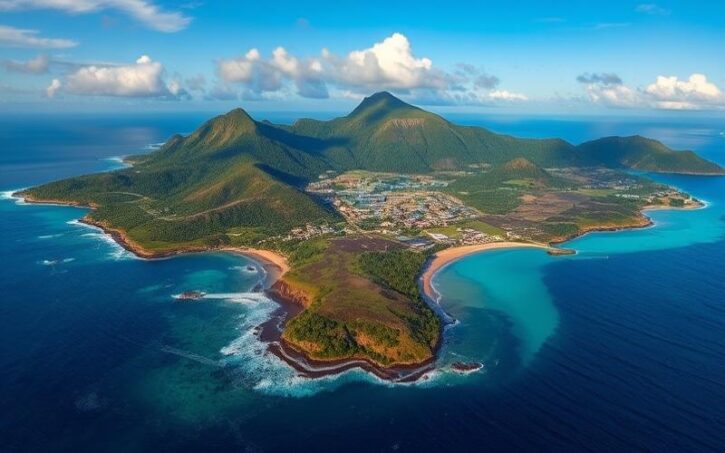
 Published on and written by Cyril Jarnias
At the heart of the South Pacific, the Solomon Islands nation holds a history far more ancient and turbulent than one might imagine while gazing upon its turquoise lagoons. Beneath the coconut palms and coral reefs, this archipelago of over 900 islands bears the traces of 30,000 years of human occupation, successive migrations, colonial clashes, world wars, and recent political crises. Tracing this trajectory tells the story of how small island societies transitioned from the stone fortresses of Nusa Roviana to the debates of an independent Parliament, passing through the cannons of Guadalcanal and Spanish expeditions in search of King Solomon’s gold.
Origins: A Laboratory of Pacific Migrations
Long before the arrival of Europeans, the Solomon Islands nation was already a crossroads of peoples and languages. Archaeological research in recent decades has profoundly renewed the image of islands long perceived as peripheral.
The First Inhabitants: A Footprint of Over 30,000 Years
The oldest human traces date back to the late Pleistocene. The first populations arrived from New Guinea and the Bismarck Archipelago, likely island-hopping at a time when sea levels were lower. Buka and Bougainville were not separate islands then, but the extremities of a single continental block connected to the southern archipelago, often referred to by researchers as “Greater Bougainville” or “Greater Solomons.”
Excavations at Kilu Cave on Buka Island have yielded remains dating from approximately 30,000 to 28,000 BCE. On other nearby islands, like New Ireland or Buka, ancient human occupation is of a similar magnitude (over 30,000 years), confirming the antiquity of this western Pacific colonization front.
During the first millennia of settlement, populations were mobile hunter-gatherers, with no traces of animal or plant domestication. They were capable of crossing sea channels on simple watercraft but do not seem to have reached the most remote islands before the arrival of new migratory waves.
Rising Seas, Fragmented Lands, and New Sites
Starting around 4000–3500 BCE, rising seas ended this era of continuous “large islands.” The vast block that connected Buka, Bougainville, and the southern archipelago fragmented into dozens of islands. It is in this island landscape, closer to what we know today, that new occupation sites appear on Guadalcanal, notably the Poha and Vatuluma Posovi caves, dated between 4500 and 2500 BCE.
Archaeological research conducted in 2010 by the Solomon Islands National Museum and the German Archaeological Institute shows that around 6000 years before present, sea levels stabilized and coral reefs began to develop rapidly, allowing, in the last 2500 years, the formation of atolls and sandy islets like Leli off Malaita. The current geography of the archipelago is therefore relatively recent on the scale of its human history.
In the Vanuatu archipelago, sites like the Daighavora rock shelter, the Nu’usi site, or the Marapa islets have not yet been fully explored by archaeologists. These potential discoveries indicate that the history of the early settlements in this Pacific region remains open and likely to be rewritten as new research is conducted.
Linguistic and Genetic Legacies of Very Ancient Settlement
The identity of these first inhabitants is not known precisely, but linguistics offers a powerful clue: the speakers of so-called “Central Solomon” languages appear to be their most direct descendants. This small language group forms a separate family, with no direct link to other languages in the region, suggesting a very ancient substrate, predating the arrival of Austronesian languages.
Genetic studies point in the same direction. In the northern islands, populations form a distinct biological group, while speaking both Austronesian and so-called Papuan languages. The fact that no clear genetic difference is found between these two language groups shows the intensity of contact and mixing over the millennia. The Y-chromosome haplogroup M2-M353, very common in the archipelago, moreover seems to have emerged there about 9200 years ago.
Geneticists have also highlighted a split between the west and east of the archipelago, which coincides with a well-known linguistic boundary, the Tryon–Hackman line. This invisible frontier, perceptible in the language map, reflects different histories of migration and contact on either side of the islands.
A major turning point occurs around 1200–800 BCE with the arrival of Lapita groups, descended from Austronesians. These long-distance navigators, who departed about 6000 years ago from southern China and Taiwan before passing through the Philippines and then Indonesia, reached New Guinea, Melanesia, and finally the South Pacific islands.
A “Leapfrog” Expansion and a Return to the Large Islands
Contrary to a linear image of progressive island-by-island settlement, linguistic, genetic, and even… rat data attest to a more complex scenario. The Lapita appear to have first “jumped” over the main Solomon Islands chain to reach directly the more remote islands of Santa Cruz and the Reef Islands, even further east. It was only in a second phase that “return” movements brought Austronesian populations back to larger islands like New Georgia, Malaita, or Isabel.
Lapita pottery has been found in five distinct Pacific archipelagos.
Human migrations are even traced by an unexpected passenger: the Pacific rat (Rattus exulans), intentionally introduced as a food resource. Its mitochondrial DNA lineages delineate three major groups across Oceania, confirming a complex colonization model rather than a simple “express train” expansion from Asia.
A New Way of Life: Gardens, Pigs, and Exchange Networks
With the Lapita came new agrarian landscapes. These groups, horticulture experts, introduced plants from Southeast Asia and New Guinea like yam, araceae, breadfruit, or sugarcane, as well as domestic animals—pigs, dogs, chickens. From about 3200 years ago, evidence of gardens and domestic animals multiplies in the archipelago.
Communities then lived in small villages, combining subsistence agriculture, exploitation of marine resources, and long-distance exchange networks. Most of the 60 to 70 languages spoken today in the Solomon Islands belong to the Oceanic branch of Austronesian languages, showing how profoundly this migratory wave durably marked the linguistic landscape, while mixing with older populations.
From Stone Fortresses to Skull Sanctuaries
From around 1000 CE, archaeological remains testify to an intensification of human occupation and the construction of imposing monuments. In the Western Province, around New Georgia, the Roviana culture developed. From the 13th century onward, megalithic complexes like the Bao sanctuaries were erected, and between the 14th and 19th centuries, the Nusa Roviana fortress and its stone altars.
The sites of Nusa Roviana and Vonavona illustrate the political, religious, and economic role of these centers. Between the 17th and 19th centuries, Nusa Roviana became a major trading hub, while the fame of its warriors, known for headhunting raids, spread throughout the region. At Vonavona, the “skull island” preserves the material trace of these practices where a chief’s prestige was measured by the number of enemy heads brought back.
19th-century European accounts, fascinated and horrified, describe an archipelago where headhunting and, in some cases, cannibalism played a central social and ritual role. These practices, often caricatured, were nevertheless at the heart of the power dynamics of the time.
The Spaniards and the Mirage of Solomon’s Gold
The written history of the Solomon Islands truly begins, for the European world, in 1568. That year, a Spanish navigator, Álvaro de Mendaña de Neira, set sail from Peru with an idea in mind: to find the gold-rich lands from which, it was believed, the biblical King Solomon drew his wealth.
1568: Santa Isabel, Guadalcanal, and the Birth of a Name
On February 7, 1568, Mendaña sighted an island he named Santa Isabel. During the same expedition, he sailed along and explored other major islands of the archipelago: Makira, Guadalcanal, Malaita. On Guadalcanal, at the mouth of the Mataniko River, he found a few flecks of gold, a meager discovery that would nonetheless fuel the imagination. Convinced he was on the trail of the biblical king’s mines, he renamed the whole group “Isles of King Solomon.” This name, laden with fantasy, would stick durably to the archipelago.
Initial contacts with the inhabitants oscillated between cordial exchanges and deadly clashes. Cultural misunderstandings, introduced diseases, and mutual violence quickly undermined relations.
Mendaña returned to Peru in August 1568, without establishing a lasting presence in the archipelago. But he did not give up.
Álvaro de Mendaña
1595: Attempted Colonization and Bloody Failure
In 1595, he set out again with a larger expedition, this time with a clear goal of colonization. The squadron reached Nendö in the Santa Cruz Islands and founded a small settlement at Gracioso Bay on September 21. The beginnings were difficult: disease, internal tensions, clashes with local populations. Within a few months, the enterprise collapsed. Mendaña himself died on October 18, 1595. His second-in-command, Pedro Fernandes de Queirós, took command and, faced with the catastrophic situation, decided to abandon the colony on November 18 to head for the Philippines.
Evidence suggests that survivors nevertheless reached the northern coast of Makira, near Pamua, but the Spanish dream of a New Castile in the Pacific vanished.
Queirós would return to the region in 1606, sighting Tikopia and Taumako, but his expedition mainly aimed for islands further south (present-day Vanuatu) in the insane quest for a mythical southern continent.
Two Centuries of Relative Obscurity
After these aborted adventures, the archipelago fell back into relative European obscurity for over a century. The sole exception was the distant passage of the Dutchman Abel Tasman, who sighted Ontong Java Atoll in 1648. It was not until the second half of the 18th century that the “Solomon Islands” resurfaced on maps.
Between 1767 and 1769, several European expeditions explored the Solomon Islands. The Briton Philip Carteret sailed past Santa Cruz and Malaita in 1767. The following year, the Frenchman Louis-Antoine de Bougainville reached and named the islands of Choiseul and Bougainville. In 1769, another Frenchman, Jean-François-Marie de Surville, rediscovered the islands of Isabel, Ulawa, Makira, and Santa Ana. Subsequently, the wreck of the La Pérouse expedition at Vanikoro, further south, was elucidated in 1826 by the trader Peter Dillon, who identified objects from the expedition at Tikopia, a discovery later confirmed by Jules Dumont d’Urville.
At the turn of the 19th century, geographers and cartographers realized that these successive voyages were, in fact, rediscovering Mendaña’s old islands.
Whalers, Sandalwood Traders, and First Missionaries
From the late 18th century onward, the Solomon Islands nation gradually became part of global economic circuits. The first regular visitors were not colonial administrators but British, American, or Australian whalers seeking water, food, wood… and sometimes local sailors for their crews.
Exchanges with island populations were ambivalent, mixing trade (food, goods, labor) and reciprocal violence. The introduction of European diseases caused devastation. The acquisition of firearms by coastal groups gave them an advantage over inland peoples, durably altering local power balances.
In the 19th century, sandalwood and bêche-de-mer (sea cucumber) traders multiplied. They sometimes established semi-permanent trading posts, notably from the 1840s onward from present-day Vanuatu. Benjamin Boyd even attempted, in 1851, to found a European colony on Guadalcanal, without success.
It was also during this period that inhabitants of the Solomon Islands began to travel far beyond their archipelago, signing on as sailors or servants on whaling or merchant ships. Thus, a man from Makira was found working as a boatman in the port of Sydney in the late 19th century.
“Blackbirding”: The Pacific Body Trade
Between the 1840s and the early 20th century, another form of contact, far more brutal, profoundly marked the memory of the islands: the labor trade known as “blackbirding.” Recruiters—sometimes official, often pirates—shipped thousands of men, and sometimes women and children, to the sugarcane plantations of Queensland, Fiji, or Samoa.
Between 1870 and 1910, approximately 30,000 Solomon Islanders were deported to other Pacific islands or to Australia.
This dark history, later recounted by authors like Joe Melvin or Jack London, contributed to the British desire to establish a legal framework in the region. Missionaries, who began to establish themselves durably from the 1840s–1850s onward, also played a key role in denouncing abuses.
Christian Missions: Bloody Failures and Patient Rooting
The missionary enterprise to the Solomon Islands was one of the longest and most tumultuous in the Pacific.
The First Catholics, a Dramatic Fiasco
In 1845, a first group of Marist Catholic missionaries, led by Bishop Jean‑Baptiste Epalle, landed on Makira and then Santa Isabel. The enterprise quickly turned into tragedy. Epalle was killed shortly after his arrival at Astrolabe Harbour. The survivors attempted to re-establish themselves on Makira, but diseases—notably malaria—, conflicts with European sailors, and local tensions wore them down. Within a few years, nine missionaries died. Subsequent attempts on Makira, Woodlark, or Tikopia also failed, with some clergymen even disappearing at sea. In the early 1850s, Rome gave up on any new attempts in the region for several decades.
The Anglicans and the “New Zealand Schools”
Meanwhile, the Anglican mission adopted a different strategy. From the 1850s onward, it took young islanders to training schools in New Zealand before sending them back as catechists or religious auxiliaries. From the 1870s, Anglicans began to settle more durably in the archipelago. Other Protestant churches, like the Methodists and Adventists, followed, each opening their own schools, clinics, and mission stations.
The relations between Catholic, Methodist, and Adventist missions were not always peaceful. On some islands, they competed, disputing land and converts, which could harm local communities caught in this competition.
The Return of Catholics and the Rise of Missions
By the late 19th century, political and ecclesiastical circumstances changed. New congregations, notably the Missionaries of the Sacred Heart and the Society of the Divine Word, divided Melanesia and Micronesia among themselves. From 1898, Catholic Marists returned to the southern archipelago, establishing stations on Guadalcanal (at Rua Sura, Avuavu, Tangarare, then Visale), Makira, Malaita, and in the Shortlands.
Catholic missionaries developed significant infrastructure across the archipelago, marking the landscape with durable construction and significant human commitment.
Creation of schools, convents, clinics, and sometimes full-fledged mission villages, structuring the territory.
Completed in 1910, this stone church was then the only permanent building in the entire archipelago, a symbol of permanence.
By 1914, the mission already counted several dozen priests and nuns working on Guadalcanal Island.
The Protestants followed a comparable dynamic. The Adventists, for example, developed a center at Batuna combining a school, printing press, and clinic, and relied on mission boats like the Melanesia or the Advent Herald to reach the Marovo Lagoons and beyond. Music and singing were powerful evangelization tools, often mentioned by inhabitants as what first attracted them.
Throughout the 20th century, missions took charge of the bulk of education, healthcare, and social services in the Solomon Islands, playing a much more concrete role than the colonial administration itself.
British Protectorate: Between Pacification, Plantations, and Revolts
As missionaries crisscrossed the terrain, the great European powers divided the map. In 1884, Germany annexed north New Guinea and the Bismarck Archipelago, then extended its control in 1886 over the northern Solomon Islands (Bougainville, Buka, Choiseul, Santa Isabel, Shortlands, Ontong Java). An agreement with Great Britain formalized “spheres of influence,” north for Berlin, south for London.
1893: Birth of the British Protectorate
Faced with abuses in the labor trade, missionary pressure, and the fear of French interest in the archipelago, London decided to act. In March 1893, Captain Herbert Gibson, commanding HMS Curacoa, proclaimed a British protectorate over the southern islands—New Georgia, Malaita, Guadalcanal, Makira, Mono, and the Nggela Islands. This was the official birth of the “British Solomon Islands Protectorate.”
At the turn of the century, all the islands, except for the German-held Bougainville and Buka, came under British control. The administrative seat was established at Tulagi, on a small island in the center of the archipelago. Charles Morris Woodford, a former naturalist and explorer, became the first Resident Commissioner in 1897. His mission was to suppress the labor trade, control the arms trade, and establish a semblance of order.
Armed Pacification and Land Exploitation
The colonial administration was tiny and poorly funded. The beginnings were marked by permanent tensions. Attacks on settlers or missionaries provoked punitive expeditions led by the Royal Navy: villages burned, canoes destroyed, chiefs executed. Arthur Mahaffy, appointed Deputy Commissioner at Gizo in 1898, was explicitly tasked with suppressing headhunting in the New Georgia region.
At the same time, London wanted the protectorate to be self-financing. Land regulations sought to declare certain lands “vacant” to allocate them to plantation companies, in total contradiction with Melanesian custom where the notion of “empty land” did not exist. Large firms like Levers Pacific Plantations (a subsidiary of Lever Brothers) or the Malayta Company thus acquired vast concessions to develop coconut plantations for copra production.
Copra exports rose to over 4,000 tons in 1912-1913, marking strong growth compared to 1903-1904.
To limit land alienation, a 1914 regulation theoretically ended the free sale of native land and generalized leases for plantations. Despite this, land tensions persisted.
Low-Intensity Colonization, a Fragmented Power
Throughout the colonial period, the European presence remained numerically weak. In 1902, there were only about 80 permanent Europeans. Most were planters, traders, or missionaries. The administration itself remained light, relying on a network of native police, recognized or appointed chiefs, and the sometimes arbitrary authority of district commissioners.
As shown by the Malaita tragedy in 1927—the assassination of Commissioner William R. Bell by the Kwaio chief Basiana during the collection of a head tax—the misunderstandings and resentments were profound. The repression that followed, sometimes called the “Malaita massacre,” resulted in at least 60 Kwaio deaths, destroyed sacred shrines, and sent nearly 200 people to the Tulagi jails. Basiana was publicly hanged the following year. For many inhabitants, this episode remained the symbol of a violent and distant colonial power.
Table: Key Milestones of the Colonial Period
| Period / Year | Key Event |
|---|---|
| 1884–1886 | German annexation in the north, spheres of influence agreement with Great Britain |
| 1893 | Proclamation of the British protectorate over the southern islands |
| 1897 | Charles Morris Woodford appointed Resident Commissioner, capital at Tulagi |
| 1898–1900 | Extension of the protectorate to new islands; German cession of northern islands (except Bougainville, Buka) |
| 1900–1913 | Rapid expansion of copra plantations and arrival of large companies |
| 1914 | Land regulation instituting leases, end of free land sales |
| 1927–1928 | Assassination of William R. Bell, violent repression on Malaita |
World War II: Guadalcanal, Pivot of the Pacific
The archipelago, until then peripheral to the great powers, suddenly found itself on the front lines during World War II. After Japan’s attack on Pearl Harbor in December 1941, Japanese advances in the South Pacific were lightning-fast. In May 1942, the Japanese occupied Tulagi and part of the western archipelago, including Guadalcanal, where they began constructing a large airstrip.
Guadalcanal: The Decisive Clash
The United States and its allies reacted swiftly. On August 7, 1942, the Marines landed simultaneously at Tulagi, the neighboring Florida Islands, and on the north coast of Guadalcanal. The objective was clear: seize the airstrip under construction, the future Henderson Field, which threatened communication lines between the US, Australia, and New Zealand.
During the Battle of Guadalcanal, the sea area north of the island, where fierce fighting took place for months, was nicknamed “Iron Bottom Sound” due to the very high number of sunken warships, leaving the bottom littered with wrecks. This nickname illustrates the ferocity and intensity of naval engagements during this major campaign of the Pacific War.
The Japanese attempted several times to retake the airstrip, supported by nocturnal supply convoys—the famous “Tokyo Express.” In October 1942, a major land offensive against the Henderson perimeter failed at the cost of considerable human losses. At sea, the Naval Battle of Guadalcanal in November sealed the campaign’s fate. In February 1943, the Japanese command ordered the discreet evacuation of its last troops from the island.
Casualty figures, varying by source, remain staggering. Over 7,000 dead, 29 ships, and over 600 aircraft lost are cited for the Allied side for the entire Solomon Islands campaign; and over 30,000 dead, 38 to 50 ships, and up to 1500 aircraft for the Japanese side if all operations up to Bougainville are included.
Role of the Inhabitants: Scouts, Carriers, Rescuers
The inhabitants of the Solomon Islands were not mere spectators. Approximately 3,200 men served in the Solomon Islands Labour Corps, performing work for the Allied war effort, while about 6,000 others joined the British Solomon Islands Protectorate Defence Force.
Above all, many islanders participated in the “coastwatchers” network, an observation system set up by the Allies that relied on missionaries, planters, officials, and villagers to spot enemy movements, report shipwreck survivors, or guide patrols. American Admiral William “Bull” Halsey would later praise the decisive role of these informants.
American Admiral William “Bull” Halsey
The most famous episode is undoubtedly the rescue of the crew of PT‑109, the fast boat commanded by the young officer John F. Kennedy, future US President. When their vessel was rammed and sunk by a Japanese destroyer in August 1943, Kennedy and his men managed to reach a small island. It was two men from the archipelago, Biuku Gasa and Eroni Kumana, who found them, carried a message carved on a coconut, and enabled their recovery by Allied forces. Decades later, the carved coconut would sit on Kennedy’s desk in the White House.
Tulagi Destroyed, Honiara is Born
At the end of the campaign, Tulagi, the old colonial capital, was ravaged. The town was not rebuilt. In contrast, on Guadalcanal, around Henderson Field and the American logistical facilities, a new settlement had developed: Honiara. Its position on a coastal plain, equipped with an airstrip and existing buildings, made it a natural choice to become, in 1952, the new capital of the territory.
World War II profoundly transformed Solomon Islands society. Islanders were exposed to new forms of social organization, an expanded monetary economy, and levels of wages and logistics previously unknown. For many veterans, this experience made a return to silent submission to pre-war colonial authorities impossible.
Finally, the war left a heavy material legacy: thousands of munitions, bombs, and unexploded ordnance still litter the forests and lagoons today, creating a permanent risk for populations and complicating development projects.
From the “March” to Independence: Indigenous Movements and Decolonization
The immediate post-war period saw the emergence of unprecedented indigenous political movements, fueled by military experience, ideas circulating in the Pacific, and decades of accumulated frustrations.
Maasina Rule: The Aspiration for Self-Government
Between 1943 and 1944, on Malaita, chiefs Aliki Nono’ohimae and Hoasihau launched a movement known as “Maasina Ruru” or “Maasina Rule” (often translated as “March” or “Fraternal Rule”). They sought to improve the economic situation of indigenous people, strengthen their autonomy vis-à-vis the colonial administration, and structure an indigenous power capable of negotiating as equals.
The movement found particular resonance among Labour Corps veterans, who returned from Allied bases with a different worldview. It spread to other islands, established local committees, collected its own tax, organized refusals to work and participate in colonial projects.
Alarmed, the administration launched “Operation De‑Louse” in 1947–1948. The leaders were arrested, imprisoned, tried. Far from dying out, the movement transformed into a civil disobedience campaign. Prisons filled with activists.
Year of the official transfer of the capital of the Solomon Islands to Honiara, marking a symbolic fresh start.
Towards Representative Institutions
In the 1950s, London encouraged the establishment of local councils and advisory bodies. In 1960, Executive and Legislative Councils were created, initially entirely appointed, then gradually opened to elected representatives. In 1964, Honiara elected its first representative; in 1967, most of the fifteen seats on the Legislative Council became subject to suffrage.
A new constitution in 1970 merged the Legislative and Executive Councils into a single “Governing Council.” But the British governor retained very extensive powers, deemed excessive by many Solomon Islanders. A reform in 1974 introduced a model close to the Westminster system, with a Council of Ministers and a “Chief Minister” position. Solomon Mamaloni became the first holder of this office in July 1974.
Slowly but surely, the archipelago transitioned from a colonial administration directed from Suva, Fiji, to a system of government where local leaders were at the helm.
The Difficult Path to Independence
Several factors accelerated the prospect of independence. The wave of decolonization in the Pacific—notably Papua New Guinea’s accession to independence in 1975—served as an example. The 1973 oil crisis also changed the game: Great Britain, in economic difficulty, became increasingly reluctant to finance distant territories.
In 1975, the territory officially dropped the term “British” to become “The Solomon Islands,” then simplified its name to “Solomon Islands” upon independence. That same year, in-depth constitutional discussions began between London and Honiara.
In January 1976, extensive internal self-government was granted. Peter Kenilorea, a key figure in the independence movement, became Chief Minister. A decisive conference was held in London in 1977, where it was decided that formal independence would occur the following year.
On July 7, 1978, the Solomon Islands nation became a sovereign state, a member of the Commonwealth, under a constitutional monarchy. Queen Elizabeth II was the symbolic head of state, represented by a Governor-General. Sir Peter Kenilorea became the first Prime Minister, while Baddeley Devesi occupied the Governor-General’s office. The Duke of Gloucester represented the British crown at the ceremonies.
Not all provinces welcomed this independence with the same enthusiasm. In the West, a movement called “Western Breakaway” expressed fear of being marginalized in a state dominated by Honiara and Malaita. The province even boycotted the ceremonies at Gizo, the scene of an incident during the raising of the new flag.
Table: Key Steps Towards Independence
| Year | Institutional or Political Step |
|---|---|
| 1960 | Creation of Executive and Legislative Councils (appointed) |
| 1964–1967 | Introduction, then extension, of elected representation |
| 1970 | Constitution establishing a Governing Council |
| 1974 | New constitution, creation of the Chief Minister position |
| 1975 | Official name change to “The Solomon Islands” |
| 1976 | Extensive internal self-government, Kenilorea becomes Chief Minister |
| 1977 | Constitutional conference in London, decision for independence |
| July 7, 1978 | Independence, Peter Kenilorea Prime Minister, Baddeley Devesi Governor-General |
After Independence: A Young State Facing Inequalities and Tensions
Independence did not instantly resolve the structural problems inherited from colonization: strong regional disparities, economic dependence on a few export products, governance challenges in a fragmented archipelago, old and recent land tensions.
State Building and Political Cycles
The first decades saw an alternation of governments led by a few recurring figures: Peter Kenilorea, Solomon Mamaloni, Ezekiel Alebua, Francis Billy Hilly, Bartholomew Ulufa’alu, Manasseh Sogavare, Allan Kemakeza, then others. Parliamentary coalitions were fragile, votes of no confidence frequent, political parties weakly anchored. Successive governments attempted to equip the country with modern economic institutions—creation of a central bank, a national airline—while managing pressures from foreign companies in the timber, fishing, palm oil, or gold sectors.
Simultaneously, provinces demanded more power. In the West, the Western Breakaway Movement continued to advocate for a federal system that would guarantee strong provincial autonomy, denouncing what it perceived as a form of “internal colonialism” exercised by the central government.
A Fragile Economy, Dependent on Natural Resources
The economy remains narrow and highly dependent on a few sectors: copra, cocoa, palm oil, timber, fishing, and, more recently, mining. At independence, copra represented about a quarter of export earnings, but its production later declined. The gap was partly filled by timber, whose exports soared in the 1980s–1990s to become the top foreign exchange earner. Logging rates far exceeded sustainable levels—up to 19 times recommended levels by some estimates, raising fears of the exhaustion of commercial forests before the late 2020s.
Fishing, especially for tuna, is an economic pillar with a cannery at Noro, but most of the catch is exported frozen to Asia for processing. Mining projects in the 1990s, like the Gold Ridge gold mine and bauxite mining on Rennell, generated significant revenue but also caused massive environmental damage, land conflicts, and corruption scandals.
For the vast majority of the population—over 75% of the workforce—subsistence remains based on subsistence agriculture (sweet potato, cassava, taro, yams, bananas), coastal fishing, and, in some regions, pig or poultry farming. Traditional shell money, notably produced on Malaita, continues to be used in some ceremonial transactions and even in part of local commercial exchanges.
The “Tensions”: When Fractures Explode into the Open
The most serious crisis of the post-independence era erupted in the late 1990s. On Guadalcanal Island, indigenous inhabitants (often called “Guale”) watched with concern the rapid growth of Honiara, pressure on land near the capital, and the massive arrival of migrants from densely populated Malaita.
Grievances ranged from a feeling of land expropriation to the impression that jobs, contracts, and development benefits largely favored Malaitans. Towards the end of 1998, an armed group, first presented as the Guadalcanal Revolutionary Army then renamed the Isatabu Freedom Movement (IFM), began intimidating and attacking Malaitans living outside Honiara. Within months, thousands fled, some to the capital, others to Malaita.
In reaction, Malaitans organized the Malaita Eagle Force (MEF) to defend their communities, notably in Honiara. In 1999, the government of Bartholomew Ulufa’alu declared a state of emergency and sought help from Australia and New Zealand, which declined to intervene militarily at that stage. The Honiara Peace Accord of June 1999 brought only a temporary respite.
On June 5, 2000, the MEF, now well-armed after seizing police armories, staged a power grab in Honiara. Militiamen took control of Parliament, held Prime Minister Ulufa’alu, and demanded his resignation. He eventually yielded. On June 30, Parliament elected Manasseh Sogavare as the new head of government.
Despite the signing of the Townsville Peace Agreement in October 2000 between the MEF, elements of the IFM, and the state, followed by a specific Marau agreement in February 2001, violence continued, notably in the Weathercoast region south of Guadalcanal, where a Guadalcanal chief, Harold Keke, refused any compromise. Police forces, often infiltrated by armed factions, struggled to restore order. Kidnappings, extortion, and score-settling multiplied. Religious figures, including seven members of the Melanesian Brotherhood in 2003, were murdered on the Weathercoast.
It is estimated that the conflict, generally called “the tensions,” caused about 100 to 200 direct deaths and displaced up to 30,000 people. The economy, already weakened by falling timber prices and debt, literally collapsed. In 2001, nearly half of public spending was financed by foreign aid, and the state was on the brink of bankruptcy.
RAMSI: An Unprecedented Regional Intervention
In 2003, after the electoral victory of Allan Kemakeza, the government resolved to officially request international aid via the Pacific Islands Forum. A regional mission, the Regional Assistance Mission to Solomon Islands (RAMSI), dominated by Australia but including police and defense forces from several Oceanic states (New Zealand, Papua New Guinea, Fiji, etc.), was deployed in July 2003.
RAMSI combined police presence, military support, justice sector reform, and budgetary assistance. The arrival of this multinational force quickly changed the situation: thousands of weapons were collected, key militia leaders were arrested, including Harold Keke who surrendered in August 2003. Security was restored in Honiara and gradually in the provinces. Politically, the mission facilitated the regular functioning of institutions and pushed for governance reforms.
The military component of RAMSI withdrew in 2013, the civilian mission officially closing in 2017. The assessment is mixed—some point to increased dependence on external actors, others to the neglect of the conflict’s root causes—but most observers acknowledge that without this intervention, the state risked outright collapse.
Recurrent Crises and Shifting Alliances
The 2000s–2020s saw other episodes of tension and political realignment, in a context marked by corruption scandals, growing geopolitical rivalries, and persistent socio-economic vulnerabilities.
Riots, Diplomatic Shift, and Sino-Taiwanese Rivalry
In 2006, after highly contested elections, the appointment of Snyder Rini as Prime Minister triggered violent riots in Honiara, particularly targeting the Chinatown district of the capital. Businesses were looted, buildings burned, over 1000 people, mainly of Chinese origin, were forced to flee. Rini resigned after eight days. Manasseh Sogavare then returned to power leading a so-called Grand Coalition for Change Government. However, he was ousted by a vote of no confidence in 2007.
A decade later, in 2019, a major strategic decision plunged the archipelago into the heart of the Sino-American rivalry. The Sogavare government severed diplomatic relations with Taiwan, which had supported the country for 36 years, and recognized the People’s Republic of China. Beijing quickly committed to infrastructure projects, while Chinese funds were accused by some of fueling local patronage networks.
The province of Malaita, under the leadership of Provincial Premier Daniel Suidani, opposed the national diplomatic shift and maintained its alignment with Taiwan and the United States. This position materialized in a substantial aid program from Washington and the organization, in 2020, of a symbolic provincial independence referendum, declared illegal by the Solomon Islands central government.
In this tense climate, also marked by the COVID‑19 pandemic, social inequalities, and lack of jobs, a new wave of protests erupted in November 2021. Starting from Malaita, peaceful demonstrations in Honiara quickly degenerated into riots. Buildings were burned near Parliament, Chinatown was again targeted. The government invoked a 2017 bilateral security treaty to call on Australia, and other Pacific countries (Papua New Guinea, Fiji, New Zealand) sent peacekeeping forces.
A security agreement between China and the Solomon Islands permits the deployment of Chinese forces upon request. Although the Solomon Islands government denies any plans for a military base, this agreement raises serious concerns in Australia, New Zealand, and the United States, which perceive it as a shift in the strategic balance of the Pacific region.
Truth, Reconciliation, and Governance Challenges
To try to settle the legacy of the 1998–2003 tensions, a truth and reconciliation process was launched in the late 2000s. A Truth and Reconciliation Commission, inspired by the South African experience, held hearings in the 2010s and submitted a detailed report to the government in 2012. Long kept confidential, this document was only made public through unofficial channels several years later.
The Commission’s recommendations, concerning land reform, anti-corruption efforts, and addressing provincial grievances, remain partly unheeded. The country continues to face governance problems: weak political parties, unstable parliamentary coalitions, frequent votes of no confidence, disproportionate influence of a few economic groups, including foreign ones, in key sectors (forestry, mining, fishing).
Gender inequalities and violence against women also remain major challenges: out of 50 members of Parliament, only a few women manage to get elected, while women’s participation in security or conflict management decision-making processes remains marginal.
An Ancient Archipelago at a Crossroads
The history of the Solomon Islands nation is that of an archipelago that, for 30,000 years, has dealt with distance, the sea, and diversity. The first Pleistocene hunter-gatherers, the Lapita navigators, the Roviana warriors, the missionaries from France, England, or Australia, the colonial commissioners, the Japanese and American soldiers of Guadalcanal, the Maasina Rule leaders, the MEF and IFM militiamen, the present-day representatives debating alliances with Beijing, Canberra, or Taipei: all have, in their own way, shaped this string of islands.
The archipelago faces a convergence of crises: extreme vulnerability to climate change and natural disasters, environmental degradation (deforestation, depletion of fishery resources), demographic pressure with rapid urbanization around Honiara, political instability, growing foreign power interference, and the persistent threat of unexploded ordnance from World War II.
But it also possesses unique assets: a cultural and linguistic mosaic of exceptional richness, living customary land management systems, deeply rooted churches, a historical legacy of inter-island networks and mediation practices that, despite recent conflicts, remain a resource for the future.
At a time when the archipelago attempts to reconcile traditions with the demands of a modern state caught in the geopolitical turbulence of the 21st century, understanding the depth of its history—from the Kilu caves to the Battle of Guadalcanal, from Maasina Rule to contemporary security agreements—is essential to grasp the dilemmas playing out on its shores today.
Disclaimer: The information provided on this website is for informational purposes only and does not constitute financial, legal, or professional advice. We encourage you to consult qualified experts before making any investment, real estate, or expatriation decisions. Although we strive to maintain up-to-date and accurate information, we do not guarantee the completeness, accuracy, or timeliness of the proposed content. As investment and expatriation involve risks, we disclaim any liability for potential losses or damages arising from the use of this site. Your use of this site confirms your acceptance of these terms and your understanding of the associated risks.

Cyril Jarnias is an independent expert in international wealth management with over 20 years of experience. As an expatriate himself, he is dedicated to helping individuals and business leaders build, protect, and pass on their wealth with complete peace of mind.
On his website, cyriljarnias.com, he shares his expertise on international real estate, offshore company formation, and expatriation.
Thanks to his expertise, he offers sound advice to optimize his clients' wealth management. Cyril Jarnias is also recognized for his appearances in many prestigious media outlets such as BFM Business, les Français de l’étranger, Le Figaro, Les Echos, and Mieux vivre votre argent, where he shares his knowledge and know-how in wealth management.





