
 Published on and written by Cyril Jarnias
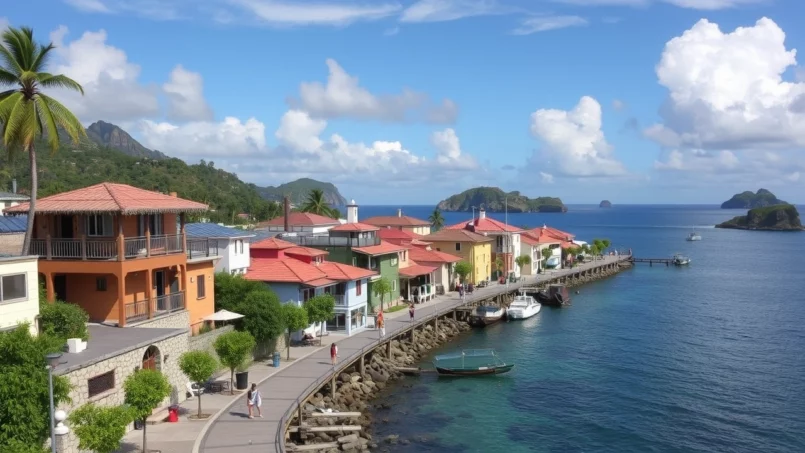
Moving to the Solomon Islands is anything but an ordinary relocation. A vast archipelago of over 900 islands in the heart of the Pacific, it is a still developing, sometimes unstable country, yet blessed with stunning lagoons and a very specific expatriate community. It forces one to choose their neighborhood carefully. For the vast majority of foreigners, this choice is made in and around a single city: Honiara.
Honiara, the capital, concentrates the majority of skilled jobs, international-standard housing, international schools, and the most comprehensive health services. Outside the capital, in towns like Gizo or Auki, opportunities are mainly limited to tourism, fieldwork, or humanitarian experiences, rarely suited for a long-term family settlement for expats.
This article provides an overview of the areas most sought after by expatriates, explaining concretely what is available there, how much it costs, and what trade-offs to accept between safety, comfort, accessibility, and environment.
Honiara, the epicenter of expatriate life
Honiara is simultaneously the capital, largest city, and main port of entry into the country. Located on the northwestern coast of Guadalcanal, it had a population of 92,344 at the 2021 census and likely exceeds 110,000 inhabitants today. Including its periphery, the “Greater Honiara Area” would already group over 100,000 people and could reach 235,000 people by 2035.
In practice, for an expatriate employed by an international organization, a large company, or an NGO, Honiara represents almost the only realistic residential option. This is where you will find:
In Honiara, the capital of the Solomon Islands, you find the country’s main administrative, medical, and economic infrastructure, such as ministries and Parliament, the main hospital (National Referral Hospital), and the international airport. The city also concentrates financial services with banks and insurance companies, as well as the business center. For expats, it offers tailored services like international schools (including Woodford International School) and most of the secure housing designed for them.
The city stretches along the Kukum Highway, the main road artery connecting the center to the airport while following the coast. The neighborhoods sought by foreigners are largely distributed across three main zones: the center (expanded Point Cruz / Chinatown area), the eastern fringe (Naha, Panatina, Vura, Lau Valley), and the western fringe (White River, Tanaghai, and neighboring areas). In addition, there are specific real estate complexes, often gated and secure, which function almost like “micro-neighborhoods” within the city.
Honiara Center: proximity, services… and tensions
The heart of Honiara, around Point Cruz, Chinatown, and the central market, is both the business center and one of the most sensitive areas in terms of safety and political tensions. Yet, it is also where hotels, restaurants frequented by expats, public institutions, bank headquarters, and offices of many organizations are concentrated.
A dense and strategic center
Point Cruz is home to the main port, the very lively central market, several hotels known to foreigners (Mendana Hotel, Heritage Hotel, King Solomon Hotel, Honiara Hotel), as well as cafes and restaurants that serve as informal meeting points, like the Garden Bar and Restaurant or the Lime Lounge, highly appreciated for 24/7 coffee.
The area also concentrates many office buildings, government services (including the Central Bank, the Chamber of Commerce, ministries) and cultural venues like the National Museum and its Cultural Centre, or the National Art Gallery.
For an expat working for an administration, embassy, large NGO, or a company located downtown, choosing housing within walking distance or a short drive away is a real advantage. This helps avoid major inconveniences related to often degraded roads and sometimes chaotic traffic, significantly improving daily commuting conditions.
Housing in the center: small apartments and high rents
The city center mainly offers apartments and studios, rarely houses with gardens. Space is modest, but meets the demand of singles, couples without children, or short-term consultants.
Available data shows that rents in the center can vary greatly. In practice, two distinct segments are observed: the local market and the expat/professional market.
| Type of housing in central Honiara | Indicative monthly rent range | Typical occupant profile |
|---|---|---|
| Studio or 1-bedroom “local” | 3,500 – 6,000 SBD | Local young professionals |
| 1-bedroom “standard expat” (center) | ~ 600–650 USD | Consultants, solo expats |
| 2-bedroom in a recent building | 18,000 – 22,000 SBD | Executives, couples |
| 3-bedroom/townhouse expat | 26,000 – 29,000 SBD and up | Families, diplomats |
On a country-wide scale, it is estimated that renting a studio downtown is around 658 USD per month, and that a three-bedroom apartment can exceed 1,300 USD. These figures hold true in the heart of Honiara, where the tension between strong expat demand and a limited supply of housing “up to standard” leads to rents that seem very high relative to local salaries.
Safety: a center to frequent with caution
The center is not the quietest option. Authorities and several foreign governments regularly report risks of theft, assault, harassment, and an increase in incidents around Christmas, during elections, or in times of political tension.
Areas such as the Central Market, Point Cruz, the old Mataniko Bridge in Chinatown, Kukum, Burns Creek, Borderline, or Kombito Market are identified as particularly exposed, especially after dark.
Nevertheless, some expats choose to live in the center, precisely to:
– reduce commute times,
– benefit from proximity to shops and services,
– enjoy a dense social network (bars, cafes, professional meetings).
Those who choose this option typically favor well-guarded buildings, sometimes located on higher ground, with 24/7 guards and enhanced lighting.
Secure “compounds”: the preferred model for expats
More than neighborhood names, it’s often specific addresses – secure residential complexes – that structure the geography of expat housing. These “compounds” offer what is lacking in the classic urban fabric: security, maintenance, more reliable electricity, sometimes a private generator, better-managed internet, and a semi-community environment where one mostly encounters other foreigners and local middle classes.
Ridgeback Oceanview and similar: the secure bubble
Among the regularly cited residences, the Ridgeback Oceanview units stand out as a representative example: a fenced complex, continuously monitored, often equipped with a backup generator. This type of residence mainly hosts employees of international NGOs, consultants, and sometimes mid-ranking diplomats.
The offerings include studios, one- to three-bedroom apartments, and sometimes townhouses. These units are often located in gated micro-neighborhoods, a common feature in Pacific capitals. These compounds help partially compensate for local infrastructure shortcomings, such as electricity and water cuts, as well as nighttime insecurity.
Prestige Apartments and private buildings
Prestige Apartments illustrates this wave of residences explicitly targeting expats: a complex of around twenty two- to four-bedroom units. The manager indicates that enhancing external security – particularly lighting – is a priority, especially after hosting Australian police during the 2021 riots.
These units, often located near the center but away from the bustle of Chinatown or the market, offer centralized management (security, maintenance, cleaning). This avoids complex negotiations with private landlords for expats.
Ruaniu Subdivision: a “new neighborhood” designed for the future
About 15 minutes west of Honiara, Ruaniu Subdivision is presented as a large mixed-use subdivision combining residential and tourist development, with nearly 400 residential plots and about 190 for commercial and tourist activities. Located outside the current urban core but connected to the Kukum Highway, this project illustrates the orientation of urban development towards the western periphery.
For expats, Ruaniu represents less an established neighborhood than a bet on the future: a more spacious environment, theoretically better planned, but still under construction. Investors see potentially high rental yields in the “standard expat residential” segment, estimated between 9 and 14%, at the cost of greater risk linked to the market’s youth.
Honiara East: Naha, Panatina, Vura, Lau Valley… middle-class residential neighborhoods
East of the center, on the other side of the Matanikau River, neighborhoods like Naha, Panatina, Vura, or Lau Valley form a residential strip where local middle classes and some expat enclaves coexist. You find town-managed primary schools here, and major road axes connecting the center to the airport.
A mixed fabric between local housing and more “standardized” accommodations
These neighborhoods are not “expat ghettos.” You mostly encounter urban Solomon Islander families, civil servants, employees of companies or religious missions. However, amidst this mesh of small houses, certain streets and real estate complexes are rented to foreigners, often near schools or main arteries.
Rents in these areas are lower than downtown but remain far above the budget of a local household.
– decent 1 to 2-bedroom units between 3,000 and 10,000 SBD per month depending on location,
– 3-bedroom houses that can reach 15,000 to 25,000 SBD, especially if adapted to expat expectations (fence, gate, water tank, generator, air conditioning, security).
Advantages: access to schools and the airport
One of the strengths of East Honiara is the proximity to educational institutions and transport infrastructure:
– public primary schools in Naha, Panatina, Vura, Lau Valley,
– community high schools (Naha Community High School, Panatina Community High School, Vura Community High School),
– relatively quick access to the international airport, located about 11 km from the center on the Kukum Highway.
For expat families whose children attend Woodford International School or a neighboring private institution, living in the east of the city can significantly reduce school commute times while maintaining acceptable proximity to the city center.
Limitations: rapid urbanization and strained services
The flip side is very rapid urbanization, often poorly planned. Honiara has an urban growth rate of around 4.7% per year, and about 35% of its inhabitants already live in informal settlements, sometimes in immediate proximity to more affluent areas.
Basic services — water, sanitation, waste collection, electricity — struggle to keep up. The eastern neighborhoods are no exception: frequent outages, degraded roads, insufficient drainage during heavy rainy seasons are common. Hence the importance, for an expat, of very concretely verifying the reality of services on the street where they plan to settle (water pressure, electricity grid stability, quality of the access road).
Honiara West: White River, Tanaghai and periphery, between contrasts and projects
The western part of Honiara, around White River and up to Tanaghai, particularly visibly reflects the city’s contrasts: beaches and lagoons minutes away, rich history (this is where Bellonese communities settled as early as the 1960s), but also squatter settlements, poverty, and occasional insecurity.
White River: a changing periphery
White River is both a historic suburb – marked by the settlement of families from other provinces – and an area of strong population growth. You find primary and secondary schools, churches, some shops, but also dense informal settlements.
Discover the main assets of White River, a sought-after destination for its accessibility and development potential.
White River is considered one of the gateways to the famous West Coast beaches, a major asset for the quality of life.
Land and house prices there are perceived as more accessible than in the center or the east near the island.
Projects like Ruaniu Subdivision, to the west, aim to organize and support the area’s growth.
However, security there is more uncertain, especially at night. Some parts of White River are on the list of areas authorities recommend avoiding after sunset. Expats who choose to live there therefore generally favor well-fenced properties, with a guard and generator, preferably on higher ground or in mini-compounds.
West beyond the city: sought-after “semi-rural” areas
As you move away from Honiara westward, density decreases, the landscapes become more green, and the sense of isolation increases. This is precisely what attracts a minority of expats seeking a quieter setting: a few houses or eco-lodges by the sea, tourist accommodation projects, sometimes long-term housing for consultants or entrepreneurs in the hospitality industry.
Remote coastal areas can offer high rental yields by targeting an international clientele (diving tourists, digital nomads). However, for a typical expat on assignment, they present major drawbacks: distance from schools, hospitals, and offices, logistics heavily dependent on cars, and a coastal road vulnerable to weather.
The cross-cutting assets of sought-after neighborhoods: safety, network, services
Beyond neighborhood names, it’s a few cross-cutting criteria that determine the attractiveness of a residential area for expats in the Solomon Islands.
Safety, the primary filter
Local authorities and foreign embassies agree: Honiara remains “overall” manageable, but certain sectors present an increased risk of theft, assault, harassment, notably for women and LGBTQ+ individuals, the latter explicitly facing significant societal hostility.
This translates into an implicit sorting of neighborhoods:
– strong appeal for secure compounds (Ridgeback, Prestige, various gated residences),
– caution towards areas already identified as sensitive in the evening or in times of political tension (Chinatown, certain parts of White River, Borderline, Burns Creek, peripheral markets),
– preference for quieter streets on higher ground, with good visibility, lighting, and structured police or community presence.
This safety filter partly explains the very high level of some “expat” rents: you’re not just paying for square footage, but also for protection measures (24/7 guards, fences, cameras, lighting, generators).
Essential services: water, electricity, internet
An expat’s daily life in the Solomon Islands also depends on the reliability of networks. Honiara has the bulk of the country’s infrastructure, but its condition remains fragile.
– Tap water is not drinkable. You must rely on bottled water or home filtration.
– Power supply suffers from frequent, sometimes lengthy outages, especially outside central axes. High-end compounds therefore equip themselves with private generators.
– Fixed internet is notoriously slow: the average speed around 0.5 Mbps is barely enough for a stable video call. Some accommodations compensate with hybrid solutions (4G modems, multiple providers), but the archipelago remains far behind the standards of Australia or New Zealand.
The preferred neighborhoods of expats are therefore those where:
Water arrives regularly enough to fill tanks, the electricity grid is relatively stable or backed by a collective generator, mobile coverage is decent (Telekom, Bemobile), and a broadband provider is available, even if expensive.
Schools, a decisive criterion for families
For expat families, the school map greatly limits options. Woodford International School, founded in the 1950s, offers an IB Primary Years Program and goes up to secondary, following a curriculum inspired by Australian standards. It’s the almost automatic choice for expats with children, at the price of high fees.
Other schools, like New Hope Academy or Chung Wah School (with Mandarin teaching), also interest some profiles, but few long-term expats enroll their children in the ordinary public system, due to the perceived weak level of education and lack of resources.
In fact, neighborhoods situated at a reasonable distance from Woodford (and the few other reputable private institutions) mechanically gain in attractiveness: the expanded center, certain sectors in the east (Panatina, Vura, Naha), and some well-connected pockets in the west.
How much does life cost in these neighborhoods for an expatriate?
Living in a neighborhood favored by expatriates in the Solomon Islands has a high cost, especially when compared to local purchasing power. The country is ranked 41st out of 197 for cost of living, with an overall level 1.24 times higher than the global average. Honiara, in particular, is more expensive than many African or South American cities, even several regional cities in New Zealand.
The major expenses can be summarized as follows, for an expat profile living in Honiara in a neighborhood or housing “popular” among foreigners:
| Profile | Estimated monthly cost in Honiara (USD, housing included) | Comment |
|---|---|---|
| Single expat | ≈ 2,100 – 2,400 | Includes rent, food, transport, basic leisure |
| Digital nomad | ≈ 3,400 – 3,800 | Increased need for comfortable housing, coworking, outings |
| Family (4 people) | ≈ 3,700 – 3,800 | Not including full international school fees |
| Average local resident | ≈ 1,000 – 1,100 | High pressure as the average salary is very low |
Rents constitute the key variable. A single expat can hardly go below 600–800 USD per month for housing meeting their expectations (safety, basic equipment). A family aiming for a three-bedroom house in a good neighborhood can easily reach 26,000–29,000 SBD per month, or over 3,000 USD, in the most high-end residences.
On top of that:
– significant electricity bills (between 35 and 170 USD per month on average, more with air conditioning and a generator),
– an often expensive internet connection (90 to 240 USD per month for broadband),
– costly food (a single person’s food expenses are estimated around 460 USD per month, nearly 1,200 USD for a family).
These levels should be put in perspective with a local average salary sometimes estimated at 172 USD per month net. The gap is such that most expats depend on a foreign salary or cost-of-living allowances paid by international institutions.
Gizo, Munda, and provincial towns: mission locations more than expat neighborhoods
Outside Honiara, a few urban centers regularly host foreigners: Gizo and Munda in the Western Province, Auki on Malaita, Tulagi or Buala in other provinces. These towns, however, do not have structured “international neighborhoods” as seen in some capitals.
Gizo and Munda: divers’ paradise, base for passing nomads
Gizo, the country’s second city, is famous for its clear waters, coral reefs, and laid-back atmosphere. You find eco-lodges, guesthouses, a few more comfortable small structures aimed at diving tourists and digital nomads.
Expatriates living there year-round are often:
– tourism operators,
– managers of marine or environmental projects,
– missionaries or NGO staff.
Expatriates in Gizo primarily reside in housing provided by their employers, like mission houses or long-term rental bungalows, or in tourist accommodations converted to monthly rentals. Their settlement does not form a homogeneous neighborhood, but rather a scattered network of houses dispersed in the town and its surroundings.
Auki, Tulagi, Buala: secondary centers
Auki, a small town on Malaita, Buala on Isabel Island, or Tulagi each have a provincial hospital, a few basic services, and a limited presence of civil servants, health personnel, or foreign NGO staff. Again, expats mostly reside in houses rented directly from local families or provided by international projects.
Outside the capital Honiara, infrastructure is more basic: limited roads, erratic access to water and electricity, and restricted banking services. Rents are more modest there, but comfort is lower. Settling there with a family is not recommended, due to the absence of an international school, advanced healthcare facilities, and a developed expat social network, which complicates daily life. These posts are generally suited for specific missions without accompanying family.
Communities and networks: an invisible factor in neighborhood choice
Another parameter, less visible on a map, strongly influences residential choices: the presence of active communities of expatriates, digital nomads, and foreign professionals.
In Honiara, several groups and platforms play a role as a “social compass”:
– the Facebook group “Expats Living In Solomon Islands”,
– thematic WhatsApp groups,
– the InterNations network, which groups expats from across Melanesia,
– dedicated apps like Wooh App, which helps organize in-person meetups based on shared values.
In host cities, neighborhoods hosting social spots favored by expats, like the Garden Bar and Restaurant or the Lime Lounge, become hubs of attraction. This concentration of events and informal gatherings makes them reputed and highly sought-after areas, driving up rents. The phenomenon is amplified by a mimicry effect: new arrivals, reassured by the presence of established expats, naturally gravitate towards these same neighborhoods.
For a single person or a couple without children, settling near these social “hotspots” – even at the cost of higher rent – can make the difference between a very isolated experience and a rich social life.
Between risks and opportunities: why these neighborhoods remain attractive
Despite the country’s obvious weaknesses in infrastructure, safety, health, and education, the neighborhoods favored by expatriates in the Solomon Islands continue to attract varied profiles: diplomats, aid workers, technical specialists, tourism entrepreneurs, researchers, adventurous digital nomads.
Several reasons explain this attractiveness:
Discover the main elements that characterize this Pacific archipelago and make it a unique destination.
Offers unique experiences like diving, forest exploration, and discovering lagoons.
Often described as generous, curious, and warm towards visitors.
Presents opportunities with high rental yields on properties targeting the expat clientele.
Honiara, the capital, hosts many foreign missions due to its importance in Pacific affairs.
The most sought-after neighborhoods – secure compounds, the expanded Honiara center, well-served eastern and western fringes – are in a way the places where these opportunities can be pursued with a minimum of risks and logistical constraints.
Conclusion: choosing your neighborhood, a balancing act
In the Solomon Islands, even more than in better-endowed capitals, the choice of neighborhood encapsulates the entire complexity of expatriation: weighing proximity to work, access to school, quality of the environment, safety, housing cost, and reliability of services.
For most expats, the map is drawn as follows:
For a long-term stay, Honiara is the almost unavoidable base. It is recommended to prioritize secure residences or specific streets in the neighborhoods of the capital’s center, east, or west. Gizo and a few provincial centers may be suitable for missions or temporary stays, but are rarely chosen as a permanent family base.
The most sought-after neighborhoods are not necessarily the most beautiful or the quietest, but those that offer the best compromise between the sometimes harsh reality of the Solomon Islands and the life and work requirements of a foreigner. Understanding this fine-grained geography – made more of addresses, compounds, and safe streets than of grand neighborhood names – is undoubtedly the first step to calmly considering settling in this archipelago that is as demanding as it is fascinating.
Disclaimer: The information provided on this website is for informational purposes only and does not constitute financial, legal, or professional advice. We encourage you to consult qualified experts before making any investment, real estate, or expatriation decisions. Although we strive to maintain up-to-date and accurate information, we do not guarantee the completeness, accuracy, or timeliness of the proposed content. As investment and expatriation involve risks, we disclaim any liability for potential losses or damages arising from the use of this site. Your use of this site confirms your acceptance of these terms and your understanding of the associated risks.

Cyril Jarnias is an independent expert in international wealth management with over 20 years of experience. As an expatriate himself, he is dedicated to helping individuals and business leaders build, protect, and pass on their wealth with complete peace of mind.
On his website, cyriljarnias.com, he shares his expertise on international real estate, offshore company formation, and expatriation.
Thanks to his expertise, he offers sound advice to optimize his clients' wealth management. Cyril Jarnias is also recognized for his appearances in many prestigious media outlets such as BFM Business, les Français de l’étranger, Le Figaro, Les Echos, and Mieux vivre votre argent, where he shares his knowledge and know-how in wealth management.





