
 Published on and written by Cyril Jarnias
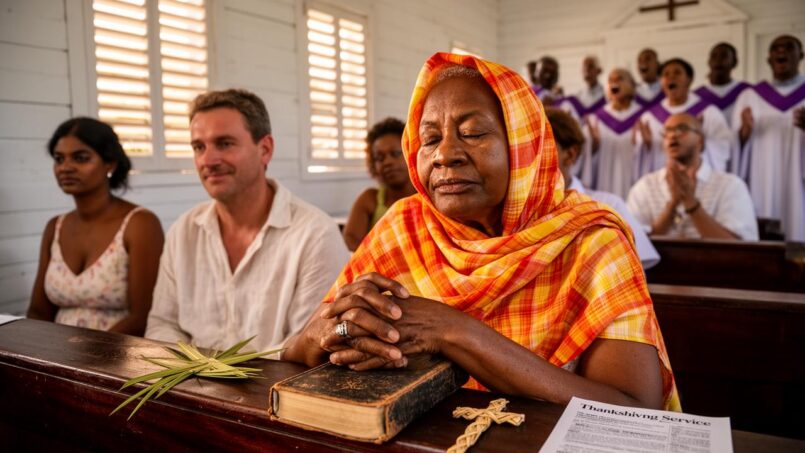
Settling in the U.S. Virgin Islands, whether on St. Thomas, St. John, or St. Croix, means entering a society where religion still broadly structures daily life, social relationships, and even the holiday calendar. For an expatriate, understanding this religious landscape is not merely a cultural curiosity: it is a key to integration, a way to reduce feelings of isolation, and a means of accessing strong networks of support and friendship.
This guide explains how religion fits into the local culture, presents the major faith traditions, indicates appropriate behaviors in places of worship, and shows how a newcomer can, if they wish, find their place within religious communities.
A Largely Christian Society… but More Diverse Than It Appears
In the U.S. Virgin Islands, the vast majority of the population identifies as Christian. The most commonly cited figures point to around 94–95% Christian, with a very significant weight of Protestant churches and a strong Catholic presence. Yet beneath this apparent homogeneity, the religious landscape is far more diverse, marked by a history where West African, European, Caribbean, Jewish, Hindu, Muslim, and Rastafarian influences intersect.
The overall structure looks like this:
| Main Religious Tradition | Estimated Share of Population | Notable Details |
|---|---|---|
| Protestantism (overall) | approx. 59–65.5% | Baptists, Pentecostals, Adventists, Episcopalians, Moravians, Lutherans, Evangelicals… |
| Baptists | 32–42% | About 46,000 adherents, heavily present on all three islands |
| Pentecostals | approx. 12% | Lively worship, strong role of the Holy Spirit |
| Seventh-day Adventists | approx. 10% | Observance of the Sabbath on Saturday |
| Episcopalians (Anglicans) | 9–17% | Heritage of the Church of England |
| Roman Catholic Church | 27–34% | 8 parishes, about 30,000 baptized |
| Other Christians (Jehovah’s Witnesses, Mormons, etc.) | approx. 2–3% | Jehovah’s Witnesses, LDS, independent churches… |
| Other Religions (Jewish, Hindu, Muslim, Bahá’í, Buddhist, Rastafari…) | 5–6% | Strong historical symbolism despite the small numerical share |
For an expatriate, this means two things. First, the Christian foundation is omnipresent in language, values, and the rhythm of the week (Sunday remains a day deeply marked by worship and family). Second, the internal diversity is real: you can go from a highly liturgical Lutheran service to a flamboyant Pentecostal worship, from a Shabbat service in a historic synagogue to a Hindu prayer in an Indian temple, or to a Bahá’í meeting focused on interfaith dialogue.
A Respectful, Community-Oriented, and Slow Culture… at the Pace of Faith
The local culture is often described as conservative, with a strong sense of community, family, and respect. The famous “island time”—a slower, less hurried pace—applies to religious life as well. Churches play the role of social centers: people pray, but they also organize youth activities, fundraisers, community meals, and after-school programs.
In Ghana, basic greetings like “Good morning,” “Good afternoon,” or “Good night” are essential when entering a store or office. Omitting this politeness can be seen as disrespectful. This expectation of civility extends to places of worship, where discreet behavior, proper attire, and a respectful attitude are expected from everyone, including non-believing visitors.
To integrate, an expatriate will do well to adopt these simple codes: greet people, take a moment for a few words about the day or weather, use “Miss,” “Mr.,” or “Mrs.” with elders, and avoid rushing interactions.
St. Thomas: A Concentrate of Christian Pluralism… and Beyond
St. Thomas, home to the capital of Charlotte Amalie, boasts an exceptional density of places of worship. Here you will find historic churches, evangelical megachurches, very active Catholic parishes, several Moravian and Lutheran churches, as well as an iconic synagogue and Bahá’í and Buddhist centers.
Practical Map of Major Christian Places of Worship on St. Thomas
Without aiming for completeness, here is an overview of the diversity of churches available, helpful for a Christian expatriate seeking community.
| Church / Institution | Main Tradition | Location and Sunday Service Type |
|---|---|---|
| Frederick Evangelical Lutheran Church | Lutheran (historic) | 7 Norre Gade, service at 9 am, Bible study and Sunday school at 8 am |
| Lutheran Church of the Reformation | Lutheran | East of Tutu Park Mall, service at 8:30 am |
| Memorial Moravian Church | Moravian | 17 Norre Gade, service 8:45 am, Sunday school 10 am |
| Nisky Moravian | Moravian | 6 Nisky, double service (6:30 am and 10 am), Sunday school 9 am |
| St. Thomas Reformed Church of America | Reformed / Dutch Reformed | Corner Crystal Gade / Nye Gade, service at 9 am |
| St. Thomas Assembly of God | Pentecostal / Evangelical | 133 Contant, service at 10:30 am and 6:30 pm |
| Full Body Evangelistic Pentecostal Church | Pentecostal | 9B Contant, service 9 am, many weekday services |
| Christian Fellowship Ministries Center | Charismatic Evangelical | Smith Bay (Frydendahl), very dense weekly schedule |
| Living Word Family Ministries | Evangelical | Four Winds Plaza, service 10 am, evening service at 7 pm |
| V.I. Christian Ministries | Multi-generational Evangelical | Bolongo Bay, service at 9 am for adults, children, and youth |
| Holy Family Church | Catholic | 213 Anna’s Retreat, Masses Saturday evening and Sunday morning |
| Sts. Peter and Paul Catholic Church (Cathedral) | Catholic (seat of the diocese) | Kronprindsens Gade, multiple Sunday Masses including one in Spanish |
| Our Lady of Perpetual Help | Catholic | Estate Elizabeth, Masses early morning and evening, including novena |
| St. Anne’s Chapel | Catholic | Frenchtown, Masses Saturday evening, Sunday morning |
| Cathedral Church of All Saints | Anglican | Garden Street, three services on Sunday |
| St. Andrew’s Episcopal Church | Anglican | Sugar Estate, multiple services, Bible studies |
| St. Luke’s Episcopal Church | Anglican | Smith Bay, Eucharist at 9 am |
| Island Fellowship Church | Non-denominational Christian | Independent Boat Yard, service at 10 am |
| Faith Christian Fellowship | Non-denominational | Anna’s Retreat, service 8 am |
For an expatriate, this density offers almost every Christian sensibility possible: from very liturgical worship (Catholic, Anglican, Lutheran, Moravian) to evangelical assemblies with a contemporary musical style and preaching.
A Historic Judaism in the Heart of Charlotte Amalie
Among the most emblematic places of worship, the St. Thomas Synagogue (Hebrew Congregation of St. Thomas) holds a special place. Built in 1833 on Crystal Gade, it is considered the second oldest synagogue still standing in all U.S. territories, and the oldest in continuous use. Historically tied to Reform Judaism, it testifies to a very ancient Jewish presence: as early as the mid-19th century, the Jewish community represented about half of the white population of the islands.
Today, the synagogue combines spiritual life with heritage. It offers a gift shop, a small museum open on weekdays, and guided tours of the prayer hall by appointment. For a Jewish expatriate, it provides a natural anchor; for others, it is a place for respectful discovery of a religious history rarely highlighted in tourist guides.
Hindus, Muslims, Bahá’ís, and Buddhists: A Visible Minority
Even if numbers remain modest, St. Thomas also hosts communities of other traditions. Hindu temples exist especially at Frenchman’s Bay (St. Thomas) and La Grande Princesse (St. Croix), sustained by an Indo-Caribbean and Indian population (often Sindhi tradition) arriving from the 19th century onward.
A 2011 estimate suggested about 1,200 Muslims across the entire U.S. Virgin Islands territory.
Important point for expatriates of other faiths: religious freedom is fully guaranteed by U.S. law and the local Organic Act, and relations between communities are described as largely harmonious. Interfaith initiatives have even been highlighted, for example when Muslim and Christian leaders gathered at the Masjid Nur Mosque on St. Thomas to condemn an isolated act of vandalism against flags and reaffirm a message of peace.
St. John: Small Island, Active Religious Life
St. John, smaller and more rural, nevertheless has a dense network of churches. Both in Cruz Bay and Coral Bay, religion is part of the fabric of social life.
Among the main communities:
| Church / Group | Tradition | Location / Main Times |
|---|---|---|
| Bethany Moravian Church | Moravian | Cruz Bay, service at 10 am, Sunday school at 9 am and 10 am |
| Emmaus Moravian Church | Moravian | Coral Bay, service at 9 am, Bible studies Tuesday and Wednesday evening |
| Cruz Bay Baptist Church | Baptist | Service at 11 am and 6:30 pm |
| Cruz Bay Seventh Day Adventist | Seventh-day Adventist | Services on Saturday |
| Our Lady of Mount Carmel Catholic Mission | Catholic | Masses Sunday morning, weekday at 8:30 am, Saturday 6 pm |
| St. John Missionary Baptist Church | Baptist | Sunday school 9:30 am, service 10:30 am |
| St. John Pentecostal Church | Pentecostal | Service 11:05 am, Sunday school 10 am, evening evangelistic service |
| St. Ursula’s Anglican Church | Anglican | Three services (7:15 am, 8:30 am, 10:30 am) |
| Unitarian Universalist Fellowship | Unitarian Universalist | Service and Sunday school at 9:45 am, Pine Peace School |
| United Methodist Church | Methodist | Service at 10 am |
| Christian Science Society of St. John | Christian Science | Sunday morning service, testimony meeting twice a month on Wednesday |
| Bahá’í National Spiritual Assembly (St. John contact) | Bahá’í | Prayer meeting on Wednesday evening |
For an expatriate, this diversity in a small space is an opportunity: whatever Christian or spiritual sensibility you seek, you will likely find an accessible community, often modest in size, where welcoming newcomers is valued.
St. Croix: Old Traditions and New Communities
St. Croix, larger, presents an equally varied religious landscape. Christiansted and Frederiksted host many churches, often housed in historic buildings inherited from the Danish colonial period.
Some landmarks to help orient yourself:
| Church / Institution | Tradition | Location |
|---|---|---|
| Holy Cross Catholic Church | Catholic | Queen Street, Christiansted |
| Lutheran Church Lord God of Sabaoth | Lutheran | King Street, Christiansted |
| Frederiksted Moravian Church | Moravian | Hospital Street, Frederiksted |
| Moravian Church-Friedensfeld | Moravian | Glynn, Christiansted |
| Central Seventh Day Adventist Church | Seventh-day Adventist | Plessen, Christiansted |
| First Assembly of God Church | Pentecostal / Evangelical | Fisher Street, Christiansted |
| Southgate Baptist Church | Baptist | Company Street |
| St. Croix Reformed Church | Reformed | Estate La Reine, Kingshill |
| Unitarian Universalist Fellowship | Unitarian Universalist | Little Princess Estate (2nd and 4th Sunday of the month) |
| Temple B’nai Or | Reform Judaism | Hermon Hill, near Christiansted |
St. Croix also houses Hindu temples, mosques, and a significant Rastafarian presence. For an expatriate, the island thus offers a privileged vantage point to observe how different traditions coexist and interact within a relatively small space.
What Religious Practice Actually Changes in Daily Life
For a newcomer, this religious landscape is not just a backdrop. It has very concrete repercussions on how to dress, how to organize weekends, how to interact with neighbors or colleagues, and sometimes even on the perception of certain social issues.
Attire: Decency in Town, “Sunday Best” at Church
Standards of modest dress are stricter than in many large Western cities. Swimsuits are reserved for beaches and pools; in town, men are expected to wear at least a t-shirt or shirt, and women a dress, shorts, or pants that cover, with an opaque top. Sarongs or sheer knitwear are not considered sufficient in downtown or at restaurants.
These requirements are not merely moral: local code provides that walking in bathing attire in certain urban areas can be considered a breach of public decency, subject to penalties, except for very young children.
In churches, the notion of “Sunday best” remains alive. For many faithful, attending a service literally means dressing to the nines, with more formal and polished attire than what is worn daily.
– women in dresses, sometimes with stockings and heels, and for older ladies, very elaborate hats;
– men in dress pants, long-sleeved shirts, sometimes a jacket and tie.
Non-denominational communities or evangelical assemblies may be more flexible: canvas pants (like chinos or khakis) and a clean polo for a man, pants or a skirt with a blouse for a woman, typically work just fine. In all cases, beach shorts and tank tops are rarely well regarded. Also note the practical aspect: many places of worship are semi-outdoor, with fans rather than air conditioning. Heavy jeans can quickly become uncomfortable.
Behavior During Services: Observation and Respect
Even without sharing the local faith, it is entirely possible—and often appreciated—to attend as an observer at a service. A few simple guidelines help avoid missteps:
Arrive on time, or even early, and stay until the end if possible. Put your phone on silent and avoid taking photos. Follow the congregation’s movements (standing, sitting) without obligation; staying seated is acceptable if you are respectful. For Communion, discreetly inquire: it may be reserved for members of that denomination. It is polite to decline by saying, “Thank you, I prefer to observe.” Remember to thank the religious leader or a parishioner as you leave.
Services can be longer and more spirited than some expatriates are used to. A Baptist or Pentecostal service can easily exceed two hours, with a long portion of songs, testimonies, and spontaneous prayers. Rather than comparing, it is often more rewarding to let yourself be carried along, while staying aware of your own limits.
A Typical Sunday: Between Worship, Cooking, and Family
In practice, many islanders still dedicate Sunday to worship and family. They attend morning service, sometimes Sunday school for children, then the day continues with shared meals, sometimes a series of visits to different relatives—a habit also seen at Thanksgiving, where it is not uncommon to visit several homes in one day.
For an expatriate, accepting an invitation to lunch after church or during a religious holiday is a sign of respect and openness. It is a prime opportunity to discover local cuisine, such as fungi, kallaloo, saltfish dishes, or tropical fruits, which are intimately tied to religious and family traditions.
Festivals, Carnivals, and Holy Days: A Calendar Woven with Religion
The calendar of the U.S. Virgin Islands blends American civil holidays, local commemorations, and Christian holy days. Many of these dates have an explicit or implicit religious dimension.
Among the important markers:
– Three Kings Day in early January, a holiday strongly marked in Caribbean culture, with a Christian (Epiphany) dimension and popular celebrations.
– Holy Week with Maundy Thursday, Good Friday, Easter, and Easter Monday, which strongly structure parish activities, especially Catholic and Anglican.
– Emancipation Day in early July, tied to the abolition of slavery, often accompanied by celebrations where churches speak out.
– Transfer Day in late March, commemorating the transfer of the islands from Denmark to the United States, often an occasion for official speeches where religious references are not uncommon.
Add to these the major carnivals of each island. Although they seem purely festive at first glance, they are deeply marked by religious and spiritual heritage: the mocko jumbies, those giant stilt-walkers parading in costume, are directly linked to beliefs about “jumbies,” spirits of Afro-Caribbean tradition. Carnival itself draws from a mixture of Christian traditions (the period before Lent) and African traditions (rites of symbolic reversal, music, dance).
For an expatriate, participating in these events with caution and respect—for example, by avoiding mockery of folkloric figures with heavy symbolic weight like the jumbies—allows for a deeper understanding of the religious depth of local culture, beyond just a street party.
Folk Beliefs, Syncretism, and Rastafarianism
One of the particularities of the U.S. Virgin Islands is the way Christianity was adopted and adapted by people of African descent. From the slavery era, many converted slaves integrated into their Christian practice spiritual elements from West Africa: belief in invisible forces, importance of dreams, the role of “Obeah” (a figure or force associated with magic, able to influence good or evil), or the fear and respect of “jumbies.”
“Don’t let the Jumbies get ya!” and the practice of downplaying one’s success to avoid attracting jealousy or malevolent forces.
Caribbean cultural habit
Rastafarianism, present on the islands as in many Caribbean territories, adds another layer of complexity. Born in Jamaica in the 1930s, this movement defines itself simultaneously as an Abrahamic religion (centered on a single God, Jah), an Afrocentric current of resistance to colonial oppression, and a lifestyle (livity) including an ital diet, dreadlocks, sacramental use of cannabis in “reasoning” or “nyabinghi” rituals, and the aspiration for a symbolic or physical return to Africa (Zion). Rastas do not have temples in the classical sense: they gather instead in houses or community spaces to discuss, sing, pray, and debate social and political issues.
For an expatriate, it is essential not to reduce Rastafarianism to a few stereotypes (like locked hair, reggae, or cannabis). It is in reality a complex spiritual universe, with its own theology, linguistic codes, and specific biblical references. The most respectful approach is to listen actively, ask open-ended questions, and avoid any condescending tone toward what might seem “exotic.”
Interfaith Dialogues and Peaceful Coexistence
The territory stands out for its long tradition of religious tolerance. Freedom of worship has been guaranteed since colonial times and is reinforced by the U.S. legal framework. In practice, open tensions between religious groups appear limited, and several interfaith initiatives have been highlighted.
After official flags were replaced with flags bearing the name “Allah” at Cyril E. King Airport, the leaders of Masjid Nur Mosque immediately condemned the act, reaffirmed their commitment to the law, and themselves reported the suspect. To promote tolerance and combat stereotypes, an interfaith meeting was organized at the mosque, bringing together imams, pastors like Charles Brown Jr. of the Family of Faith AME Church, and other community representatives.
On another level, the organization of Hindu prayers within the territorial legislature itself—for example, an invocation led by Hindu leader Rajan Zed, with excerpts from the Rig Veda, the Upanishads, and the Bhagavad Gita—illustrates the openness of institutions to minority religious expressions, in a spirit of recognizing pluralism.
For an expatriate from a minority tradition (Hinduism, Islam, Judaism, Buddhism, Bahá’í, agnosticism, etc.), this general climate means one can live and express one’s faith without legal fear. However, one must also accept living in an environment where the Christian majority is very visible, in public space as well as in political discourse or official ceremonies.
How an Expatriate Can Connect with a Local Religious Community
Settling in a new country or territory often comes with a feeling of loneliness and mental overload: a change of language, social codes, administration, pace of life. Studies on international migration show that anchoring in a religious community can significantly reduce the loneliness felt by expatriates and accelerate their cultural adaptation.
The reasons are simple: places of worship offer “social capital”—circles of friends, professional networks, informal help, but also a framework where codes are relatively stable and predictable, which reduces the cognitive load of a completely new environment.
Practically speaking, in the U.S. Virgin Islands, several strategies can help:
To integrate into a religious community in the U.S. Virgin Islands, it is advisable to start by locating churches and places of worship near your home or workplace, as the concentration of communities on St. Thomas, St. John, and St. Croix usually allows you to find one within a reasonable distance. Next, choose a worship style that suits your expectations: Catholics or Anglicans accustomed to structured liturgies can turn to Saints Peter and Paul Cathedral, All Saints Cathedral, St. Andrew’s, or St. Luke’s; evangelical Protestants may prefer V.I. Christian Ministries, Christian Fellowship Ministries Center, St. Thomas Assembly of God, or a Baptist church; and Unitarian Universalists (present on all three islands) attract those seeking a more liberal, interfaith spiritual space. Take advantage of services in English, the main language of religious life, making participation easier for expatriates; some parishes also offer Masses in Spanish for Spanish speakers. Finally, first participate in peripheral activities such as Bible studies, youth groups, choirs, English classes, after-school programs, or charitable programs—this allows you to get known in an informal setting before committing more deeply.
Some Conduct Tips for a First Visit
For a first attendance at a service or religious activity:
For a first visit to a place of worship, briefly introduce yourself to the leader at the end of the service. Avoid controversial topics like local politics or sensitive moral issues until you know the community better. If you belong to another religious tradition, state it simply without engaging in theological debate. Scrupulously respect the internal rules of the place, such as no photography, requiring head covering, or removing shoes.
Religion, Work, and Social Life: What an Expatriate Should Anticipate
In an environment where faith is important, certain topics and behaviors are perceived differently than in more secularized contexts.
At work, religious references in everyday language are frequent and do not necessarily indicate proselytizing. Christian holidays (Holy Week, Christmas) strongly impact business hours, requiring adapted planning. Public morality values decency and family values, making certain behaviors that are ordinary elsewhere (public displays of affection, humor about religion) potentially poorly perceived. Invitations to religious or community events are common for expatriates; it is advisable to respond with openness, explaining your limits while thanking, to foster integration.
Photography, Social Media, and Respect for Beliefs
In the age of Instagram and travel vlogs, the temptation is strong to photograph every detail, especially picturesque places of worship, colorful ceremonies, or carnivals. In the context of the U.S. Virgin Islands, some precautions are in order:
Always ask permission before photographing people, a ritual, or the interior of a place of worship in the presence of worshippers. Avoid turning a living community into mere exotic decor on social media, especially if it involves minority populations or little-known practices. Accept a refusal without insisting, as some groups prefer to keep part of their rituals away from cameras, and this decision must be respected.
When You Do Not Wish to Get Involved Religiously
Not all expatriates want to join a religious community. Some are agnostic, others belong to traditions not represented locally, and many simply prefer to keep their spirituality private. Living in the U.S. Virgin Islands is entirely possible in this configuration, provided you navigate with tact in a cultural environment where religion is very visible.
Some useful pointers:
It is socially acceptable to politely decline an invitation to a service. You can participate in cultural or charitable activities organized by religious institutions without adhering to their doctrine. To deepen your understanding of religions, resources like the Bahá’í center, the historic synagogue, or interfaith educational programs are accessible.
As a Compass: Three Key Attitudes for Religious Integration
In summary, religious life in the U.S. Virgin Islands is both very present, very diverse, and generally welcoming. For an expatriate, three simple attitudes make it possible to get the most out of it and avoid misunderstandings.
First, respectful curiosity: enter a church, temple, synagogue, or local mosque as an observer, ask questions with kindness, read a few historical markers, listen to residents’ stories. This simple effort is generally perceived as a sign of respect.
Second, personal consistency: do not force yourself to practice a religion you do not share, but be clear, calm, and consistent in how you express that. Most communities appreciate respectful sincerity more than superficial adherence.
Recognizing the role of churches and other religious institutions as places of solidarity and networking helps you better understand your surroundings. Participating in events like a parish festival, a carnival, an interfaith conference, or a family meal after a service constitutes a valuable gateway into local society.
In the U.S. Virgin Islands, religion is not just a matter of dogma; it is a shared language, a relational fabric, a historical and cultural framework. Being able to read it, even from the outside, allows the expatriate to cease being a mere temporary resident and gradually become a full participant in the life of the archipelago.
Disclaimer: The information provided on this website is for informational purposes only and does not constitute financial, legal, or professional advice. We encourage you to consult qualified experts before making any investment, real estate, or expatriation decisions. Although we strive to maintain up-to-date and accurate information, we do not guarantee the completeness, accuracy, or timeliness of the proposed content. As investment and expatriation involve risks, we disclaim any liability for potential losses or damages arising from the use of this site. Your use of this site confirms your acceptance of these terms and your understanding of the associated risks.

Cyril Jarnias is an independent expert in international wealth management with over 20 years of experience. As an expatriate himself, he is dedicated to helping individuals and business leaders build, protect, and pass on their wealth with complete peace of mind.
On his website, cyriljarnias.com, he shares his expertise on international real estate, offshore company formation, and expatriation.
Thanks to his expertise, he offers sound advice to optimize his clients' wealth management. Cyril Jarnias is also recognized for his appearances in many prestigious media outlets such as BFM Business, les Français de l’étranger, Le Figaro, Les Echos, and Mieux vivre votre argent, where he shares his knowledge and know-how in wealth management.





