
 Published on and written by Cyril Jarnias
The United States Virgin Islands form a small American archipelago in the heart of the Caribbean, east of Puerto Rico. Three main islands – St. Thomas, St. John, and St. Croix – concentrate most of the must-see sites, set against a backdrop of white sand beaches, turquoise sea, and a history marked by Danish colonization, slavery, and Creole culture. Add to that a series of national parks, forts, colonial villages, festive events, and diving spots that make it a destination far richer than a mere postcard backdrop.
Each island in the archipelago has a distinct identity: St. Thomas (Rock City) is known for its panoramic views, monuments, and urban vibe; St. John (Love City) for its preserved national park and legendary beaches; St. Croix (Twin City) for its historic towns, forts, marine life, and Buck Island. The stay is also punctuated by strong cultural experiences like Carnivals, mango festivals, and major nautical events.
St. Thomas: Panoramic Views, Colonial Monuments, and a Legendary Cove
St. Thomas is both the main gateway to the U.S. Virgin Islands – via Cyril E. King Airport – and the tourist capital with Charlotte Amalie. It is also the most urbanized island, with the largest number of hotels, duty-free shops, and an exceptional concentration of viewpoints and historical monuments.
Charlotte Amalie and the Danish Historic Heart
The capital, Charlotte Amalie, is a microcosm of colonial history. Cobblestone streets, houses with red roofs built from bricks imported from Copenhagen as ballast for ships, and steep stairways recall the 251 years of Danish rule.
On the waterfront, one building dominates the skyline: Fort Christian. Built between 1672 and 1680, this fort, named after King Christian V, is the oldest standing structure in the entire territory. It has served as a military bastion, administrative center, governor’s residence, police station, and prison. A Victorian bell tower added in 1874 gives it a unique silhouette today. Designated a National Historic Landmark in 1977, it now houses the St. Thomas Museum, where visitors can discover period artifacts and works retracing the island’s history, from the Danish period to integration into the United States.
Located a few streets from the center, Emancipation Garden commemorates the proclamation of the freedom of slaves in 1848. The park contains a bust of the Danish king who signed the emancipation decree and a replica of the American Liberty Bell. This symbolic site is essential for understanding the importance of the slave past in shaping the local identity of the archipelago.
Higher up, another symbol dominates the city: the “99 Steps” staircase. Despite its name, it actually has 103 steps, built in the mid-18th century with bricks from Denmark. It was once used to climb the hill towards the upper neighborhoods of the city. These steps lead to another key site, Blackbeard’s Castle, a watchtower erected in 1679 by the Danes to watch the sea and prevent the arrival of enemy ships. The site, now a National Historic Landmark, has been under renovation since damage from Hurricane Irma, but its function as a lookout over the harbor remains a must-see once it reopens to the public.
The city holds other iconic buildings: Government House, the governor’s seat, with its neoclassical facade and white wrought-iron balconies, and St. Thomas Synagogue. Originally built in 1803, rebuilt after several fires, it is the second oldest standing synagogue in the Western Hemisphere. Its sand floor evokes the practices of persecuted Sephardic communities, who muffled their footsteps during clandestine prayers.
Magens Bay and the Great Viewpoints
While St. Thomas is rich in colonial architecture, it also owes its reputation to one of the most famous beaches in the Caribbean: Magens Bay. Located on the north coast, this heart-shaped cove stretches about a kilometer of white sand, bordered by vegetated hills. The water is shallow, calm, and protected, making it a particularly family-friendly beach. Entrance is fee-based, with well-organized services: lifeguards, showers, food, and rentals of loungers and equipment. On cruise ship days, the beach fills up quickly, but it remains a classic to include in any itinerary.
A simple bench built in 1933 by philanthropist Arthur Fairchild, but placed in a spectacular spot from which you can see the bay, the nearby islets of Inner Brass and Hans Lollik, and sometimes even the distant islands. Legend has it that Sir Francis Drake once observed the passage of Spanish ships from here.
Drake’s Seat, viewpoint overlooking Magens Bay
Even more panoramic, Mountain Top has become an attraction in its own right. Perched at 1,200 feet (about 365 meters) above Magens Bay, this site combines a 360-degree viewpoint with a huge duty-free shop. They serve the “house” banana daiquiri made with Cruzan rum, a tourist ritual as much as a nod to the local rum industry. For many visitors, the shot “glass in hand, view of the bay” is a must-do.
Paradise Point, located at 700 feet elevation, overlooks the harbor and offers stunning views. Accessible by tram from Havensight near the cruise ship docks, the site includes an observation deck, a bar-restaurant, and shops, ideal for watching the sunset over Charlotte Amalie’s roadstead.
Museums, Gardens, and Varied Activities
St. Thomas is not limited to postcard views. The St. Thomas Historical Trust, for example, offers a small museum accessible by appointment, with collections of West Indian art, artifacts from archaeological digs and shipwrecks, as well as a guided walking tour of the historic center. The Pirates Treasure Museum, near the cruise terminals, displays treasures recovered by Odyssea Marine Exploration and interactive exhibits on piracy and shipwrecks.
Families will also find things to do at the Virgin Islands Children’s Museum or the Coral World Marine Park and Observatory, while nature lovers can head to the Estate St. Peter botanical garden or explore the trails leading to Mermaid’s Chair, an isolated beach at the junction of two seas within the preserved domain of Botany Bay.
To this add a whole range of activities: helicopter tours of the island, ziplining with Tree Limin Zipline, horseback riding, 4×4 excursions, golf at Mahogany Run Golf Course, or craft beer tasting at Frenchtown Brewing Company. In short, St. Thomas is the island with the highest density of attractions of all kinds.
For a quick overview of the major highlights, here is a summary:
| St. Thomas Must-See | Type of Site | Main Feature |
|---|---|---|
| Fort Christian | Fort / historical museum | Oldest building in the territory, St. Thomas Museum |
| 99 Steps & Blackbeard’s | Staircase & watchtower | Iconic ensemble from the Danish era |
| Magens Bay | Beach | One of the most famous beaches in the Caribbean |
| Drake’s Seat | Viewpoint | Panorama of Magens Bay and northern islets |
| Mountain Top | Lookout / shopping | 360° view and Cruzan rum banana daiquiris |
| Paradise Point | Viewpoint / tram | Panorama of Charlotte Amalie harbor |
| St. Thomas Synagogue | Historic place of worship | Second oldest synagogue in the Western Hemisphere |
St. John: The Realm of Virgin Islands National Park
St. John is the smallest of the three main islands, but also the most preserved. More than half of its land area – and over 5,500 acres of adjacent sea – is protected within Virgin Islands National Park and Virgin Islands Coral Reef National Monument. The island exudes a more peaceful, almost “timeless” atmosphere, with contained tourist development and a very dense network of wild beaches and hiking trails.
Virgin Islands National Park: A Park Between Rainforest and Coral Reefs
Established in 1956, the national park protects about 60% of St. John’s land and a large portion of its coastline. It also extends over nearly all of Hassel Island, in Charlotte Amalie’s roadstead, where 19th-century fortifications remain. On St. John itself, the park alternates between secondary rainforest, ruins of sugar plantations, turquoise coves, and mangroves.
Over 40% of its area is underwater: mangroves, seagrass beds, fringing reefs, and patch reefs. It is this coral heritage that makes the place famous among diving and snorkeling enthusiasts. The park emphasizes the need to use only mineral sunscreens – based on zinc oxide or titanium dioxide – because chemical filters like oxybenzone, octinoxate, or octocrylene contribute to coral bleaching, even in very small doses.
The park’s Visitor Center is located in Cruz Bay, the main port of St. John. There you can pick up maps, ranger advice, trail lists, and tips on the best snorkeling areas based on daily conditions. Beaches suitable for snorkeling are marked in pink on the official map. Given the limited cell coverage, a paper map remains essential for navigation.
To reach St. John, you must fly into St. Thomas, then take a ferry – passenger or “car barge” – to Cruz Bay. You can choose to stay on St. Thomas and do a day trip, but visitors who really want to enjoy the park prefer on-site accommodation: camping at Cinnamon Bay, villas, small properties like St. John Inn, or the Westin Resort Villas.
Trunk Bay, Cinnamon Bay, Maho Bay: Legendary Beaches
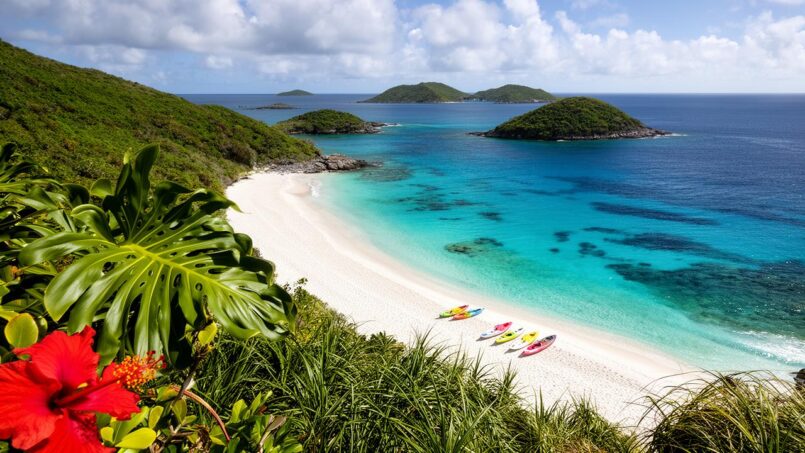
The northern coast of St. John is a succession of beaches that regularly appear in rankings of the world’s most beautiful.
This is the entrance fee in dollars per person to access Trunk Bay beach, the only one on the island that charges a fee.
A bit further, Cinnamon Bay offers one of the longest stretches of sand on St. John, nearly a mile long. Access is free and the atmosphere is quieter than at Trunk Bay. You’ll find restrooms, restaurants, a bar, a shop, and a water sports equipment rental center. Most notably, this is where the Cinnamon Bay Beach & Campground is located, offering “glamping” tents, cottages, bare sites, or equipped tents for various budgets. Behind the beach, a short trail – the Cinnamon Bay Nature Trail – passes through the ruins of a former sugar plantation, with interpretive panels about the site’s slave history and remnants of Taíno culture uncovered by archaeologists.
Maho Bay has become a social media star for one simple reason: the near-certainty of encountering green sea turtles grazing on the seagrass in the middle of the bay. The water is shallow, calm, and clear, making it an ideal spot for beginner snorkelers and families. A cluster of food trucks, a small beach bar, and paddleboard and kayak rentals complete the experience. Turtles are most visible early in the morning or late afternoon; it is imperative to observe them from a distance, without touching or chasing them.
Other northern coves are equally worth the detour: Hawksnest Bay with its “fingers” of reef dominated by fragile elkhorn corals (a protected species), Francis Bay known for its calm waters, turtles, large predatory fish, and a boardwalk trail popular with birdwatchers, and Gibney/Oppenheimer Beach, a small almost-secret beach with discreet access behind a wrought-iron gate.
An overview of the main sandy stretches on St. John, to better visualize their characteristics and advantages.
Iconic beach with a marked underwater trail, ideal for snorkeling. Its white sand and turquoise waters make it one of the most famous.
The longest beach on the island, bordered by forest. Popular camping site and historic location with sugar plantation ruins.
Shallow, calm bay, perfect for families. Famous for spotting sea turtles from the beach or while snorkeling.
Easily accessible beach with good facilities. Several small coves offer privacy and good snorkeling spots near the shore.
| St. John Beach | Main Highlights | Ideal Audience |
|---|---|---|
| Trunk Bay | Marked underwater trail, iconic scenery | First-time visitors, cruisers |
| Cinnamon Bay | Long beach, camping, plantation ruins | Backpackers, nature lovers |
| Maho Bay | Turtle watching, calm water | Families, beginning snorkelers |
| Hawksnest Bay | Reefs close to shore, elkhorn corals | Careful experienced snorkelers |
| Francis Bay | Calm water, varied marine life, excellent birdwatching | Photographers, naturalists |
Hikes and Plantation Ruins: Another Side of the Caribbean
Virgin Islands National Park is not just a series of beaches. The interior of the island is crisscrossed by more than 20 hiking trails, from short family loops to more challenging treks.
The Reef Bay Trail is often described as the most remarkable – and most strenuous – hike on St. John. About 6 miles round trip, with an elevation gain that can reach 900 to 1,200 feet depending on the variant, the trail descends from the ridge road (Centerline Road) to Reef Bay Beach. Along the way, you pass through several layers of tropical vegetation, alongside the ruins of a particularly well-preserved sugar mill, and, most notably, reach a set of Taíno petroglyphs carved into rocks near a seasonal waterfall. These figures, sometimes inverted to reflect in a pool, testify to the island’s occupation by the Taíno from the 12th century until around 1550. Guided hikes, offered in season by the Friends of Virgin Islands National Park, allow you to descend via the trail and return by boat to Cruz Bay.
The Cinnamon Bay Nature Trail, much more accessible (0.5 mile, nearly flat), winds among the remains of a plantation, with educational panels about the sugar economy, slavery, and a major revolt that occurred in 1733. This insurrection, led by about 150 slaves from the Akwamu empire (present-day Ghana), has sometimes been called one of the first major slave revolts in the Americas.
To the northeast, the Annaberg Plantation complex offers one of the most significant ruin complexes in the park: windmill, factory, slave village, guard buildings. Managed by the National Park Service, the site offers guided tours, often combined with a walk to Leinster Bay and Waterlemon Cay, one of the island’s top snorkeling spots.
To explore the island’s varied landscapes, several hiking trails are essential. In the south, the Ram Head Trail follows a rocky, arid peninsula offering spectacular views of the Atlantic Ocean. The Caneel Hill Trail leads to a wooden lookout with panoramas of St. Thomas, Jost Van Dyke, and, on clear days, as far as St. Croix and Puerto Rico. To reach the island’s highest point (about 1,277 feet), take the Bordeaux Mountain Trail. Finally, shorter routes like Peace Hill–Denis Bay combine discovering historical ruins (such as an old mill) and accessing isolated beaches.
Exceptional Snorkeling: Waterlemon Cay, Salt Pond Bay, and Beyond
Beyond the great classics of the north coast, some snorkeling sites are considered gems for those who want to get off the beaten path a bit.
Leinster Bay and Waterlemon Cay, accessible via a coastal trail from the Annaberg parking lot, offer a reef particularly rich in fish, corals, and gorgonians. Entering from the beach, you pass over a seagrass bed and small rocks where long-spined sea urchins and crustaceans hide. Further out, when circling the cay, you must stay on the south side to avoid the strong current that sweeps the north face facing Tortola. Here, the essential instruction remains the same as elsewhere: never stand or place fins on the coral, only on the sand.
To the south, Salt Pond Bay is a reward after a short half-mile walk from Route 107. The beach, sheltered in a cove, combines fringing reefs on either side, seagrass beds in the center where green turtles and stingrays cross paths, and a deeper reef further offshore. A trail also leads to an actual “salt pond” in the hinterland, where salt deposits form in places depending on the season, and where water birds are abundant.
The coves of Great and Little Lameshur, at the end of a bumpy road discouraged by most car rental companies, remain more confidential. Again, the waters at Yawzi Point, the rocky headland separating the two coves, are highly appreciated by snorkelers.
An Island Focused on Ecotourism
The protected nature of St. John makes the island a living laboratory for ecotourism. Organizations like Island Green Living Association promote recycling (via a “ReSource Depot” where building materials are reused), environmental legislation, and beach cleanups. Accommodations like the former Maho Bay camp (tents on stilts to reduce erosion) or solar energy initiatives on several villas illustrate the local desire to reconcile tourism and preservation.
Visitors are encouraged to strictly follow “Leave No Trace” principles: stay on trails, pack out all trash, take nothing (no shells, corals, or sand), conserve water and electricity, and make more sustainable food choices (e.g., favoring pelagic fish like mahi-mahi over threatened reef species or Caribbean lobster).
St. Croix: Colonial Towns, Danish Forts, and Protected Reefs
The largest island in the archipelago, St. Croix lies about forty miles southeast of St. Thomas and St. John. It has a more extensive and wilder coastline, renowned marine life, and two historic towns marked by Danish architecture: Christiansted and Frederiksted.
Christiansted: Fort Christiansvaern, Colonial Streets, and Apothecary Hall
Christiansted concentrates a significant portion of St. Croix’s built heritage. Its pale yellow fort, Fort Christiansvaern, is the heart of the Christiansted National Historic Site. Built in 1749 in a star shape around a central courtyard, it long served as the center of Danish power on the island, as a courthouse, and a prison. It is now considered one of the best-preserved colonial forts in the Caribbean. Exhibitions cover the history of the town and daily life on St. Croix; it can be explored on a self-guided or guided tour.
A few streets away, the Apothecary Hall Museum offers a completely different look at the past. This museum, housed in a 19th-century pharmacy founded in 1820 to supply the garrison with medicines, displays bottles, dried herbs, medical instruments, as well as pottery, axes, beads, and an indigenous canoe. It reminds us that St. Croix was inhabited by indigenous peoples for over 3,000 years before the arrival of Europeans.
The sugar heritage is highlighted at the Whim Plantation Museum, a former 18th-century Danish sugar estate turned living museum. On 12 acres, you can visit a furnished great house, the ruins of the sugar factory, and watch craft demonstrations (calabash bowls, basketry, pottery) accompanied by “Crucian” music and dance. A genealogical research center allows descendants of local families to explore their roots.
Frederiksted, Fort Frederiksted, and the Great Pier
To the west of the island, Frederiksted has long been St. Croix’s second town, more intimately tied to the sea. Here too, a fort dominates the waterfront: Fort Frederiksted, a crimson masonry building, designated a National Historic Landmark in 1997. Built by the Danes, it protected the port from external threats and now serves as a museum and art gallery. Visitors can self-guide through its bastions overlooking the bay.
The Ann E. Abramson Pier accommodates cruise ships and large sailing vessels. It is also a renowned diving spot for observing nocturnal marine life (corals, sponges, fish, seahorses). When cruise ships are docked, Frederiksted becomes a lively market with artisan stalls and music.
Buck Island Reef National Monument: A Reference Marine Park
Off the north coast of St. Croix, Buck Island is one of the most iconic places in the archipelago for snorkeling. Designated a national monument in 1961, Buck Island Reef National Monument protects nearly 30 square miles of reefs and marine ecosystems. Turtle Beach, on the western part of the islet, is famous for its white sand and brilliant blue water, as well as hiking trails on the hill.
The park imposes strict rules: no fishing is allowed, some areas are marked by an underwater trail, and visitors generally must go through authorized operators to get there. The goal is to limit pressure on the reef, regulate moorings, and prevent degradation of seagrass beds by anchors.
Beaches and Diving: Cane Bay and the “Walls”
On St. Croix itself, Cane Bay beach, on the north side, has earned a reputation among divers worldwide. A few dozen yards from shore, a coral wall drops dramatically to over 13,000 feet deep. This unique “wall diving,” combined with the presence of the largest living reef in the Caribbean, attracts scuba divers and snorkelers of all levels. Dive shops, kayak rentals, hotels, and restaurants have set up around the bay.
The Jack and Isaac Bay Reserve includes Isaac Bay, a often deserted beach accessible after a 20-minute walk. Excellent for snorkeling (brain corals), it is also a nesting site for green and hawksbill turtles from July to December. Other beaches like Dorsch Beach, Rainbow Beach, and Judith’s Fancy complete the island’s coastal offerings.
Finally, at the eastern tip of St. Croix, Point Udall symbolizes another “end of the world”: it is the easternmost point of U.S. territory. A sundial-shaped monument, the Millennium Monument, marks the first sunrise on American soil of the 21st century. The panorama of the Atlantic and surrounding hills makes it a memorable stop.
To summarize the major highlights of St. Croix:
| St. Croix Must-See | Type of Site | Main Feature |
|---|---|---|
| Fort Christiansvaern (Christiansted) | Fort / national historic site | Well-preserved star fort |
| Apothecary Hall Museum | Thematic museum | Former 19th-century pharmacy, artifact collection |
| Whim Plantation Museum | Sugar estate / living museum | Great house, crafts, “Crucian” music and dance |
| Fort Frederiksted | Fort / museum | Red building on the sea, view of the bay |
| Ann E. Abramson Pier | Pier / dive site | Night diving, corals and seahorses |
| Buck Island Reef National Monument | Marine park | Protected reef, Turtle Beach, and underwater trail |
| Cane Bay | Beach / diving | Coral wall dropping to over 13,000 feet |
| Point Udall | Panoramic site | Easternmost point of the United States, sundial |
Events, Festivals, and Cultural Life
Beyond the physical sites, the U.S. Virgin Islands are also discovered through a calendar of events that blends music, costumes, gastronomy, and Caribbean traditions.
Carnivals, Moko Jumbies, and Parades
The word “Carnival” appears everywhere in the islands, but it covers a reality far broader than a simple parade. On St. Thomas, the Carnival spans several weeks around springtime. It includes beauty pageants, village nights with concerts, a grand food fair, nights in the Carnival Village, and especially the main parades, including the Adults Parade. Festivities often start before dawn with J’ouvert, a moment when the crowd floods the streets to the sound of soca and calypso.
The “moko jumbies” are one of the visual signatures of these parades: stilt dancers reaching nearly 6 meters high, costumed as protective spirits, swaying above the crowd. They appear at all major celebrations, whether Carnivals or more occasional events.
Each main island of the U.S. Virgin Islands has its own major festival. On St. John, the St. John Celebration takes place from late June to July 4th, blending American independence celebrations with emancipation commemoration. On St. Croix, the Crucian Christmas Festival enlivens the Christmas and New Year period with events like an amusement park, J’ouvert, parades, and concerts, primarily in Frederiksted.
Agricultural Fairs, Mango Festivals, and Nautical Events
The archipelago lives on more than just music and dance. On St. Croix, Agrifest is a major event for local agriculture and gastronomy. This large fair highlights produce from the land, mangoes and other tropical fruits, as well as traditional recipes and farming know-how. During the Mango Melee & Tropical Fruit Festival, also on St. Croix, the mango is queen: tastings, culinary competitions, and educational workshops allow you to discover the diversity of varieties and culinary uses.
Sailing and yachting enthusiasts can participate in the St. Thomas International Regatta, organized by the St. Thomas Yacht Club, which combines athletic competition and dockside parties. They can also visit the Virgin Islands Boating Expo (VIBE) at Yacht Haven Grande, a show that brings together shipyards, brokers, equipment suppliers, and cruise organizers.
On St. John, the VI Jam Fest, a music festival organized at Windmill Bar by Cruz Bay Music and the Lightbrush collective, attracts an ever-growing audience each year in a hillside setting with sea views. Other sporting events like the 8 Tuff Miles foot race, which crosses the island from Cruz Bay to Coral Bay, round out the program.
Living Culture Day to Day
Beyond the big dates, the culture of the U.S. Virgin Islands is also expressed in everyday places: farmers’ markets like the Bordeaux Farmers’ Market on St. Thomas, where Rastafarian farmers sell fruits and vegetables accompanied by live music; small art galleries like the Caribbean Museum Center for the Arts in Frederiksted, which exhibits artists from the islands; or craft shops where you can find the famous St. Croix “hook” bracelet, woven baskets, or local spices.
Music, omnipresent, oscillates between calypso, soca, reggae, and more contemporary sounds imported from the United States. While some fear a form of erosion of traditions in the face of globalization, many initiatives seek to promote local artists, calypso standards, or steelbands.
Practical Tips for Exploring Must-See Sites
To make the most of the tourist sites in the U.S. Virgin Islands, some logistical and environmental pointers are essential.
The climate is tropical, with temperatures generally between 77°F (25°C) in winter and 90°F (32°C) in summer, high humidity but moderated by trade winds. The dry season (December-April) corresponds to the tourist peak: more stable weather, calmer seas, but high prices and crowds. The shoulder seasons (April-June, sometimes November) offer a good compromise between crowds, cost, and conditions. The period from June to November, wetter and marked by cyclone risk, still includes many sunny days and excellent rates, provided you opt for flexible travel insurance.
St. Thomas is the main air gateway. For St. John, ferries depart from Red Hook or Charlotte Amalie. St. Croix has its own airport, and seaplanes connect Christiansted to Charlotte Amalie. On the ground, transportation is by ‘safari’ taxi, VITRAN bus (irregular schedules), or rental car. Caution while driving: left-hand traffic, narrow and steep roads.
Regarding environmental respect, regulations are increasingly strict: sunscreens containing oxybenzone, octinoxate, or octocrylene are banned; only mineral is allowed; the Virgin Islands Coral Reef National Monument is a “no-take” zone, with no fishing or collecting; the national park asks to avoid single-use plastic, and waste sorting remains a challenge on islands where incineration dominates. Visitors thus have a direct role to play, by favoring reusable water bottles, cloth bags, and purchases from engaged local businesses (ecotours, “green” accommodations, farm-to-table restaurants).
Safety is generally good for tourists, especially on St. John and in the beach areas of St. Thomas and St. Croix. For a worry-free trip, it is recommended to take basic precautions: do not leave valuables visible in cars, avoid isolated neighborhoods at night, and use official taxis.
A Destination That Goes Beyond the Postcard
Seen from afar, the U.S. Virgin Islands mostly evoke beaches, cocktails, and palm trees. In reality, the must-see sites of the archipelago tell a much denser story: Danish forts and Sephardic synagogues, sugar plantations and slave revolts, marine national parks at the forefront of reef protection, carnivals where moko jumbies dance on dizzying stilts, mango festivals and agricultural fairs, trails carved through secondary forest and the memories of the slave trade.
Whether you spend your days hiking the Reef Bay Trail, sipping a banana daiquiri overlooking Magens Bay, or watching the turtles of Maho Bay, each island reveals a different facet of this territory sometimes described as “America’s Caribbean paradise.” Approaching these sites with curiosity, respect, and environmental awareness gives new depth to this dreamlike setting – and helps ensure it remains so, for both residents and future visitors.
Disclaimer: The information provided on this website is for informational purposes only and does not constitute financial, legal, or professional advice. We encourage you to consult qualified experts before making any investment, real estate, or expatriation decisions. Although we strive to maintain up-to-date and accurate information, we do not guarantee the completeness, accuracy, or timeliness of the proposed content. As investment and expatriation involve risks, we disclaim any liability for potential losses or damages arising from the use of this site. Your use of this site confirms your acceptance of these terms and your understanding of the associated risks.

Cyril Jarnias is an independent expert in international wealth management with over 20 years of experience. As an expatriate himself, he is dedicated to helping individuals and business leaders build, protect, and pass on their wealth with complete peace of mind.
On his website, cyriljarnias.com, he shares his expertise on international real estate, offshore company formation, and expatriation.
Thanks to his expertise, he offers sound advice to optimize his clients' wealth management. Cyril Jarnias is also recognized for his appearances in many prestigious media outlets such as BFM Business, les Français de l’étranger, Le Figaro, Les Echos, and Mieux vivre votre argent, where he shares his knowledge and know-how in wealth management.





