
 Published on and written by Cyril Jarnias
Moving to Samoa means choosing a small island state in the South Pacific where daily life is shaped by the sea, family, and tradition. For an expatriate, it’s not a “plug and play” destination like Singapore or neighboring Australia: the economy is modest, infrastructure is limited, and administration can sometimes be opaque. On the other hand, the natural setting is spectacular, the culture is rich, and society generally remains welcoming to foreigners.
This guide covers the key steps before moving: obtaining a visa, evaluating the cost of living, finding housing in Apia, job opportunities, the healthcare system, schooling options, social integration, safety guidelines, and common pitfalls to avoid.
Understanding the country you will live in
Samoa is an island state in Polynesia, located near the International Date Line and about 14° south of the equator. It should not be confused with American Samoa, an unincorporated territory of the United States: both entities belong to the same archipelago but fall under completely different jurisdictions, currencies, and immigration systems.
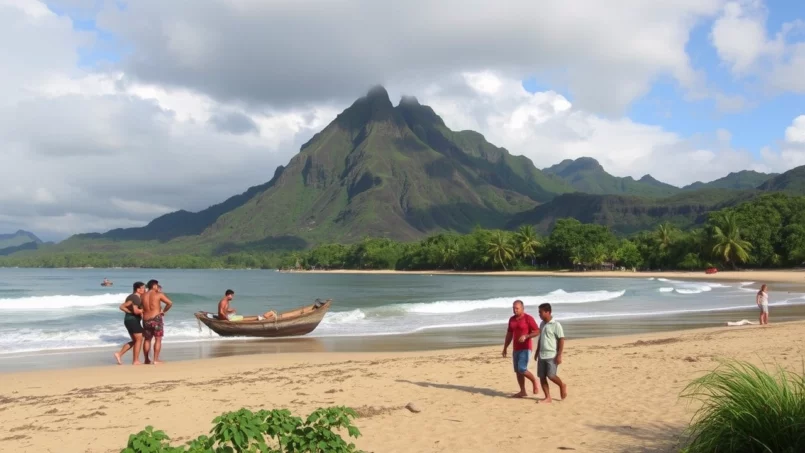
Independent Samoa consists mainly of two large islands, Upolu and Savai’i, surrounded by several islets. The capital, Apia, is located on the north coast of Upolu and concentrates most of the country’s political, economic, and social life.
The frequent humidity level in the country’s tropical climate, which is hot and humid year-round.
The official language is Samoan, but English is also an official language and widely used in administration, education, and business. The local currency is the Samoan tala (WST), with an exchange rate of approximately 1 WST to 0.37 USD (or 10 WST to about 3.59 USD).
Fa’a Samoa: Living on Samoan time
For an expatriate, understanding the local culture is not just a “plus”: it is the key to successful integration. Everything revolves around a central concept: “Fa’a Samoa”, literally “the Samoan way”.
Fa’a Samoa values the extended family (aiga), the traditional hierarchy of chiefs (matai), respect for elders and leaders, community solidarity, and religion. In many villages, decisions are still made within the council of chiefs (fono), and Sunday life revolves around church and family.
It is important to adopt indirect communication, prioritizing harmony over direct conflict. Avoid speaking loudly, boasting, or contradicting an elder in public, as this would be very poorly received. Regarding clothing, modesty is essential, especially in villages and churches: cover your shoulders, wear skirts or shorts that reach at least to the knee. Swimsuits are reserved for beaches or hotel complexes; topless sunbathing and nudity are prohibited.
A few basic rules: remove your shoes before entering a traditional house (fale), do not pass in front of someone without bending slightly and saying “tulou lava”, avoid pointing your feet at others when sitting, ask for permission before taking photos of people or ceremonies, and above all, respect the evening prayer time (Sa), during which you should avoid moving around or making noise in the villages.
Visas, stay, and work: What an expatriate must clarify
Samoa does not have a specific visa for digital nomads, nor a generic work permit for job seekers. The immigration system is structured around several main categories: visitor, temporary resident, permanent resident, and ministerial permit.
Short-term stays
Many nationals can enter Samoa without a visa for a tourist stay of 60 to 90 days, according to current agreements, by obtaining a Visitor Permit upon arrival. In practice, you must present:
– a passport valid for at least six months after the intended departure date,
– a return or onward ticket,
– proof of sufficient funds,
– an accommodation address,
– no serious criminal record or health threat.
This Visitor Permit does not authorize work, even remotely for a local employer. It can be extended on-site by applying to the immigration services in Apia, but it remains a visitor status.
Temporary Residence Permit
For a stay longer than 60 days with a specific purpose (employment, investment, studies, religious or cultural activities, family reunification), you must apply for a Temporary Resident Permit from the Immigration Division in Apia. A single basic form (MPMC100) is used for different categories:
– salaried employment,
– business / investment,
– studies or academic research,
– cultural or religious activities,
– family support or reunification.
The cost of a temporary resident visa for Mexico, in US dollars, not including additional fees for expedited processing.
Work Permit: An employer-sponsored system
To work, a foreigner must combine a temporary residence permit for employment and a work permit managed by the Ministry of Commerce, Industry, and Labor (MCIL): the Foreign Employee Employment Permit (FEEP).
Samoa does not issue job-seeking visas. Obtaining a work permit is strictly conditional on sponsorship by a local employer, via a signed job offer. This permit is then tied to a specific position, employer, and duration, typically 1 to 2 years, with a maximum of 3 years.
The employer must prove the inability to hire a Samoan for the position, demonstrate the legality of their business, and respect a minimum ratio of local employees to foreigners (a commonly cited reference is one non-citizen to three citizens). For their part, the worker must provide a clean criminal record, a medical certificate, their CV, diplomas (certified by the Samoa Qualifications Authority), and a valid passport.
Annual work permit fees in Samoa range from 500 to 1500 WST, in addition to application and residence fees.
Non-compliance with immigration rules is taken seriously: fines, deportations, and bans on returning are possible for working without a permit or overstaying.
Spouses, children, and long-term settlement
The spouse and minor children of a work permit holder can generally obtain dependent visas. They must provide proof of family relationship, medical and police certificates, as well as proof of sufficient financial means. These visas do not automatically grant the right to work: to work, the spouse must in turn apply for a work permit.
Access to permanent residence is not automatic: it is based on a combination of length of stay (often 5 to 10 years), stable employment, tax compliance, good conduct, and sometimes significant investment or family ties with citizens. Naturalization remains a separate, rather selective process.
Where to live in Apia and how much does it cost?
Most expatriates choose to settle in Apia or its outskirts. The city has between 36,000 and 38,000 inhabitants, but the urban area encompasses a string of urbanized villages. Upolu concentrates most of the housing, services, and job offerings, while Savai’i remains more rural and traditional.
Several neighborhoods in Apia are particularly popular with foreigners. Vailima is appreciated for its lush setting and proximity to Mount Vaea and the Robert Louis Stevenson Museum. Vaiala offers access to the waterfront with beaches and high-end resorts. Taufusi is the commercial heart with its shops, restaurants, and government offices. Malifa and Sinamoga are quiet residential areas near the center. Moata’a is distinguished by its traditional small houses along the Vaisigano River. Vaitele and Tulaele are developing areas on the outskirts. Fugalei is a lively neighborhood housing a large fresh produce market, and Vaimoso offers a peaceful village atmosphere.
Rentals and real estate purchase: A numerical overview
Estimates vary by source, but the order of magnitude is clear: rent remains affordable by Western standards, even though some “expatriate” properties or modern villas reach high levels.
Here is a summary of some housing cost benchmarks:
| Type of housing / location | Indicative amount (per month) | Currency |
|---|---|---|
| 1-bedroom apartment in Apia (low-high range) | 357 – 470 | USD |
| 3-bedroom apartment in Apia | ≈ 1,500 | USD |
| 40 m² studio in city center | ≈ 253 | USD |
| 40 m² “budget” studio | ≈ 177 | USD |
| 3-bed, 80 m² in city center | ≈ 498 | USD |
| 1-bed apartment in center (other source) | 980.35 | WST |
| 1-bed apartment outside center | 420.15 | WST |
| 3-bed apartment in center | 1,960.70 | WST |
| 3-bed outside center (average) | 3,278.38 | WST |
| Studio to buy, center (per m²) | ≈ 2,500 | WST |
| Studio to buy, outside center (per m²) | ≈ 2,000 | WST |
| Purchase price per m², center (other source) | ≈ 1,414 | USD |
| Purchase price per m², suburb (other source) | ≈ 963 | USD |
Local ads in tala (SAT) give another idea of the “custom” market: a 3-bedroom house in Siusega around 3,500 SAT per month, a ½ acre plot of land in Lotopa at 3,000 SAT, a large furnished 4-bedroom house in Ululoloa for 5,500 SAT monthly, or a 2-bedroom unit in Ululoloa at 400 SAT per week.
This is the number of utility services (electricity, water, internet) whose cost, although reasonable, should be budgeted for by a typical household.
| Item | Monthly range | Currency |
|---|---|---|
| Electricity | 45 – 190 (avg. ≈ 95) | USD |
| Water | 12 – 38 (avg. ≈ 25) | USD |
| Gas / heating | 10 – 28 (avg. ≈ 15) | USD |
| Unlimited high-speed internet | 55 – 145 (avg. ≈ 95) | USD |
| Mobile plan with data | 13 – 40 (avg. ≈ 25) | USD |
Apartments and modern houses intended for expatriates often include air conditioning, a water tank, a generator, sometimes a pool, and security features (electric gate, fence, covered parking). Conversely, simpler, village-style or outlying accommodations can be much cheaper but with more basic comfort.
For short-term stays, Airbnb and guesthouses remain very present, with hundreds of listings in Apia, ranging from small units at $10 per night (before fees) to much more expensive villas with pools.
Cost of living: A reasonable budget but low local incomes
Overall, the cost of living in Samoa is about 1.5 times lower than the global average and 70% lower than that of the United States. On the other hand, local salaries are very low, which explains why life will seem affordable to an expatriate paid by a foreign employer but significantly tighter if you rely on a Samoan salary.
Several estimates summarize the order of magnitude well:
| Profile / scenario | Average monthly cost (incl. rent) | Currency |
|---|---|---|
| Single person | ≈ 753 – 1,649 | USD |
| Couple | ≈ 2,295.5 | USD |
| Family of 4 | ≈ 1,880 – 3,178.5 | USD |
| Digital nomad | ≈ 2,725 | USD |
| Single expatriate (“classic” profile) | ≈ 1,569 | USD |
| Local | ≈ 641 | USD |
| Tight budget for single person | ≈ 832 | USD |
| “Comfortable” budget for single person | ≈ 3,270 | USD |
The variations are mainly explained by the type of housing, the level of comfort sought, and the proportion of imported foods in your consumption.
Food: Cheap local, more expensive imported
Local products – tropical fruits, vegetables, fish, taro, chicken – are relatively affordable, especially if you shop at markets like the Fugalei Market. On the other hand, imports (dairy products, wines, cheeses, some meats) quickly add up.
Some useful benchmarks for your grocery shopping at the supermarket or market, expressed in tala.
Fruits like apples or bananas generally cost between 2 and 5 tala per kilo, depending on the season and quality.
Basic vegetables (carrots, onions, potatoes) are often around 3 to 6 tala per kilo.
Milk (1 liter) costs about 4 tala, and a dozen eggs are between 6 and 8 tala.
A pack of pasta or rice (1 kg) is generally sold for between 3 and 7 tala.
Chicken is about 10-15 tala per kilo, while fresh fish can vary from 12 to 25 tala per kilo.
For essential groceries on a small budget, plan for at least 50 to 70 tala per week for one person.
| Product | Approximate price | Unit |
|---|---|---|
| Simple lunch menu | 15 | WST |
| Fast-food meal | 25 | WST |
| Local beer 0.5 L (supermarket) | 4.96 | WST |
| Decent bottle of wine | 39 – 45 | WST |
| Milk 1 L | 3.61 | WST |
| 12 eggs | 10 – 11.76 | WST |
| Tomatoes 1 kg | ≈ 20 | WST |
| Apples 1 kg | ≈ 3 | WST |
| Apples 1 lb (other source) | ≈ 6.35 | WST |
| Chicken (breast fillets 1 lb) | ≈ 4.54 | WST |
| Beef (1 lb) | ≈ 10.43 | WST |
| Bread (1 day for 2 people) | 1.68 | WST |
Converted to dollars, the orders of magnitude are consistent: a meal in a small restaurant is around 4.5 to 5 USD, a cappuccino around 2.5 to 3 USD, a beer in a bar around 4 USD.
Over a month, a food budget for one person can range from 150 to 650 USD, with the average being around 300 USD if you cook at home and mix local products with some imports.
Local incomes and taxation
On a macroeconomic level, GDP per capita is around 4,200 to 4,900 USD per year, and the average net salary is very low: on the order of 292 USD per month according to one source, 600 USD according to another, or 1,680.60 WST.
This is the number of months of common expenses that the average after-tax salary can cover.
However, the tax system presents a major advantage for some expatriates: it is territorial, meaning that the foreign income of residents is not taxed in Samoa. For companies, the corporate tax rate is around 27%, VAT (or VAGST) is set at 15%, and a 2% tax applies to real estate transactions.
Working, connecting, and doing business
The local job market remains limited, more oriented towards public services, tourism, fishing, agriculture, and some infrastructure projects. The startup and freelance ecosystem is described as minimal, and opportunities for digital nomads are more constrained than in other Pacific hubs.
Internet and telephony
Connectivity has improved but remains below Western standards. In Apia, average download speeds range between 6 and 12 Mbps, with an average around 15 Mbps for fixed lines and up to 20 Mbps for mobile. Occasional outages are not uncommon.
The main operators are Digicel and Bluesky (Vodafone is also present). SIM cards with data can be easily purchased at the airport and in shops upon presentation of a passport. A prepaid plan with 10 GB of data costs about 20 USD. A postpaid plan with unlimited calls and SMS is offered for around 50 USD per month.
Coworking spaces are rare: one space, SPC Coworking Space, is mentioned, with subscriptions around 80–100 USD monthly and hot desk options close to 189 USD. In practice, many expatriates or freelancers work from cafes with Wi-Fi like Café Niu, The Coffee Bean Cafe, or Pacific Jewell.
Doing business and opening a bank account
To start a business, you must confront a reality: “doing business is difficult” in Samoa according to several indicators. The regulatory environment is complex, markets are niche, and access to financing is limited.
The main banks for expatriates are ANZ, Samoa Commercial Bank, and National Bank of Samoa. Visa and Mastercard cards are widely accepted in hotels, supermarkets, and some restaurants in Apia. ATMs are available in town and at the airport.
Opening an account requires a local presence and supporting documents (passport, address, sometimes an employment contract or proof of residence). It is also possible to open offshore accounts for international structures, but these arrangements are more relevant to financial planning than the daily life of a salaried expatriate.
The financial system is regulated by the Central Bank of Samoa, and capital transfers are not subject to strict exchange controls: sending funds abroad remains possible without heavy formalities.
Health: A limited system, insurance is essential
The Samoan healthcare system combines public and private sectors, under the supervision of the Ministry of Health. Public facilities provide basic care, but specialized care remains very limited.
The main public hospital, Tupua Tamasese Meaole Hospital, is located in Motootua (Apia) and has about 200 beds. On Savai’i, the Malietoa Tanumafili II hospital in Tuasivi plays the main role. Several district hospitals complete the network, both on Upolu and Savai’i.
Basic public healthcare (general medicine, maternity, vaccinations, simple emergencies) is generally accessible, but the local healthcare system has limitations such as restricted resources, a lack of specialists, and wait times. For serious or complex conditions (cancers, heart surgery, severe neurological disorders), patients are usually evacuated to specialized centers in New Zealand, Australia, or Hawaii.
For an expatriate, international health insurance with medical evacuation coverage is not a luxury but a necessity. Insurers like Cigna Global, Allianz, April, or MSH are referenced for this type of coverage. Consultation costs remain modest (a private doctor’s visit can be around 24–37 WST or USD depending on sources), but in case of evacuation, the bill can run into tens of thousands of dollars.
Hyperbaric chamber equipment is available on-site to treat diving accidents, providing additional safety for water sports enthusiasts.
The country experienced a severe measles epidemic in 2019, which led authorities to make vaccination against this disease mandatory for citizens and visitors. Other vector-borne diseases (dengue, chikungunya, Zika) circulate in the region: mosquito repellent and bed nets remain essential.
Education: What options for expatriate families?
Samoa has a high literacy rate (above 97%), and the education system is largely structured around public and faith-based schools, coordinated by the Ministry of Education, Sports, and Culture. Education is compulsory from ages 4 to 16.
Primary school goes from Year 1 to Year 8, secondary school from Year 9 to Year 13, with a national curriculum and standardized exams (SPELL, SPECA, SSC, SSLC). English is the main language of instruction in secondary school and district schools.
For expatriates, the international education offering in Samoa is primarily concentrated in Apia. An example is the Brilliant Star Montessori Centre, a facility inspired by Montessori pedagogy that accepts children from 1.5–2.5 years old in preschool. Other primary and secondary institutions with an international or missionary orientation are also mentioned, such as Marist Brother’s School (Mulivai), Saint Mary’s School, Apia Baptist School, and the Seventh-day Adventist Primary School.
The costs of international schools are significantly higher than those of the public system but are lower than in many Western capitals. One estimate puts the cost at about 2,143 to 4,658 USD per year for an international primary school, depending on the facility and services offered.
For higher education, the country has the National University of Samoa (NUS) and a campus of the University of the South Pacific (USP) in Alafua. Programs in agriculture, business, education, science, or health are offered. There is also a medical training institution, the Oceania University of Medicine, operating as a public-private partnership.
Getting around, driving, importing a vehicle
Faleolo International Airport is the main gateway, served by Samoa Airways, Air New Zealand, Fiji Airways, and other regional carriers. Apia is relatively compact and walkable, but to explore the island or regularly travel to the outskirts, having a vehicle quickly becomes comfortable.
The price of a bus ticket in Samoa is often less than 2 USD.
Fuel remains affordable: a liter of gasoline costs about 2.63 WST (1.08 USD). Scooter and bicycle rentals are offered for around 10 USD per day.
To drive, you must either use an international driver’s license with local validation or apply for a temporary Samoan license valid for 30 days. Converting a foreign license to a permanent Samoan license is done through the Land Transport Authority (LTA) for significant fees (about 270 USD).
Banks, payments, and daily money matters
Daily banking life remains simple: most expatriates use a mix of local accounts and foreign cards. Cash withdrawals in tala are made at ATMs from ANZ, Samoa Commercial Bank, NBS, or BSP. Visa and Mastercard cards are accepted in hotels, restaurants, and shops in Apia, but as soon as you leave the capital or venture off the tourist trails, cash becomes king again.
For frequent transfers like a salary paid abroad or expenses in Samoa, prioritize online transfer services or multi-currency accounts (offered by some foreign banks or fintechs) to significantly reduce currency exchange fees.
For an expatriate employed locally, opening an account requires a number of documents: ID, proof of address, sometimes an employer’s letter. Salaries are often paid in tala, and managing savings abroad sometimes requires specialized assistance.
Social life, culture, and leisure
Beyond the postcard clichés, Samoa offers a wider range of activities than one might imagine, even though those seeking a cultural metropolis or vibrant nightlife may be left wanting.
Natural attractions are numerous: Palolo Deep Marine Reserve for snorkeling just steps from Apia, the Papase’ea Sliding Rocks for sliding down natural waterfalls, the natural pools of Piula Cave Pool, O Le Pupu-Pu’e National Park, white sand beaches like Lalomanu, or spectacular sites like the To Sua Ocean Trench.
To discover Samoan culture, several sites are essential: the Robert Louis Stevenson Museum and his tomb on Mount Vaea, the Falemata’aga (national museum), and the Samoa Cultural Village. These places allow you to explore history and traditions, including ceremonial tattoos (tatau), ‘ava ceremonies, and “fiafia” shows featuring dances and fire knife performances.
Local tour operators – Coconut Tours Samoa, Samoa Surf & Turf, Tai’s Native Experience, Samoa Holidays & Events, Autobots, Golden Eco Tours – offer ready-made excursions. Golf (Faleata Golf Course, Royal Samoa Country Club), deep-sea fishing trips (Troppo Fishing Adventures), spas, yoga, and sailing from the Apia marina complete the offerings.
Nightlife in Apia, although limited, exists around the marina, bars, and restaurants. The Black Sands Casino, located on Beach Road, is open to people over 21 from 4 p.m. to 4 a.m.
To build a social network, expatriates often rely on Facebook groups (“Expats in Samoa”), a women’s association like the Pan-Pacific and South East Asia Women’s Association (PPSEAWA), or apps like Wooh to find activities and meetups. The environment is very family and community-oriented; integration involves participating in village life, Sunday church services, or shared meals (“to’onai”).
Apia is generally considered a safe city, with a low rate of violent crime. The local population is known to be warm and welcoming, the air is relatively clean, and spaces are sparsely populated. Tap water is theoretically potable, but many expatriates prefer filters or bottled water.
Although some rankings present Samoa as very safe with a good quality of life, others highlight significant shortcomings: a social climate sometimes unfavorable to women and LGBTQ+ people, an environment considered less safe for families, and healthcare and entertainment infrastructure deemed insufficient.
Homosexual relations are criminalized under Samoan law, with penalties of up to seven years in prison, although the practical application of these laws is complex and the culture also recognizes traditional gender identities (fa’afafine). In any case, LGBTQ+ expatriates must be aware of the legal and social risks and adjust their level of visibility accordingly.
Freedom of expression is generally respected, but public criticism of authorities, religion, or traditions can be very poorly received. Furthermore, possession and trafficking of marijuana are illegal and subject to severe penalties.
Finally, the natural risk (cyclones, tsunamis, landslides) must be taken seriously: familiarizing yourself with evacuation procedures, risk zones, and shelters is essential, especially if you live near the coast.
Conclusion: For which profile is Samoa a good expatriation destination?
Moving to Samoa as an expatriate means choosing a country that is both welcoming and demanding, where you gain in quality of life what you lose in urban comfort and job opportunities.
The profile for which the destination works well:
– Individuals or families able to work remotely for a foreign employer or clients, and thus escape the weakness of local salaries;
– Professionals coming for specific projects (cooperation, development, NGOs, teaching, healthcare, project management) with expatriation contracts or suitable packages;
– Retirees or semi-retirees with stable foreign income, looking for a tranquil lifestyle, moderate cost, and tropical climate, provided they properly anticipate health issues.
Conversely, the destination will be more challenging for:
– Young graduates looking for a dynamic job market,
– Entrepreneurs wanting to quickly launch a tech startup or scalable business,
– LGBTQ+ individuals wishing to live openly,
– Those who cannot tolerate humid heat, island isolation, or limited healthcare infrastructure.
By carefully preparing your project – residence permit, budget, health insurance, children’s schooling, cultural integration – Samoa can offer a rare living environment: a country where community comes first, where time seems to pass more slowly, and where the sea is never far away. But this “paradise” requires patience, adaptation, and a genuine desire to live the Samoan way, not just observe it from a beach bungalow.
Disclaimer: The information provided on this website is for informational purposes only and does not constitute financial, legal, or professional advice. We encourage you to consult qualified experts before making any investment, real estate, or expatriation decisions. Although we strive to maintain up-to-date and accurate information, we do not guarantee the completeness, accuracy, or timeliness of the proposed content. As investment and expatriation involve risks, we disclaim any liability for potential losses or damages arising from the use of this site. Your use of this site confirms your acceptance of these terms and your understanding of the associated risks.

Cyril Jarnias is an independent expert in international wealth management with over 20 years of experience. As an expatriate himself, he is dedicated to helping individuals and business leaders build, protect, and pass on their wealth with complete peace of mind.
On his website, cyriljarnias.com, he shares his expertise on international real estate, offshore company formation, and expatriation.
Thanks to his expertise, he offers sound advice to optimize his clients' wealth management. Cyril Jarnias is also recognized for his appearances in many prestigious media outlets such as BFM Business, les Français de l’étranger, Le Figaro, Les Echos, and Mieux vivre votre argent, where he shares his knowledge and know-how in wealth management.





