
 Published on and written by Cyril Jarnias
Traveling to the U.S. Virgin Islands remains relatively simple for U.S. citizens, but when combining this stay with other Caribbean destinations, the passport question becomes central. Adding to this is another, lesser-known reality: territory residents have access to full-service facilities on-site to apply for or renew a passport, without needing to go to Puerto Rico or the mainland.
This guide explains the process for obtaining a U.S. passport in the U.S. Virgin Islands, whether you are a resident of the territory or a traveler using the islands as a departure point.
Understanding the Status of the U.S. Virgin Islands and Its Impact on Passports
The U.S. Virgin Islands are a U.S. territory. Essentially, for U.S. citizens and lawful permanent residents, a flight between the mainland and St. Thomas, St. John, or St. Croix is treated as a domestic flight. Entry rules are the same as between two U.S. states, even though customs checks on the return remain rigorous.
For a U.S. citizen, no passport is required to travel to the U.S. Virgin Islands from the mainland or Puerto Rico. A government-issued photo ID (such as a driver’s license) is sufficient to board. However, when leaving the territory and returning to the mainland, authorities require proof of citizenship or legal residence. A valid passport, combining proof of identity and citizenship in a single document, simplifies this step and avoids having to present multiple documents (e.g., a driver’s license and an official birth certificate).
For foreign travelers, the rules are entirely different: entering the U.S. Virgin Islands follows the exact same requirements as for the continental United States. Valid passport, U.S. visa or ESTA authorization for countries in the Visa Waiver Program, same forms, same checks.
Once the federal REAL ID requirement is fully in effect, a non-compliant driver’s license will no longer be accepted for boarding domestic flights, including to or from the U.S. Virgin Islands. A valid U.S. passport remains an accepted form of identification for these flights.
Do You Need a Passport for the U.S. Virgin Islands?
The answer depends on your status, your itinerary, and your travel plans in the region.
U.S. Citizens: Not Required, but Highly Recommended
A U.S. citizen traveling directly from the mainland to St. Thomas, St. John, or St. Croix is not legally required to have a passport. A driver’s license or state ID is sufficient for boarding, and a certified birth certificate or a trusted traveler program card can serve as proof of citizenship when departing the territory.
Traveling without a passport is possible for certain destinations but comes with constraints. It becomes mandatory for excursions to countries like Mexico, Canada, the British Virgin Islands, or other non-U.S. islands. Additionally, this practice requires carrying multiple identification documents (such as an ID and an original birth certificate), increasing the risk of loss or damage.
Many travelers therefore choose to always use a valid passport, even for a simple stay in the U.S. Virgin Islands, to simplify checks upon departure and arrival and to keep the door open for an unplanned getaway to a neighboring country.
Lawful Permanent Residents (Green Card): Proof of Status Essential
Lawful permanent residents can also travel to the U.S. Virgin Islands with a standard U.S. ID but must keep proof of their status on them, typically the permanent resident card (Form I‑551). This card serves as proof of legal residence during checks when departing the archipelago.
Foreign Travelers: Same Rules as for the Continental United States
For a non-U.S. traveler, the U.S. Virgin Islands are legally a point of entry into U.S. territory. The same rules apply as for arriving in Miami or New York: valid passport, B1/B2 visa if required, or valid ESTA authorization for nationals of Visa Waiver Program countries. The duration of authorized stay, customs formalities—everything follows the U.S. federal framework.
Excursions to the British Virgin Islands and Other Islands
As soon as you cross the border into the British Virgin Islands, a passport becomes mandatory, even if you leave from St. Thomas for a simple day of snorkeling. British authorities require a valid passport for all visitors, including U.S. citizens.
When traveling to most Caribbean countries, the rules are similar to those of the United States: your passport often must be valid for at least six months beyond your planned departure date. To avoid any issues at boarding, it is wise to apply for or renew your passport with this requirement in mind.
Where and How to Apply for a Passport in the U.S. Virgin Islands?
Residents of St. Thomas and St. Croix have local facilities to submit a U.S. passport application without having to go to Puerto Rico or the mainland. These offices are officially designated Passport Acceptance Facilities by the Bureau of Consular Affairs of the Department of State.
Main Acceptance Facilities in the Territory
The two major administrative entry points are under the office of the Lieutenant Governor.
| Island | Office / Facility | Main Address | Phone | Special Notes |
|---|---|---|---|---|
| St. Thomas | St Thomas Usvi, Lt. Governor Office | Nisky Center, 18 Kongens Gade | (340) 774‑4024 | ADA accessible, 1 listed acceptance agent |
| St. Croix | Office of the Lieutenant Governor, Passport Division | 35 Castle Coakley, Christiansted | 340‑773‑6449 | On-site photos (approx. $15, cash preferred) |
These offices are open to the public on weekdays, generally between late morning and mid-afternoon, with slightly varying hours depending on the source (e.g., 8:30 a.m.‑4 p.m. or 9 a.m.‑3 p.m. in St. Thomas). They are closed on weekends and federal holidays.
To minimize wait times, it is highly recommended to make an appointment, especially during peak periods (summer, school vacations, year-end holidays). Appointments can be booked either through the Department of State website or directly by phone with the relevant office.
Role of the Lieutenant Governor’s Offices
Since 1988, the Passport division of the Lieutenant Governor’s office has been officially authorized to accept passport applications on behalf of the Department of State. This allows residents to have their cases processed locally rather than having to submit the application in Puerto Rico or on the mainland.
Specifically, the agents:
– verify the applicant’s identity and the conformity of supporting documents,
– have the applicant sign the form in their presence,
– collect the execution fees,
– seal the application in an official envelope,
– send it to the federal processing center (such as the San Juan agency or a national center).
The decision-making authority (issuance or denial of the passport) rests solely with the Department of State in Washington, but all preparatory work and public interface are handled on-site.
Types of Passport Applications Available in the Territory
In the U.S. Virgin Islands, the standard range of passport services offered throughout the U.S. territory is available.
New Applications and Passports for Minors
All first-time applications, as well as applications for minors under 16, use Form DS‑11 and must be submitted in person. This also applies when the previous passport:
– was issued before the applicant turned 16,
– was issued more than 15 years ago,
– is lost, stolen, or severely damaged.
Children under 16 must be present, accompanied by parents or legal guardians. In principle, both parents must appear and give their consent. If one parent cannot come, they must provide a notarized DS‑3053 consent form or documents proving sole custody or special circumstances (death, inability to contact, etc.).
Passports for minors are valid for five years and cannot be renewed: upon expiration, a new complete application using DS‑11 is required.
Adult Renewals
Adults whose passport is still in good condition, never reported lost, and issued less than 15 years ago when they were at least 16 years old, can generally use Form DS‑82 for a mail-in renewal. However, many choose to go through a local office, especially in the territory, to benefit from guidance and document verification before mailing, reducing the risk of rejection.
To renew your passport by mail, you must send your previous passport, a new passport photo, and, if applicable, legal documents supporting a name change (marriage certificate, divorce decree, or court order). Your previous passport will be canceled and returned to you separately, a few weeks after you receive your new document.
Name Change, Damaged Passport, Lost Passport
In case of a name change occurring within one year of passport issuance, Form DS‑5504 can be used to obtain a correction at no additional cost, provided legal proof of the new name is supplied. After one year, a new standard renewal application is required, with the usual fees.
For a severely damaged passport, an explanatory statement and submission of the damaged document are necessary; most often, Form DS‑11 is required, as for a first-time application.
In case of loss or theft, it is mandatory to fill out Form DS‑64 to report it, then apply for a new passport using Form DS‑11. The Lieutenant Governor’s offices can provide assistance with the list of required documents and inform you of any additional processing times.
Second Passport, Additional Pages, Passport Card
Certain frequent travelers may apply for a second passport, for example, when the first document is tied up for a visa application while another trip is planned. This application requires proof of necessity (frequent travel, visa clearances, etc.) and is only possible if the first passport is still valid and in the holder’s possession.
Travelers anticipating many stamps or visas can, at the time of the initial application, check the “large book” option to receive a passport with more pages, at no additional cost for this option.
The passport card, cheaper than a passport book, is sufficient for land or sea travel to Canada, Mexico, the Caribbean, and Bermuda, but is not valid for international air travel. It therefore never fully replaces a passport book in the context of air travel.
Documents to Prepare for Your Application
The success of a passport application largely depends on the quality of the supporting documents provided. In the U.S. Virgin Islands, the requirements are identical to those applied everywhere in the United States.
Proof of U.S. Citizenship
You must provide the original or a certified copy of one of the following documents:
– U.S. birth certificate meeting specific criteria (official seal, full names, place and date of birth, parents’ names, date filed within one year of birth, registrar’s signature),
– previous U.S. passport, undamaged, issued for the full validity period,
– Consular Report of Birth Abroad,
– Certificate of Naturalization or Certificate of Citizenship.
Scanned copies, plain photocopies, or electronic versions are not accepted as primary proof. The administration requires a physical document bearing an official seal or stamp. This document is returned to the applicant once processing is complete, sometimes in a separate mailing.
Proof of Identity
The applicant must also present an official photo ID, in original, and provide a photocopy of the front and back on Letter-size paper (8.5″ x 11″). Commonly accepted forms include:
To prove U.S. citizenship, several official documents are accepted. These may include a permanent driver’s license (excluding provisional or learner’s permits), a previous U.S. passport, a government employee ID (federal, state, or municipal), a military ID, or a Certificate of Naturalization or Citizenship.
If the ID comes from a different state than the one where the application is filed, it is often advisable to provide a second photo ID to secure the application.
Passport Photo
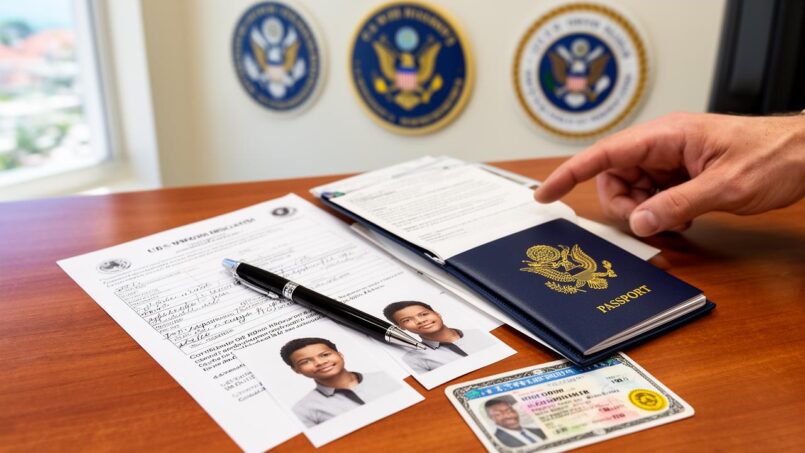
Non-compliant photos are among the leading causes of delays or rejections. The standard size is 2 x 2 inches (51 x 51 mm), in color, on a white or off-white background, with the face forward and a neutral expression or slight smile. The photo must be taken within the last six months, reflect the current appearance, and be printed on quality photo paper, matte or glossy.
The height in inches that the head must occupy in a passport photo, centered with eyes clearly visible.
The Christiansted office offers on-site photo service for about $15, which minimizes the risk of non-compliance. In St. Thomas, you need to arrange for photos in advance.
Social Security Number and Tax Warning
The form requires the applicant’s Social Security number. This is a requirement under federal tax law. The Department of State transmits this information to the Internal Revenue Service (IRS). If you refuse to provide this number, the administration may not only refuse or delay the application, but the IRS is authorized to impose a penalty of up to $500.
For individuals who have never obtained a Social Security number, the procedure is to enter zeros in the appropriate field and sign a specific statement explaining this.
How Much Does a Passport Cost in the U.S. Virgin Islands?
Fees are broken down into two main categories: the passport fee paid to the Department of State, and the execution fee paid to the local acceptance facility. Some amounts may vary by source or updates, but the ranges remain consistent.
Typical Passport Fee Structure
The following table summarizes the most commonly cited amounts for a new passport or first-time application, based on available data.
| Document Type / Application | Applicant Age | Passport Fee (Federal) | Execution / Local Fees | Estimated Total |
|---|---|---|---|---|
| Passport Book – First Time | 16 and older | approx. $130 to $135 | $35 (execution) + $12 (security surcharge) | approx. $165 to $179 |
| Passport Book – Minor (Under 16) | 0–15 years | approx. $40 to $105 | $30 (execution) + $12 (surcharge) | approx. $82 to $120 |
| Passport Card – Adult | 16 and older | approx. $30 to $55 | $35 | approx. $65 to $90 |
| Passport Card – Minor | 0–15 years | approx. $40 | $30 | approx. $70 |
| Book + Card – Adult First Time | 16 and older | $160 to $165 | $35 | approx. $195 to $200 |
| Adult Renewal (Book only, by DS‑82) | 16 and older | $110 to $130 | $0 (no execution fee by mail) | $110 to $130 |
To these base amounts, where applicable, add:
Applicable rates for specific services related to applying for or renewing a U.S. passport.
Urgent fee of $60 for expedited processing of your application.
Fee of $22.05 for 1–3 day delivery of the passport once issued.
Cost of $82 to add visa pages to an existing passport.
Fee of $150 if the applicant cannot produce any citizenship document.
For a resident going through a local U.S. Virgin Islands office with an expedited request, the total federal portion can reach around $212.05 (including renewal fee, urgent fee, and fast delivery). Add local execution fees and, if applicable, the cost of the photo.
Passport Validity and Budget Planning
Adult passports (16 and older) are valid for 10 years, minor passports for 5 years. When planning your budget, it is useful to remember that many countries require a remaining validity of six months at the time of entry. Renewing a passport when it still has eight to twelve months of validity left is therefore not excessive if a long trip abroad is planned.
Processing Times: What to Expect from the U.S. Virgin Islands?
Announced processing times from the Department of State vary over time based on national demand. Added to this is mail transit time to and from the U.S. Virgin Islands.
Standard and Expedited Times
Generally, there are two main processing speeds:
– Routine service: approximately 4 to 6 weeks of processing, plus up to 2 weeks for mail in and 2 weeks for mail back,
– Expedited service: approximately 2 to 3 weeks of processing, also plus mail times.
This is the number of weeks needed for standard passport processing for residents of the U.S. Virgin Islands, including transit times and the workload of regional centers.
For very urgent travel (within two to three weeks), only an appointment at a federal passport agency (e.g., in San Juan, Puerto Rico) is appropriate. You must then provide proof of imminent departure, with tickets, or a need for a foreign visa.
In case of absolute emergency (serious illness, death, life-threatening situation) involving a relative abroad, a “life-or-death emergency service” is available to obtain a passport very quickly. This procedure requires presenting compelling supporting documents, such as medical certificates or attestations.
Checking Your Application Status
Once the application is submitted, tracking is done through the Department of State’s online status system or by phone through the National Passport Information Center. Each application is assigned a nine-digit case number, the first two digits of which identify the agency handling the case (e.g., “67” for cases processed by San Juan).
Original supporting documents, such as the birth certificate, are returned to the applicant separately from the passport itself. It is therefore not uncommon to receive two or even three separate mailings (booklet, card, civil documents), sometimes spaced a few weeks apart.
Private Expediting Services: Convenience or Unnecessary Expense?
In the territory as elsewhere in the United States, private companies specialize in expedited passport application assistance. For a fee, they handle document checking, scheduling appointments at federal agencies, hand-carrying applications, and managing follow-ups.
Companies like PassportsAndVisas.com, VisaHQ, or UPV Services advertise turnaround times ranging from 24 hours to 3 business days for very urgent cases, and 1 to 6 weeks for more standard but still accelerated requests. Their service fees often start around $119 to $199, on top of all standard government fees.
These providers are not part of the Department of State and have no decision-making power over passport issuance. Their main advantage is handling administrative tasks and quickly securing appointments at agencies, which is useful for those who need to travel urgently and want to delegate logistics.
For a resident of the U.S. Virgin Islands whose trip is not imminent, using these services is not essential. However, in a major emergency, they can avoid a complex trip to a mainland agency or Puerto Rico, provided you accept a sometimes significant additional cost.
Traveling from the U.S. Virgin Islands: ID, REAL ID, and Security Checks
Even though the core of this guide is about obtaining a U.S. passport in the U.S. Virgin Islands, it is useful to place this issue in the broader context of airport security checks and evolving identification rules.
REAL ID and Domestic Flights
Eventually, all adult passengers will need to present either a REAL ID-compliant identification (driver’s license or state ID marked with a star) or an alternative document accepted by the TSA, such as a passport, passport card, or trusted traveler card.
For any domestic flight within the United States, including to territories like the U.S. Virgin Islands, a valid passport is a universally accepted identification document for security checks, whether the trip is one-way or between two mainland states.
Departures from the U.S. Virgin Islands to the Mainland
When departing from the U.S. Virgin Islands to the mainland, travelers go through customs and agricultural checks. Federal authorities remind that U.S. citizens must present proof of citizenship (passport, certified birth certificate, trusted traveler program card) in addition to their photo ID. Here again, a single passport simplifies this dual check.
For non-U.S. travelers transiting through the United States to another destination, U.S. departure rules apply. Your ESTA or U.S. visa must be valid for the duration of your transit, and your foreign passport remains the mandatory reference document.
Cases of Families and Children
U.S. citizen children do not need a passport for a simple flight to or from the U.S. Virgin Islands, but it is highly recommended to travel with at least a birth certificate. If only one parent is present, a consent letter from the other parent, ideally notarized, can prevent any suspicion of custody dispute or international abduction.
For international travel (e.g., to the British Virgin Islands), children must have their own passport for air travel, as is the general rule in international aviation.
Practical Specifics of the U.S. Virgin Islands for Travelers
Applying for a passport in the U.S. Virgin Islands is not just about filling out a form. The local context brings a few practical specifics worth keeping in mind.
In the U.S. Virgin Islands, traffic drives on the left, which can be disorienting for drivers used to driving on the right. However, a standard U.S. driver’s license is perfectly valid for renting and driving a vehicle. For a visitor, this license, along with a passport, serves both for car rental and for most travel formalities.
Monetarily, the archipelago uses the U.S. dollar, which simplifies budget management, especially when paying for passport fees, any express shipping services, or fees for private expediting services based on the mainland.
Finally, U.S. Customs applies a fairly favorable duty exemption to travelers returning from the territory to the mainland: for stays of 48 hours or more, you can bring back $1,600 worth of goods duty-free, then benefit from a flat rate of 1.5% on the next $1,000.
How to Structure Your Approach: From Travel Planning to Passport Acquisition
For residents as well as long-term visitors, it is useful to see the passport application as one step among others in preparing for a stay or a mobile life between islands and the mainland.
A St. Thomas resident working in tourism might, for example, need a passport to attend a trade show in Puerto Rico, then Miami, and perhaps a fair in the Bahamas. In this case, they would do well to:
For frequent travelers, it is crucial to: check the remaining validity of your passport before each new project, anticipate renewal times (allow 7 to 13 weeks depending on the administration), keep digital and paper copies of your identification documents, and consider a “large format” passport (with more pages) if you accumulate many visas and stamps.
Conversely, a tourist from New York on a one-week vacation in St. John, with a planned excursion to the British Virgin Islands, must ensure well before departure that their passport is still valid, ideally beyond six months after the planned return date. If in doubt or if validity is too short, a DS‑82 renewal application must be submitted early enough to avoid having to resort to an expensive emergency service.
When to Seek Help and Who to Contact?
Even well-informed, an applicant may encounter complex situations: lack of citizenship documents, multiple name changes, pending naturalization case, family health emergency, etc.
In these cases, several official channels should be prioritized:
Official points of contact for questions and emergencies related to U.S. citizen passports.
Contact this center by phone or email for any general questions about the procedure or the status of your application.
For questions specific to filing an application in the U.S. Virgin Islands, contact the offices in Christiansted or St. Thomas.
Urgent assistance for Americans in distress abroad (deaths, disappearances, political crises).
Additionally, private passport expediting companies can be useful in very specific scenarios, especially when an unexpected trip abroad must happen within a few days and no quick consular appointment is available.
—
Obtaining a U.S. passport in the U.S. Virgin Islands follows the standard federal procedure (Forms DS-11 or DS-82, supporting documents, photo, fees). Local specifics include the status of a domestic destination for U.S. citizens, proximity to foreign islands (like the British Virgin Islands), and the presence of local offices for submitting applications.
In practice, the best strategy is to consistently consider the passport as the key document for any trip involving the U.S. Virgin Islands: even when it is not strictly required for a direct trip from the mainland, it remains the simplest and safest tool to smoothly cross the sometimes blurry line between domestic and international travel in the Caribbean.
Disclaimer: The information provided on this website is for informational purposes only and does not constitute financial, legal, or professional advice. We encourage you to consult qualified experts before making any investment, real estate, or expatriation decisions. Although we strive to maintain up-to-date and accurate information, we do not guarantee the completeness, accuracy, or timeliness of the proposed content. As investment and expatriation involve risks, we disclaim any liability for potential losses or damages arising from the use of this site. Your use of this site confirms your acceptance of these terms and your understanding of the associated risks.

Cyril Jarnias is an independent expert in international wealth management with over 20 years of experience. As an expatriate himself, he is dedicated to helping individuals and business leaders build, protect, and pass on their wealth with complete peace of mind.
On his website, cyriljarnias.com, he shares his expertise on international real estate, offshore company formation, and expatriation.
Thanks to his expertise, he offers sound advice to optimize his clients' wealth management. Cyril Jarnias is also recognized for his appearances in many prestigious media outlets such as BFM Business, les Français de l’étranger, Le Figaro, Les Echos, and Mieux vivre votre argent, where he shares his knowledge and know-how in wealth management.





