
 Published on and written by Cyril Jarnias
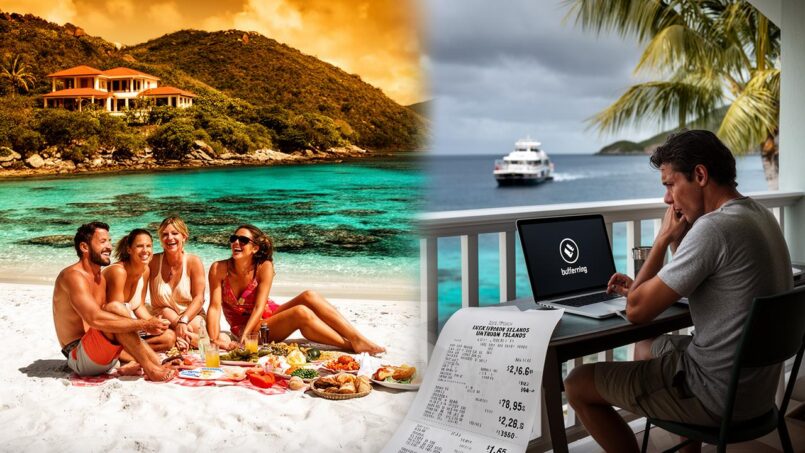
Moving to the U.S. Virgin Islands first brings to mind a picture: turquoise sea, green hills, colorful houses perched above calm bays, weekend boat trips, and sunset cocktails. But behind the postcard lies a complex territory: expensive, vulnerable to climate, heavily dependent on tourism, and marked by economic and social inequalities.
For a French person, settling in the U.S. Virgin Islands offers advantages such as quality of life, attractive taxation, and proximity to the U.S. system. However, you must anticipate potentially significant challenges: cost of living, access to the job market, climate adaptation, as well as considerations regarding health, education, crime, and governance. Thorough preparation is essential.
A tropical living environment, between mildness and climatic extremes
Living in the U.S. Virgin Islands means switching to a subtropical climate, with trade winds that generally make the year pleasant. Life largely takes place outdoors: beach, diving, hiking, neighborhood parties, and Carnival set the pace. This setting is one of the major assets for those fleeing gray skies or seeking a slower pace.
But this same environment is now profoundly shaken by climate change.
A warm paradise… that is heating up and drying out
Climate data shows that the Caribbean region has warmed by about 2°F over the past 50 years, and days exceeding 90°F (about 32°C) are significantly more frequent. “Too hot” nights, which prevent the body from cooling down, are also increasing, a phenomenon already measured in neighboring Puerto Rico, with approximately 50% more hot nights since 1950.
Projections indicate an overall decrease in precipitation, potentially reaching 25% by the 2080s, especially in spring and summer. However, this trend is accompanied by an increase in the frequency of extreme events: heavy rainfall, droughts, and flash floods.
For an expatriate’s daily life, this means: a radical change in lifestyle, adapting to a new culture, daily challenges, and often, a rediscovery of oneself through the prism of being a foreigner.
– more heavy and stifling days, with an increased risk of heatstroke and dehydration;
– greater reliance on air conditioning and therefore on already expensive electricity;
– a higher likelihood of water restrictions or deliveries by tanker truck during drought periods, as in 2015.
Hurricanes and sea-level rise: a structural risk for housing
The U.S. Virgin Islands lie directly in the path of Atlantic hurricanes. On average, two to three cyclonic systems pass through their “zone of influence” each year, with truly damaging hurricanes approximately every six years. Since 1950, nearly half of the hurricanes passing within 120 miles have left impacts on the territory.
Hurricane Irma-Maria in 2017 cost nearly 200% of the GDP of the affected islands.
Sea-level rise, on the order of 2.5 cm per decade so far, could reach between 30 cm and nearly 1 m by the end of the century depending on scenarios, with some models going up to 2.5 m in the most pessimistic assumptions. A large portion of infrastructure, hotels, and residences are in low-lying coastal areas: in Charlotte Amalie, several waterfront urban islets lie only 90–120 cm above the current sea level.
For an expatriate, the choice of neighborhood and altitude is crucial, as it determines exposure to flood risks and storm surges. This choice also influences future increases in insurance premiums, going beyond the simple consideration of the view.
Health and safety under climate pressure
Warming increases health risks: heatstroke, dehydration, aggravation of cardiovascular and neurological conditions. Extreme rainfall events and flooding also affect water quality. After Hurricanes Irma and Maria, more than 80% of community cistern samples on St. Thomas were contaminated with dangerous bacteria. Result: diarrhea, vomiting, digestive and respiratory infections.
Heat and warming waters also promote diseases such as vibriosis (bacterial infection linked to warm waters) and ciguatera (toxin in some reef fish). The region is also experiencing an increase in dengue cases, reinforcing the importance of mosquito protection.
Finally, repeated climate shocks (disasters, loss of housing or employment) have documented psychological effects: anxiety, post-traumatic stress, depression. An element to integrate into any long-term life project on these islands.
A cost of living among the highest in the Caribbean world
The other major reality of expatriation to the U.S. Virgin Islands is financial: almost everything is imported by boat or plane, which inflates prices. According to several comparisons, the cost of living is 47% to nearly 60% higher than in the continental United States, and “local purchasing power” is about 47% lower than on the mainland.
Realistic monthly budget: far beyond low-cost tropics
Estimates vary by source but paint a similar picture. Combining available ranges gives the following view:
| Household Profile | “Realistic” Monthly Budget (with rent) | “Tight” Budget | “Comfort/Luxury” Level |
|---|---|---|---|
| Single person | approx. $2,200 – $3,000 | ≈ $2,720 – $2,899 | ≈ $7,715 – $8,078 |
| Couple | approx. $4,000 – $6,700 (by source) | ≈ $3,808 – $4,149 | ≈ $10,953 – $11,627 |
| Family of 4 | approx. $5,000 – $9,700 | ≈ $5,364 – $5,866 | ≈ $15,284 – $16,263 |
Over the year, this gives a family of four a budget easily exceeding $110,000 if living comfortably in rental, without particular extravagances.
In Singapore, the average net monthly salary ranges between $3,250 and $3,800, with a median annual salary of about $37,950. For a household living on these local incomes without high qualifications, especially with children, this implies tight budget management and constant financial trade-offs.
Housing: high rents, complicated but possible purchase
The real estate market varies greatly by island: housing prices, demand, and property types can differ considerably from one region to another.
| Main Island | Median Sale Price | Median Rent | Average Price per sq ft (sale) |
|---|---|---|---|
| St. Thomas | ≈ $449,900 | ≈ $2,300/month | ≈ $385/sq ft |
| St. John | ≈ $549,000 | (few rental listings) | ≈ $603/sq ft |
| St. Croix | ≈ $249,000 | ≈ $2,200/month | ≈ $253/sq ft |
| Territory-wide | ≈ $325,000 | ≈ $2,300/month | ≈ $294/sq ft (median) |
A few additional benchmarks:
– a 1-bedroom apartment in the city center rents for an average of about $1,500 (ranging from $1,125 to $2,500);
– a 3-bedroom in the city center easily climbs to $3,000–$5,000;
– studios and small “efficiency” units can sometimes be found for around $700–$1,000, but demand is high.
The minimum purchase price of a modest condo in New Caledonia, a real estate market requiring a 20% down payment and burdened with additional fees.
Daily consumption: the bill adds up quickly
Restaurant and grocery prices reflect this import-dependent archipelago status.
At restaurants, you need to plan for: reservations, dish choices, budget, number of diners, time of visit.
| Item | Average Price Indicated |
|---|---|
| Simple lunch menu | ≈ $18 |
| Meal at an inexpensive restaurant | ≈ $25 (typical range $15–$40) |
| 3-course meal for 2 (mid-range restaurant) | ≈ $127.50 (range $90–$175) |
| Local draft beer (1 pint) | ≈ $6 |
| Cappuccino | ≈ $6 to $7.18 |
In supermarkets, some prices illustrate the gap with the mainland:
| Product (approximate) | Price Indicated |
|---|---|
| Whole milk | ≈ $2.47/L (or ≈ $10.08/gallon) |
| Dozen eggs | ≈ $5.27 – $7.12 |
| Chicken breast (500 g) | ≈ $4.40 (or $11.67/lb) |
| Beef (round, 1 lb) | ≈ $12.63 |
| Bread (1 day for 2 people) | ≈ $2.11 (or ≈ $5.44/lb) |
| Lettuce | ≈ $4.57/head |
| Local beer (0.5 L, supermarket) | ≈ $2.24 |
Comparative studies mention food prices up to 64 to 95% higher than on the mainland, with utilities (electricity, water) about 65% above the U.S. average.
Basic bills for a standard apartment (electricity, water, trash, air conditioning) often run around $250–$500 per month, high-speed internet around $80–$110, and a mobile plan between $60 and $140.
In summary: if you bring a solid income, especially remotely paid at U.S. or Western European rates, the equation becomes more comfortable. However, living solely on average local salaries while bearing a full family budget can be very tight.
A narrow job market heavily dependent on tourism
The economy of the U.S. Virgin Islands relies very heavily on tourism and a few related pillars (services, finance, post-hurricane construction, small-scale agriculture, fishing). More than 1.8 million visitors stayed in 2022, and tourism already represented about 30% of GDP and tens of thousands of direct jobs before the pandemic.
Real opportunities… but mainly in certain sectors
The job market has several key characteristics:
– officially low unemployment (around 3.5% in 2023) but in a small market, with few qualified positions open at any given time;
– very strong presence of the public sector, which employs a much larger share of the working population than in other island regions or the continental United States;
– many low-skilled jobs in restaurants, hotels, beach services, sales, cleaning, and tourist transport;
– pockets of better-paying jobs in finance, certain professional services, construction project management, or management roles in hotels and resorts.
The median annual salary is $37,950, a modest amount given the cost of living.
Sectors that hire or will need skilled labor include:
– tourism and high-end hospitality;
– financial and insurance services;
– engineering, architecture, electrical, plumbing, construction;
– healthcare (doctors, nurses, specialists);
– education (teachers in public and private sectors);
– technical and technology services, especially for data centers and infrastructure.
Some professions require a license or local certification (architects, engineers, hairdressers, electricians, accountants, real estate agents, etc.), through the Department of Licensing and Consumer Affairs.
A reality often striking for new expatriates
For many newcomers, the shock comes from the gap between expectations and reality:
Employers generally prefer candidates already on the island, and applying remotely works poorly, except in healthcare, education, or some highly specialized positions. The local job market is particularly tight during the high tourist season (mid-November to mid-May) due to the influx of seasonal workers. The work culture, often called “Island Time,” is less rushed than in North America or Europe, with slower processes, collegial decisions, and great importance placed on personal relationships.
Local authorities and employment agencies recommend:
– having savings to last at least one to two months without income;
– making a “pre-visit” to understand the job market and the real cost of expenses;
– networking on the ground, by participating in professional, community, or association events;
– sometimes accepting a first transitional job while aiming for the desired opportunity.
Alongside the constraints, some signals remain positive: GDP growth is forecast at 3 to 4% per year in the medium term, tourism has recovered and exceeded pre-COVID levels, and new dynamics are developing around the “blue economy” (marine economy), renewable energy, and international remote work.
Taxation: a major advantage for some profiles, but highly technical
Tax-wise, the U.S. Virgin Islands occupy a unique place in the American landscape. The territory applies a “mirror code” of federal tax law: broadly, “United States” is replaced by “Virgin Islands” in the tax code, and the local administration (Virgin Islands Bureau of Internal Revenue, VIBIR) collects the taxes.
For an expatriate who becomes a tax resident, especially if an entrepreneur or investor, the advantages can be considerable.
“Bona fide” residency: the cornerstone
To fully benefit from the local regime, you must be a “bona fide resident” of the U.S. Virgin Islands. The criteria combine:
– physical presence of at least 183 days in the tax year (or other equivalent multi-year tests);
– no “tax home” outside the territory;
– a closer connection to the U.S. Virgin Islands than to any other country or U.S. state (domicile, family, bank accounts, local driver’s license, voter registration, etc.).
A bona fide resident who lives year-round on the islands:
– reports all worldwide income to VIBIR;
– pays local tax, mirroring U.S. federal tax;
– generally does not owe additional federal tax to the U.S. IRS on that same income;
– may, in some cases, avoid levies like the Net Investment Income Tax.
The downside: they can no longer vote in U.S. presidential elections as long as they remain a resident of the U.S. Virgin Islands, though they participate in local political life.
A very powerful exemption program for businesses
The Economic Development Commission (EDC) program makes the U.S. Virgin Islands one of the most aggressive tax regimes in the American world, while remaining anchored in the U.S. legal framework.
Qualified businesses can benefit from:
– a 90% reduction in corporate income tax and tax on dividends received;
– full exemptions from excise taxes, gross receipts tax, and commercial property tax;
– a reduction of import duties to only 1%.
Concretely, with a theoretical maximum federal rate of 37%, the effective tax can drop to around 3.7% for certain eligible activities. These benefits can be granted for 20 to 30 years.
In return, the company must:
To benefit from the incentive programs, the investor must: invest a minimum of $100,000 (excluding inventory) in the territory, create at least 10 full-time jobs for local residents, and strictly comply with tax codes (sections 934 and 937 of the Internal Revenue Code) as well as all local laws, including environmental regulations.
For financial entrepreneurs, fund managers, international service companies or consulting firms, this framework can be extremely attractive. But it requires serious legal structuring and guidance from tax professionals familiar with such cases.
A complex system for non-residents and foreigners
For a U.S. citizen or U.S. tax resident who is not a bona fide resident of the territory but has local-source income (salary earned there, professional activity, real estate), the rules quickly become technical: separate forms for the IRS and VIBIR, tax allocation mechanisms via Form 8689, cross tax credits, etc.
For a non-resident alien, the situation becomes even more complicated when they have income from both the continental United States and the U.S. Virgin Islands. The conclusion is clear: any expatriation partly motivated by tax considerations must involve specialized advice, to avoid unpleasant surprises, especially in case of a change in residency status or return to the mainland.
Health and healthcare system: treating everyday issues, evacuating for specialized care
In terms of health, the U.S. Virgin Islands have hospital infrastructure on St. Thomas and St. Croix, and a community health center on St. John, with transfer by medical boat if needed. The public system is supported by several mechanisms: local Medicaid (Medical Assistance Program), insurance programs, reform initiatives like “Healthier Horizons.”
However, the territory does not have the health resources of a large continental state.
Medical offerings: adequate but limited
Common conditions are treated: general practitioner consultations, emergencies, some specialties, maternity. Costs are comparable to the mainland:
| Type of Care | Approximate Cost (without insurance) |
|---|---|
| Emergency room visit | ≈ $300 – $1,500 |
| Hospitalization per day | ≈ $2,000 – $5,000/day |
| Urgent care consultation | ≈ $150 – $500 |
| Medical evacuation to the USA | ≈ $25,000 – $100,000 and up |
For specialized procedures (complex surgery, oncology, certain chronic conditions), evacuation to the continental United States remains common. Many residents therefore take out supplemental insurance, with monthly premiums often between $450 and $950 for decent health coverage.
Foreigners residing in the United States cannot purchase insurance through standard marketplaces (like Obamacare). They must opt for international insurance, private plans, or specific solutions like long-stay travel insurance. For people over 65, the Medicare program is accessible but has limitations, including a restricted offering for drug plans (Part D).
Access inequalities and health vulnerabilities
Disadvantaged populations, the elderly, the chronically ill, and children are particularly exposed: financial constraints, transportation issues, shortage of specialists. Climate shocks worsen the situation, by contaminating water supplies, cutting power, and overloading hospitals.
Territorial initiatives to improve preparedness and response to health needs.
Creation of a formalized emergency medical system for faster, more structured care.
Deployment of telehealth solutions to improve access to remote care.
Projects for dedicated structures to strengthen mental health care and fight addictions.
Implementation of prevention programs to act upstream on health determinants.
For an expatriate, the conclusion is pragmatic:
– carefully verify the geographic scope of your health coverage (whether it includes the U.S. Virgin Islands, whether it includes evacuations);
– build up a savings reserve for out-of-pocket costs;
– accept that some care will be on the mainland, with associated transport costs.
Education: a decent offering, but a public system under pressure
For families considering enrolling their children in the U.S. Virgin Islands, education becomes a central criterion. The public system, free and based on the American model (12 compulsory years from ages 5 to 17), coexists with a network of private and international schools.
Public: free but fragile
The Department of Education manages 21 elementary schools, 6 middle schools, and 6 high schools on St. Croix, St. Thomas, and St. John. Before the 2017 hurricanes, the building stock represented nearly 3 million square feet of infrastructure, some of which also serve as shelters in case of disaster.
The public system suffers from multiple difficulties:
The system faces chronic funding shortfalls, a severe lack of qualified personnel (with significant imbalances between certified and non-certified teachers), aging infrastructure, and alarming academic results, as evidenced by reading difficulties. This situation is exacerbated by the added burden of climate trauma and serious psychosocial difficulties affecting adolescents.
Public authorities have launched an infrastructure renovation plan and several support programs, but these efforts take time.
Private and international: the preferred choice of expatriates
Many affluent families, both local and foreign, turn to private or parochial schools, or even international institutions offering programs like the IB (International Baccalaureate) or an enriched U.S. curriculum.
However, fees remain significant:
| Type of School | Tuition Fees Level |
|---|---|
| Private elementary school | ≈ $5,000 – $10,000/year |
| Private middle / high school | ≈ $8,000 – $15,000/year |
| International school (IB, etc.) | ≈ $10,000 – $20,000/year (and up) |
| Examples: Antilles School | ≈ $10,500 – $19,600/year |
| Virgin Islands Montessori & PGIA | ≈ $13,150 – $21,000/year (excluding additional fees) |
| Daycare / preschool | ≈ $900 – $1,500/month |
Additional costs include: supplies ($100–$300 per year), uniforms ($50–$100), transportation, extracurricular activities, tutoring.
For higher education, the University of the Virgin Islands (UVI) offers more than 40 programs with relatively moderate tuition for residents (≈ $5,000–$10,000/year), higher for non-residents (up to $15,000/year). International students may see it as an intermediate option between a U.S. university and a Caribbean campus.
Safety, crime, and risk perception
Safety is a sensitive topic. Officially, the U.S. Virgin Islands welcome millions of tourists every year without major incident. Yet crime statistics, particularly the homicide rate per capita, are higher than the U.S. average.
Insecurity mostly internal, but to be factored in
Perception data collected over several years indicates:
– a “crime index” around 59.2 and a “safety index” of about 40.8;
– a high perception of crime, corruption, drugs, and domestic violence;
– a feeling of relatively good safety during the day, but low at night (safety perception around 28% for walking alone at night).
Serious violence (murders, settling of scores) in the U.S. Virgin Islands is generally confined to specific neighborhoods and social contexts and rarely affects tourists or expatriates. However, it is important to note that isolated incidents, such as a shooting that occurred in 2024 on the Christiansted boardwalk, can happen in or near frequented areas.
The most common offenses for visitors remain opportunistic thefts: bags or phones left on the beach, unlocked vehicles, burglaries of poorly secured rentals.
Contrasts between islands
There are differences between the three main islands:
Comparative overview of crime and safety levels on the three main islands, based on demographic and economic characteristics.
Lower crime rate, smaller population, and homogeneous economy. Most incidents are thefts or burglaries, with rare serious incidents.
Tourist areas remain relatively safe, but some neighborhoods experience violence linked to local delinquency.
More densely populated and developed, it records the highest crime levels, with a significant number of annual murders. Cautious tourists are rarely targeted.
For a long-term expatriate, this means:
– carefully choosing your neighborhood;
– inquiring about areas to avoid at night;
– adopting simple safety habits (not leaving valuables in plain sight, favoring taxis at night, avoiding isolated beaches after dark).
Local authorities, aware of the issue, organize anti-crime summits, strengthen police-community partnerships, and strive to improve intelligence gathering and on-the-ground presence. But the increase in firearms in circulation and the rise in domestic violence remain heavy challenges.
Culture, society, and integration: warmth and latent tensions
The U.S. Virgin Islands are predominantly populated by descendants of Africans and Caribbeans: about 76% of the population identifies as Black or Afro-Caribbean. English is the official business language, but a local Creole is widely spoken, and the culture is a blend of African, European, and Caribbean heritages.
A community-based way of life
Research by the Department of Tourism shows that many long-term residents report levels of satisfaction and quality of life higher than before their arrival. Life here is slower, more rooted in outdoor activities and community.
The Carnival festival, with its music, parades, local cuisine, and traditional costumes, illustrates the cultural vitality of the Virgin Islands. To reinforce this sense of identity among young people, the public education system has integrated a specific “Virgin Islands History” course.
Business culture values human relationships, politeness, and mutual trust. People take time to get to know each other before strictly discussing business, and managers generally remain accessible, encouraging team expression within a nonetheless hierarchical framework.
For an expatriate, accepting invitations, participating in local festivals, listening more than speaking at first, are all keys to integration.
Not everything is idyllic, however. Some public debates denounce a form of “toxicity” towards foreigners from other Caribbean islands, discriminatory behaviors, accusations of nepotism or favoritism in some institutions. Issues like smuggling, unregistered vehicles, or non-compliance with certain rules fuel a sense of disorder for some residents.
In English-speaking Caribbean islands, rates of violence against women and HIV infection are higher than on the mainland. These dynamics are directly linked to the colonial legacy, persistent economic inequalities, and established gender norms.
For the expatriate, this demands a humble attitude: arriving with financial resources above the local average, enjoying the tropical setting and tax opportunities, while maintaining a clear awareness of the imbalances that structure the territory.
Environment and nature: a splendid but highly fragile heritage
The U.S. Virgin Islands boast remarkable natural treasures: terrestrial and marine national parks, coral reefs, mangroves, subtropical forests, seagrass beds. This environment attracts tourists, but it is also crucial for coastal protection and the safety of inhabitants.
Reefs, mangroves, and sargassum: ecological upheavals
The ocean surrounding the archipelago has warmed by about 2°F since 1901, and its acidity has increased by about 25% over the last three centuries. This combination, amplified by massive bleaching events, has already destroyed more than half of the territory’s coral reef parks.
Percentage of living coral cover that died during the massive bleaching event of 2005.
Mangroves also play an essential role: buffering swells, filtering water, sheltering fish and crustaceans, storing carbon. They are legally protected by local law on threatened and native species, and several community programs work towards their restoration, including through “citizen science” initiatives and school programs.
Major hurricanes Irma and Maria destroyed nearly a third of the mangroves in Puerto Rico and reduced biodiversity in the Virgin Islands Coral Reef National Monument. Additionally, a massive sargassum seaweed stranding event in 2015 led to beach closures and the halt of coastal nautical and hotel activities in the region.
An adaptation policy under construction
Faced with these risks, the government has multiplied initiatives: creation of a Climate Change Council (VICCC), development of territory-wide vulnerability assessments, identification of particularly exposed coastal areas (Two Brothers, Demarara, Honduras, Bovoni, etc.), programs to ramp up renewable energy.
The official goal is to achieve 30% renewable energy in the mix, with projects like a large solar farm intended to bring one island to near net-zero emissions. These efforts can make daily life more resilient in the long term, but do not prevent short-term climate shocks.
For the expatriate sensitive to environmental issues, these islands offer both a privileged vantage point for observing the climate crisis and the opportunity to get involved in concrete projects (mangrove restoration, citizen science, agroecological initiatives).
Summary: for whom is expatriation to the U.S. Virgin Islands truly worthwhile?
Bringing together these various aspects, the profiles for which expatriation to the U.S. Virgin Islands can be particularly attractive become fairly clear.
The major strengths revolve around: innovation, creativity, technical skill, efficient resource management, and team engagement.
– tropical quality of life, the sea, the climate (despite its excesses) and the strong community aspect;
– simplified access for U.S. citizens (no passport required from the mainland, no work visa for them);
– structured tax opportunities, especially for entrepreneurs and investors who can certify their tax residency and obtain EDC status;
– a certain continuity with the U.S. legal framework (property rights, banking system, English language usage, U.S.-style education system);
– the possibility for remote workers to enjoy the Caribbean setting while maintaining a mainland income level.
But the drawbacks are far from minor:
– very high cost of living, especially for housing, food, basic services, private education, and healthcare;
– narrow job market, where well-paid jobs remain limited, and it is difficult to land a qualified position remotely;
– high exposure to hurricanes, droughts, floods, with material and psychological consequences;
– limited healthcare system, with possible need for evacuation to the United States for specialized care;
– social and criminal tensions, even if they mostly affect local populations and specific neighborhoods;
– fragile public education, pushing many expatriates towards costly private options.
In practice, the U.S. Virgin Islands are mainly suitable for a few categories of expatriation candidates:
The people most likely to succeed in long-term settlement on the island of Réunion generally have one of the following profiles:
Professionals with stable, high incomes able to absorb the local cost of living premium.
Capable of structuring a business eligible for tax benefits and hiring locally.
With good health coverage, comfortable financial resources, and an affinity for island life.
Doctors, engineers, finance or education experts, ready to commit long-term.
For others – young people without savings, modest families, people with serious medical needs – expatriation to the U.S. Virgin Islands can quickly become a trial: financial pressure, isolation, difficulty projecting long-term.
Yet the islands retain an undeniable appeal: that of a territory at the crossroads of worlds, American and Caribbean, where one can combine ambitious projects, community engagement, and natural beauty. Provided you go in with your eyes open, numbers in hand, and not just with a picture of a beach at sunset.
Disclaimer: The information provided on this website is for informational purposes only and does not constitute financial, legal, or professional advice. We encourage you to consult qualified experts before making any investment, real estate, or expatriation decisions. Although we strive to maintain up-to-date and accurate information, we do not guarantee the completeness, accuracy, or timeliness of the proposed content. As investment and expatriation involve risks, we disclaim any liability for potential losses or damages arising from the use of this site. Your use of this site confirms your acceptance of these terms and your understanding of the associated risks.

Cyril Jarnias is an independent expert in international wealth management with over 20 years of experience. As an expatriate himself, he is dedicated to helping individuals and business leaders build, protect, and pass on their wealth with complete peace of mind.
On his website, cyriljarnias.com, he shares his expertise on international real estate, offshore company formation, and expatriation.
Thanks to his expertise, he offers sound advice to optimize his clients' wealth management. Cyril Jarnias is also recognized for his appearances in many prestigious media outlets such as BFM Business, les Français de l’étranger, Le Figaro, Les Echos, and Mieux vivre votre argent, where he shares his knowledge and know-how in wealth management.





